ScienceFreePrintable

Observing Cells Worksheet

A free science worksheet ready for your classroom. Open in Kuraplan to grab the print-ready PDF, customize it for your students, or generate a fresh version in seconds.
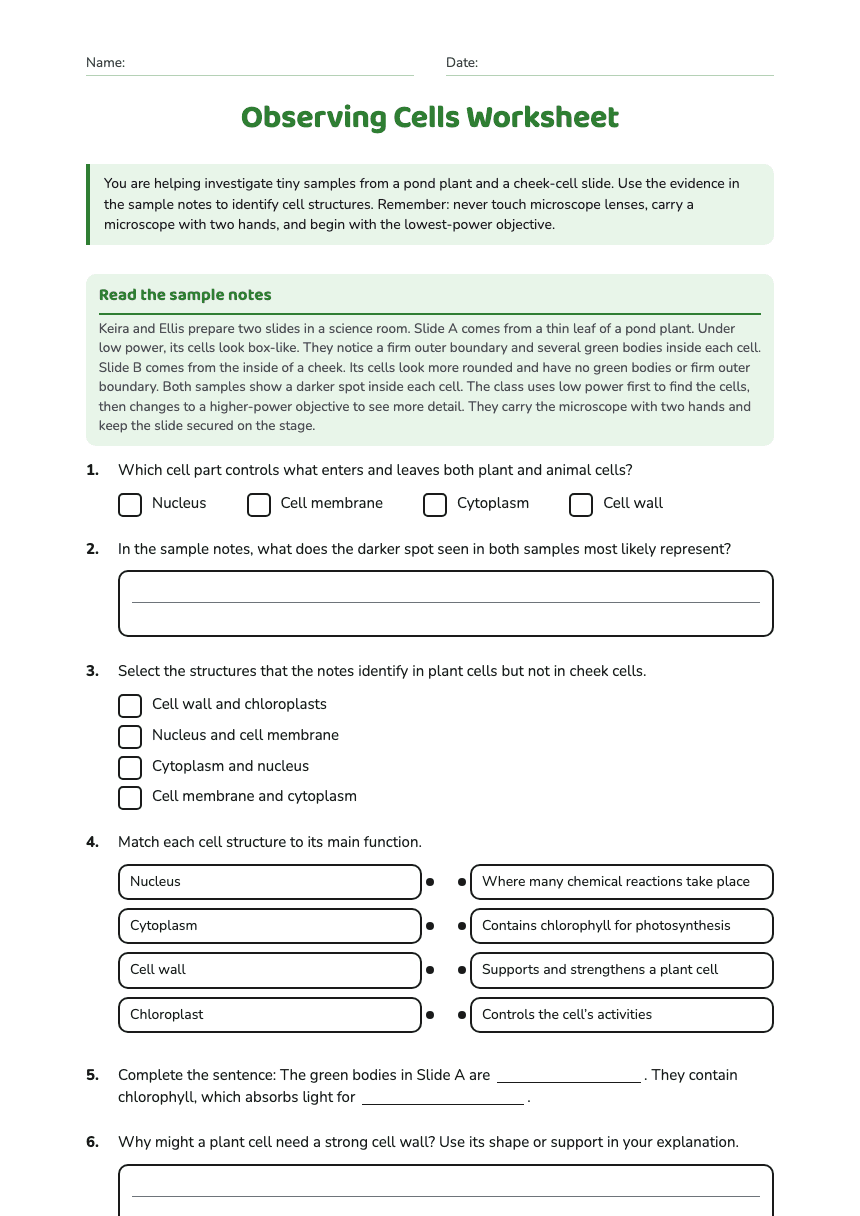
Observing Cells Worksheet worksheet preview
Name:Date:

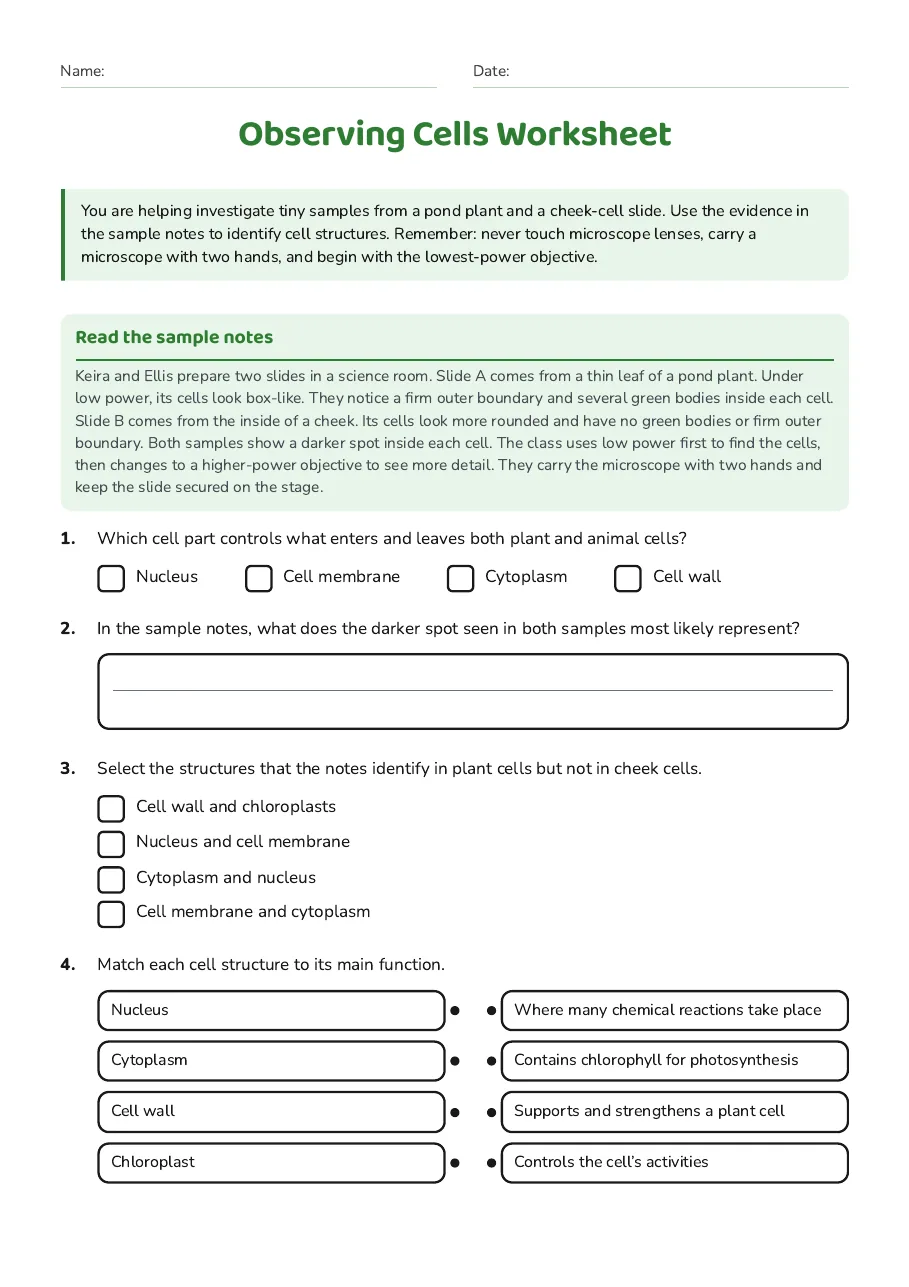
Observing Cells Worksheet

You are helping investigate tiny samples from a pond plant and a cheek-cell slide. Use the evidence in the sample notes to identify cell structures. Remember: never touch microscope lenses, carry a microscope with two hands, and begin with the lowest-power objective.

Read the sample notes

Keira and Ellis prepare two slides in a science room. Slide A comes from a thin leaf of a pond plant. Under low power, its cells look box-like. They notice a firm outer boundary and several green bodies inside each cell. Slide B comes from the inside of a cheek. Its cells look more rounded and have no green bodies or firm outer boundary. Both samples show a darker spot inside each cell. The class uses low power first to find the cells, then changes to a higher-power objective to see more detail. They carry the microscope with two hands and keep the slide secured on the stage.

1.Which cell part controls what enters and leaves both plant and animal cells?
  • Nucleus
  • Cell membrane
  • Cytoplasm
  • Cell wall
2.In the sample notes, what does the darker spot seen in both samples most likely represent?
3.Select the structures that the notes identify in plant cells but not in cheek cells.
  • Cell wall and chloroplasts
  • Nucleus and cell membrane
  • Cytoplasm and nucleus
  • Cell membrane and cytoplasm
4.Match each cell structure to its main function.
  • Nucleus
  • Cytoplasm
  • Cell wall
  • Chloroplast
  • Where many chemical reactions take place
  • Contains chlorophyll for photosynthesis
  • Supports and strengthens a plant cell
  • Controls the cell’s activities
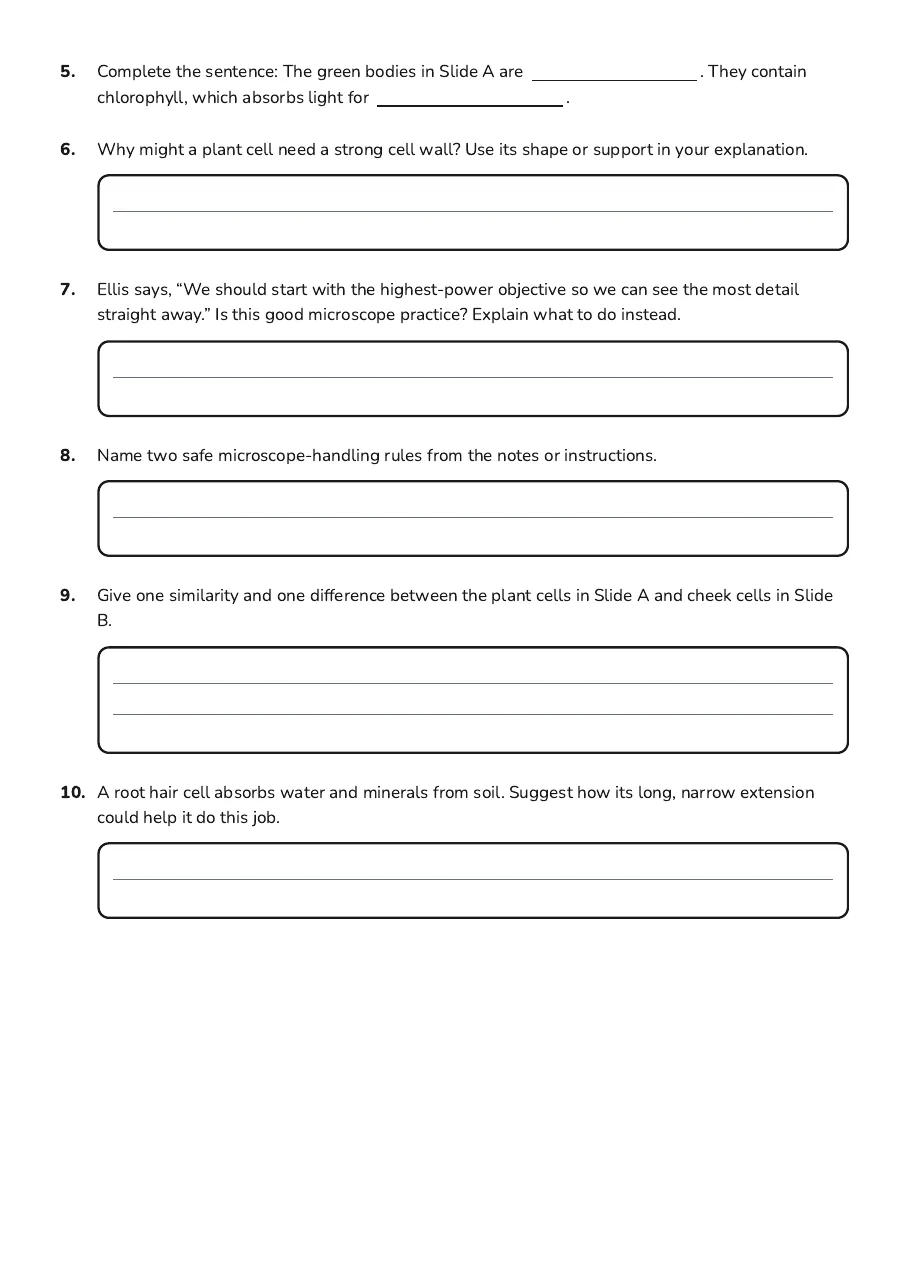
5.Complete the sentence: The green bodies in Slide A are . They contain chlorophyll, which absorbs light for .
6.Why might a plant cell need a strong cell wall? Use its shape or support in your explanation.
7.Ellis says, “We should start with the highest-power objective so we can see the most detail straight away.” Is this good microscope practice? Explain what to do instead.
8.Name two safe microscope-handling rules from the notes or instructions.
9.Give one similarity and one difference between the plant cells in Slide A and cheek cells in Slide B.
10.A root hair cell absorbs water and minerals from soil. Suggest how its long, narrow extension could help it do this job.
Draw one simple plant cell and one simple animal cell. Label the nucleus and cytoplasm in both, then add the structures found in the plant cell only.

3 printable pages

  • Observing Cells Worksheet, page 1 of 3: Read the sample notes

    Page 1

  • Observing Cells Worksheet, page 2 of 3: 5. Complete the sentence: The green bodies in Slide A are . They contain

    Page 2

  • Observing Cells Worksheet, page 3 of 3: Draw one simple plant cell and one simple animal cell. Label the nucleus and cytoplasm in…

    Page 3

About This Worksheet

Free in Kuraplan

Sign up free, grab the PDF, and customize it for your class.

Print-Ready

Formatted for standard paper. Clean layout, easy to read.

AI-Generated

Created with Kuraplan's AI, designed for real classroom use.

For Teachers & Parents

Use in classrooms, for homework, tutoring, or homeschool.

Need a custom version of this worksheet?

Kuraplan's AI generates custom worksheets in seconds — differentiated for every learner, aligned to your curriculum.

Generate Custom Worksheets — Free
No credit card Curriculum-aligned Under 60 seconds