ScienceFreePrintable

Particle Models Worksheet

A free science worksheet ready for your classroom. Open in Kuraplan to grab the print-ready PDF, customize it for your students, or generate a fresh version in seconds.

Particle Models Worksheet worksheet preview
Particle Models Worksheet

Particle Models Worksheet

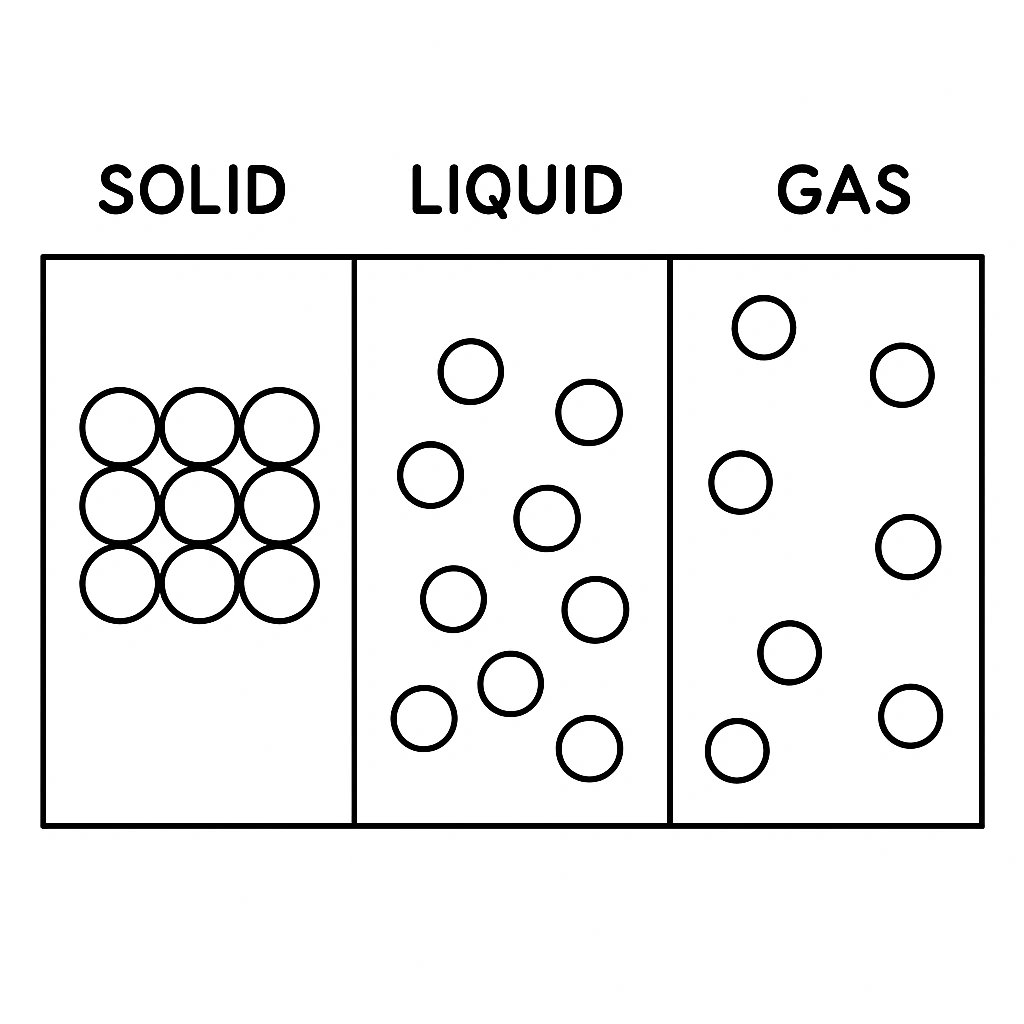
Particle model diagrams showing solids, liquids and gases

🔬 Part 1: States of Matter Knowledge

1. Circle the correct answer: What are all materials made up of?

Tiny particles

Large chunks

Nothing

Air bubbles

2. Check all the properties that describe a SOLID:

Does not pour

Takes the shape of its container

Keeps its own shape

Fills up any container completely

3. Fill in the blanks about the three states of matter:

Solids do not ________ and do not take the ________ of their container.

Liquids can be ________ and take the shape of their ________.

Gases can be poured and ________ up any container.

🎨 Part 2: Drawing Particle Models

4. Draw the particle arrangement for a SOLID in the box below. Show how the particles are arranged and add labels:
5. Draw the particle arrangement for a LIQUID in the box below. Show how the particles are arranged and add labels:
6. Draw the particle arrangement for a GAS in the box below. Show how the particles are arranged and add labels:

🧪 Part 3: Practical Observations

7. During the flour compression experiment, what happened when you tried to compress the flour?
8. When using the syringe with air, what happened when you pushed the plunger?
9. Circle the correct answer: Which state of matter can be compressed most easily?

Solid

Liquid

Gas

All compress equally

💨 Part 4: Gas Pressure and Particle Movement

10. Explain what causes gas pressure using the particle model:
11. Match the state of matter with its particle behaviour:
1. Solid particles
2. Liquid particles
3. Gas particles
A. Move freely and far apart
B. Vibrate in fixed positions
C. Move around each other but stay close
12. List three examples of materials you found in the classroom for each state of matter:

Solids: _________________, _________________, _________________

Liquids: _________________, _________________, _________________

Gases: _________________, _________________, _________________

🤔 Part 5: Understanding and Application

13. Look at the particle diagram your teacher shows you. Circle which state of matter it represents:

Solid

Liquid

Gas

14. Explain why a balloon gets bigger when you blow more air into it, using the particle model:
15. Challenge Question: Why do you think particles in a gas are much further apart than particles in a solid or liquid?

About This Worksheet

Free in Kuraplan

Sign up free, grab the PDF, and customize it for your class.

Print-Ready

Formatted for standard paper. Clean layout, easy to read.

AI-Generated

Created with Kuraplan's AI, designed for real classroom use.

For Teachers & Parents

Use in classrooms, for homework, tutoring, or homeschool.

Need a custom version of this worksheet?

Kuraplan's AI generates custom worksheets in seconds — differentiated for every learner, aligned to your curriculum.

Generate Custom Worksheets — Free
No credit card Curriculum-aligned Under 60 seconds