ScienceFreePrintable
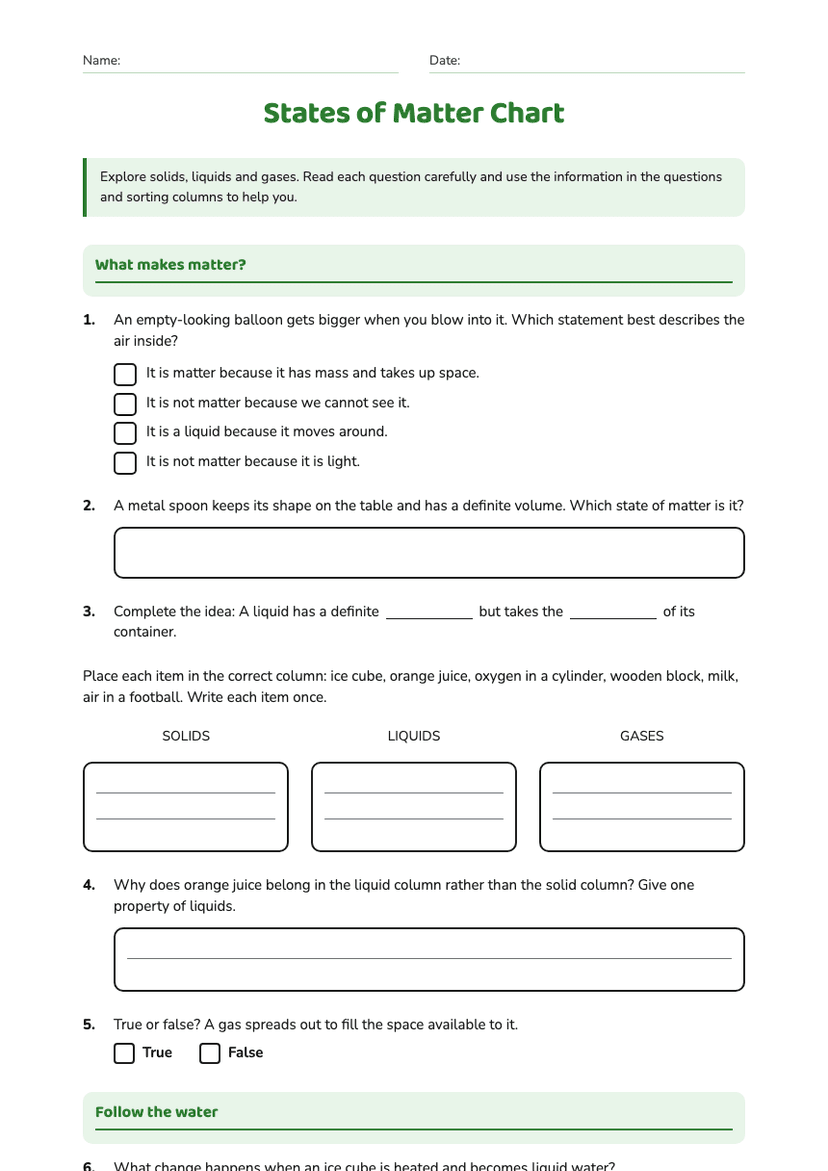
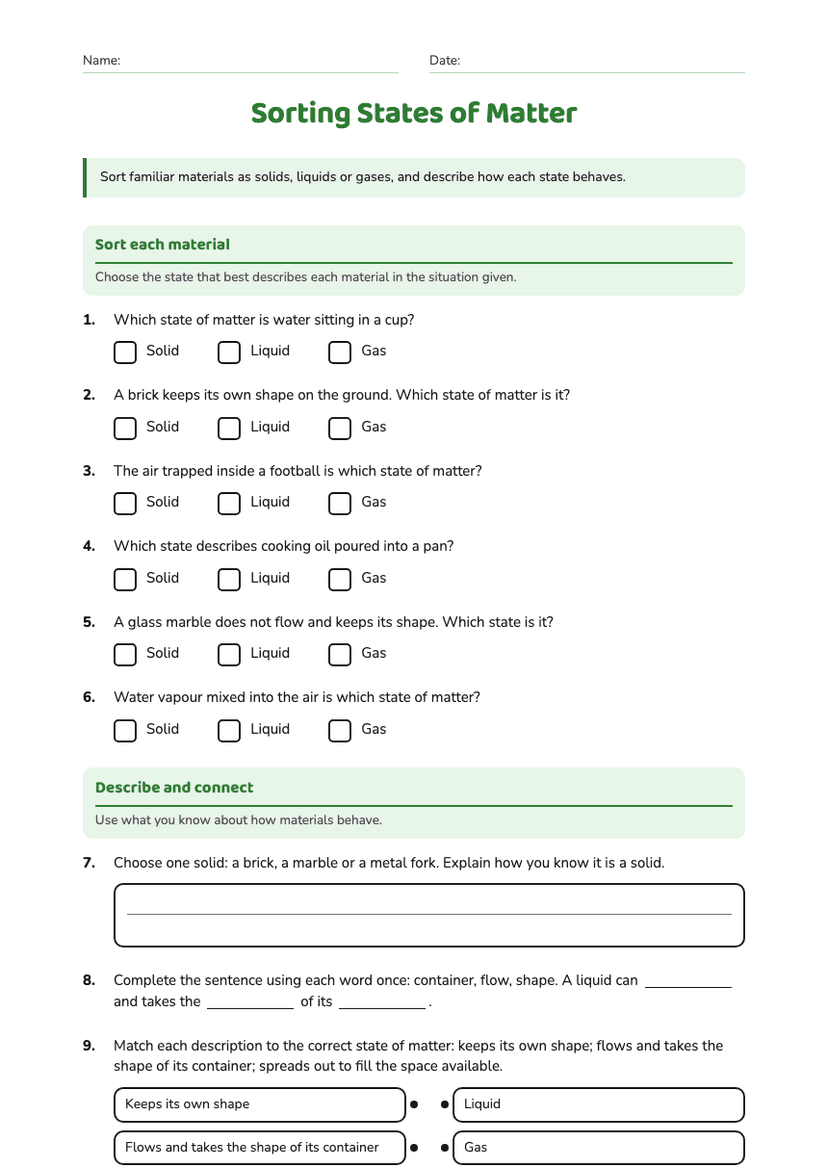
States of Matter Basics
A free science worksheet ready for your classroom. Open in Kuraplan to grab the print-ready PDF, customize it for your students, or generate a fresh version in seconds.
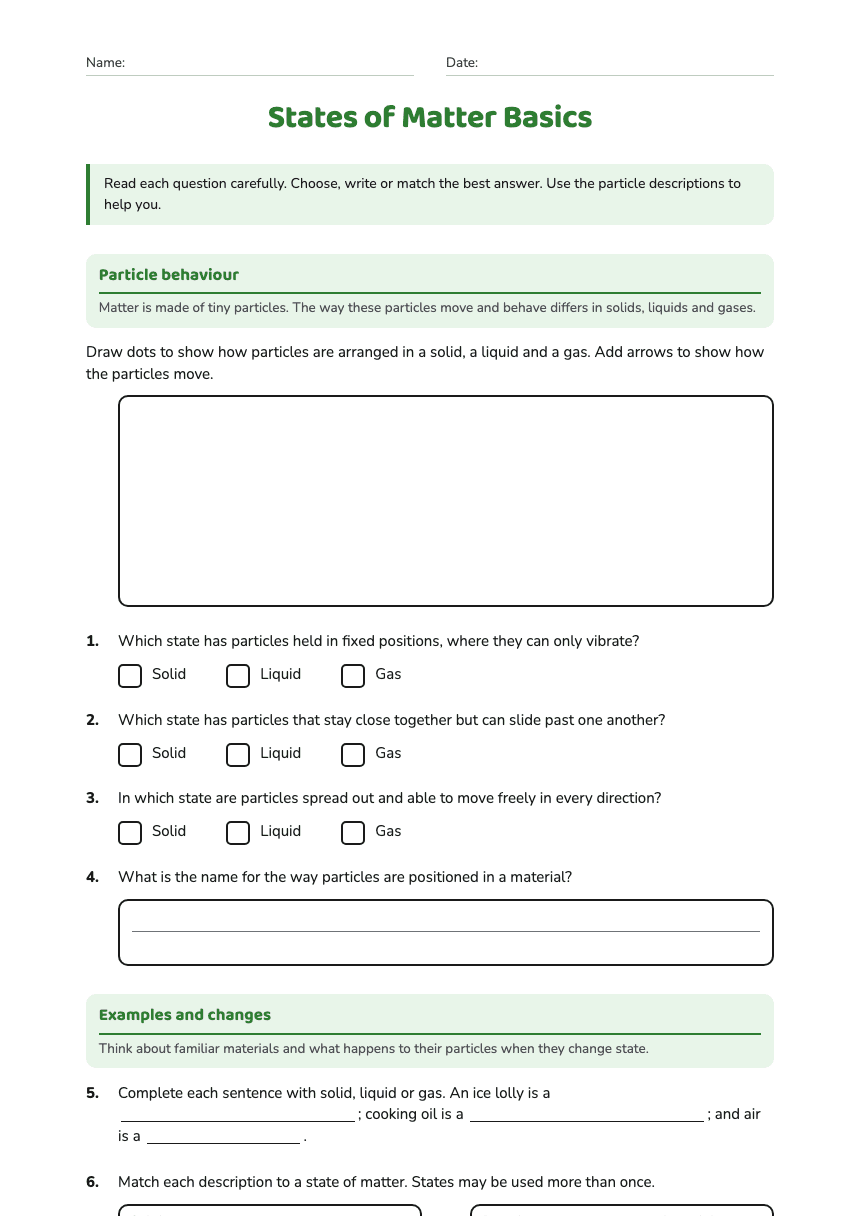
Name:Date:
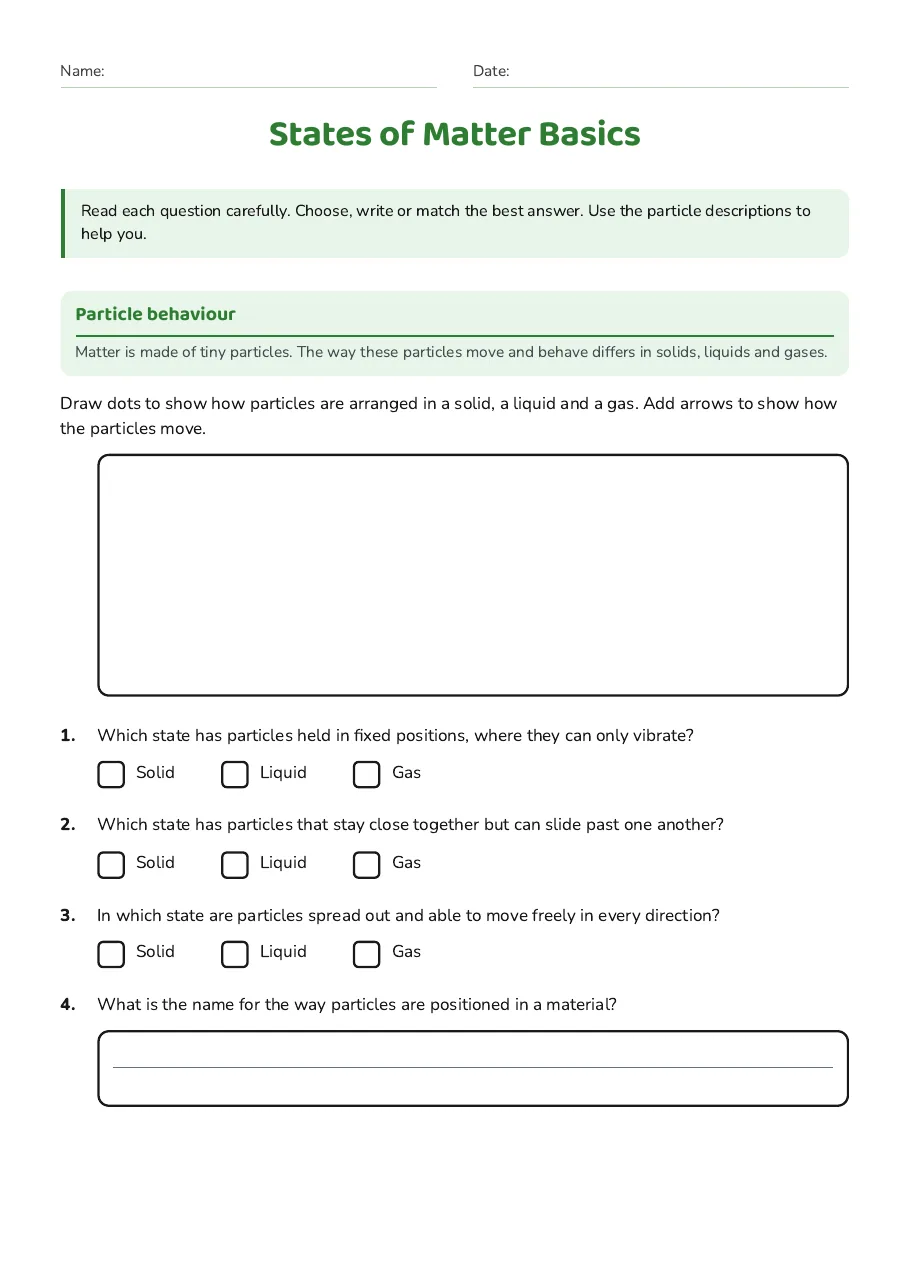
States of Matter Basics
Read each question carefully. Choose, write or match the best answer. Use the particle descriptions to help you.
Particle behaviour
Matter is made of tiny particles. The way these particles move and behave differs in solids, liquids and gases.
Draw dots to show how particles are arranged in a solid, a liquid and a gas. Add arrows to show how the particles move.
1.Which state has particles held in fixed positions, where they can only vibrate?
- Solid
- Liquid
- Gas
2.Which state has particles that stay close together but can slide past one another?
- Solid
- Liquid
- Gas
3.In which state are particles spread out and able to move freely in every direction?
- Solid
- Liquid
- Gas
4.What is the name for the way particles are positioned in a material?
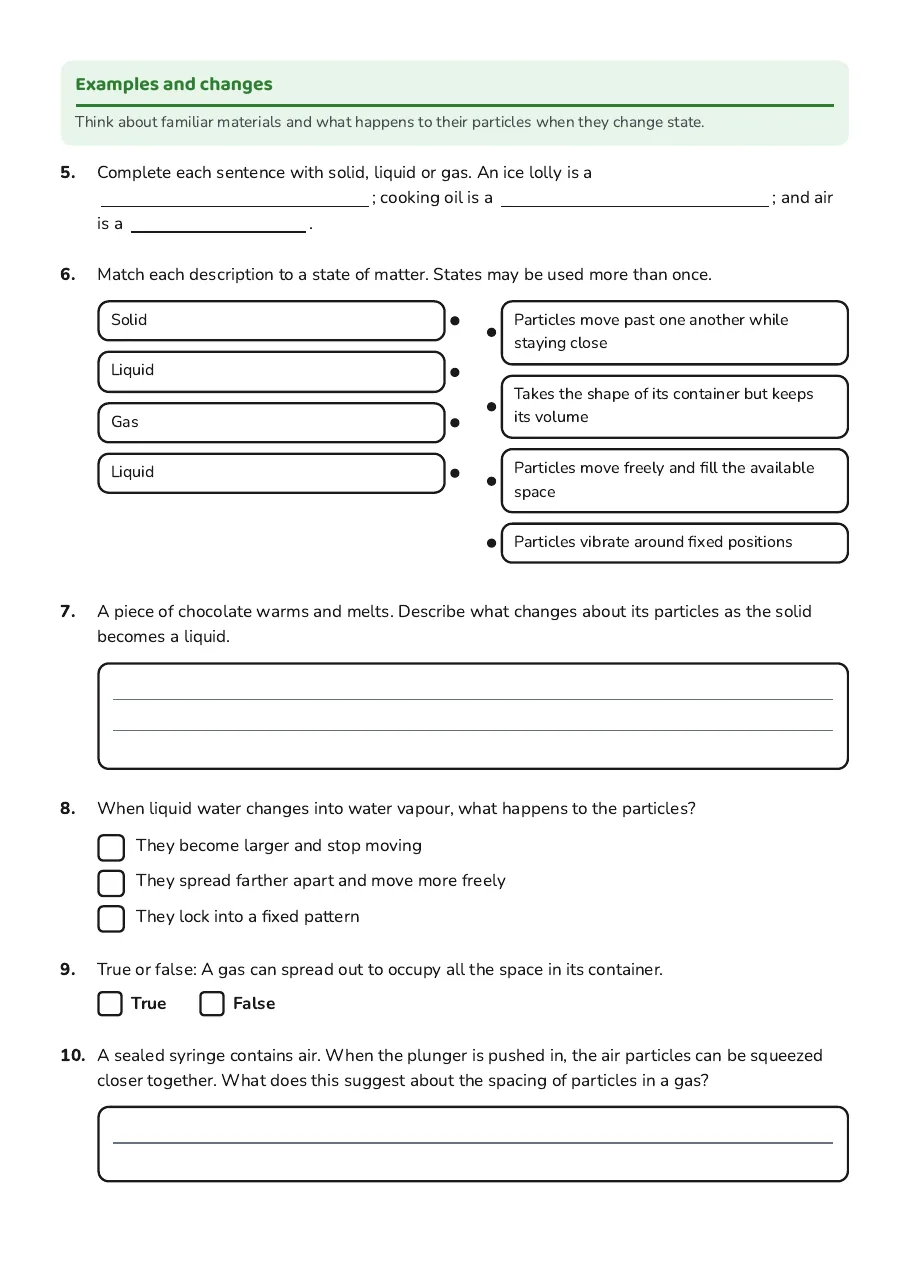
Examples and changes
Think about familiar materials and what happens to their particles when they change state.
5.Complete each sentence with solid, liquid or gas. An ice lolly is a ; cooking oil is a ; and air is a .
6.Match each description to a state of matter. States may be used more than once.
- Solid
- Liquid
- Gas
- Liquid
- Particles move past one another while staying close
- Takes the shape of its container but keeps its volume
- Particles move freely and fill the available space
- Particles vibrate around fixed positions
7.A piece of chocolate warms and melts. Describe what changes about its particles as the solid becomes a liquid.
8.When liquid water changes into water vapour, what happens to the particles?
- They become larger and stop moving
- They spread farther apart and move more freely
- They lock into a fixed pattern
9.True or false: A gas can spread out to occupy all the space in its container.
TrueFalse
10.A sealed syringe contains air. When the plunger is pushed in, the air particles can be squeezed closer together. What does this suggest about the spacing of particles in a gas?
2 printable pages
Page 1
Page 2
About This Worksheet
Free in Kuraplan
Sign up free, grab the PDF, and customize it for your class.
Print-Ready
Formatted for standard paper. Clean layout, easy to read.
AI-Generated
Created with Kuraplan's AI, designed for real classroom use.
For Teachers & Parents
Use in classrooms, for homework, tutoring, or homeschool.
Need a custom version of this worksheet?
Kuraplan's AI generates custom worksheets in seconds — differentiated for every learner, aligned to your curriculum.
Generate Custom Worksheets — Free No credit card Curriculum-aligned Under 60 seconds