Radians and Wave Oscillation
A free science worksheet ready for your classroom. Open in Kuraplan to grab the print-ready PDF, customize it for your students, or generate a fresh version in seconds.

Radians and Wave Oscillation
📚 Part 1: Understanding Radians and Waves
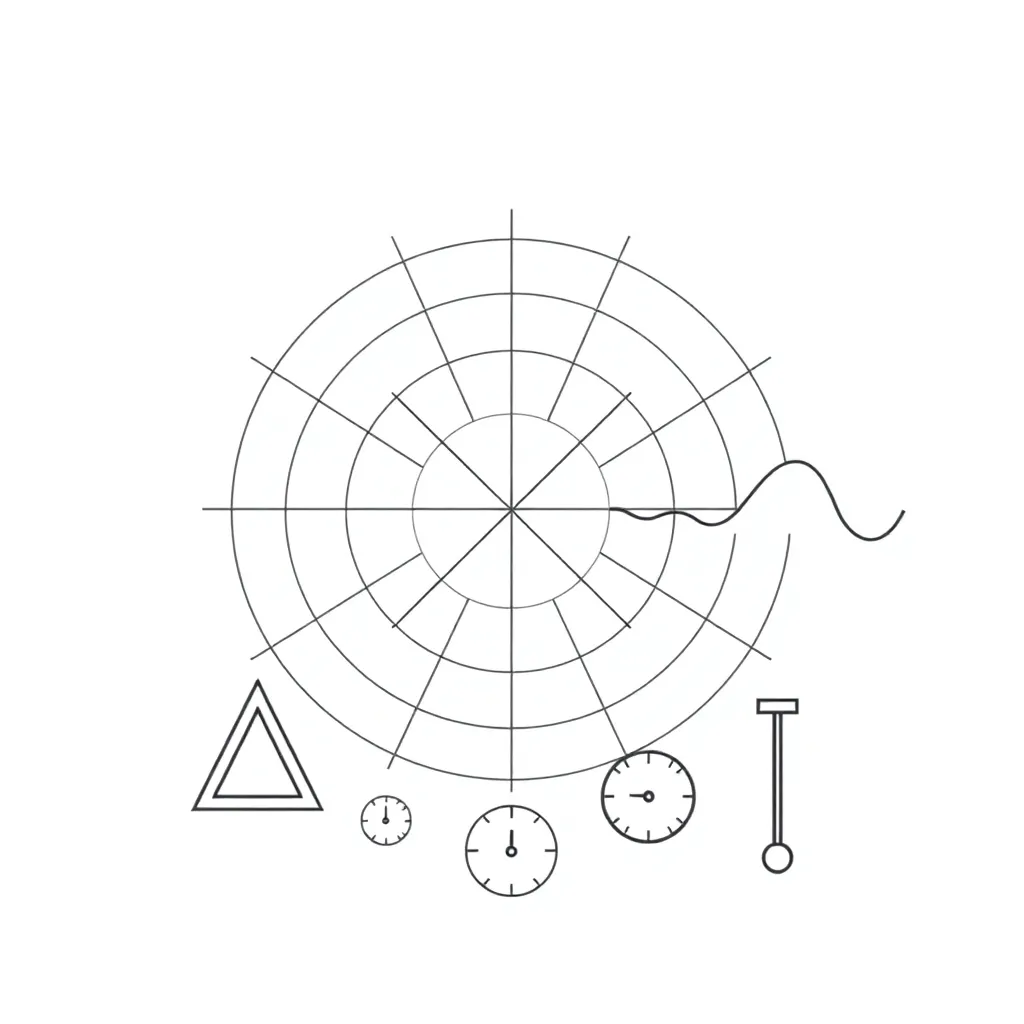
Key Information: A radian is the angle subtended at the centre of a circle by an arc equal in length to the radius. One complete revolution = 2π radians = 360°. In wave motion, radians help describe the phase of oscillation.
✏️ Part 2: Calculations and Problem Solving
a) 45° = _________ radians
b) 270° = _________ radians
Calculate the phase angle in radians: _________ radians
Sketch a sine wave with amplitude 2 units and period 4π radians
a) Amplitude = _________ units
b) Period = _________ radians
c) At what phase angle does the wave first reach maximum positive displacement? _________ radians
🔬 Part 3: Applied Problems
a) The angular frequency in rad/s: ω = _________ rad/s
b) The phase angle after 0.5 seconds: θ = _________ radians
Wave A: y₁ = 4sin(3t)
Wave B: y₂ = 4sin(3t + π/2)
What is the phase difference between these waves? _________ radians
Describe what this phase difference means physically:
Answer Key
1. The angle subtended by an arc equal to the radius
2. π/2 radians
3. The position in the wave cycle at a given time
4. 360°, 2π radians, One wavelength
5a. π/4 radians (45° × π/180°)
5b. 3π/2 radians (270° × π/180°)
6. π/2 radians (2π × 50 × 0.005 = 0.5π)
7a. 2 units
7b. 4π radians
7c. π/2 radians
8. Radians provide a natural unit for measuring phase in oscillatory motion. Since 2π radians equals one complete cycle, calculations involving frequency, period, and phase relationships become more straightforward.
9a. π rad/s (ω = 2π/T = 2π/2)
9b. π/2 radians (θ = ωt = π × 0.5)
10. π/2 radians; Wave B leads Wave A by π/2 radians (90°), meaning B reaches its maximum 1/4 cycle before A.
About This Worksheet
Free in Kuraplan
Sign up free, grab the PDF, and customize it for your class.
Print-Ready
Formatted for standard paper. Clean layout, easy to read.
AI-Generated
Created with Kuraplan's AI, designed for real classroom use.
For Teachers & Parents
Use in classrooms, for homework, tutoring, or homeschool.
Need a custom version of this worksheet?
Kuraplan's AI generates custom worksheets in seconds — differentiated for every learner, aligned to your curriculum.
Generate Custom Worksheets — FreeMore Science Worksheets

Understanding Renewable Energy
Free
Energy Concepts and Calculations
Free
Light and Vision Revision Board
Free
Heat Transfer Methods Worksheet
Free
Special Relativity Practice
Free
Thermal Radiation Worksheet
Free
Light Mid-Topic Assessment
Free