Wave Diagrams and Calculations
A free science worksheet ready for your classroom. Open in Kuraplan to grab the print-ready PDF, customize it for your students, or generate a fresh version in seconds.

Wave Diagrams and Calculations
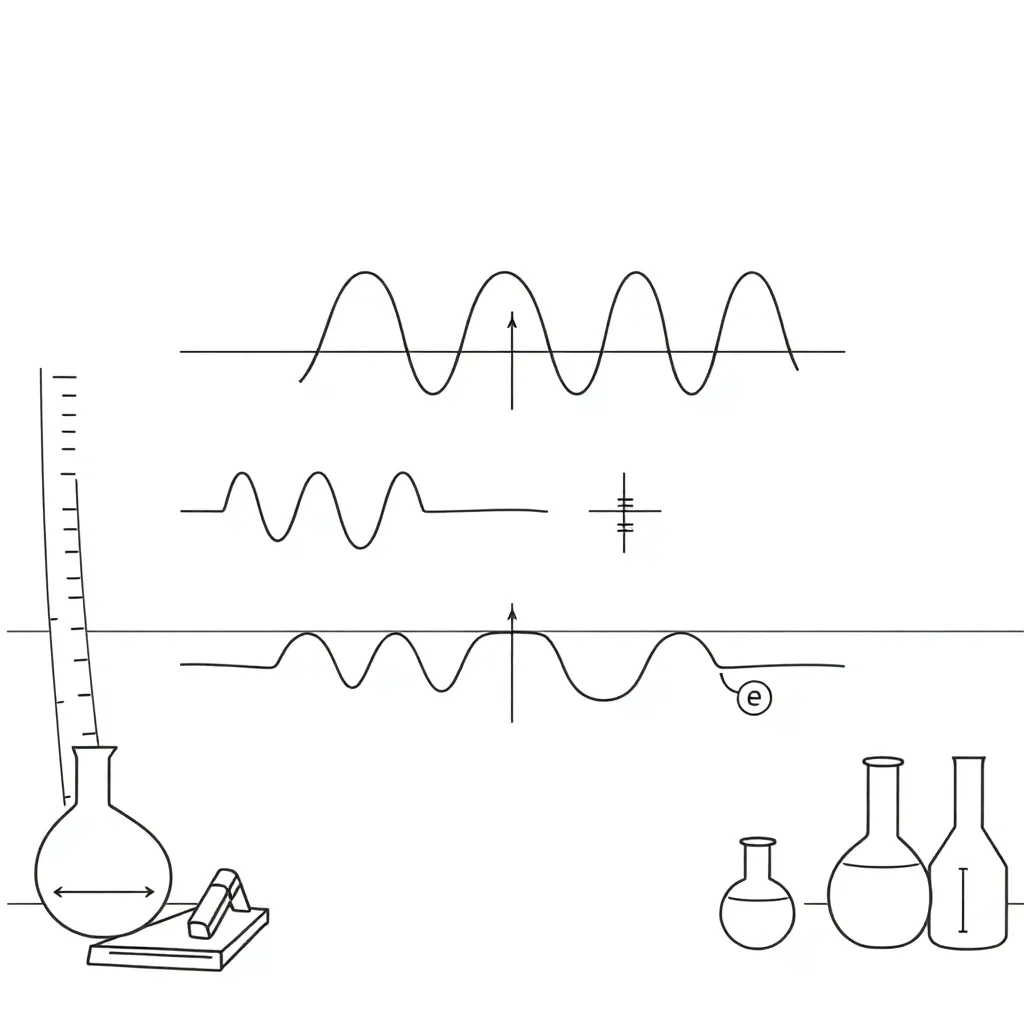
📊 Part 1: Wave Diagrams and Identification
Features to label: amplitude, wavelength, crest, trough, equilibrium position
🧮 Part 2: Wave Calculations Using π
Formula Reminders:
• Position in wave cycle: θ = 2πt/T (where θ is angle in radians, t is time, T is period)
• Phase difference: Δφ = 2πΔx/λ (where Δx is distance difference, λ is wavelength)
• Complete cycle = 2π radians = 360°
Answer: _________ radians
a) Maximum positive displacement: _________
b) Zero displacement (moving downward): _________
c) Maximum negative displacement: _________
d) Zero displacement (moving upward): _________
Answer: _________ radians
🎯 Part 3: Advanced Wave Analysis
Answer: _________ cm
Phase difference = _________ radians
About This Worksheet
Free in Kuraplan
Sign up free, grab the PDF, and customize it for your class.
Print-Ready
Formatted for standard paper. Clean layout, easy to read.
AI-Generated
Created with Kuraplan's AI, designed for real classroom use.
For Teachers & Parents
Use in classrooms, for homework, tutoring, or homeschool.
Need a custom version of this worksheet?
Kuraplan's AI generates custom worksheets in seconds — differentiated for every learner, aligned to your curriculum.
Generate Custom Worksheets — FreeMore Science Worksheets

Understanding Renewable Energy
Free
Energy Concepts and Calculations
Free
Light and Vision Revision Board
Free
Heat Transfer Methods Worksheet
Free
Special Relativity Practice
Free
Thermal Radiation Worksheet
Free
Light Mid-Topic Assessment
Free