MathsFreePrintable

Sequences and nth Terms

A free maths worksheet ready for your classroom. Open in Kuraplan to grab the print-ready PDF, customize it for your students, or generate a fresh version in seconds.
Sequences and nth Terms worksheet preview
Name:Date:

Sequences and nth Terms

Work through each question. Show your working where asked. For sequences, the first term is the term at n = 1.

Arithmetic and linear sequences

1.Is the sequence 6, 10, 14, 18, 22, … arithmetic?
  • Yes
  • No
2.Is the sequence 2, 6, 18, 54, 162, … arithmetic?
  • Yes
  • No
3.Is the sequence −3, 1, 5, 9, 13, … arithmetic? Give its common difference.
4.Find the nth term of the sequence 7, 12, 17, 22, 27, …
5.A sequence has nth term Tₙ = 4n − 3. Find the 12th term.
6.For the sequence Tₙ = 4n − 3, which term has value 53?
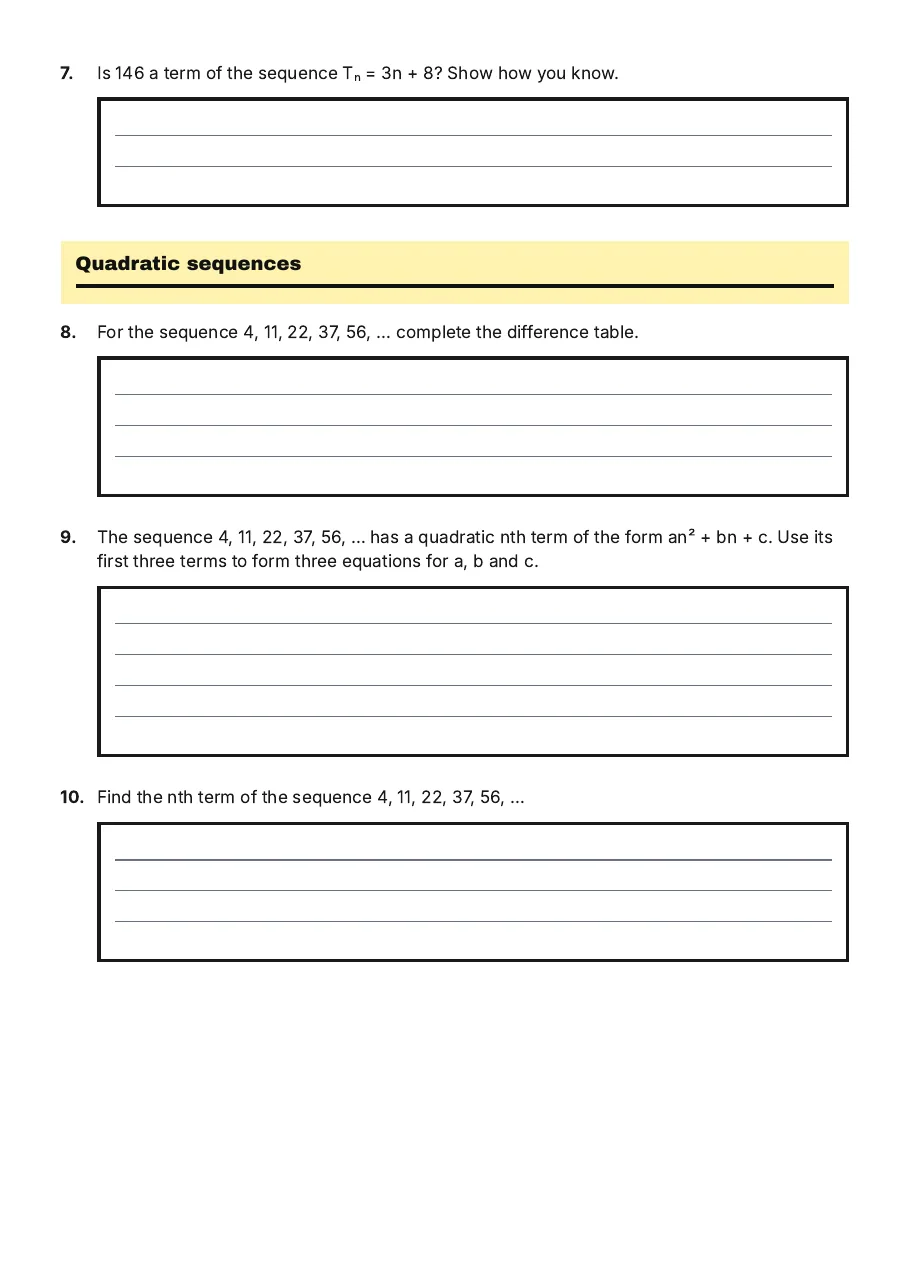
7.Is 146 a term of the sequence Tₙ = 3n + 8? Show how you know.

Quadratic sequences

8.For the sequence 4, 11, 22, 37, 56, … complete the difference table.
9.The sequence 4, 11, 22, 37, 56, … has a quadratic nth term of the form an² + bn + c. Use its first three terms to form three equations for a, b and c.
10.Find the nth term of the sequence 4, 11, 22, 37, 56, …

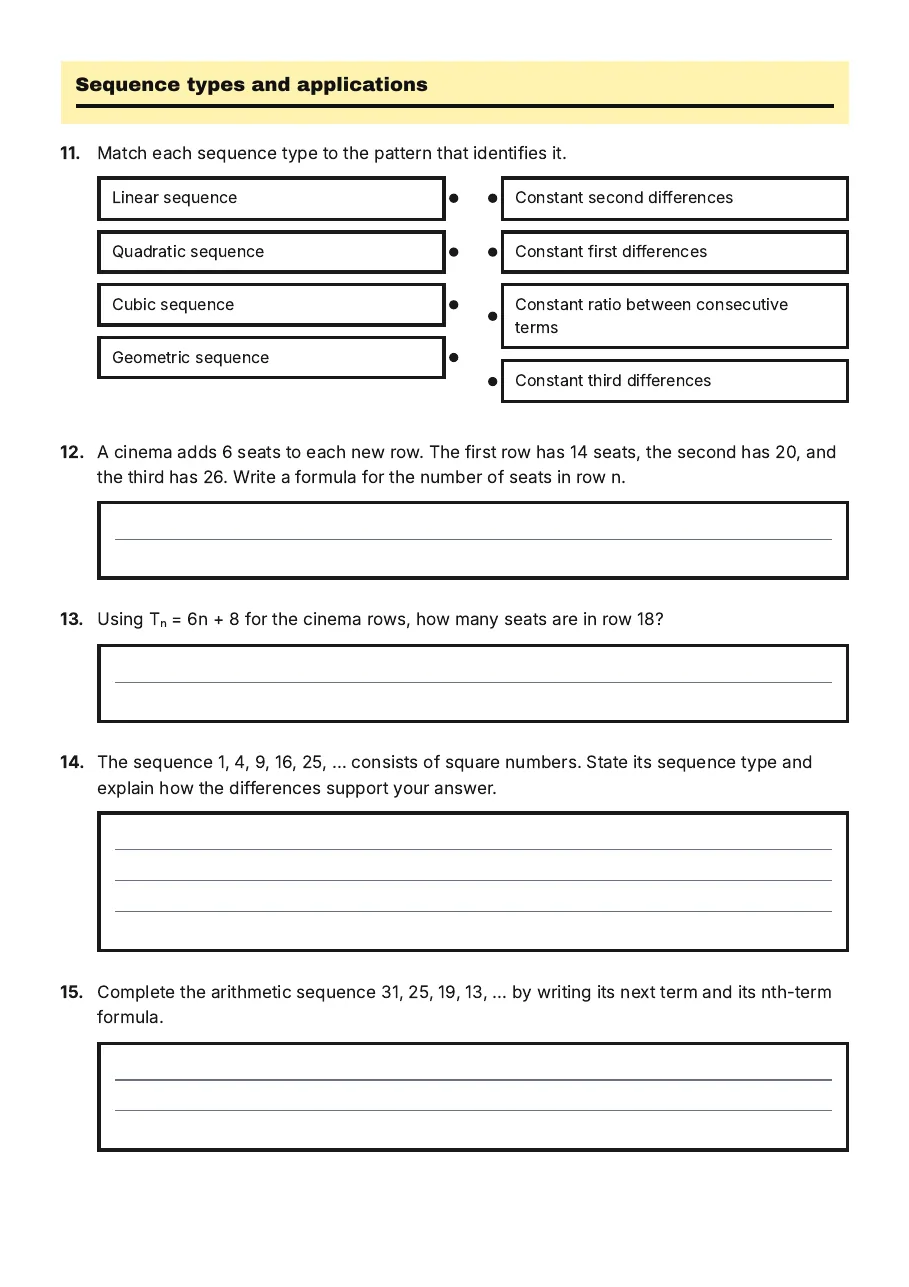
Sequence types and applications

11.Match each sequence type to the pattern that identifies it.
  • Linear sequence
  • Quadratic sequence
  • Cubic sequence
  • Geometric sequence
  • Constant second differences
  • Constant first differences
  • Constant ratio between consecutive terms
  • Constant third differences
12.A cinema adds 6 seats to each new row. The first row has 14 seats, the second has 20, and the third has 26. Write a formula for the number of seats in row n.
13.Using Tₙ = 6n + 8 for the cinema rows, how many seats are in row 18?
14.The sequence 1, 4, 9, 16, 25, … consists of square numbers. State its sequence type and explain how the differences support your answer.
15.Complete the arithmetic sequence 31, 25, 19, 13, … by writing its next term and its nth-term formula.
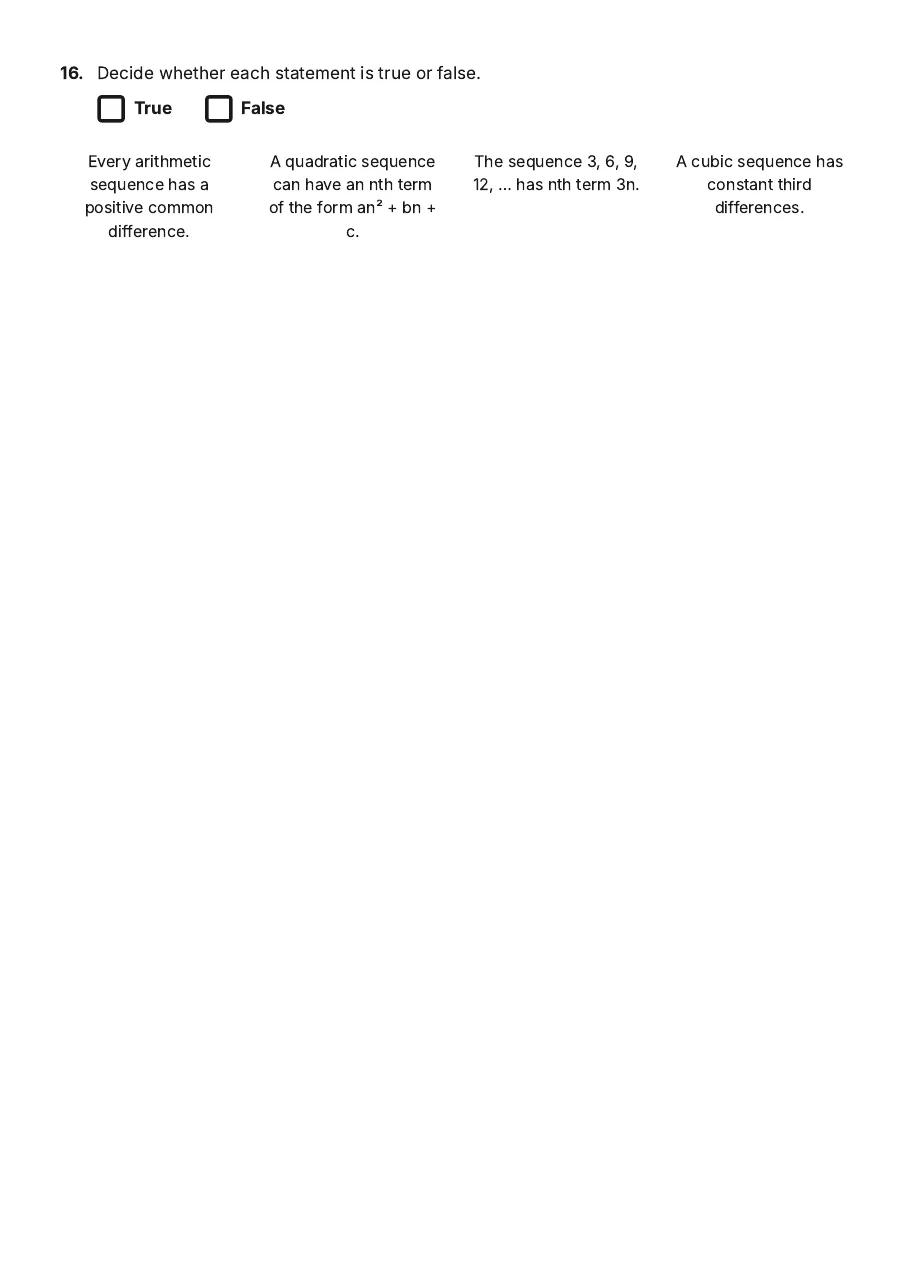
16.Decide whether each statement is true or false.
TrueFalse

Every arithmetic sequence has a positive common difference.

A quadratic sequence can have an nth term of the form an² + bn + c.

The sequence 3, 6, 9, 12, … has nth term 3n.

A cubic sequence has constant third differences.

4 printable pages
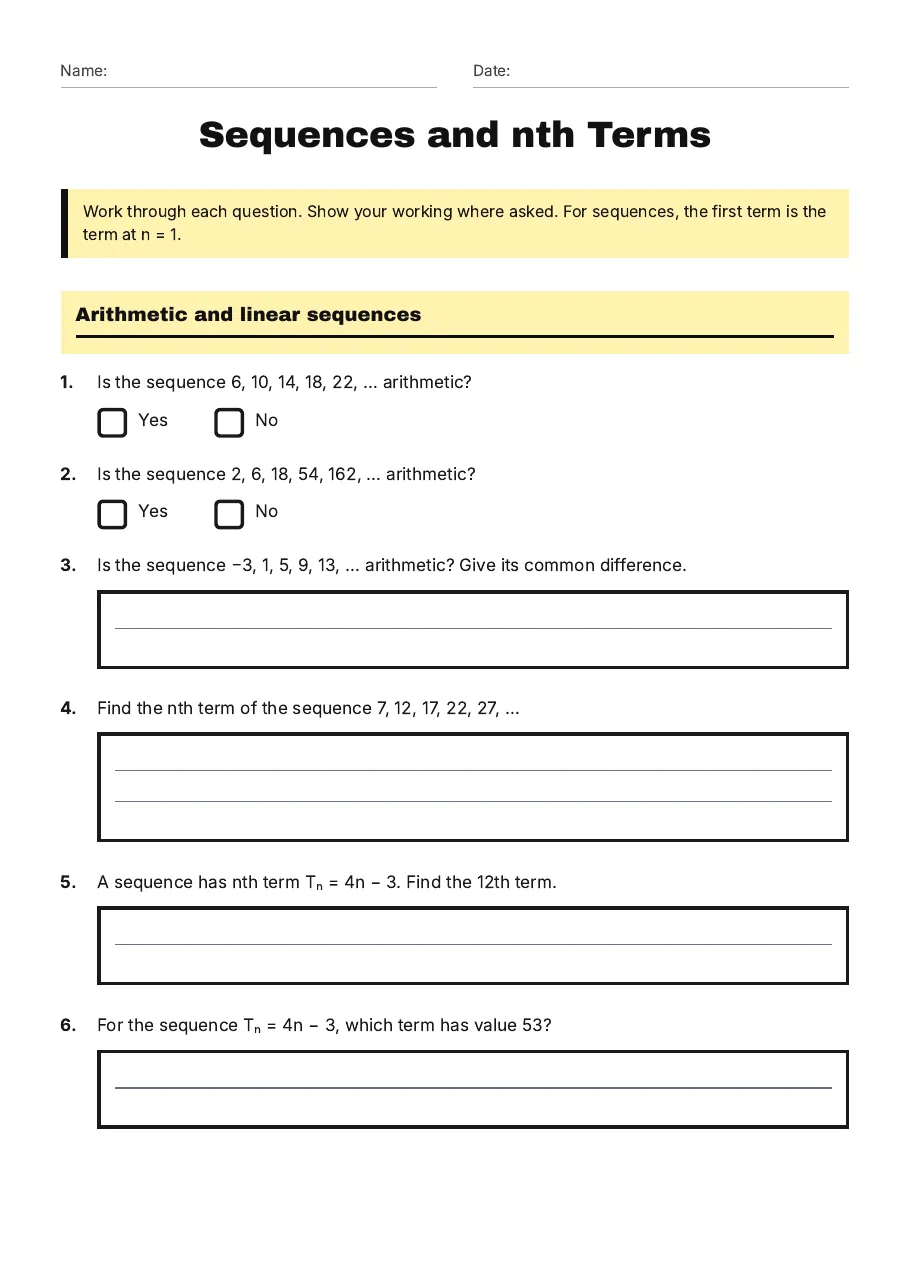
  • Sequences and nth Terms, page 1 of 4: Arithmetic and linear sequences

    Page 1

  • Sequences and nth Terms, page 2 of 4: Quadratic sequences

    Page 2

  • Sequences and nth Terms, page 3 of 4: Sequence types and applications

    Page 3

  • Sequences and nth Terms, page 4 of 4: 16. Decide whether each statement is true or false.

    Page 4

About This Worksheet

Free in Kuraplan

Sign up free, grab the PDF, and customize it for your class.

Print-Ready

Formatted for standard paper. Clean layout, easy to read.

AI-Generated

Created with Kuraplan's AI, designed for real classroom use.

For Teachers & Parents

Use in classrooms, for homework, tutoring, or homeschool.

Need a custom version of this worksheet?

Kuraplan's AI generates custom worksheets in seconds — differentiated for every learner, aligned to your curriculum.

Generate Custom Worksheets — Free
No credit card Curriculum-aligned Under 60 seconds