MathsFreePrintable

Mastering Number Sequences

A free maths worksheet ready for your classroom. Open in Kuraplan to grab the print-ready PDF, customize it for your students, or generate a fresh version in seconds.
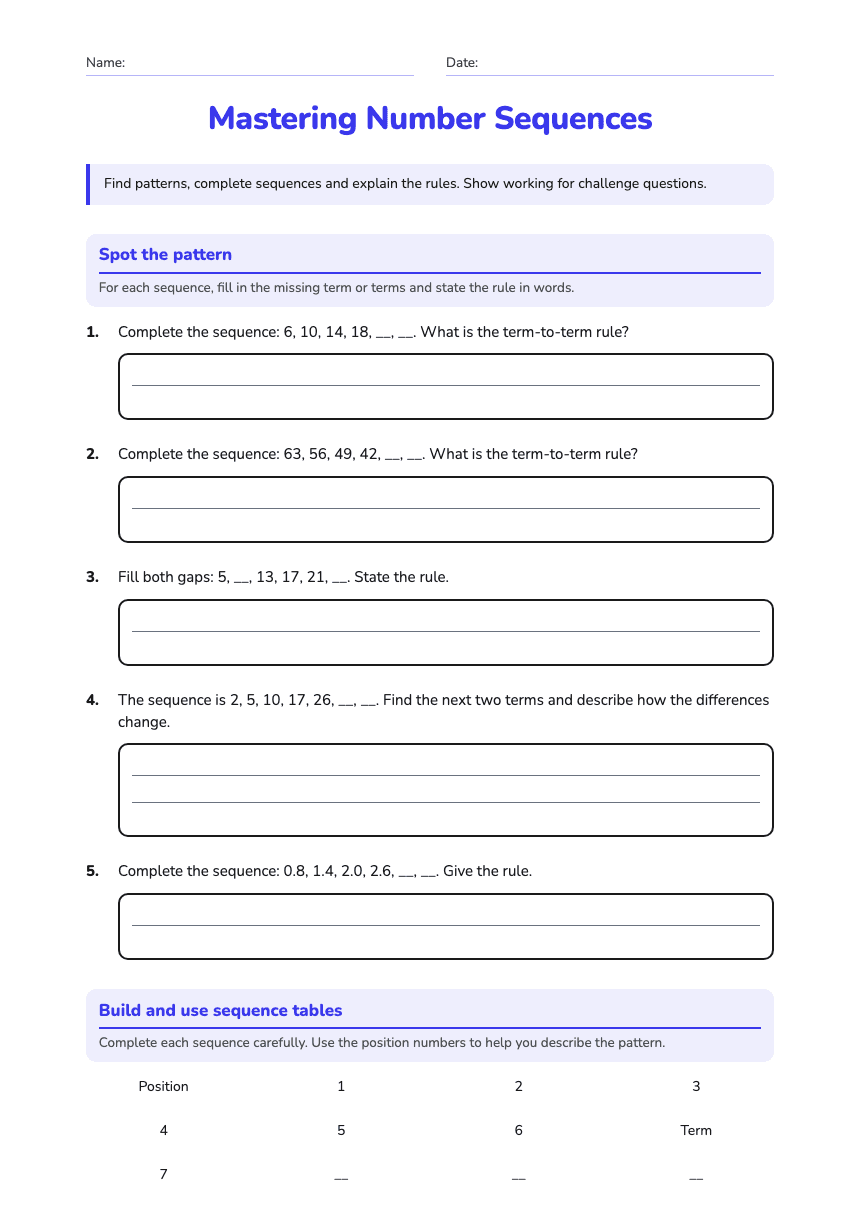
Mastering Number Sequences worksheet preview
Name:Date:

Mastering Number Sequences

Find patterns, complete sequences and explain the rules. Show working for challenge questions.

Spot the pattern

For each sequence, fill in the missing term or terms and state the rule in words.

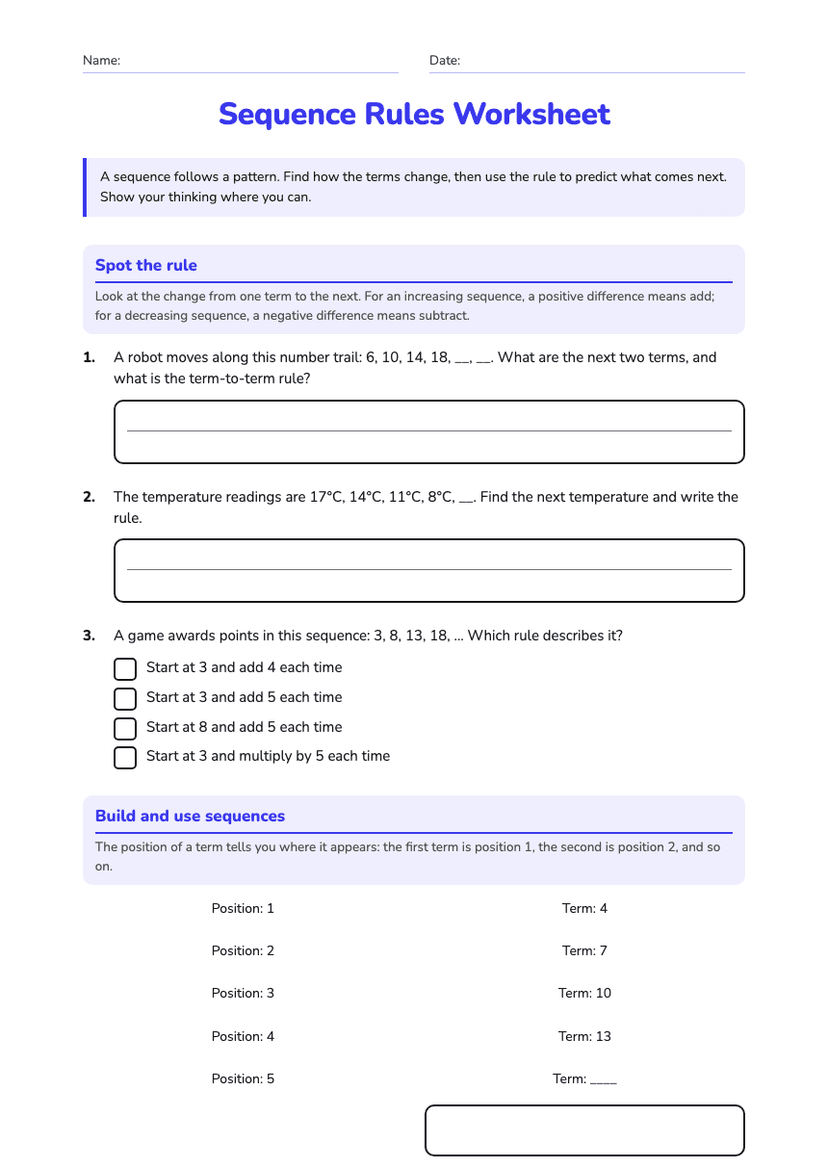
1.Complete the sequence: 6, 10, 14, 18, __, __. What is the term-to-term rule?
2.Complete the sequence: 63, 56, 49, 42, __, __. What is the term-to-term rule?
3.Fill both gaps: 5, __, 13, 17, 21, __. State the rule.
4.The sequence is 2, 5, 10, 17, 26, __, __. Find the next two terms and describe how the differences change.
5.Complete the sequence: 0.8, 1.4, 2.0, 2.6, __, __. Give the rule.

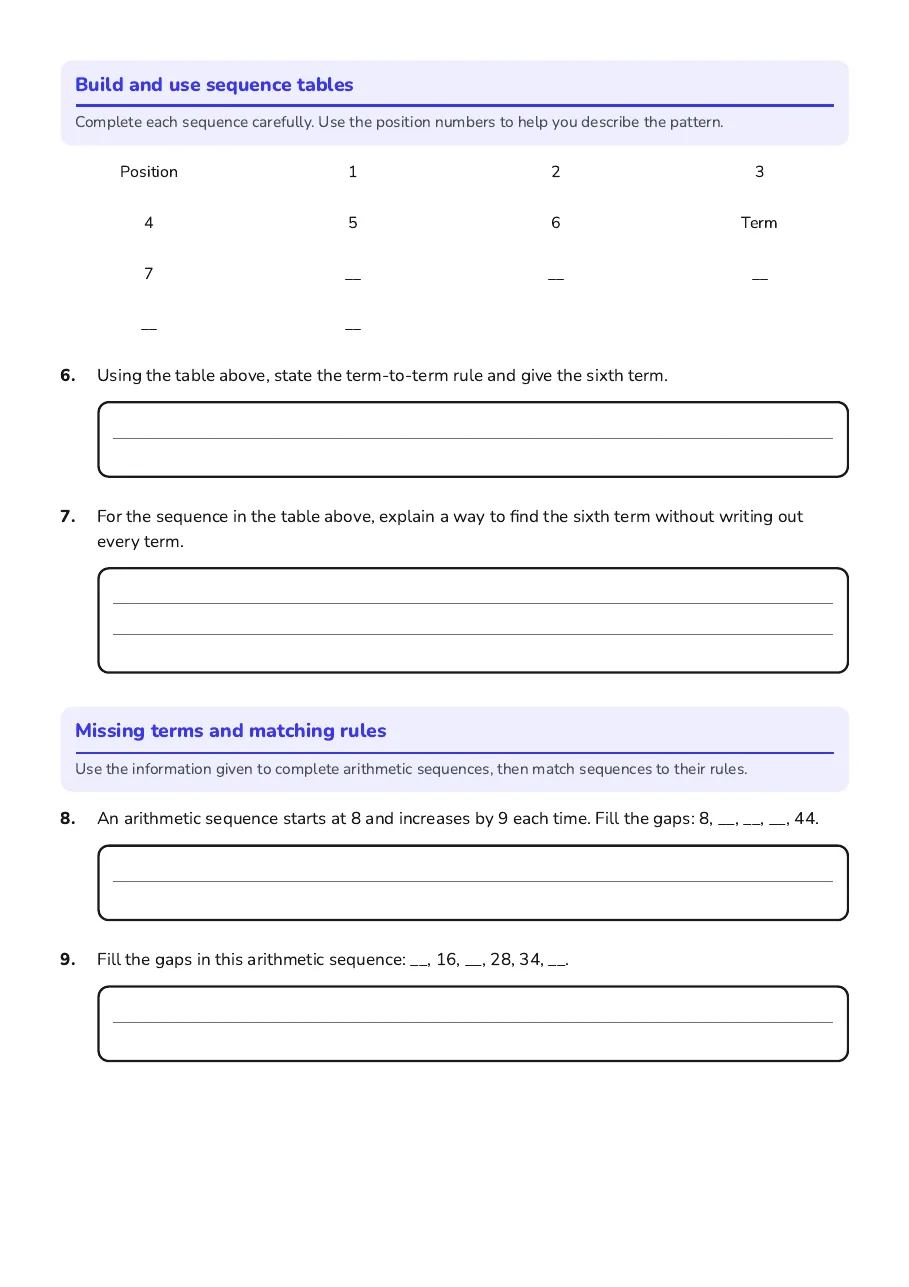
Build and use sequence tables

Complete each sequence carefully. Use the position numbers to help you describe the pattern.

Position

1

2

3

4

5

6

Term

7

__

__

__

__

__

6.Using the table above, state the term-to-term rule and give the sixth term.
7.For the sequence in the table above, explain a way to find the sixth term without writing out every term.

Missing terms and matching rules

Use the information given to complete arithmetic sequences, then match sequences to their rules.

8.An arithmetic sequence starts at 8 and increases by 9 each time. Fill the gaps: 8, __, __, __, 44.
9.Fill the gaps in this arithmetic sequence: __, 16, __, 28, 34, __.
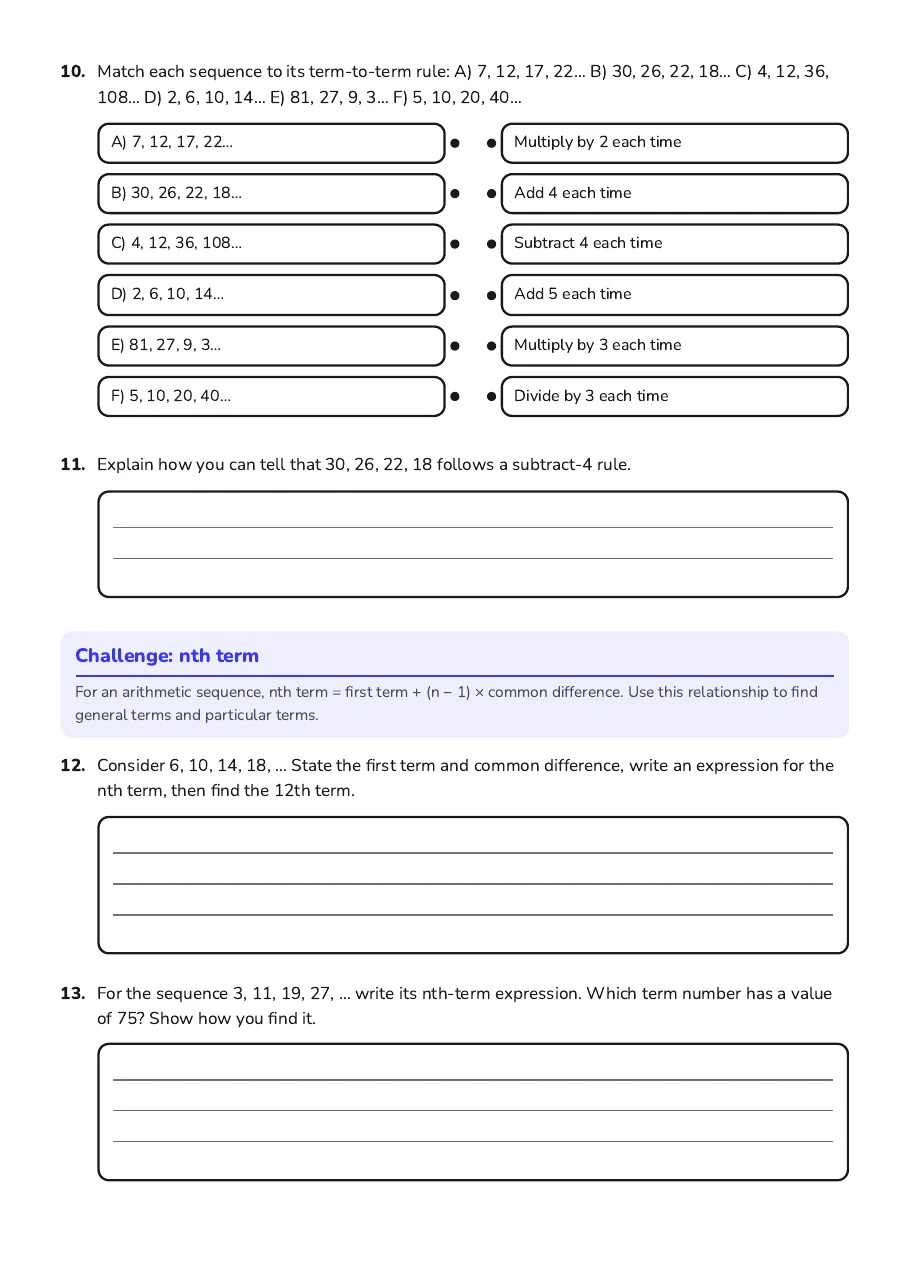
10.Match each sequence to its term-to-term rule: A) 7, 12, 17, 22… B) 30, 26, 22, 18… C) 4, 12, 36, 108… D) 2, 6, 10, 14… E) 81, 27, 9, 3… F) 5, 10, 20, 40…
  • A) 7, 12, 17, 22…
  • B) 30, 26, 22, 18…
  • C) 4, 12, 36, 108…
  • D) 2, 6, 10, 14…
  • E) 81, 27, 9, 3…
  • F) 5, 10, 20, 40…
  • Multiply by 2 each time
  • Add 4 each time
  • Subtract 4 each time
  • Add 5 each time
  • Multiply by 3 each time
  • Divide by 3 each time
11.Explain how you can tell that 30, 26, 22, 18 follows a subtract-4 rule.

Challenge: nth term

For an arithmetic sequence, nth term = first term + (n − 1) × common difference. Use this relationship to find general terms and particular terms.

12.Consider 6, 10, 14, 18, … State the first term and common difference, write an expression for the nth term, then find the 12th term.
13.For the sequence 3, 11, 19, 27, … write its nth-term expression. Which term number has a value of 75? Show how you find it.

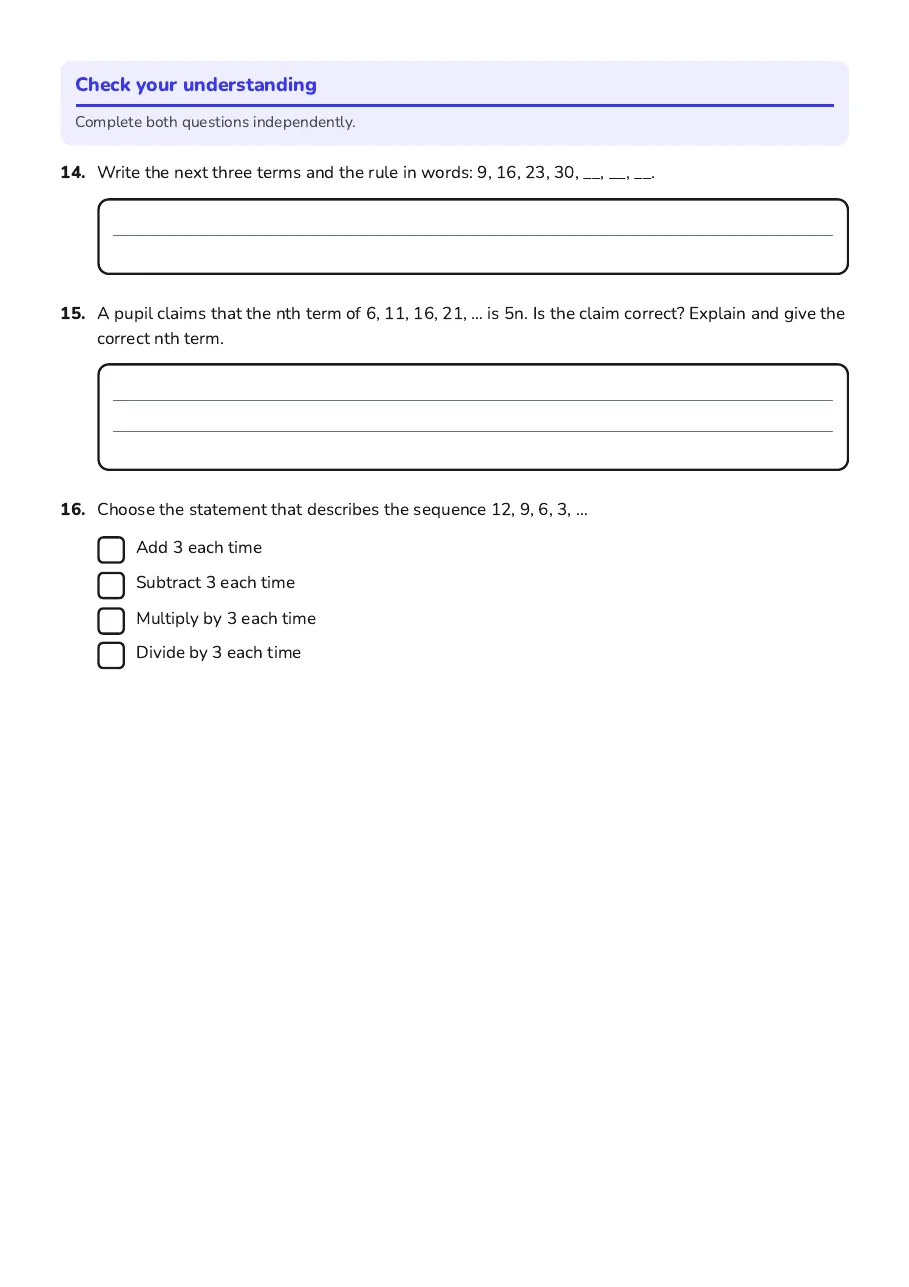
Check your understanding

Complete both questions independently.

14.Write the next three terms and the rule in words: 9, 16, 23, 30, __, __, __.
15.A pupil claims that the nth term of 6, 11, 16, 21, … is 5n. Is the claim correct? Explain and give the correct nth term.
16.Choose the statement that describes the sequence 12, 9, 6, 3, …
  • Add 3 each time
  • Subtract 3 each time
  • Multiply by 3 each time
  • Divide by 3 each time

4 printable pages
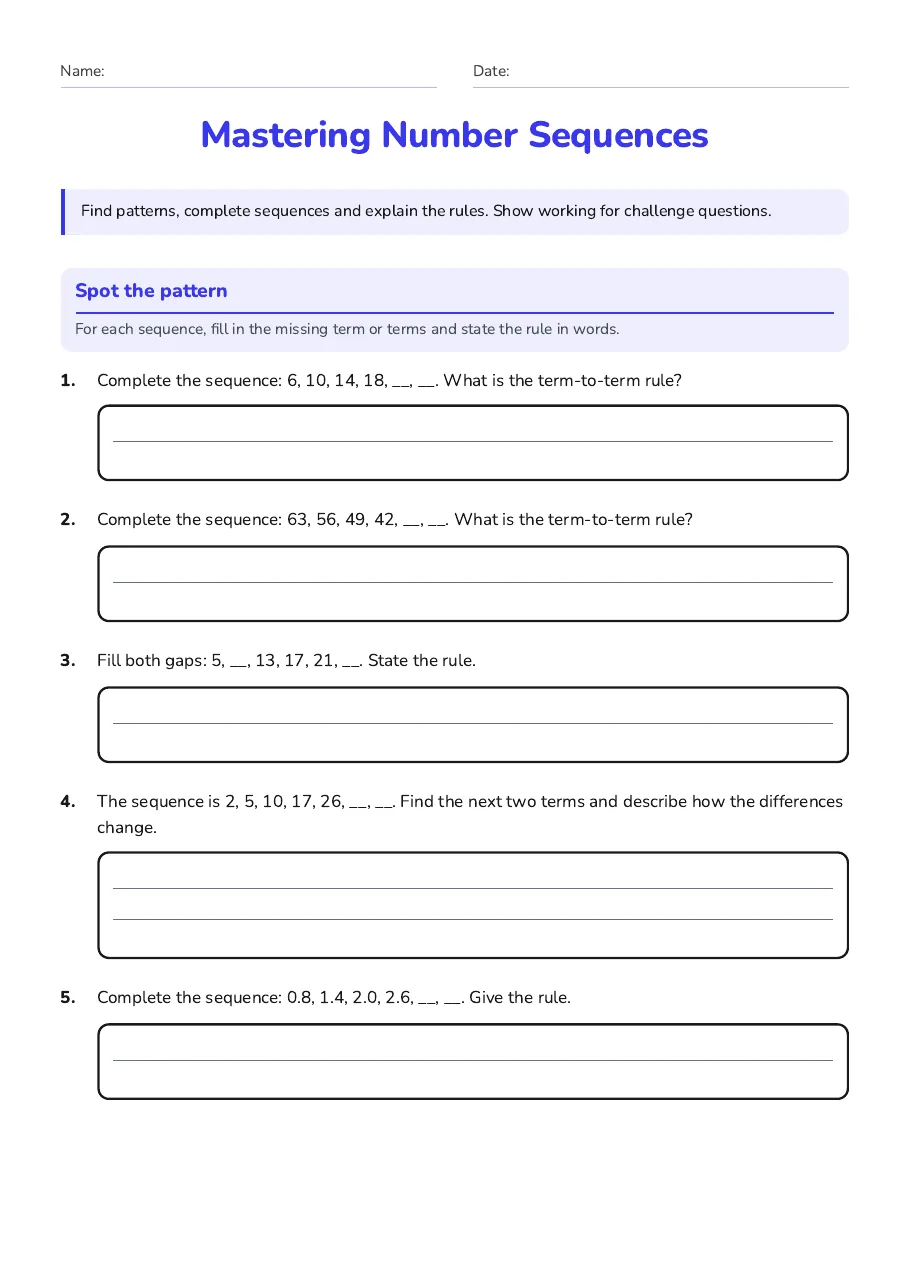
  • Mastering Number Sequences, page 1 of 4: Spot the pattern

    Page 1

  • Mastering Number Sequences, page 2 of 4: Build and use sequence tables, Missing terms and matching rules

    Page 2

  • Mastering Number Sequences, page 3 of 4: Challenge: nth term

    Page 3

  • Mastering Number Sequences, page 4 of 4: Check your understanding

    Page 4

About This Worksheet

Free in Kuraplan

Sign up free, grab the PDF, and customize it for your class.

Print-Ready

Formatted for standard paper. Clean layout, easy to read.

AI-Generated

Created with Kuraplan's AI, designed for real classroom use.

For Teachers & Parents

Use in classrooms, for homework, tutoring, or homeschool.

Need a custom version of this worksheet?

Kuraplan's AI generates custom worksheets in seconds — differentiated for every learner, aligned to your curriculum.

Generate Custom Worksheets — Free
No credit card Curriculum-aligned Under 60 seconds