EnglishFreePrintable
Taylor Swift Writing Analysis
A free english worksheet ready for your classroom. Open in Kuraplan to grab the print-ready PDF, customize it for your students, or generate a fresh version in seconds.
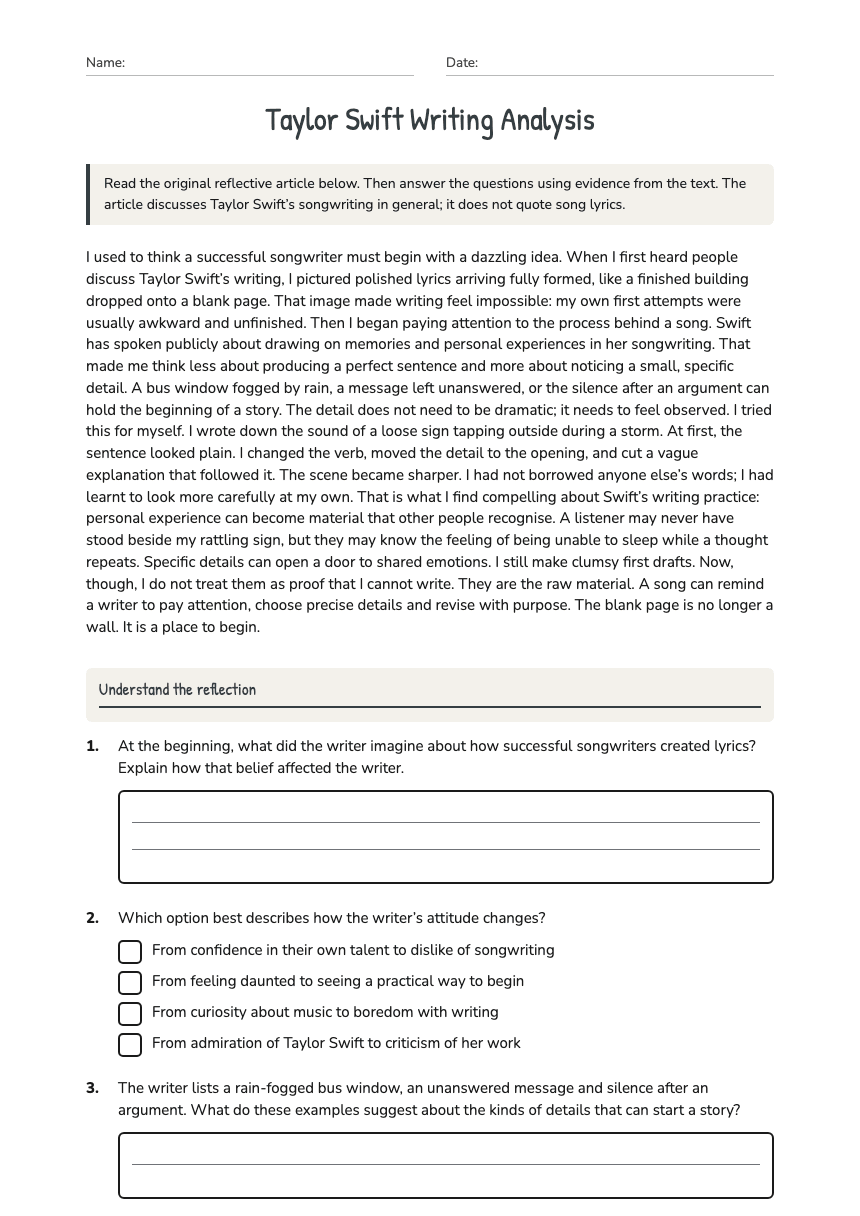
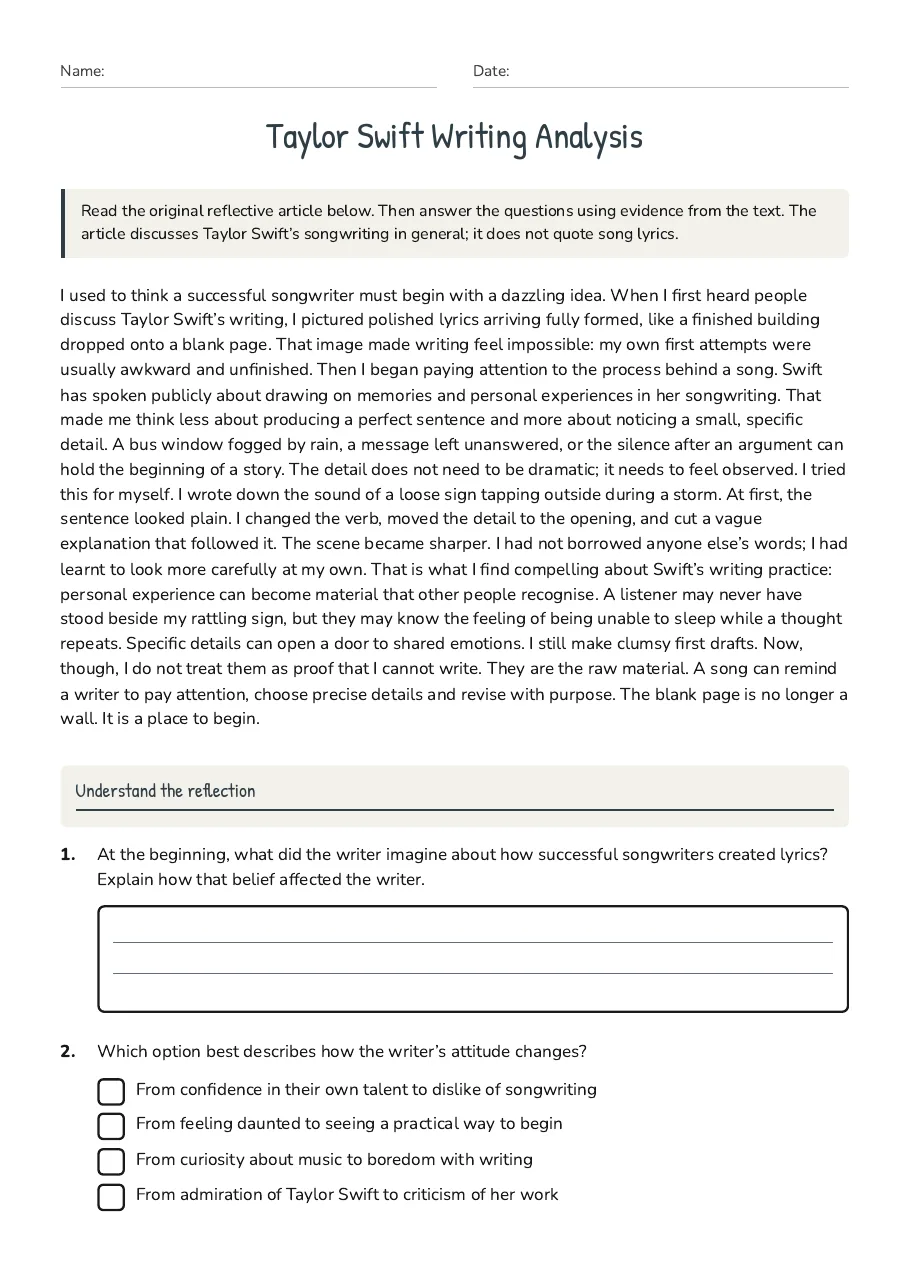
Name:Date:
Taylor Swift Writing Analysis
Read the original reflective article below. Then answer the questions using evidence from the text. The article discusses Taylor Swift’s songwriting in general; it does not quote song lyrics.
I used to think a successful songwriter must begin with a dazzling idea. When I first heard people discuss Taylor Swift’s writing, I pictured polished lyrics arriving fully formed, like a finished building dropped onto a blank page. That image made writing feel impossible: my own first attempts were usually awkward and unfinished.
Then I began paying attention to the process behind a song. Swift has spoken publicly about drawing on memories and personal experiences in her songwriting. That made me think less about producing a perfect sentence and more about noticing a small, specific detail. A bus window fogged by rain, a message left unanswered, or the silence after an argument can hold the beginning of a story. The detail does not need to be dramatic; it needs to feel observed.
I tried this for myself. I wrote down the sound of a loose sign tapping outside during a storm. At first, the sentence looked plain. I changed the verb, moved the detail to the opening, and cut a vague explanation that followed it. The scene became sharper. I had not borrowed anyone else’s words; I had learnt to look more carefully at my own.
That is what I find compelling about Swift’s writing practice: personal experience can become material that other people recognise. A listener may never have stood beside my rattling sign, but they may know the feeling of being unable to sleep while a thought repeats. Specific details can open a door to shared emotions.
I still make clumsy first drafts. Now, though, I do not treat them as proof that I cannot write. They are the raw material. A song can remind a writer to pay attention, choose precise details and revise with purpose. The blank page is no longer a wall. It is a place to begin.
Understand the reflection
1.At the beginning, what did the writer imagine about how successful songwriters created lyrics? Explain how that belief affected the writer.
2.Which option best describes how the writer’s attitude changes?
- From confidence in their own talent to dislike of songwriting
- From feeling daunted to seeing a practical way to begin
- From curiosity about music to boredom with writing
- From admiration of Taylor Swift to criticism of her work
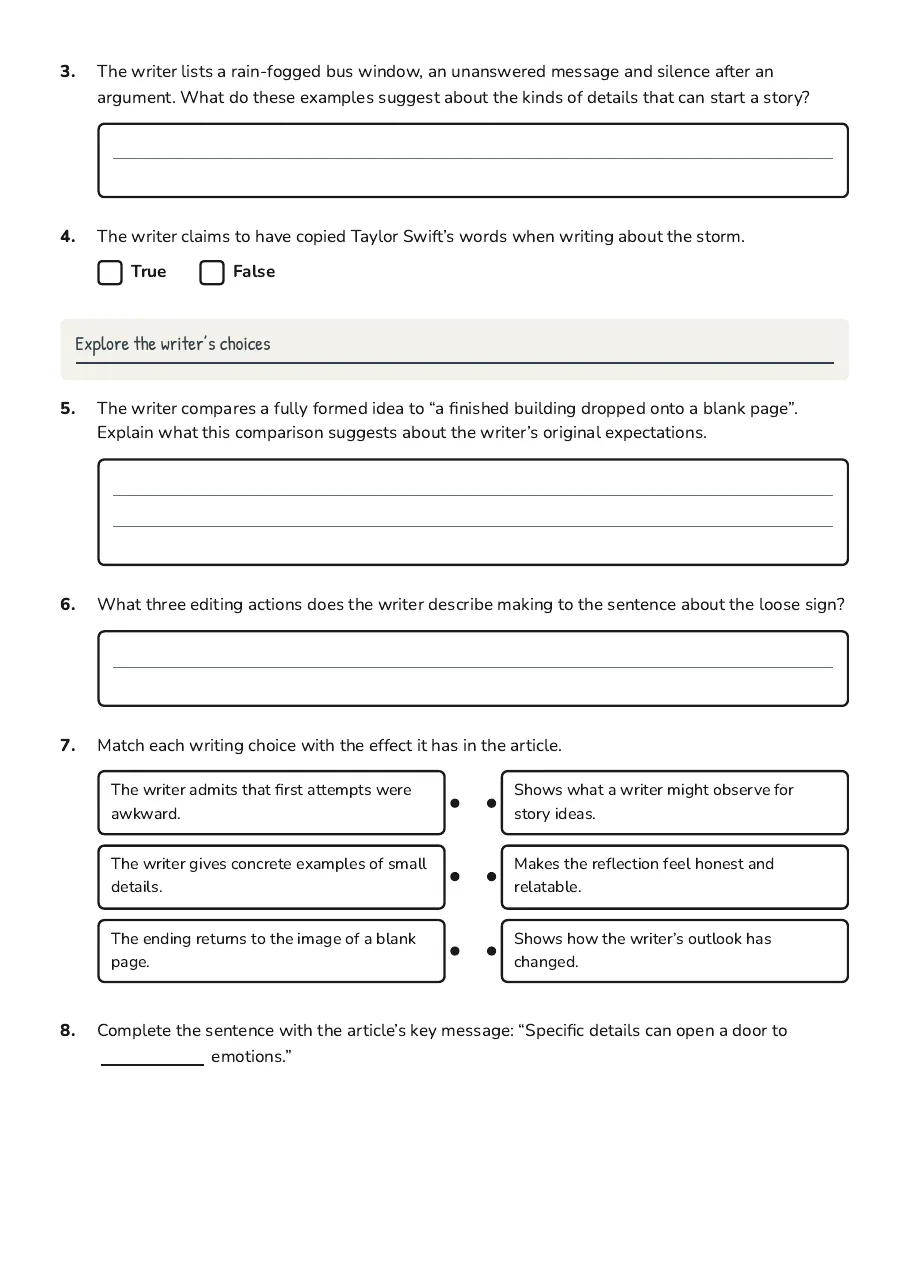
3.The writer lists a rain-fogged bus window, an unanswered message and silence after an argument. What do these examples suggest about the kinds of details that can start a story?
4.The writer claims to have copied Taylor Swift’s words when writing about the storm.
TrueFalse
Explore the writer’s choices
5.The writer compares a fully formed idea to “a finished building dropped onto a blank page”. Explain what this comparison suggests about the writer’s original expectations.
6.What three editing actions does the writer describe making to the sentence about the loose sign?
7.Match each writing choice with the effect it has in the article.
- The writer admits that first attempts were awkward.
- The writer gives concrete examples of small details.
- The ending returns to the image of a blank page.
- Shows what a writer might observe for story ideas.
- Makes the reflection feel honest and relatable.
- Shows how the writer’s outlook has changed.
8.Complete the sentence with the article’s key message: “Specific details can open a door to emotions.”
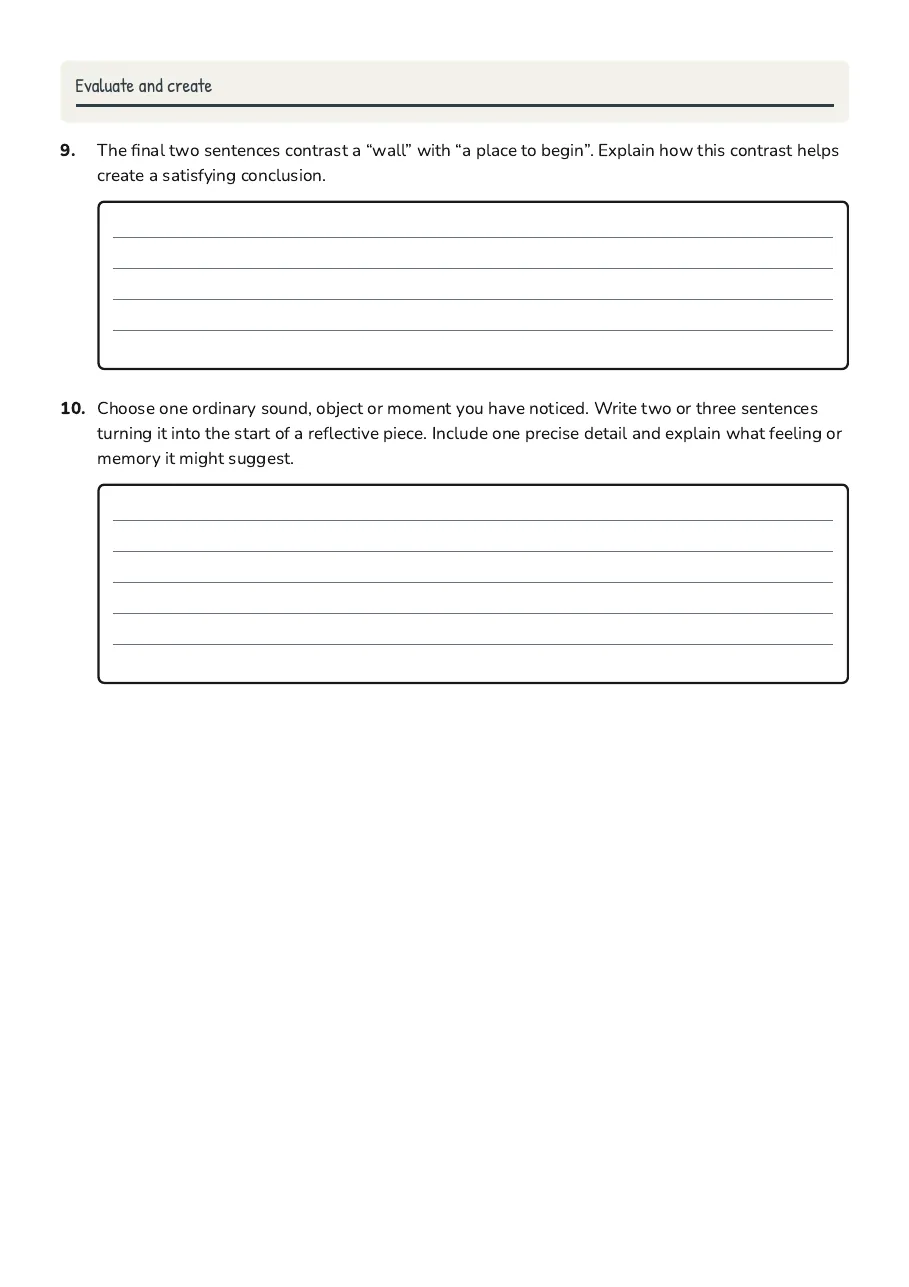
Evaluate and create
9.The final two sentences contrast a “wall” with “a place to begin”. Explain how this contrast helps create a satisfying conclusion.
10.Choose one ordinary sound, object or moment you have noticed. Write two or three sentences turning it into the start of a reflective piece. Include one precise detail and explain what feeling or memory it might suggest.
3 printable pages
Page 1
Page 2
Page 3
About This Worksheet
Free in Kuraplan
Sign up free, grab the PDF, and customize it for your class.
Print-Ready
Formatted for standard paper. Clean layout, easy to read.
AI-Generated
Created with Kuraplan's AI, designed for real classroom use.
For Teachers & Parents
Use in classrooms, for homework, tutoring, or homeschool.
Need a custom version of this worksheet?
Kuraplan's AI generates custom worksheets in seconds — differentiated for every learner, aligned to your curriculum.
Generate Custom Worksheets — Free No credit card Curriculum-aligned Under 60 seconds