ScienceFreePrintable
Wavelength and Frequency Investigation
A free science worksheet ready for your classroom. Open in Kuraplan to grab the print-ready PDF, customize it for your students, or generate a fresh version in seconds.
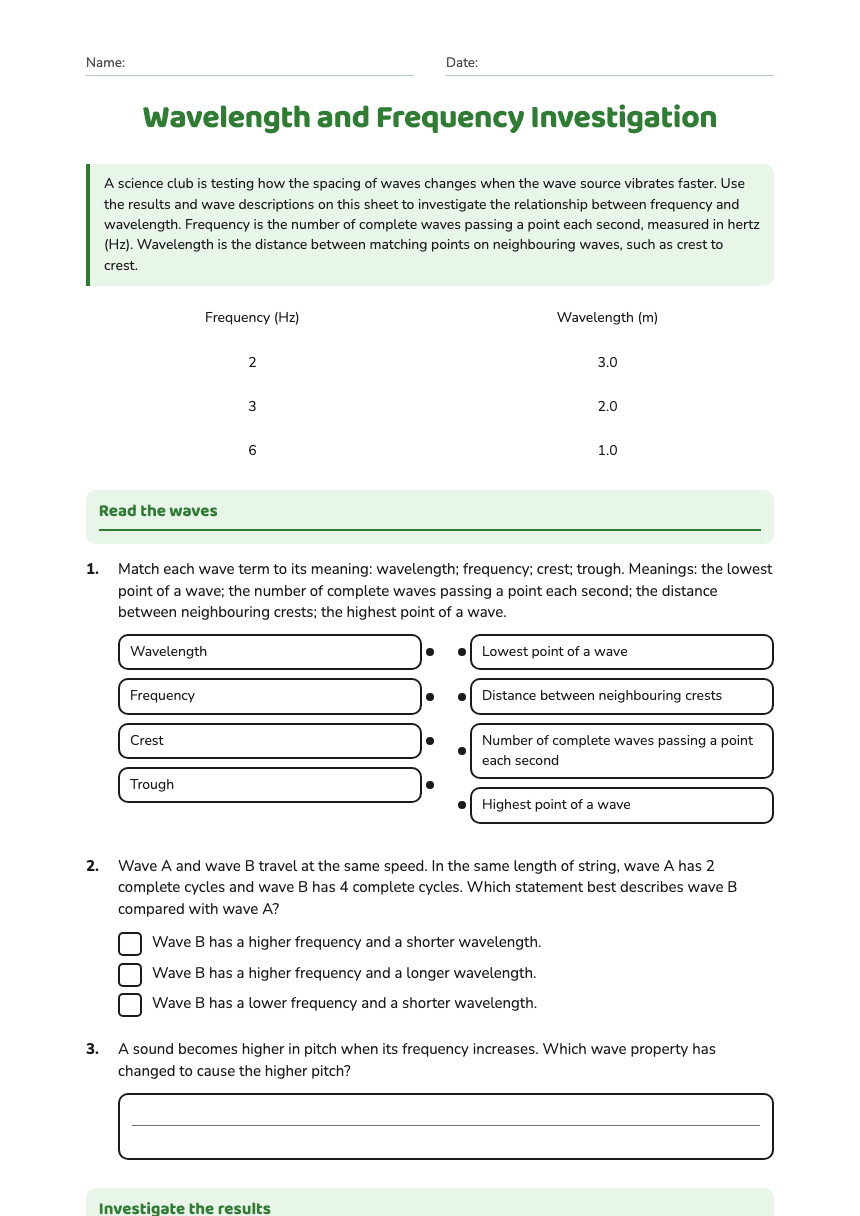
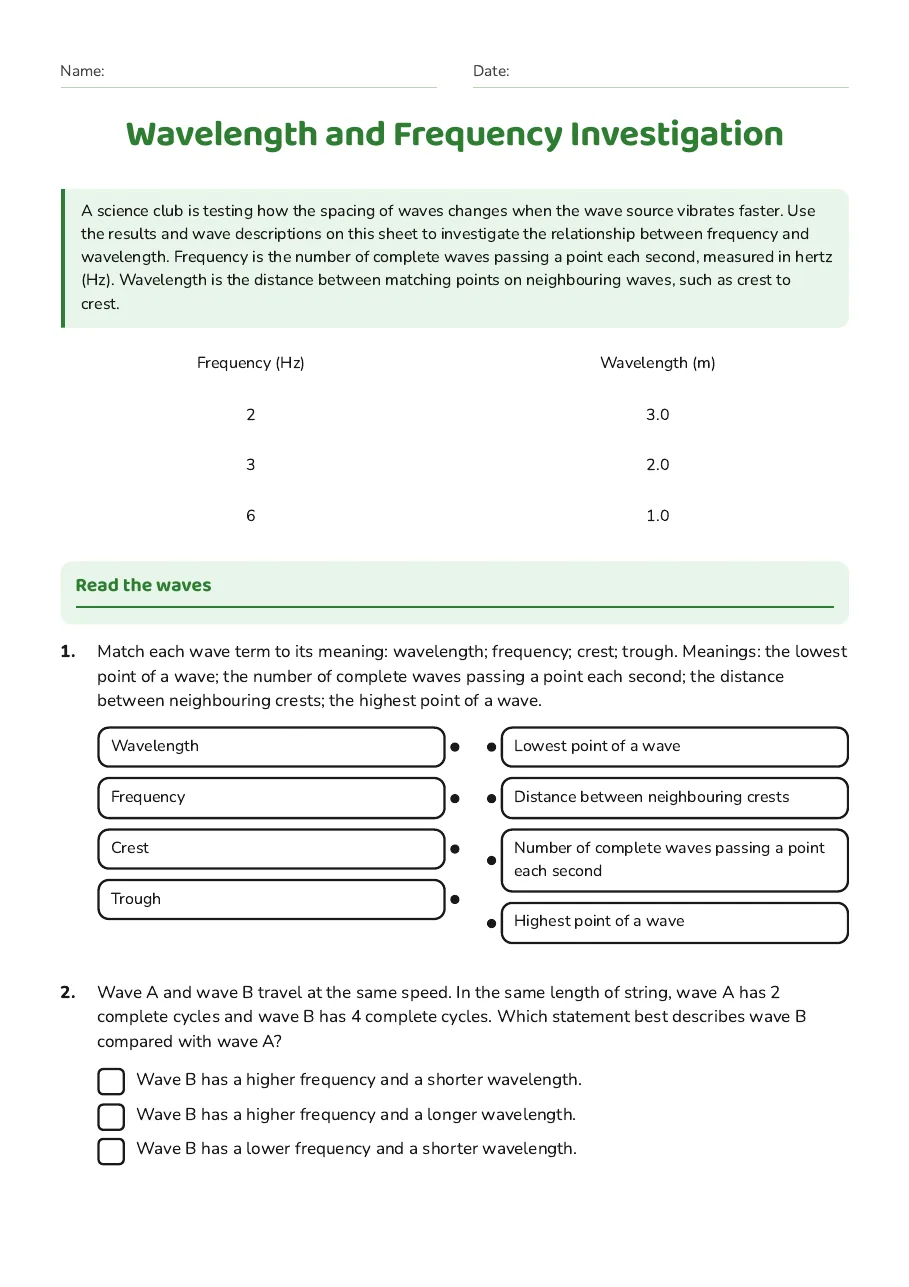
Name:Date:
Wavelength and Frequency Investigation
A science club is testing how the spacing of waves changes when the wave source vibrates faster. Use the results and wave descriptions on this sheet to investigate the relationship between frequency and wavelength. Frequency is the number of complete waves passing a point each second, measured in hertz (Hz). Wavelength is the distance between matching points on neighbouring waves, such as crest to crest.
Frequency (Hz)
Wavelength (m)
2
3.0
3
2.0
6
1.0
Read the waves
1.Match each wave term to its meaning: wavelength; frequency; crest; trough. Meanings: the lowest point of a wave; the number of complete waves passing a point each second; the distance between neighbouring crests; the highest point of a wave.
- Wavelength
- Frequency
- Crest
- Trough
- Lowest point of a wave
- Distance between neighbouring crests
- Number of complete waves passing a point each second
- Highest point of a wave
2.Wave A and wave B travel at the same speed. In the same length of string, wave A has 2 complete cycles and wave B has 4 complete cycles. Which statement best describes wave B compared with wave A?
- Wave B has a higher frequency and a shorter wavelength.
- Wave B has a higher frequency and a longer wavelength.
- Wave B has a lower frequency and a shorter wavelength.
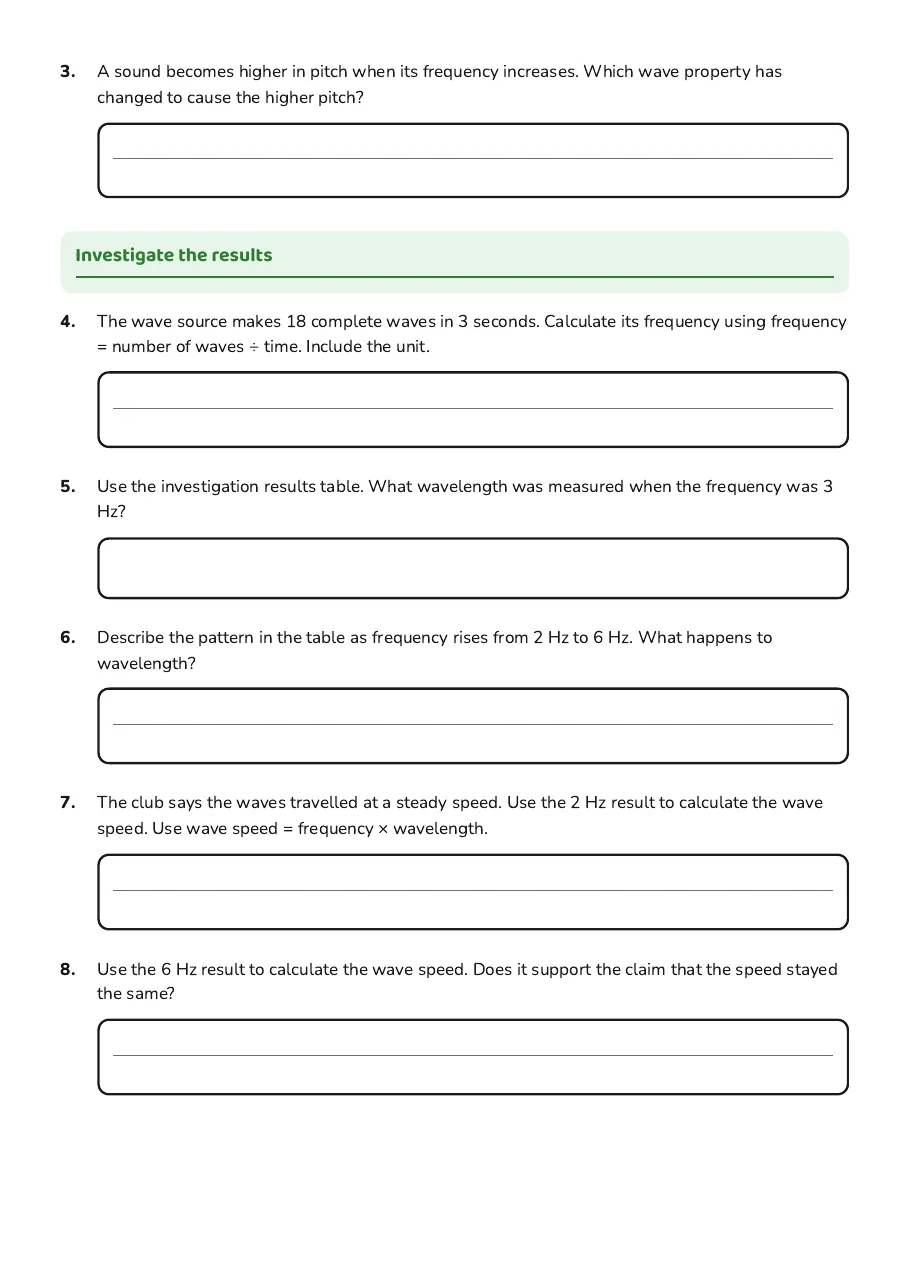
3.A sound becomes higher in pitch when its frequency increases. Which wave property has changed to cause the higher pitch?
Investigate the results
4.The wave source makes 18 complete waves in 3 seconds. Calculate its frequency using frequency = number of waves ÷ time. Include the unit.
5.Use the investigation results table. What wavelength was measured when the frequency was 3 Hz?
6.Describe the pattern in the table as frequency rises from 2 Hz to 6 Hz. What happens to wavelength?
7.The club says the waves travelled at a steady speed. Use the 2 Hz result to calculate the wave speed. Use wave speed = frequency × wavelength.
8.Use the 6 Hz result to calculate the wave speed. Does it support the claim that the speed stayed the same?
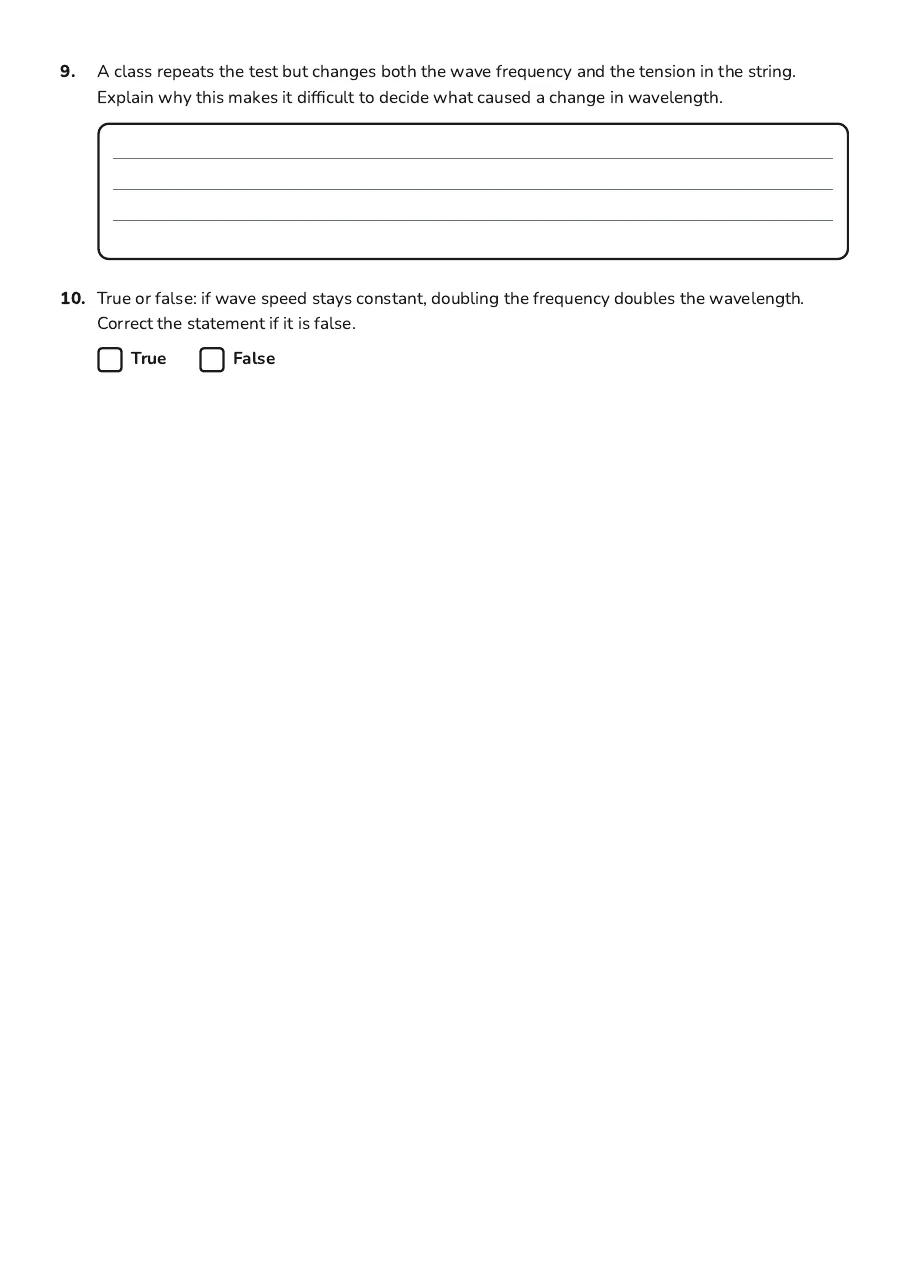
9.A class repeats the test but changes both the wave frequency and the tension in the string. Explain why this makes it difficult to decide what caused a change in wavelength.
10.True or false: if wave speed stays constant, doubling the frequency doubles the wavelength. Correct the statement if it is false.
TrueFalse
3 printable pages
Page 1
Page 2
Page 3
About This Worksheet
Free in Kuraplan
Sign up free, grab the PDF, and customize it for your class.
Print-Ready
Formatted for standard paper. Clean layout, easy to read.
AI-Generated
Created with Kuraplan's AI, designed for real classroom use.
For Teachers & Parents
Use in classrooms, for homework, tutoring, or homeschool.
Need a custom version of this worksheet?
Kuraplan's AI generates custom worksheets in seconds — differentiated for every learner, aligned to your curriculum.
Generate Custom Worksheets — Free No credit card Curriculum-aligned Under 60 seconds
More Science Worksheets
Year 3
Water Transport Experiment
Free
STEM Day Activity Guide
Free
A-Level
Buffer Solutions Investigation
Free
Light Properties Investigation
Free
Exercise and Respiration Investigation
Free
Year 5
Material Properties Investigation
Free
Cells Experiment Observation Worksheet
Free
Year 9