Beyond “What Did You Do This Weekend?” We've all been there. It's time for journal writing, half the class is staring at the page, and the prompt that worked in September now feels worn out by October. You know journal time could do more than fill ten quiet minutes, but building that kind of routine without creating a mountain of prep is the hard part.
That's where better 3rd grade journal prompts matter. Used well, they're a practical bridge from early sentence writing to fuller composition, and classroom prompt collections commonly include anywhere from 25 to 100 prompts across personal narrative, opinion, descriptive, and explanatory writing, as shown in this third-grade prompt collection from We Are Teachers. That range tells you something important. Journal writing isn't just for “creative writing day.” It can support fluency, genre practice, reflection, and assessment.
The strongest prompt sets for this age are also more intentional than they used to be. Major online libraries published in the 2020s are often labeled specifically for Grade 3 and organized by writing type, reflecting the point where students are expected to write more independently and explain ideas in sequence, as described in ClickView Education's overview of third-grade writing prompts. That's the sweet spot for turning journals into a real instructional tool.
Below, you'll find prompt categories that work in a third-grade classroom, plus the scaffolds, differentiation moves, mini-lesson ideas, and quick assessment options that make them manageable.
1. Personal Narrative and Life Events Journal Prompts
Personal narrative prompts are often the easiest entry point because most 3rd graders already have stories to tell. The problem is that “write about your weekend” usually gives you either one sentence or a rambling play-by-play with no clear middle. A stronger prompt narrows the memory and gives students a reason to tell it.
Try prompts like: write about a time you felt proud, tell about a day something surprised you, or describe a small moment from this week that you want to remember. Those topics are broad enough to invite choice but focused enough to help students sequence events.
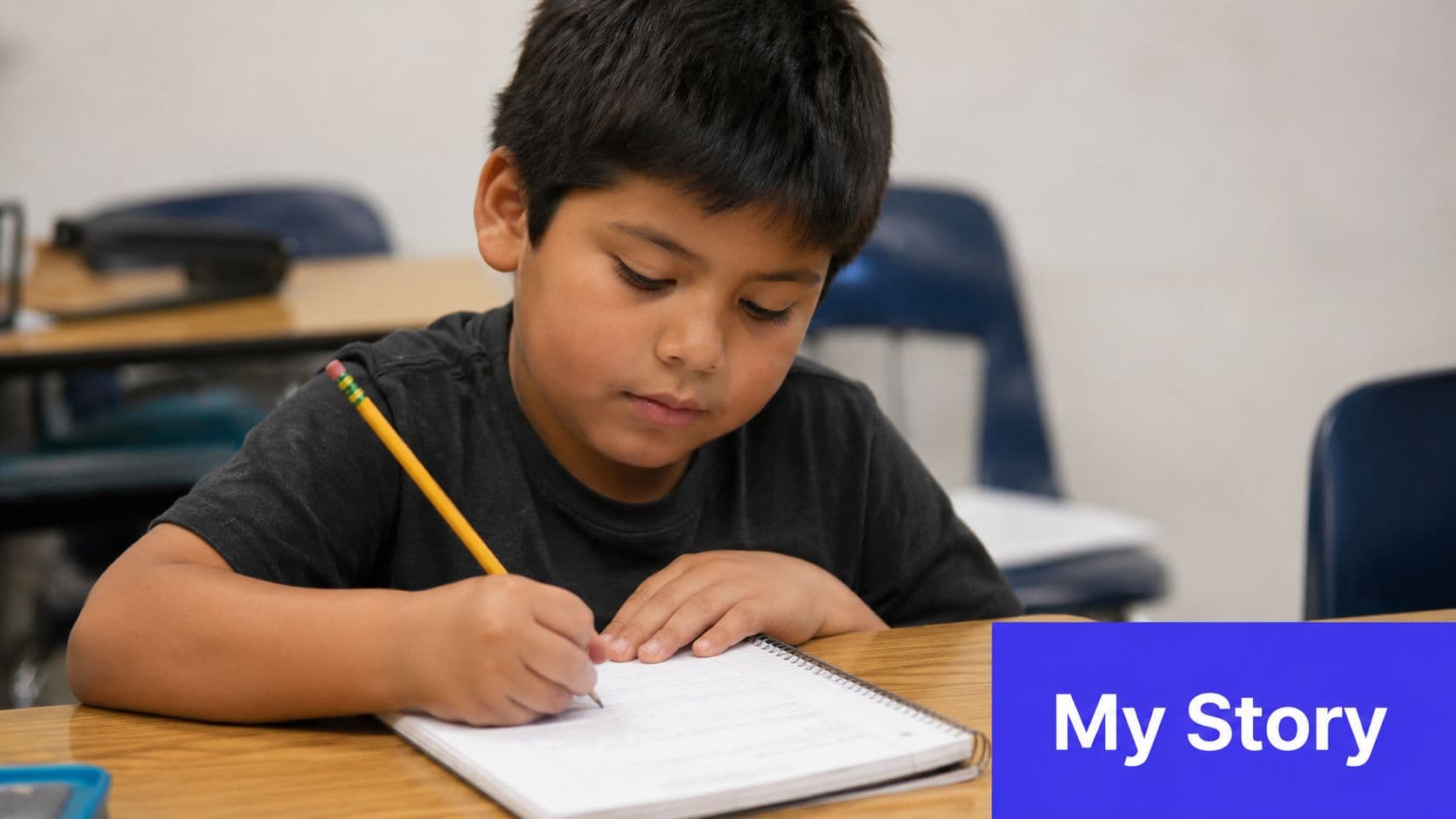
A real classroom example: after a field trip, don't ask for “everything we did.” Ask, “What was one part of the trip you'd want to show a student who missed it?” That usually leads to better detail, stronger voice, and clearer organization.
Scaffolds That Help Students Start
Students who freeze at the top of the page usually don't need a simpler topic. They need a doorway into the topic.
- Sentence starters: “At first…,” “Then I noticed…,” “The part I remember best was…”
- Story boxes: beginning, middle, end with room for quick sketches
- Oral rehearsal: partner retell before writing
- Shared model: write your own short example and underline time-order words
Practical rule: If a student can tell the story aloud but can't write it, add planning support before you lower the task.
Personal narrative also works well for quick formative assessment. You can scan for sequence, detail, and whether the student stays on one event instead of listing several.
What Works and What Doesn't
What works is specificity. “Write about a time you solved a problem during recess” gets better writing than “write about recess.”
What doesn't work is prompting students into emotional territory without support. Many common journal lists lean heavily on memories, feelings, and “write about a time…” questions. That can be useful, but elementary writing guidance also points to the need for short, structured, low-stakes writing for students with developing stamina or anxiety, as discussed in Waterford's journal prompt guidance for kids. For some students, “Tell about your favorite snack break” is more productive than “Describe a hard time in your life.”
If you use Kuraplan, this is a good place to generate leveled versions of the same narrative prompt so one student writes three sequenced sentences while another develops a full paragraph with dialogue.
2. Descriptive Writing and Sensory Detail Prompts
Descriptive prompts are where many third graders finally stop writing flat sentences. If you want students to move past “It was fun” and “My dog is nice,” this is the category to revisit often, not just once during a unit.
Good prompts give students something concrete to describe. Favorite foods work. Weather works. So do familiar classroom places. “Describe the lunchroom when it's noisy” is stronger than “describe your school.”
Build the Prompt Around the Senses
Third-grade writing resources consistently emphasize scaffolds that help students connect and expand ideas, including words like because, since, for example, another, and also, and they commonly group prompts into journal, personal narrative, descriptive, and opinion or reasoning formats, as explained in SplashLearn's third-grade writing prompt guide. In practice, that means descriptive writing gets better when you don't only ask for adjectives. You teach students how to add linked details.
Try this sequence:
- Notice one thing you can see
- Add one sound, smell, taste, or texture
- Explain why that detail matters
- Combine ideas with linking words
For example, instead of “The playground is big,” students might write, “The playground feels busy because sneakers scrape the blacktop and kids race to the swings.”
If you want a ready-made scaffold, this descriptive sentence writing worksheet fits nicely into journal warm-ups or small-group support.
Mini-Lessons That Pay Off
A quick mentor sentence lesson works better than a long lecture. Read one strong sentence from a picture book, cover it, and ask students to rebuild it with sensory words. Then send them straight into their journal prompt while the language is still fresh.
Useful prompt examples include:
- Describe your backpack without naming it first
- Write about a rainy day using sound words
- Describe your favorite place at home
- Explain what fresh popcorn smells and feels like
Don't ask for all five senses every time. Sometimes that turns writing into a checklist instead of a picture.
Word walls help here, especially if they're sorted by category. Sound words in one section, texture words in another, emotion-linked description in a third. Kuraplan can also help you build a short sequence of lessons around sensory detail, so journal time reinforces a skill instead of floating separately from the rest of your ELA block.
3. Opinion Writing and Persuasive Argument Prompts
Opinion prompts are often the fastest way to get reluctant writers talking. Third graders usually have strong views on recess, pets, read-alouds, lunch, and whether homework should exist. The trick is teaching them that a strong opinion entry isn't just a loud preference. It needs reasons.
Prompts that work well include: Which season is best and why? Should students have assigned seats at lunch? Which classroom job is most important? Which book character made the best choice?
Keep the Structure Tight
This is one place where sentence frames are worth it. Without them, students tend to repeat the opinion three times in different words.
Use a simple pattern:
- State the opinion
- Give one reason
- Add an example
- End with a restated claim
That can sound like: “I think recess should be longer. One reason is that students need time to move. For example, it's easier to focus after running and playing. That's why longer recess would help our class.”
For students who need support, these opinion writing sentence starters make journal writing more independent without lowering expectations.
Make It Measurable
Many prompt collections frame writing as fun or confidence-building, but teachers also need writing that shows progress. That gap is especially noticeable with journal prompts. There's still limited practical coverage on turning a prompt into an assessable task with clear success criteria, a point raised in Brisk Teaching's discussion of 3rd grade writing prompts. In the classroom, that means you'll want a very short rubric.
A simple journal rubric for opinion writing can look for:
- clear opinion
- at least one reason
- a supporting example
- complete sentences
That's enough for a quick check during conferencing or after independent writing.
If you can't point to the sentence where the opinion appears, the prompt wasn't clear enough or the student needs a model.
What doesn't work is making every opinion prompt into a debate. Some students thrive on that energy. Others write better when the task stays low-pressure and written first, spoken second. Let them build the claim on paper before you invite discussion.
4. Question-Based Inquiry and Wonder Prompts
Some students write more when they're allowed to ask instead of explain. Inquiry prompts tap into that naturally. They also help when your science or social studies block needs more writing without becoming a full report assignment.
Prompt examples that land well in third grade include: What do you wonder about sharks? Why do leaves change? What would you ask a community helper about their job? If you could ask one question about space, what would it be?
Turn Curiosity Into Writing
A good inquiry journal isn't only a list of questions. It asks students to pick one question and say why it matters.
That sounds like: “I wonder how bees find flowers. I think it matters because bees move from place to place so quickly, and I want to know how they do it.”
This gives students practice with reasoning language even before they research. It also creates a natural bridge to informational writing later.
A classroom example: during a weather unit, have students keep a “wonder notebook” for one week. Each day they add one question, then choose one to expand into two or three sentences. By the end of the week, you've got a ready-made bank of writing topics tied to content.
Simple Supports for Better Questions
Students often default to vague questions like “Why is space cool?” That's a sign they need stems.
Use prompts like:
- Why do…
- How does…
- What would happen if…
- Why might…
- What can we learn from…
You can also create a Wonder Wall where students post questions before writing. That lowers the pressure of inventing everything on the spot and helps students borrow structure from one another.
This is also a practical use case for Kuraplan. If your class is studying habitats, inventions, or regions, you can generate inquiry prompts that match the unit instead of pulling random journal topics that don't connect to what students are already learning.
The best wonder prompts don't end with one answer. They open a path to explanation, research, or discussion.
What doesn't work is assigning research too early. If every inquiry prompt turns into “go find facts,” students lose the habit of wondering. Let curiosity live on the page before you formalize it.
5. Creative and Imaginative Writing Prompts
Creative prompts earn their place in third grade because they lower the pressure for students who don't want to mine personal experience every day. Some children will write much more about a talking backpack than about their real morning routine. That's not avoidance. It's a useful entry point into narrative craft.
Prompts that usually work: You wake up and can talk to animals. A tiny door appears in the classroom wall. Your pencil grants one unusual power. You become the class pet for a day. You invent a machine that fixes one school problem.

Keep Imagination From Turning Into Chaos
The common problem with fantasy prompts is that students generate lots of ideas and no actual story. Give them a light structure.
Use story elements like:
- character
- setting
- problem
- one surprising event
- ending
A fast planning move is to hand students three cards or slides: who, where, what happens. That keeps the writing playful but focused.
If you want help producing fresh prompts quickly, Kuraplan's writing prompt generator is useful for spinning up topics around animals, school life, inventions, or fantasy themes.
Differentiate Without Killing the Fun
For writers who need support, offer a story starter: “One morning, I opened my desk and found…” For stronger writers, add a craft challenge: “Include dialogue and one problem the character must solve.”
Creative prompts also work well for collaborative oral rehearsal. Let pairs talk through the idea for one minute before anyone writes. You'll get fewer blank pages and fewer “I don't know what to do” conferences.
A student who says “I can't think of anything” often means “I have too many choices.”
What doesn't work is overcorrecting every invented detail. If a child writes about a flying hamster mayor, the writing conference should focus on clarity, sequence, and elaboration, not realism. Mechanics still matter, but imaginative writing grows when students feel that unusual ideas are welcome.
6. Informative and Explanatory Writing Prompts
Informative journal prompts are one of the most underused categories in third grade. Teachers often save explanatory writing for formal assignments, but journals are a smart place to practice short how-to pieces and mini-explanations first.
Prompts like “Explain how to play your favorite game,” “Teach someone how to care for a plant,” or “Describe how a caterpillar changes” build academic writing without the pressure of a full report.

Use Short Explanations Before Full Essays
Many students can explain something orally but don't know how to organize it on paper. A quick journal structure helps:
- name the topic
- tell the steps or facts in order
- end with why it matters
For example, after a science lab, ask students to explain what they did and what they learned, not just what happened. That pushes them toward academic language and sequence.
This category also pairs well with mini graphic organizers. A “main idea plus three details” box or “first, next, last” strip is often enough.
Connect Journal Writing to Content Areas
In K to 12, GenAI adoption is already common enough to affect teacher workflows. Cengage reports that 63% of K to 12 teachers say they or their district have incorporated GenAI into teaching, and 14% say access to GenAI tools that help with lesson planning would increase adoption further. The same report notes strong interest in outputs like assessments at 34% and visuals at 29%, which makes explanatory journal work a practical fit for tools that can quickly convert prompts into standards-aligned supports, visuals, and checks for understanding in class according to the Cengage Group AI in education report.
That matters because informative writing gets much easier when students have a diagram, labeled image, or short sequence strip in front of them.
A short video can also anchor this kind of writing before students explain a process in their own words.
What doesn't work is assigning a broad topic with no frame. “Write about frogs” is too open. “Explain how a frog changes as it grows” gives students a path.
7. Reflection and Metacognitive Prompts
Reflection prompts are where journal writing starts doing more than teaching writing. They help students notice how they learn, where they got stuck, and what helped. That's valuable after a math task, a reading discussion, a group project, or even a tough transition day.
Prompts that work well include: What was hard about today's work? What strategy helped you most? What's one thing you understand better now than you did yesterday? What will you try first next time?
Keep Reflection Concrete
The phrase “reflect on your learning” is too abstract for many third graders. Attach reflection to a specific event.
Better prompts sound like:
- After science, what did you discover and how?
- After independent reading, what helped you understand the chapter?
- After math, where did you get stuck and what did you do next?
That gives students something real to hold onto. It also keeps reflection from turning into “Today was good.”
A classroom example: after a quiz review, ask students to write one thing they got wrong at first and what helped them fix it. You learn more from that than from a generic confidence check.
Sentence Frames That Make Reflection Stronger
These are useful:
- I learned…
- I used to think…, but now…
- I struggled with…
- My strategy was…
- Next time I will…
This category works especially well in inclusive classrooms because students can reflect in a few sentences, with drawings, or through a shared teacher scribe if needed. The writing stays low-friction while still producing meaningful evidence.
Some of the best journal entries aren't polished. They're honest, specific, and useful for the next lesson.
Kuraplan can help here if you want to connect prompts to recent classroom tasks or generate different versions for students who need more support with language. A key benefit is that reflective journals help you spot whether the issue is skill, confidence, stamina, or misunderstanding. That's information you can use the same day.
8. Reader Response and Literature Connection Prompts
Reader response prompts are one of the easiest ways to make journals feel purposeful. Students already have a shared text, so you're not asking them to invent a topic from scratch. You're asking them to think with the text.
Try prompts like: Which character made a strong choice? What would you have done differently? How is this setting similar to a place you know? Which part of the story surprised you, and why?
Move Beyond Retelling
Retelling has its place, but most journal prompts should push one step past “what happened.” Ask students to explain, compare, or judge.
Strong examples include:
- Why did the character make that choice?
- Which problem in the story was hardest to solve?
- What lesson do you think the author wanted readers to notice?
- Which detail in the illustration added meaning?
These prompts work especially well after read-alouds because every student has access to the same text, even if independent reading levels vary.
Support Comprehension and Writing at the Same Time
A simple response frame helps: “I think ___ because ___.” “The character changed when ___.” “This part mattered because ___.”
You can also let students choose from two prompt options after reading. One can be more concrete, like character feelings. The other can be more analytical, like theme or problem-solving. That small bit of choice tends to improve both engagement and output.
For a real-world classroom scenario, use reader response after a chapter from your class novel. One group writes about a character's motivation. Another group explains which event was the turning point. Everyone writes from the same reading, but the prompts target different comprehension skills.
What doesn't work is treating every book response like a mini book report. Journal writing should stay light enough that students can focus on thinking, not just formatting. Short, thoughtful responses often tell you more than a heavily structured summary.
8-Point Comparison of 3rd Grade Journal Prompts
| Prompt Type | Implementation 🔄 Complexity | Resources ⚡ Required | Expected Outcomes 📊 | Ideal Use Cases 💡 | Key Advantages ⭐ |
|---|---|---|---|---|---|
| Personal Narrative and Life Events Journal Prompts | Low 🔄, minimal prep; routine-friendly | Paper/notebook, simple prompts, sentence starters | Sequencing, voice, confidence; oral storytelling | Morning journals, community-building, narrative assessments | Highly relatable; easy to assess narrative structure ⭐ |
| Descriptive Writing and Sensory Detail Prompts | Medium 🔄, needs modeling and examples | Visuals, sensory word banks, mentor texts | Rich sensory vocabulary; "show not tell" skills | Vocabulary lessons, picture-prompt activities | Engages reluctant writers; strengthens descriptive language ⭐ |
| Opinion Writing and Persuasive Argument Prompts | Medium 🔄, explicit instruction in reasoning | Sentence frames, graphic organizers, debate topics | Claim support, reason-giving, critical thinking | Debates, persuasive letters, civic topics | Clear rubric alignment; measurable assessment data ⭐ |
| Question-Based Inquiry and Wonder Prompts | Medium–High 🔄, requires follow-up research plans | Question stems, research materials, tech access | Questioning skills, research habits, STEM connections | STEM/STEAM units, wonder journals, long-term projects | Student-centered; fosters independent inquiry ⭐ |
| Creative and Imaginative Writing Prompts | Low–Medium 🔄, open-ended; optional scaffolds | Fantastical visuals, story starters, planning cards | Imagination, narrative structure, risk-taking | Free-writing, creative centers, portfolio pieces | Inclusive for diverse learners; highly motivating ⭐ |
| Informative and Explanatory Writing Prompts | Medium 🔄, teaches organization and structure | Content texts, graphic organizers, topic word banks | Expository structure, domain vocabulary, sequencing | Science/social studies integration, how-to tasks | Strong standards alignment; prepares for upper grades ⭐ |
| Reflection and Metacognitive Prompts | Medium 🔄, needs safe classroom routines | Formative data, sentence starters, goal templates | Metacognition, SEL growth, self-assessment | Post-assessment reflections, SEL lessons, goal-setting | Builds agency and teacher insight into thinking ⭐ |
| Reader Response and Literature Connection Prompts | Medium 🔄, text-specific planning required | Grade-level books, discussion guides, organizers | Deeper comprehension, text connections, inference | Guided reading, literature circles, book responses | Integrates reading & writing; reveals comprehension levels ⭐ |
Make Journaling a Cornerstone of Your Classroom
It is 8:20, students are settling in, and you need writing to do real instructional work before the day picks up speed. Journal time can handle that job. With purposeful 3rd grade journal prompts, students practice narrative writing, description, reasoning, explanation, reflection, and reading response inside a routine you can sustain.
The shift is practical. Choose the prompt type based on the writing move you want to teach that day. Use personal narrative or descriptive prompts for elaboration. Use opinion or inquiry prompts for claims and evidence. Use informative or reflective prompts when students need to process science, social studies, or their own learning. A varied journal routine helps, but the stronger payoff comes from matching the task to the skill.
Keep the writing low-stakes, but make the target visible. Third graders do not need a full scoring guide every morning. They do need a clear success point. On Monday, that might be a beginning, middle, and end. On Tuesday, it might be one opinion with a reason and an example. On another day, it might be using linking words such as because, for example, another, and also to stretch an idea past a single sentence.
The hard part is prep time.
Teachers want stronger writing samples, but few want to build new prompts, sentence frames, visual supports, differentiation options, and quick checks from scratch every week. A repeatable routine solves that problem. Keep a small prompt bank by category. Reuse the same planning templates. Build a few reliable sentence stems for each writing type. Rotate categories across the week so students get range without having to relearn the system each day.
That is also where this list works differently than a basic prompt roundup. Each prompt type can carry its own mini-lesson, scaffold, differentiation move, and simple rubric. That makes journaling easier to implement and easier to assess. It also gives you cleaner evidence of growth because you know what students were practicing in each entry.
If you use AI during planning, use it for the pieces that save the most time. Generating a prompt is useful, but generating the support around the prompt is usually more valuable. Visuals, leveled versions, success criteria, and quick assessments are what turn a journal idea into a usable classroom routine. Kuraplan fits that workflow because it is built for standards-aligned lesson planning, worksheets, visuals, and rubrics. That matters when you want journal writing to connect to the rest of your instruction instead of sitting off by itself.
Protect the routine. Short, consistent journal writing gives students regular chances to rehearse ideas, take risks, and build fluency as writers. Over time, those entries become a dependable set of authentic samples. In my experience, they often show more about a student's real writing habits than a polished final draft does.
If you're also thinking about broader curriculum fit for upper elementary, these picks for compliant 3-5 grade curriculum may be useful alongside your writing plans.
If you want a faster way to turn ideas into usable 3rd grade journal prompts, Kuraplan can help you generate standards-aligned prompts, scaffolds, worksheets, visuals, and rubrics without rebuilding the whole routine from scratch each week.