It's 10:07. You've barely started the fractions mini-lesson, and the room is already pulling in five directions. One student is rocking back in a chair, two are stuck on yesterday's recess argument, someone is halfway out of their seat, and the rest of the class is watching to see what you do next.
That moment is why elementary classroom management has to be treated as a toolkit, not a single trick.
Good management starts before behavior goes off track. It shows up in how you teach routines, arrange the room, build trust, redirect, plan for different learning needs, and respond when things still fall apart. In elementary classrooms, those pieces work together. If one is weak, the others have to work harder.
I've found that teachers usually get the best results when they stop hunting for one magic strategy and start organizing their approach by function. Some tools are proactive. Some shape the environment. Some strengthen relationships. Some help you respond in the moment without turning every interruption into a class-wide event.
That matters because young students need more than reminders to behave. They need explicit practice, predictable structures, movement, connection, and support during transitions. A class with strong management usually looks calm from the outside, but behind that calm is a lot of intentional setup.
The ten strategies below are the ones elementary teachers return to because they hold up in real classrooms with real constraints. They also work better as a set than in isolation. If you use a planning tool like Kuraplan, it can help you map routines, group supports, transition plans, and behavior responses so your system stays consistent from Monday morning to Friday afternoon.
1. Positive Reinforcement and Reward Systems
At 9:05, you have one student already working, three still unpacking, and two watching to see who gets your attention first. That first minute matters. If the only students you address are the ones off task, the class learns that correction gets the spotlight.
Positive reinforcement shifts that pattern. It gives students a clear picture of what to repeat and helps you build momentum without turning every reminder into a lecture. In elementary classrooms, I've found this works best as a proactive tool, not a prize machine.
Behavior-specific praise usually carries more weight than general praise. “You started your morning work right away and put your folder in the bin” is more useful than “Nice job.” It tells the student what worked, and it gives everyone else a model they can copy.
What this looks like in practice
Start with two or three behaviors that will make the biggest difference in your day.
- Choose high-impact behaviors: entering calmly, starting work quickly, raising a hand for help, cleaning up materials
- Be specific: name the action you want repeated
- Respond quickly: younger students connect the praise to the behavior when it happens in the moment
- Keep the system manageable: table points, class marbles, sticker charts, or simple shout-outs all work if you can stick with them
A common example is writing time. One group has notebooks open and pencils moving, while another group is still talking. Instead of stopping the whole class, name what's going well. “I see Table 2 opened notebooks, wrote the date, and started the prompt.” You often get a reset from the rest of the room without a public correction cycle.
One caution. Rewards can help, but too many teachers build systems they can't maintain. If every positive behavior earns a token, a coupon, and a tracker update, the system falls apart by Thursday. Keep it light enough to use every day.
I also avoid making rewards the center of the classroom culture. Students still need satisfaction from doing the job well, helping the group, and meeting a class expectation. Low-cost incentives are usually enough. Extra read-aloud choice, line leader, lunch with the teacher, first partner pick, or a note home can carry plenty of weight in elementary grades.
If you want this part of your toolkit to stay consistent, write it down. A simple set of shared goals and recognition routines helps you avoid praising randomly or only noticing your easiest students. I like using a classroom expectations and agreements worksheet to decide which behaviors will be reinforced, how students will earn recognition, and when the system needs a reset. Kuraplan can also help you plan age-appropriate reward ideas that fit your class without adding more prep to your week.
2. Clear Expectations and Routines
Most behavior problems in elementary school aren't defiance. They're uncertainty, inconsistency, or plain old under-practiced procedures.
Students need to know exactly what “be ready” means when they enter, what “clean up” looks like during centers, and what happens when they need help during independent work. Research-based guidance from NCTQ's classroom management standard frames management as a time-allocation issue. In other words, your routines either protect instruction or eat it alive.
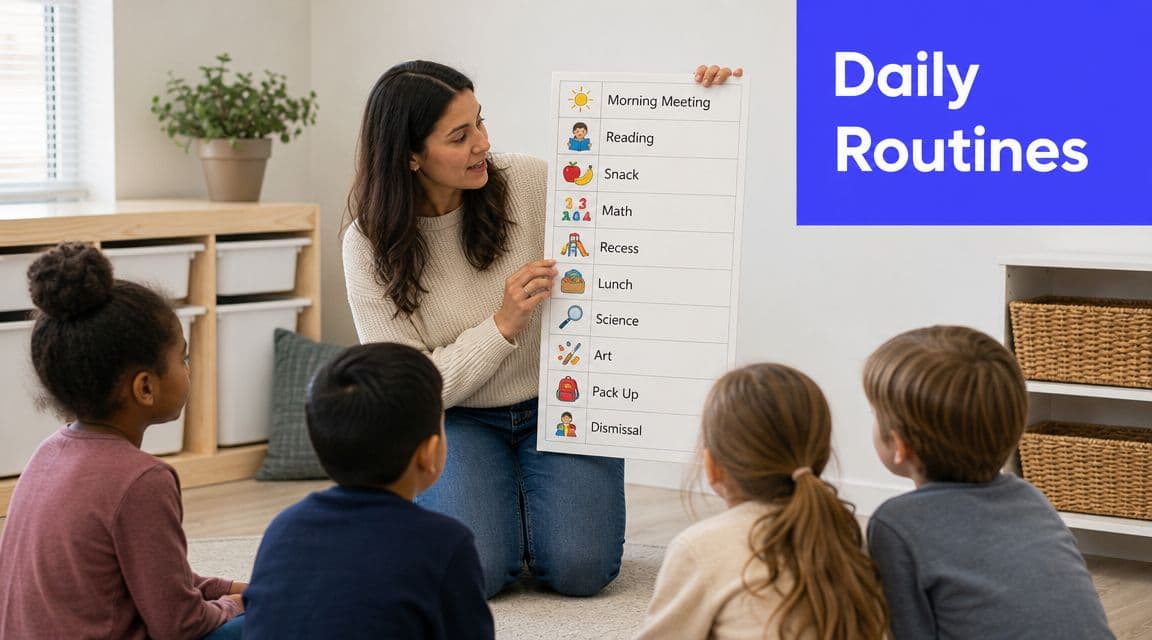
Teach routines like content
Don't announce a procedure once and assume students have it. Model it. Practice it. Reset it when needed.
A few routines matter more than others:
- Arrival routine: What do students do with backpacks, folders, and morning work?
- Attention signal: What happens when you need eyes and ears quickly?
- Help routine: How do students get support without calling out?
- Transition routine: How do they move from desks to carpet, or from mini-lesson to stations?
One of the best ways to reduce confusion is to make expectations visible. Student-created charts, picture cues, color-coded bins, and short step cards at stations do a lot of heavy lifting. If you need a ready-made support, this classroom expectations and agreements worksheet from Kuraplan can help you build expectations with students instead of just posting rules at them.
What doesn't work is changing your language every day. If Monday is “put your work in the blue bin,” Tuesday is “drop it in the tray,” and Wednesday is “leave it on the back table,” you've built friction where you didn't need any.
3. Relationship Building and Connection
It's 8:05. One student walks in chattering, one is half-asleep, one is already upset, and another is ready to argue before the first lesson starts. In an elementary classroom, management often rises or falls on whether students feel safe, noticed, and respected by the adult in the room.
That does not mean becoming every child's friend. It means building enough trust that your directions, corrections, and consequences carry weight. Students usually cooperate faster when they believe the teacher is on their side.
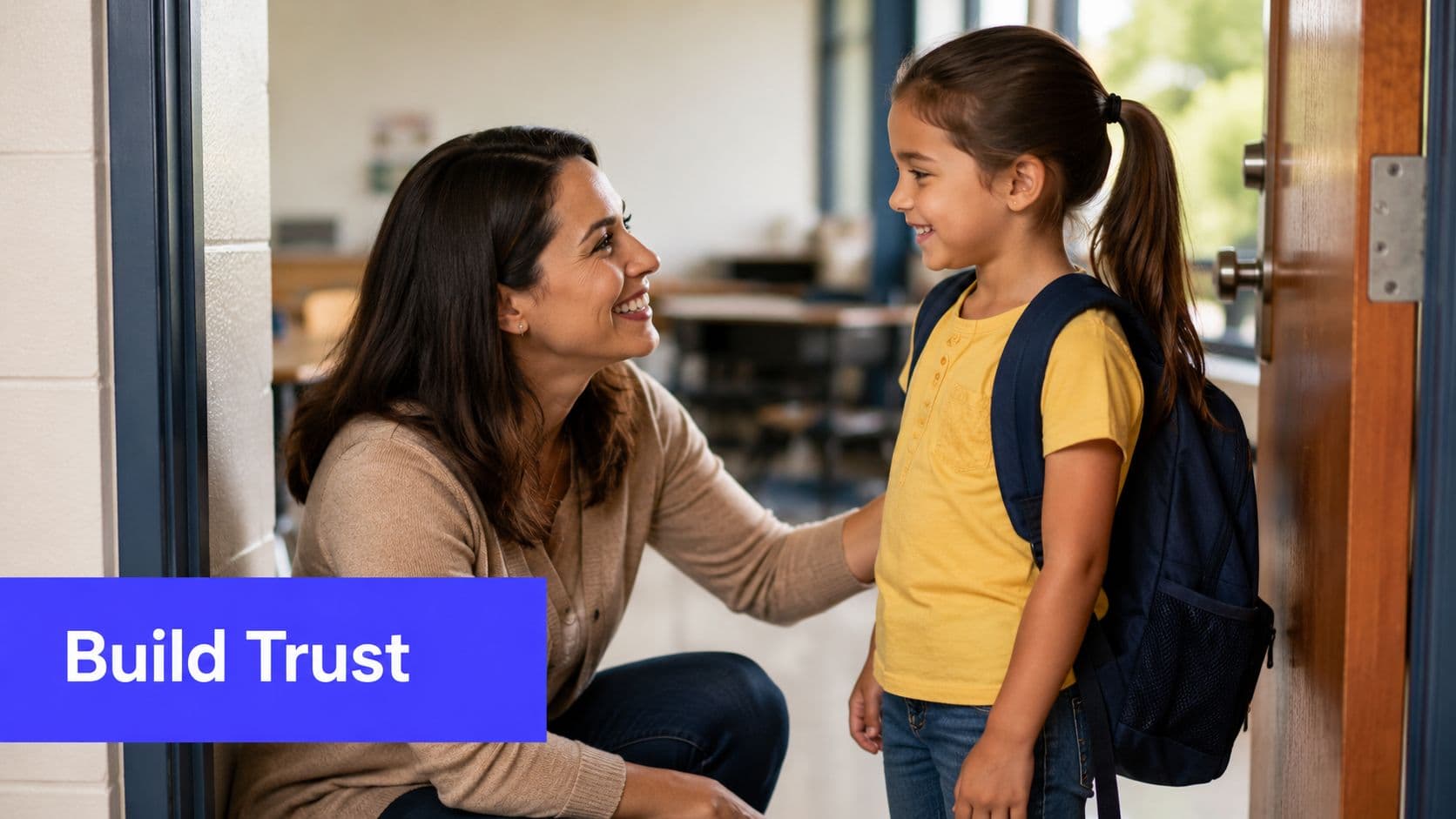
Build connection in small, repeatable ways
Relationship-building works best as a daily practice, not a once-a-week check-in. The goal is simple. Help each student feel known before behavior gets hard.
A few habits do that well:
- Use the doorway well: Greet students by name and notice their state right away.
- Leave room for one personal moment: Ask about the lost tooth, the new puppy, the soccer game, or the grandparent visiting.
- Repair after conflict: If a student had a rough moment, talk privately later and reset the relationship.
- Contact families with good news too: A short positive note changes the tone of future hard conversations.
- Follow through on details: If a child tells you they had a dance recital Tuesday night, ask about it Wednesday morning.
Those moments are small. Their effect is not.
I've found that the students who test limits the most often notice consistency the fastest. They pay attention to whether you remember what matters to them, whether you stay calm when they are not, and whether yesterday's problem is still hanging over them today. A consequence may still be needed. The relationship makes that consequence more likely to teach instead of just escalate.
Connection changes how correction feels
Two teachers can say the same words and get very different results. Students hear correction differently when it comes from an adult who has already built trust.
Compare these two moments. A student mutters, shoves a paper aside, and refuses to start. If your only interactions with that child are reminders and reprimands, you are likely headed for a power struggle. If that same student knows you check in, notice effort, and speak respectfully even when they are off track, you have a better chance of hearing the underlying issue. Maybe the directions felt confusing. Maybe recess drama followed them inside. Maybe they are digging in because they expect to be embarrassed.
That is why relationship-building belongs in a classroom management toolkit. It is not extra. It reduces friction before you need to correct anything.
Some students do not need a tougher tone. They need evidence that the adult in the room still sees them as worth the effort.
Kuraplan can support this part of management on the planning side. When you build lessons around student interests, offer accessible entry points, and keep notes on what hooks specific learners, you remove some of the mismatch that later shows up as resistance, shutdown, or acting out.
4. Proactive Redirection and Non-Verbal Cues
The best correction is the one that barely interrupts instruction.
A lot of off-task behavior starts small. A pencil becomes a drumstick. A whisper turns into a side conversation. A student glances around instead of opening the page. If you step in early, calmly, and discreetly, you can often redirect without creating a scene.
Quiet moves that work
Use your body, your eyes, and your positioning before you use your voice.
- Proximity: Stand near the student who's drifting.
- Point cues: Tap the page, gesture to the pencil, indicate where eyes should be.
- Eye contact: Sometimes that's enough.
- Pause: A short pause near the disruption often resets the room.
- Private check-in: A whisper works better than a public callout.
Public correction can turn minor behavior into a performance. In elementary classrooms, some students would rather argue than lose face.
Here's a practical example. You're reading directions aloud and one student starts turning around to talk. Instead of saying, “James, stop talking,” keep teaching as you walk over and rest a finger on the assignment sheet. Then move on. Most of the time, that's all you need.
A short demonstration can help newer teachers picture the pacing and presence this requires:
Kuraplan fits here in a less obvious way. Better-planned lessons with built-in movement, visual supports, and varied task formats reduce the number of times you need to redirect in the first place.
5. Differentiation and Engagement
A surprising amount of “behavior” is really a mismatch between the task and the learner.
If work is too hard, some students avoid it. If it's too easy, others create their own excitement. If directions are muddy, half the class stalls. That's why engagement belongs in any serious conversation about classroom management strategies elementary teachers can employ.
One practical gap in mainstream advice is that it often repeats broad basics but doesn't help teachers decide what to do when those basics stop working in high-need classrooms with frequent transitions, mixed ability levels, or students who need movement and private redirection. That gap is described well in HMH's discussion of elementary classroom management strategy challenges.
Fix the task before you blame the student
When a lesson keeps producing the same problems, look at the design.
- Offer choice: Let students show understanding through writing, drawing, speaking, or building when appropriate.
- Adjust entry points: Use leveled texts, scaffolded directions, or sentence frames.
- Chunk the work: Long assignments often need visible stopping points.
- Rotate formats: Mini-lesson, partner task, movement break, independent practice.
A concrete example: during reading response, one student shuts down whenever asked to write a full paragraph. Instead of repeating “get started,” offer a graphic organizer, sentence stems, or voice-to-text if that's available. You've removed a barrier instead of escalating a standoff.
If you want ready support for planning multiple levels of the same lesson, this differentiated learning worksheet from Kuraplan is a useful starting point. You can also discover Space Ranger Fred's strategies for additional engagement ideas that pair well with behavior prevention.
What doesn't work is assigning “early finisher” busywork to one group and remediation packets to another with no dignity or challenge built in. Kids spot that immediately.
6. Restorative Practices and Conflict Resolution
Punishment can stop behavior in the moment. It doesn't always teach what to do next.
When two students clash, or when one child's behavior affects the whole class, elementary teachers need something beyond “say sorry” and move on. Restorative practice gives students language for impact, responsibility, and repair.
Focus on repair, not just removal
That doesn't mean there are no consequences. It means consequences are paired with reflection and amends.
A restorative conversation can sound like this:
- What happened?
- Who was affected?
- What were you thinking at the time?
- What needs to happen now to make this right?
That's much more useful than a lecture. It helps students connect their choices to other people, which is a skill they need repeated practice with.
For example, if a student ruins a partner's project in frustration, the repair might include apologizing, helping rebuild materials, and practicing a better way to ask for space next time. If a whole group has grown sarcastic during discussions, a class circle can reset norms and let students name what respectful talk should sound like.
A consequence without a repair plan often leaves the relationship damaged and the skill untaught.
Restorative practices work best when they aren't saved only for crisis moments. Use short circles, reflection prompts, and problem-solving language during calm times so students have a script when emotions are high.
7. Social-Emotional Learning and Self-Regulation
Some students don't need another warning. They need help recognizing that they're overwhelmed before they tip over into shouting, hiding, or refusing.
Self-regulation isn't automatic for young children, and it definitely isn't automatic for every older elementary student either. If we want students to manage feelings, transitions, frustration, and peer conflict, we have to teach those skills directly.
Build regulation into the school day
Morning meetings, calm-down routines, reflection sheets, and emotional check-ins aren't “extra” when behavior is eating your day. They are part of instruction.
Useful SEL routines include:
- Feeling check-ins: Mood meters, color cards, or quick private signals
- Reset tools: Breathing prompts, sensory grounding, stretch breaks
- Problem-solving scripts: “I feel… when… I need…”
- Reflection after mistakes: What happened, what can I do differently next time?
A third grader who crumples work every time math gets hard may need a break routine and help naming frustration. A first grader who grabs materials may need repeated practice with waiting language and turn-taking scripts. That teaching pays off later when you're in the middle of a lesson and students can use the tools without a full teacher intervention.
If you want a structured resource, this SEL growth toolkit worksheet from Kuraplan gives you something concrete to build from. For schools that are also thinking beyond the classroom, Interactive Counselling's Penticton youth services may be relevant as a broader support reference.
The biggest mistake here is treating SEL as a one-off mini-lesson on kindness and expecting behavior to change by itself. Students need repetition, modeling, and practice in the exact moments that challenge them.
8. Classroom Environment Design and Physical Space Management
Some classrooms feel calmer the second you walk in. That's not magic. It's design.
The room itself teaches. It tells students where to put materials, where to gather, how to move, and whether the day will feel organized or chaotic. If your space creates bottlenecks, visual overload, or constant wandering, behavior problems grow fast.
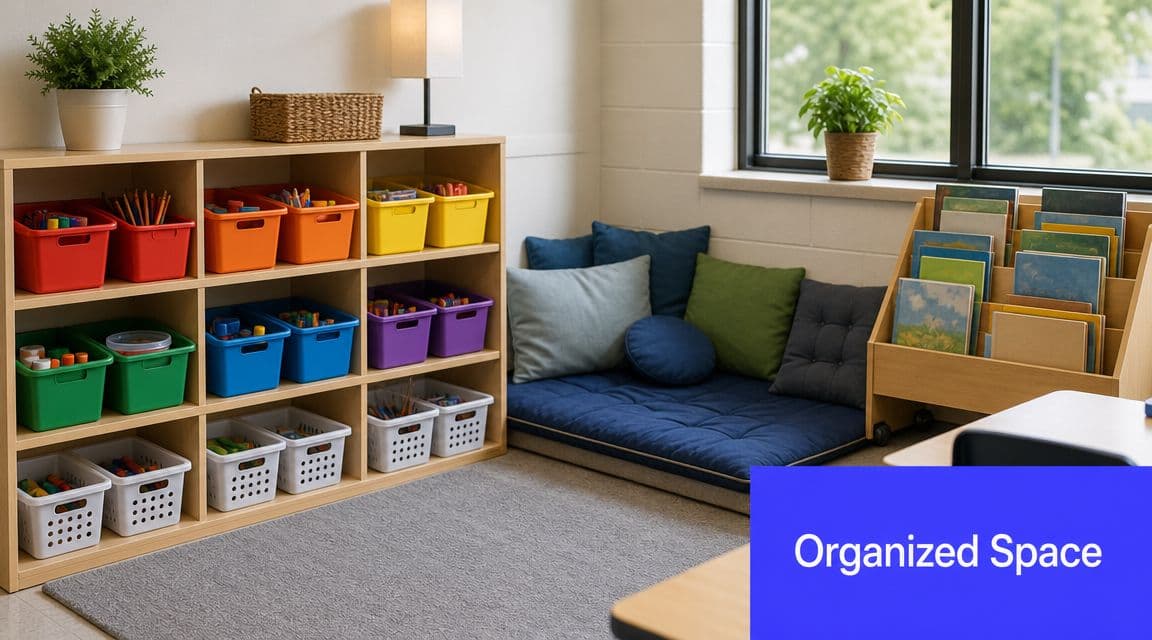
Set the room up to reduce friction
You want students to find what they need without asking you twenty times.
A few high-impact adjustments:
- Label everything clearly: Bins, folders, turn-in trays, station tubs
- Protect traffic flow: Keep high-use materials from creating crowding
- Create zones: Whole group, small group, independent work, calm space
- Use visual supports: Schedules, timers, anchor charts, step cards
One real-world example: if students always pile up near the sharpened pencils or hand sanitizer, move those supplies or duplicate them. If transitions to centers are noisy, check whether students can see where to go and what to bring.
Your desk matters too. If your teacher space is buried in stacks, papers spread into student areas, and materials constantly go missing, the room starts to feel unsettled. If you want practical setup ideas, these stylish teacher desk solutions may spark some improvements.
Kuraplan can also support this visually. Teachers can use generated visuals, diagrams, and instruction cards to make expectations easier for students to follow without adding random clutter.
9. Collaborative Learning and Peer Support Systems
Elementary students affect each other all day long. You can fight that, or you can structure it.
Peer influence can drive off-task behavior, but it can also strengthen routines, boost engagement, and reduce your need to manage every interaction yourself. The key is not putting kids in groups and hoping for the best. Collaboration has to be taught.
Teach students how to work together
Don't assume they know how to share materials, disagree respectfully, or divide a task.
Try teaching and rehearsing:
- Partner talk norms: Face your partner, listen fully, respond to the idea
- Group roles: Facilitator, recorder, materials manager, speaker
- Help protocols: Ask your partner, check the directions, then ask the teacher
- Peer support systems: Reading buddies, table captains, class jobs
For example, in a science station rotation, one student can be materials manager and another can read the task card aloud. That structure reduces the aimless chatter and conflict that happen when responsibilities are vague.
Collaborative systems also help students who need models from peers. A student who struggles to unpack in the morning may do much better when seated near a classmate who follows the routine consistently and kindly.
What doesn't work is using group work as a reward for classes that haven't yet learned collaborative habits. If students can't manage a partner turn-and-talk, they aren't ready for loosely structured group projects.
10. Consistent Consequences and Follow-Through
It's 2:15 on a Thursday. One student is calling out, another is poking a classmate, and you already used half your patience before lunch. If the consequence depends on your energy level in that moment, students learn the wrong lesson. They learn that expectations shift.
That uncertainty fuels more testing, more arguing, and more interruptions. Students do better when they can predict your response, even if they do not like it.
Calm, predictable, and boring is good
Consistent consequences are part of the proactive side of a strong classroom toolkit. They protect your routines, support your relationships, and keep small behavior issues from taking over instruction.
The goal is simple. Students know what happens next.
A workable sequence might look like this:
- First step: Quiet reminder
- Second step: Private redirection or seat change
- Third step: Brief consequence connected to the behavior
- Next step: Problem-solving conversation and family communication if needed
The order matters, but so does your tone. A consequence delivered calmly is usually more effective than one delivered with a lecture. Elementary students often react more to adult emotion than to the correction itself. If your response stays steady, the room stays steadier too.
For example, a student keeps calling out during math. You give one brief reminder. The second time, you move closer and point to the hand-raising expectation. If it continues, the student changes seats or loses a participation-based privilege for that lesson. Later, you check in privately and practice what to do next time.
Students trust follow-through they can predict.
Logical consequences help here. If a student dumps out supplies, they clean and reorganize the area. If partner time turns into goofing off, that student works independently for a short stretch before trying again. The consequence matches the behavior, which makes it easier for students to see the point and harder for them to argue that the response came out of nowhere.
There is a trade-off, though. Consequences that are too soft get ignored. Consequences that are too heavy create power struggles and eat class time. The sweet spot is firm, brief, and repeatable. In elementary classrooms, repeatable matters more than dramatic.
Kuraplan can help you plan those responses ahead of time by organizing behavior steps, likely scenarios, and follow-up notes. That makes it easier to respond the same way on a calm Monday morning and on a noisy Thursday afternoon.
10-Point Elementary Classroom Management Comparison
| Strategy | Implementation Complexity 🔄 | Resource Requirements ⚡ | Expected Outcomes 📊 | Ideal Use Cases 💡 | Key Advantages ⭐ |
|---|---|---|---|---|---|
| Positive Reinforcement and Reward Systems | Medium 🔄🔄, planning & tracking needed | Medium ⚡⚡, rewards/time to deliver | Increased motivation and engagement; fewer punitive incidents 📊 | Whole-class management, early grades, behavior improvement 💡 | Promotes positive behavior, peer modeling, boosts confidence ⭐ |
| Clear Expectations and Routines | High 🔄🔄🔄, upfront teaching and practice | Low–Medium ⚡⚡, time up front, minimal materials | Predictability; fewer interruptions; smoother transitions 📊 | New classes, transitions, students needing structure 💡 | Reduces ambiguity, saves instructional time, aids inclusion ⭐ |
| Relationship Building and Connection | High 🔄🔄🔄, sustained emotional labor | Medium ⚡⚡, time-intensive, low material cost | Stronger cooperation, long-term behavior change and engagement 📊 | At-risk students, trauma-informed classrooms, trust-building 💡 | Deep student buy-in, increased motivation, resilience ⭐ |
| Proactive Redirection and Non-Verbal Cues | Medium 🔄🔄, practice makes natural | Low ⚡, minimal materials, high vigilance | Fewer escalations; minimal instructional disruption 📊 | During live instruction; classes where dignity-preserving interventions matter 💡 | Prevents escalation, preserves dignity, maintains momentum ⭐ |
| Differentiation and Engagement | High 🔄🔄🔄, complex planning & grouping | High ⚡⚡⚡, prep time, materials, ongoing assessment | Reduced boredom/frustration; higher achievement across levels 📊 | Mixed-ability classes; diverse learners; acceleration/remediation 💡 | Meets individual needs, increases autonomy and achievement ⭐ |
| Restorative Practices and Conflict Resolution | High 🔄🔄🔄, skilled facilitation required | Medium–High ⚡⚡⚡, training and time for circles | Fewer repeat offenses; stronger classroom community and empathy 📊 | Conflict repair, repeat behavioral issues, community-building 💡 | Addresses root causes, builds social-emotional skills and repair ⭐ |
| Social-Emotional Learning (SEL) and Self-Regulation | Medium–High 🔄🔄🔄, ongoing instruction & modeling | Medium ⚡⚡, curriculum time and teacher training | Improved self-management, reduced discipline issues over time 📊 | Whole-school initiatives, early grades, resilience-building 💡 | Develops lifelong skills, enhances academic outcomes and well-being ⭐ |
| Classroom Environment Design and Physical Space Management | Medium 🔄🔄, initial setup and upkeep | Medium ⚡⚡, materials, furniture, labeling | Increased independence, reduced sensory-related behaviors 📊 | ADHD/sensory-sensitive students, routines support, independent work 💡 | Lowers cognitive load, supports routines and inclusivity ⭐ |
| Collaborative Learning and Peer Support Systems | Medium 🔄🔄, requires explicit teaching of roles | Medium ⚡⚡, planning, grouping, monitoring | Higher engagement, peer-supported achievement and belonging 📊 | Cooperative tasks, peer tutoring, leadership development 💡 | Leverages peer influence, shares responsibility, builds social skills ⭐ |
| Consistent Consequences and Follow-Through | Medium 🔄🔄, clear systems and fidelity needed | Low ⚡, documentation and communication | Predictability; reduced power struggles and anxiety 📊 | Establishing discipline frameworks, older students, school-wide systems 💡 | Fairness, transparency, trust; reduces ad-hoc decision-making ⭐ |
Putting It All Together Your Management Toolkit
The strongest classroom management strategies elementary teachers use are rarely flashy. They're repeatable. They reduce uncertainty. They protect learning time. They help students feel safe, capable, and accountable.
That's also why management works best as a toolkit instead of a single philosophy. Clear routines support positive reinforcement. Positive reinforcement strengthens relationships. Strong relationships make redirection more effective. Differentiated, engaging lessons prevent a lot of the behavior you'd otherwise spend energy correcting. Restorative conversations and SEL routines help you respond without turning every problem into a power struggle. Physical setup and peer systems make the day run more smoothly in the background.
If your classroom feels hard right now, don't try to implement all 10 strategies at once. Pick one area that creates the most friction. For some teachers, that's transitions. For others, it's constant calling out, unfinished work, or conflict during partner activities. Start there and make one change you can sustain.
A simple starting point might be greeting students at the door and tightening one transition routine. Another good reset is to script your behavior-specific praise so it becomes automatic. If your class is academically all over the place, improve the task before you assume students are refusing. If consequences feel inconsistent, write out your response ladder and keep it visible to yourself.
One of the most useful mindset shifts is this: classroom management is not separate from instruction. It is instruction. When you teach students how to enter, discuss, disagree, clean up, ask for help, recover from mistakes, and repair harm, you're teaching the habits that make learning possible.
For teachers who want support with the planning side, Kuraplan is one relevant option. It's an AI-powered lesson planning platform built for K-12 educators, and it can help with standards-aligned lessons, differentiated materials, worksheets, visuals, and classroom planning supports. That won't replace teacher judgment, but it can reduce prep load so you have more energy for the relational and responsive parts of management that only a teacher can do.
The goal isn't a silent classroom. It's a functioning one. Students should be active, talk when the lesson calls for it, move when needed, and still understand the boundaries that keep everyone learning. When your systems are clear and your responses are steady, the room changes. Not overnight, usually. But steadily, and for the better.
If you want help building routines, visuals, differentiated tasks, or classroom management supports without creating everything from scratch, Kuraplan is worth exploring. It gives K-12 teachers a practical way to plan lessons, generate worksheets and visuals, and get quick support from an AI teaching assistant during busy school weeks.