
Harlem Renaissance: A Cultural Revolution
8th Grade Social Studies Exploring the New Negro Movement of the 1920s-1930s

Historical Context: The Great Migration
6 million African Americans moved from rural South to urban North (1916-1970) Seeking better jobs, education, and escape from Jim Crow laws Harlem became a cultural hub for Black Americans Economic opportunities in Northern cities during WWI
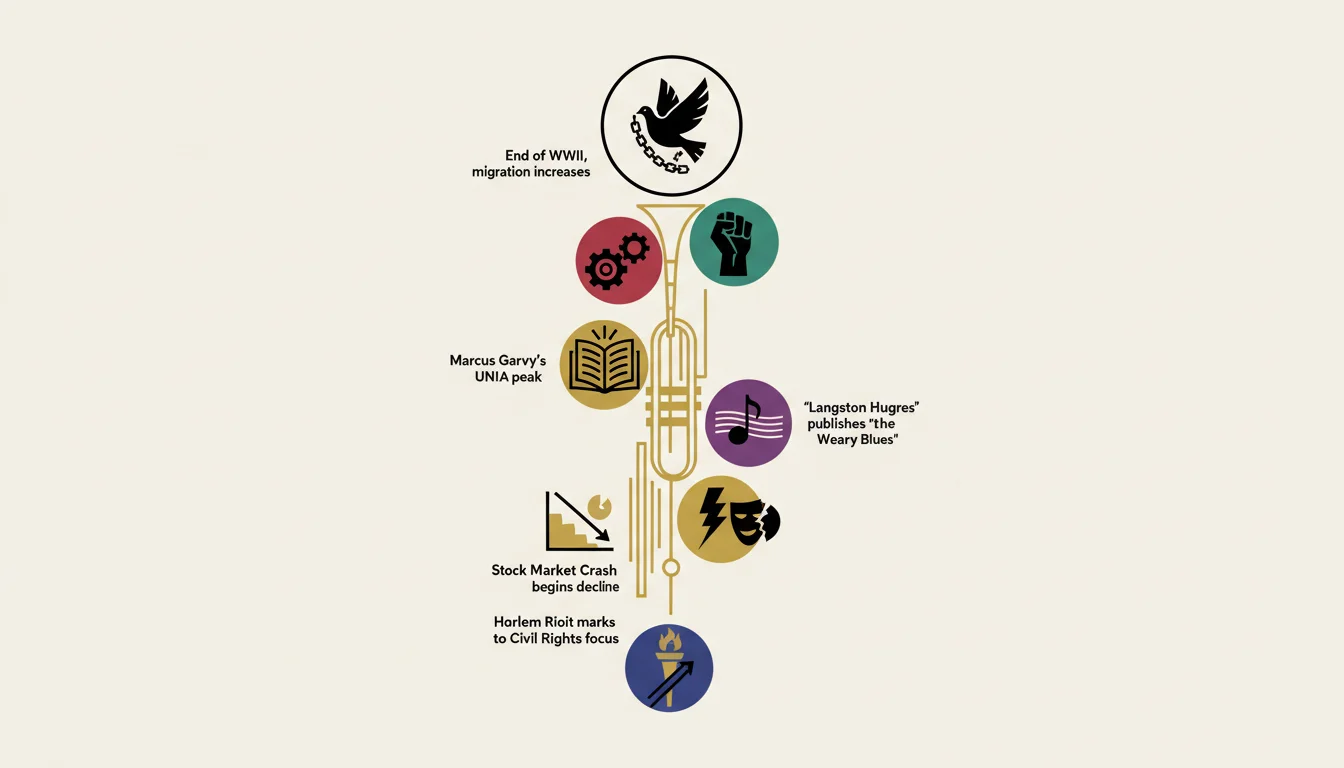
Timeline of the Harlem Renaissance

Key Literary Figures
Langston Hughes - 'The Weary Blues', celebrated jazz poetry Zora Neale Hurston - 'Their Eyes Were Watching God', folklore Claude McKay - 'If We Must Die', defiant poetry Countee Cullen - refined classical poetry style

Musical Revolution: Jazz and Blues
Duke Ellington - sophisticated jazz compositions at Cotton Club Bessie Smith - 'Empress of the Blues', powerful vocals Louis Armstrong - revolutionary trumpet and scat singing Jazz became America's first original art form

Visual Arts and Intellectual Movement
{"left":"Aaron Douglas - 'Father of Black American Art', silhouette style murals\nAugusta Savage - sculptor, fought discrimination in art schools\nPalmer Hayden - painted scenes of Black urban life","right":"W.E.B. Du Bois - 'The Talented Tenth' philosophy\nMarcus Garvey - Black nationalism and 'Back to Africa' movement\nAlain Locke - 'The New Negro' anthology editor"}
Primary Source Analysis Activity
Form groups of 5 students Each group receives a different primary source Analyze: What is the main message? Prepare 2-minute group presentation Sources: Du Bois speech, jazz club photo, newspaper review, Hughes poem, civil rights poster
Discussion Questions
How did the Harlem Renaissance challenge racial stereotypes? What connections can you make to today's social movements? Why was this cultural movement so important to American history? How did different art forms work together to create change?

Cultural Impact and Legacy
Challenged negative stereotypes about African Americans Influenced the Civil Rights Movement of the 1950s-60s Jazz became globally recognized American art form Inspired pride in Black culture and identity Literature and art entered mainstream American culture
Reflection and Exit Ticket
Write in your journal: What is one new thing you learned about the Harlem Renaissance today? Why is this important to American history? How does this movement connect to issues we see today?
More Social Studies slide decks
Other ready-to-teach social studies decks for US classrooms.


