
Solving Systems of Linear Equations
Grade 9 Mathematics Two Methods: Graphing and Substitution Real-World Problem Solving

Real-World Problem
Two friends buy concert tickets: Friend 1: 3 adult + 2 child tickets = $45 Friend 2: 1 adult + 4 child tickets = $40 How much does each ticket cost?
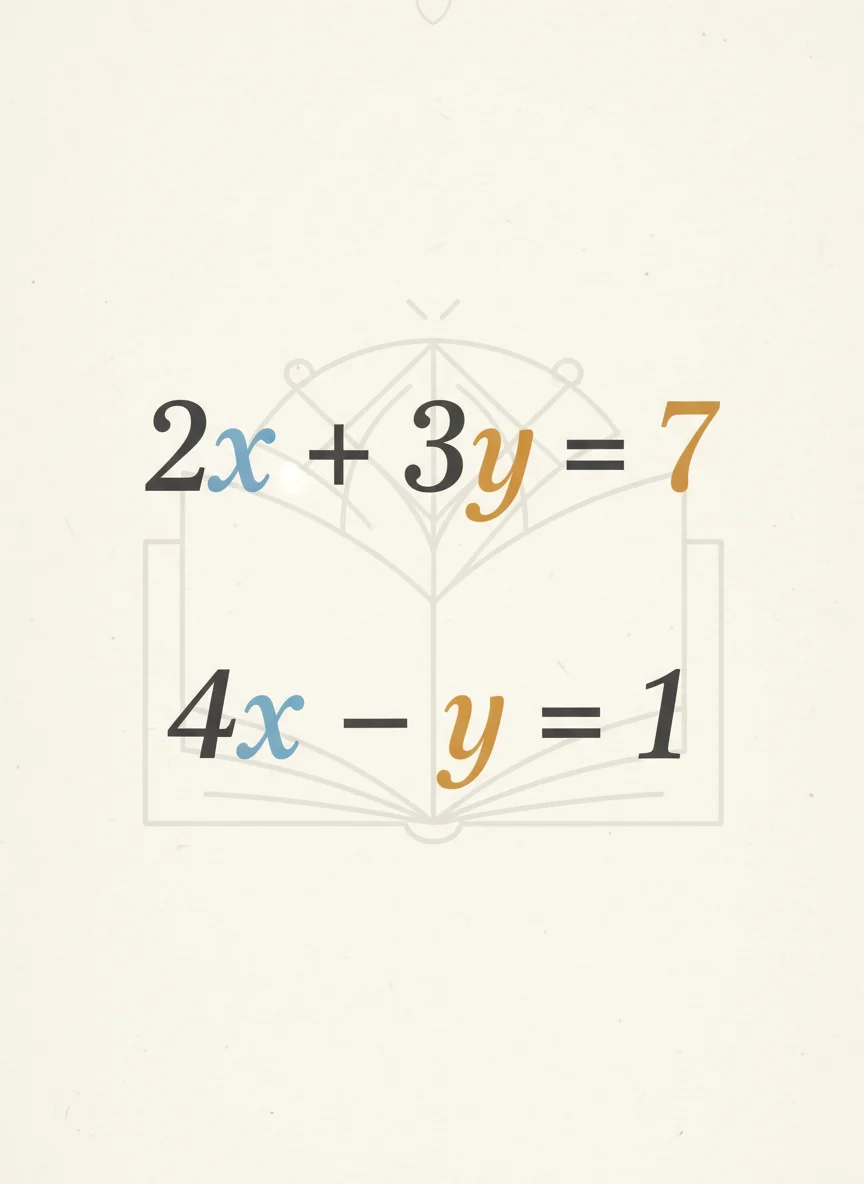
What is a System of Linear Equations?
Two or more linear equations with the same variables Example: x + y = 5 and 2x - y = 1 The solution satisfies ALL equations simultaneously We're looking for the values of x and y that work in both equations
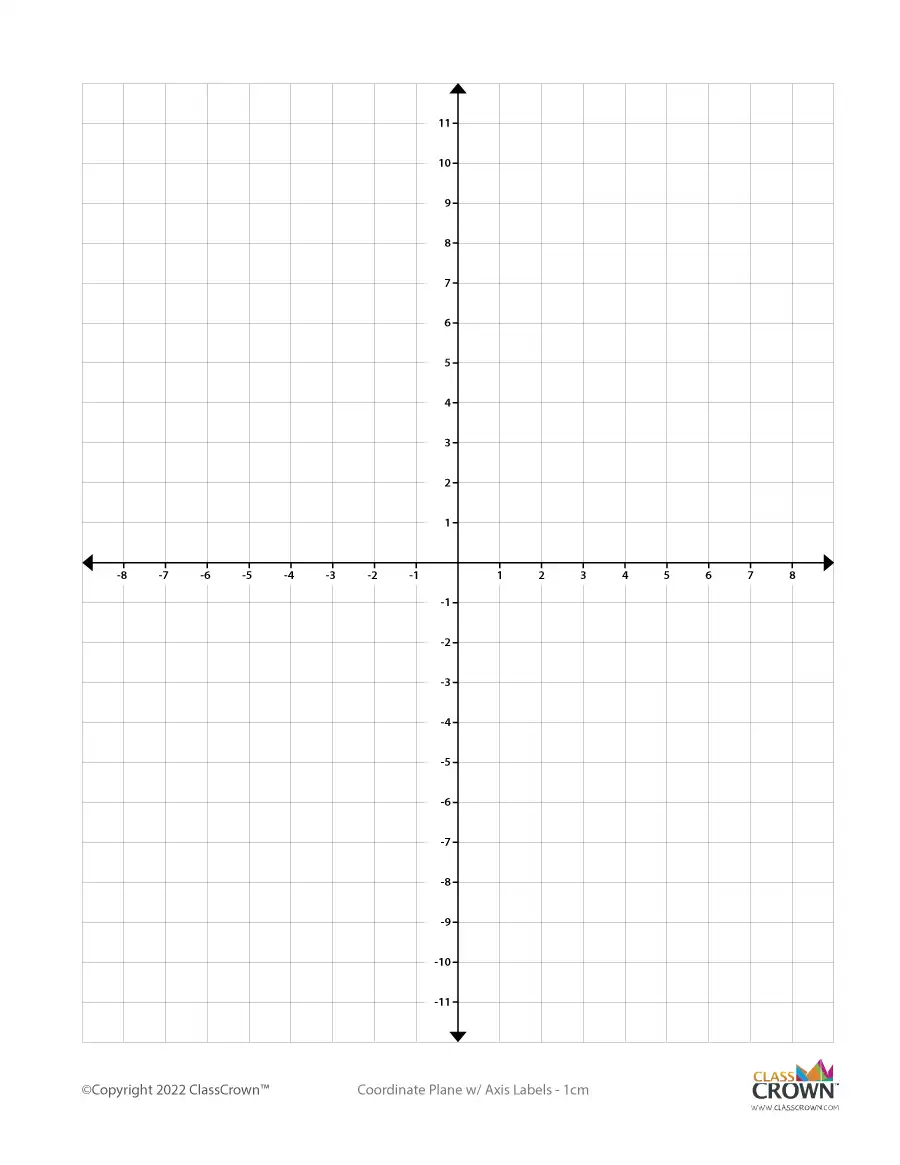
Method 1: Solving by Graphing
Graph each equation on the same coordinate plane Find where the lines intersect The intersection point (x, y) is your solution Check: substitute back into both original equations

Practice: Graphing Method
System 1: y = x + 2 and y = -x + 4 System 2: y = 2x - 1 and y = x + 1 Graph both equations on your paper Find and label the intersection point Verify your solution by substitution
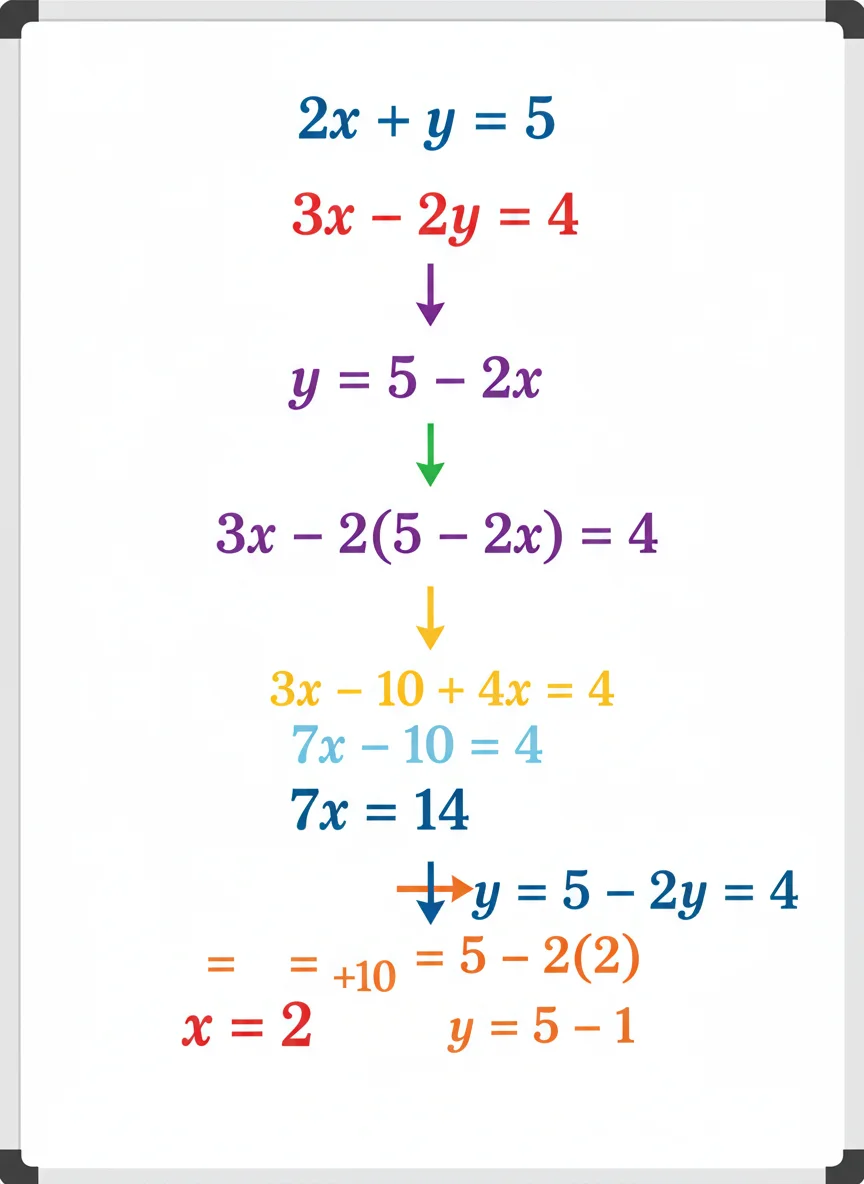
Method 2: Solving by Substitution
Step 1: Solve one equation for one variable Step 2: Substitute that expression into the other equation Step 3: Solve for the remaining variable Step 4: Back-substitute to find the other variable Step 5: Check your solution in both original equations
Graphing vs. Substitution
{"left":"Visual representation of the solution\nGood for understanding the concept\nMay not give exact answers\nQuick for simple systems","right":"Gives exact algebraic solutions\nWorks for any system\nMore precise than graphing\nBetter for complex numbers"}

Key Takeaway
A system of linear equations can have: • One solution (lines intersect) • No solution (parallel lines) • Infinitely many solutions (same line)