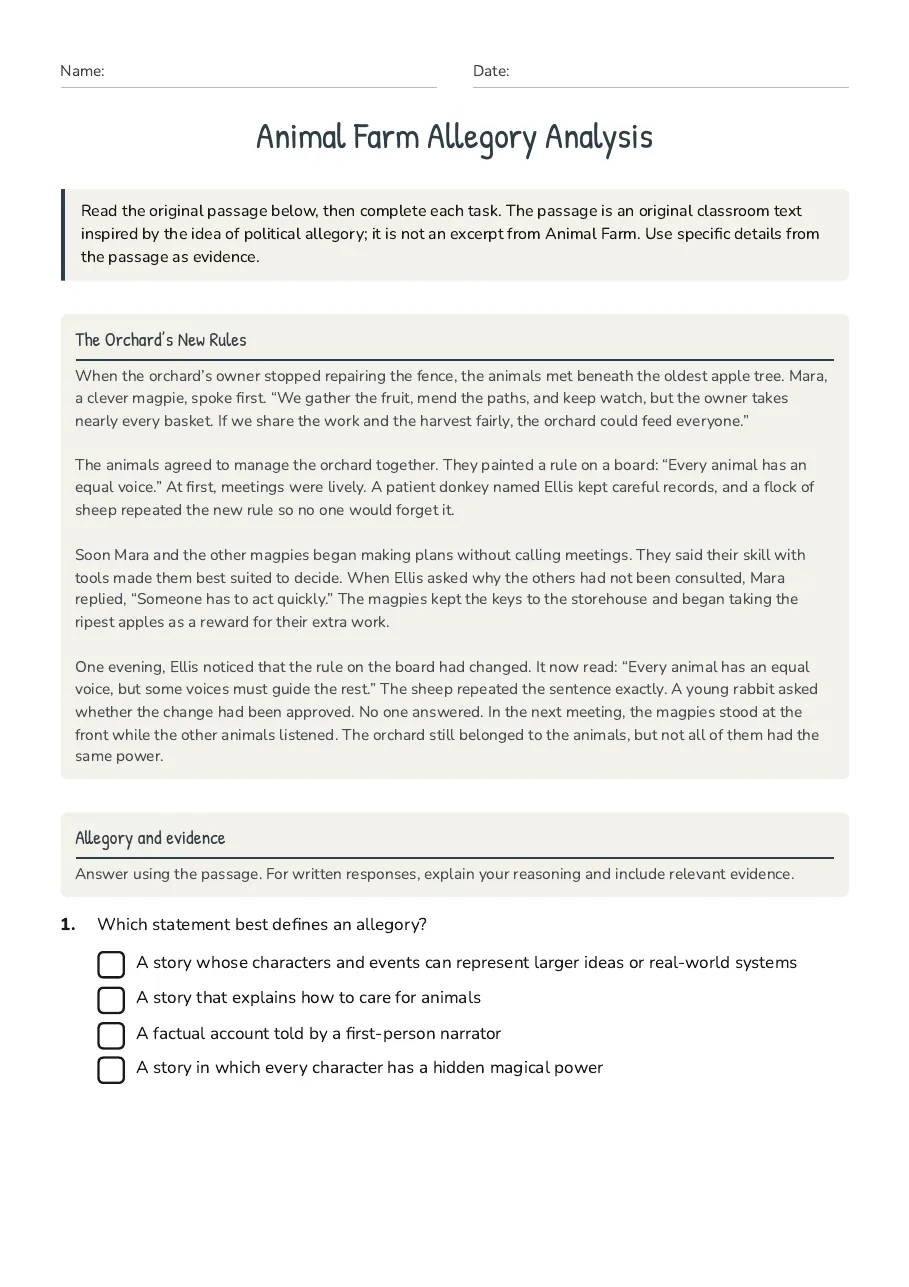
Animal Farm Allegory Analysis
A free english (ela) worksheet ready for your classroom. Open in Kuraplan to grab the print-ready PDF, customize it for your students, or generate a fresh version in seconds.
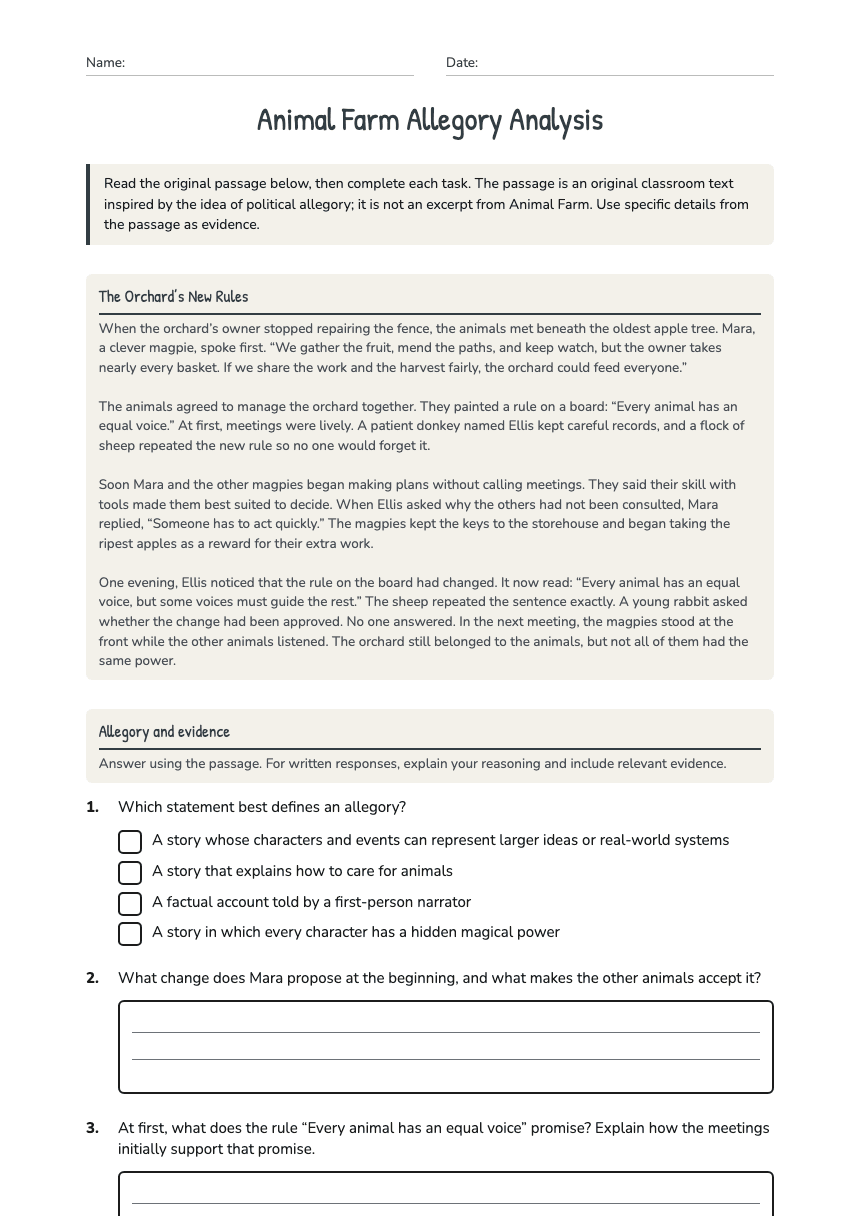
Animal Farm Allegory Analysis
The Orchard’s New Rules
When the orchard’s owner stopped repairing the fence, the animals met beneath the oldest apple tree. Mara, a clever magpie, spoke first. “We gather the fruit, mend the paths, and keep watch, but the owner takes nearly every basket. If we share the work and the harvest fairly, the orchard could feed everyone.” The animals agreed to manage the orchard together. They painted a rule on a board: “Every animal has an equal voice.” At first, meetings were lively. A patient donkey named Ellis kept careful records, and a flock of sheep repeated the new rule so no one would forget it. Soon Mara and the other magpies began making plans without calling meetings. They said their skill with tools made them best suited to decide. When Ellis asked why the others had not been consulted, Mara replied, “Someone has to act quickly.” The magpies kept the keys to the storehouse and began taking the ripest apples as a reward for their extra work. One evening, Ellis noticed that the rule on the board had changed. It now read: “Every animal has an equal voice, but some voices must guide the rest.” The sheep repeated the sentence exactly. A young rabbit asked whether the change had been approved. No one answered. In the next meeting, the magpies stood at the front while the other animals listened. The orchard still belonged to the animals, but not all of them had the same power.
Allegory and evidence
Answer using the passage. For written responses, explain your reasoning and include relevant evidence.
- A story whose characters and events can represent larger ideas or real-world systems
- A story that explains how to care for animals
- A factual account told by a first-person narrator
- A story in which every character has a hidden magical power
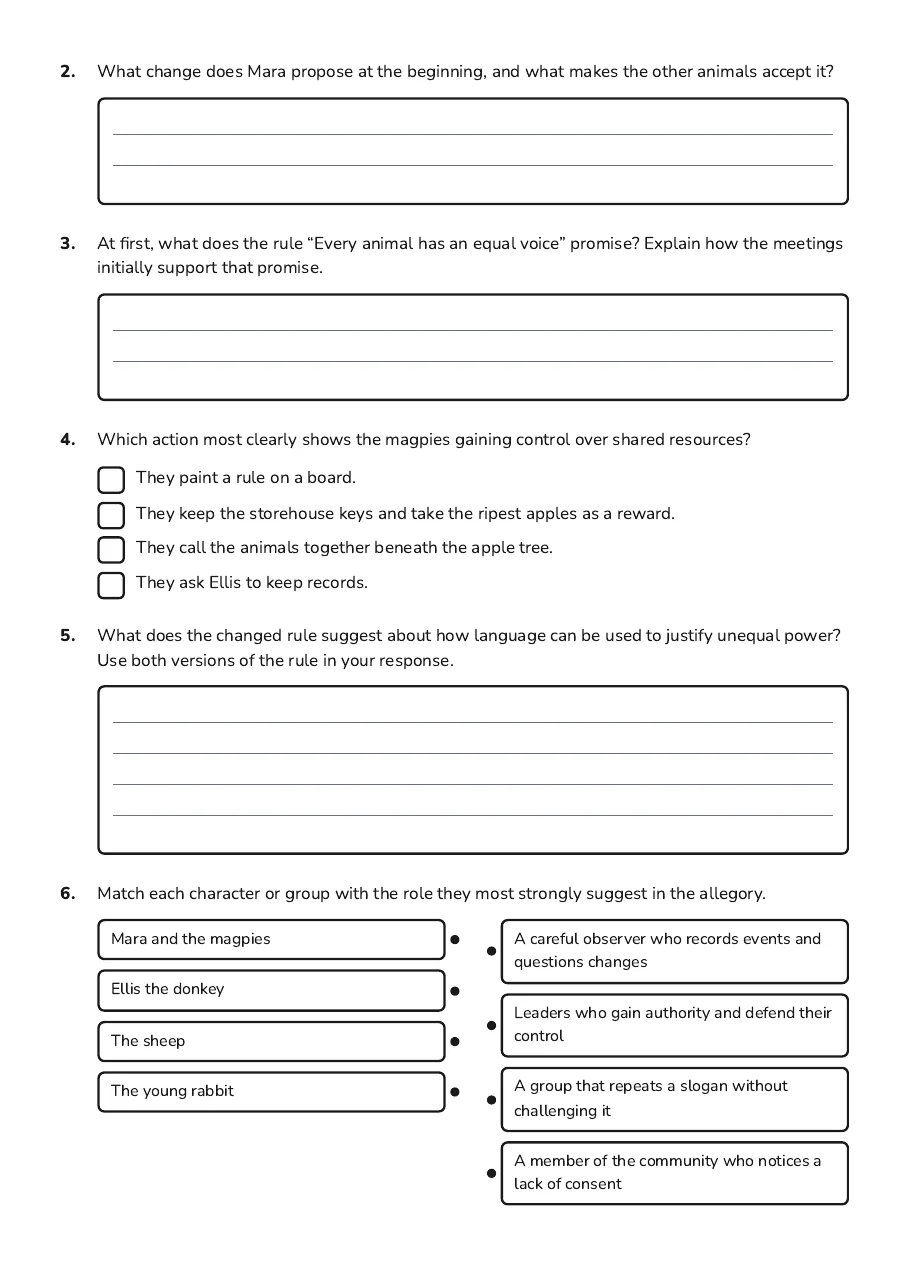
- They paint a rule on a board.
- They keep the storehouse keys and take the ripest apples as a reward.
- They call the animals together beneath the apple tree.
- They ask Ellis to keep records.
- Mara and the magpies
- Ellis the donkey
- The sheep
- The young rabbit
- A careful observer who records events and questions changes
- Leaders who gain authority and defend their control
- A group that repeats a slogan without challenging it
- A member of the community who notices a lack of consent
3 printable pages
Page 1
Page 2
Page 3
About This Worksheet
Free in Kuraplan
Sign up free, grab the PDF, and customize it for your class.
Print-Ready
Formatted for standard paper. Clean layout, easy to read.
AI-Generated
Created with Kuraplan's AI, designed for real classroom use.
For Teachers & Parents
Use in classrooms, for homework, tutoring, or homeschool.
Need a custom version of this worksheet?
Kuraplan's AI generates custom worksheets in seconds — differentiated for every learner, aligned to your curriculum.
Generate Custom Worksheets — Free