Measurement Detective Missions
A free mathematics worksheet ready for your classroom. Open in Kuraplan to grab the print-ready PDF, customize it for your students, or generate a fresh version in seconds.
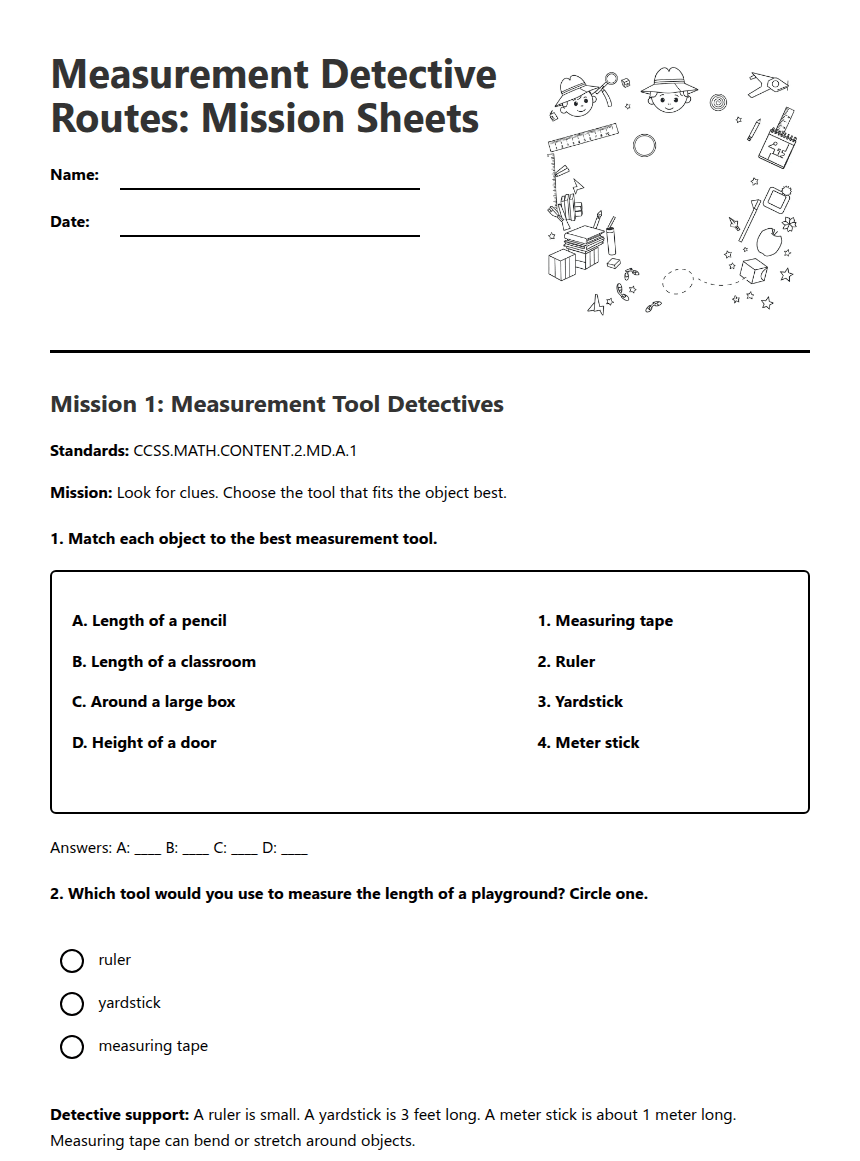
Measurement Detective Routes: Mission Sheets
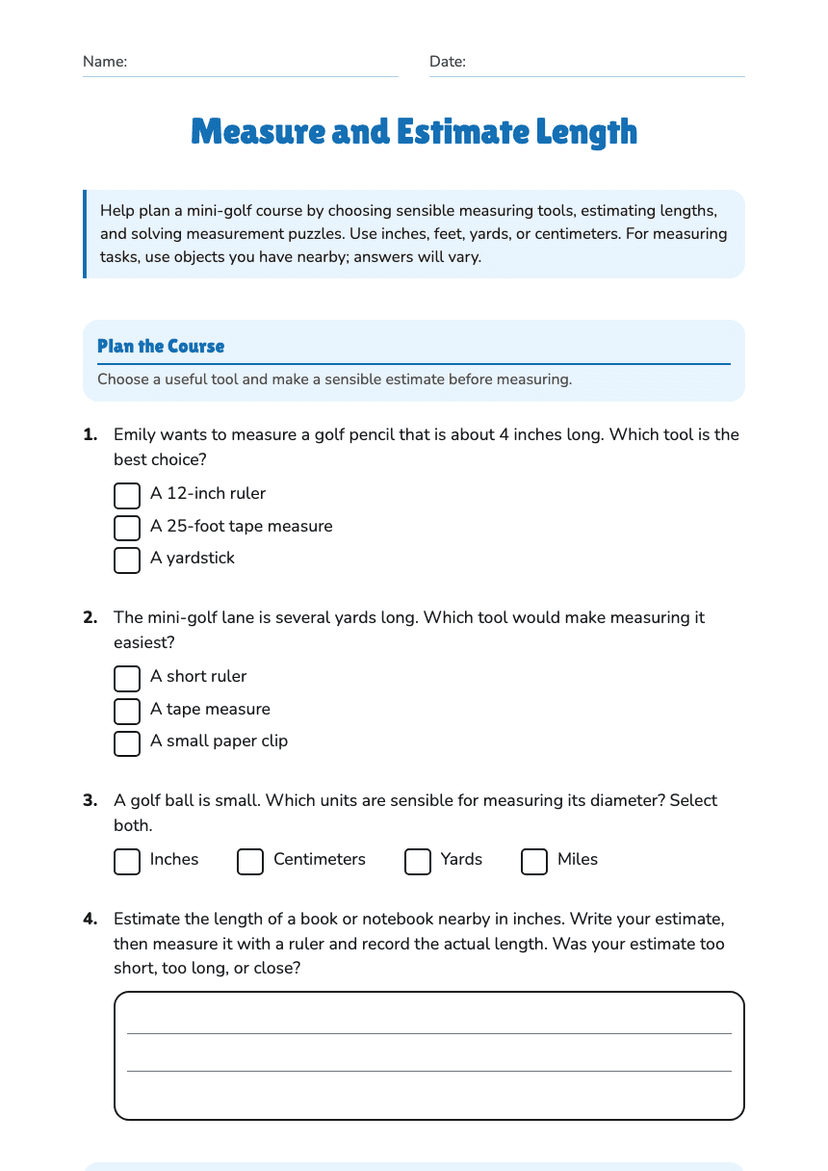
Mission 1: Measurement Tool Detectives
Standards: CCSS.MATH.CONTENT.2.MD.A.1
Mission: Look for clues. Choose the tool that fits the object best.
Answers: A: ____ B: ____ C: ____ D: ____
Detective support: A ruler is small. A yardstick is 3 feet long. A meter stick is about 1 meter long. Measuring tape can bend or stretch around objects.
Optional challenge: Name another object that would be best measured with a measuring tape.
Teacher key: 1. A-2, B-4, C-1, D-3. 2. Measuring tape. Challenge answers will vary.
Mission 2: Estimate and Measure
Standards: CCSS.MATH.CONTENT.2.MD.A.1, 2.MD.A.2, 2.MD.A.3
Mission: Make a smart estimate. Then measure carefully and record your clues.
Object 1: ____________________ Estimate: ______ inches Measure: ______ inches
Object 2: ____________________ Estimate: ______ feet Measure: ______ feet
Small object: ____________________ ______ centimeters
Longer object: ____________________ ______ meters
Partner challenge: One partner estimates. The other partner measures. Switch jobs and compare whose estimate was closer.
Detective support: Start at zero on the ruler. Keep the ruler straight. Write the unit after every number.
Optional challenge: Find an object whose measured length is within 2 units of your estimate.
Teacher key: 3–4. Answers will vary. Check that students choose suitable units, begin at zero, and record reasonable measurements.
Mission 3: Same Object, Different Units
Standards: CCSS.MATH.CONTENT.2.MD.A.2, 2.MD.A.3
Mission: The object stays the same, but the unit changes. Find the secret!
Using paper clips: The pencil is ______ paper clips long.
Using inches: The pencil is ______ inches long.
The numbers are different because the units are ______________________________.
Visual clue: A small unit needs more pieces. A large unit needs fewer pieces.
Partner challenge: Measure the same book with hand spans and inches. Compare your results with a partner.
Optional challenge: Which unit would give the larger number: inches or feet? Explain.
Teacher key: 5. Answers will vary. 6. Accept “different sizes” or “one unit is smaller/larger.” Optional challenge: inches, because an inch is smaller than a foot.
Mission 4: Compare Lengths
Standards: CCSS.MATH.CONTENT.2.MD.A.3, 2.MD.A.4
Mission: Compare two lengths. Find the difference and show it with a drawing.
Object A: ____________________ ______ inches
Object B: ____________________ ______ inches
Object ______ is longer. It is ______ inches longer.
Equation: ______ − ______ = ______ inches
Detective support: Put the longer length first. Subtract the shorter length to find the difference.
Optional challenge: Write a comparison sentence using the words “longer than” or “shorter than.”
Teacher key: 7. Answers will vary; check subtraction and unit labels. 8. 18 − 11 = 7 inches. The desk is 7 inches longer. Challenge: Answers should match the measurements.
Mission 5: Measurement Route Challenge
Standards: CCSS.MATH.CONTENT.2.MD.A.4, 2.MD.B.5
Mission: Solve the route clues, then design your own classroom detective route.
Equation: ______ + ______ = ______ feet
Equation: ______ + ______ = ______ feet
Stop 1: ____________________ to ____________________ ______ feet
Stop 2: ____________________ to ____________________ ______ feet
Stop 3: ____________________ to ____________________ ______ feet
Total route: ______ + ______ + ______ = ______ feet
Detective support: Circle each stop as you reach it. Add one part at a time. Keep the total less than 100 feet.
Optional challenge: Create a second route that is shorter than your first route. How many feet shorter is it?
Teacher key: 9. 24 + 16 = 40 feet. 10. 35 + 12 = 47 feet. 11. Answers will vary; check that the route has three measured parts and a correct total.
About This Worksheet
Free in Kuraplan
Sign up free, grab the PDF, and customize it for your class.
Print-Ready
Formatted for standard paper. Clean layout, easy to read.
AI-Generated
Created with Kuraplan's AI, designed for real classroom use.
For Teachers & Parents
Use in classrooms, for homework, tutoring, or homeschool.
Need a custom version of this worksheet?
Kuraplan's AI generates custom worksheets in seconds — differentiated for every learner, aligned to your curriculum.
Generate Custom Worksheets — Free