Safe Science Inquiry Worksheet
A free science worksheet ready for your classroom. Open in Kuraplan to grab the print-ready PDF, customize it for your students, or generate a fresh version in seconds.
Safe Science Inquiry Worksheet
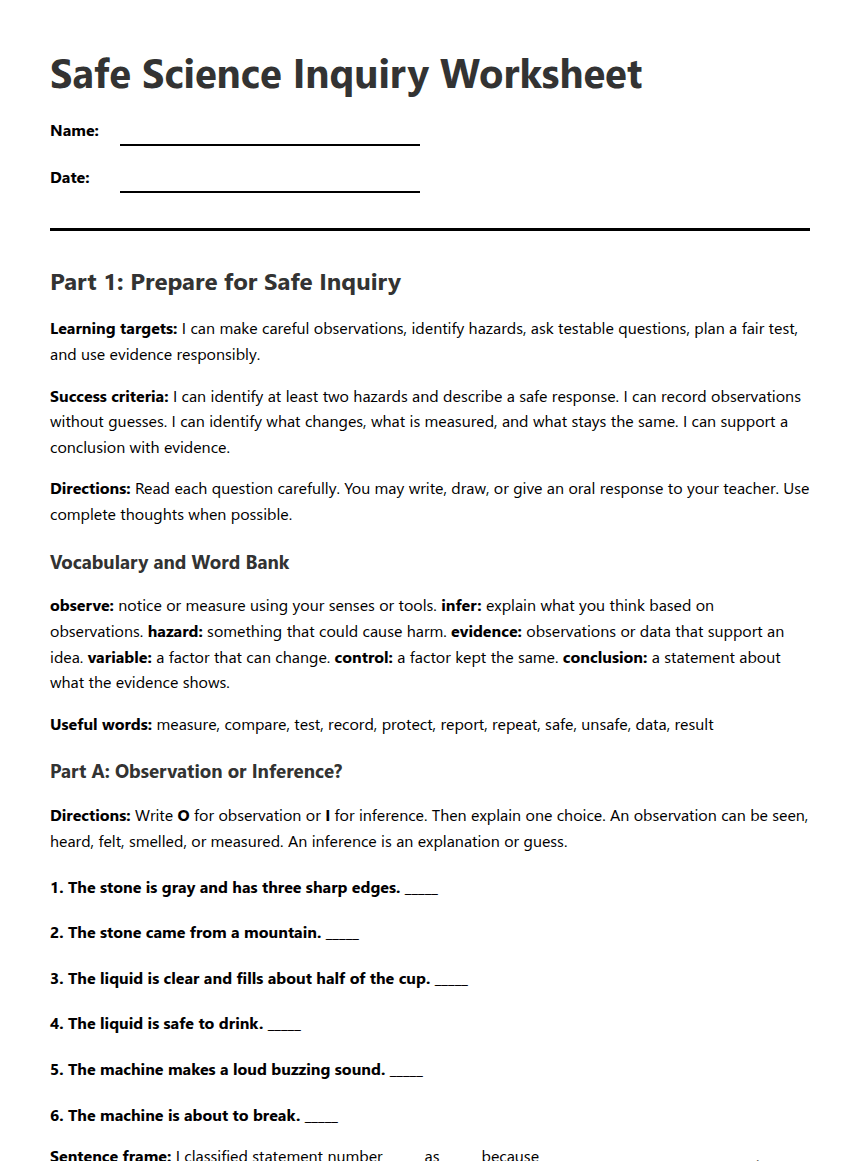
Part 1: Prepare for Safe Inquiry
Learning targets: I can make careful observations, identify hazards, ask testable questions, plan a fair test, and use evidence responsibly.
Success criteria: I can identify at least two hazards and describe a safe response. I can record observations without guesses. I can identify what changes, what is measured, and what stays the same. I can support a conclusion with evidence.
Directions: Read each question carefully. You may write, draw, or give an oral response to your teacher. Use complete thoughts when possible.
Vocabulary and Word Bank
observe: notice or measure using your senses or tools. infer: explain what you think based on observations. hazard: something that could cause harm. evidence: observations or data that support an idea. variable: a factor that can change. control: a factor kept the same. conclusion: a statement about what the evidence shows.
Useful words: measure, compare, test, record, protect, report, repeat, safe, unsafe, data, result
Part A: Observation or Inference?
Directions: Write O for observation or I for inference. Then explain one choice. An observation can be seen, heard, felt, smelled, or measured. An inference is an explanation or guess.
Sentence frame: I classified statement number _____ as _____ because ________________________________.
Part B: Safety Scenarios
Directions: For each situation, identify the hazard, possible harm, and safest action. Never taste or touch an unknown material. Stop and report an unsafe situation.
Hazard: ____________________ Possible harm: ____________________
Safest action: ______________________________________________________________
Hazard: ____________________ Possible harm: ____________________
Safest action: ______________________________________________________________
Hazard: ____________________ Possible harm: ____________________
Safest action: ______________________________________________________________
Sentence frame: This action is responsible because it reduces the risk of ____________________.
Part 2: Investigate and Plan
Part C: Mystery Object Inquiry
Directions: Study the safe object or photograph. Record direct observations only. Do not write what you think the object is yet.
1. __________________________________________________________________________________
2. __________________________________________________________________________________
3. __________________________________________________________________________________
4. __________________________________________________________________________________
5. __________________________________________________________________________________
a. How or what could we measure to find out __________________________________________?
b. How or what could we measure to find out __________________________________________?
Inference: I infer that ____________________________________________________________.
Prediction: If we ____________________________________________________, then ________.
Part D: Fair-Test Planner
Directions: Choose a safe question about soil, water, weather, crops, seeds, or insulation. A fair test changes one factor, measures a result, and keeps other factors the same.
Focus question: ________________________________________________________________?
Prediction: If ______________________________________, then _______________________ because ______________________________________.
Independent variable—what will change: __________________________________________
Dependent variable—what will be measured or observed: ____________________________
Controlled variables—what will stay the same:
1. __________________________________________________________________________________
2. __________________________________________________________________________________
3. __________________________________________________________________________________
Materials: _______________________________________________________________________
Safety concerns and precautions: __________________________________________________
1. __________________________________________________________________________________
2. __________________________________________________________________________________
3. __________________________________________________________________________________
4. __________________________________________________________________________________
Measure or observe: ____________________ Unit or description: ____________________
Trial 1: ____________________ Trial 2: ____________________ Trial 3: ____________________
Result or pattern noticed: ______________________________________________________________
Team roles: facilitator, recorder, materials manager, safety monitor, reporter. We will work respectfully by ________________________________________________.
Differentiation: Use the word bank, draw a plan, explain answers orally, use a bilingual partner, or ask for a partially completed procedure. Advanced learners may plan repeated trials, identify a source of uncertainty, compare two fair tests, or redesign the test for a farm, lake, forest, or machinery-safety setting.
Part 3: Claim-Evidence-Reasoning Exit Ticket
Claim: A responsible science investigation __________________________________________.
Evidence from today: ____________________________________________________________
Reasoning: This evidence supports my claim because __________________________________.
Teacher Answer Guide
Part A: 1 O—visible features; 2 I—an explanation not directly observed; 3 O—appearance and amount can be observed; 4 I—safety is not known from appearance; 5 O—sound can be heard; 6 I—a prediction or explanation about the machine.
Part B: Unknown liquid: chemical or biological hazard; possible burns, poisoning, or skin/eye injury; do not touch or smell, keep others away, and report it. Wet floor near electrical equipment: shock or electrocution hazard; avoid the area, do not touch the equipment, and report the spill immediately. Operating machinery: moving-part or struck-by hazard; stay outside the safety zone, follow posted instructions, and tell the teacher or operator.
Parts C–D: Accept responses that are observable, measurable, testable, and safe. A strong plan changes one independent variable, measures a dependent variable, names at least two controls, includes a numbered procedure, and identifies precautions. Accept oral, drawn, or written responses when the scientific meaning is clear.
Literacy connection: Students follow a multistep procedure and connect observations, variables, and results (CCSS.ELA-LITERACY.RST.6-8.3). Students state a claim, select evidence, and explain reasoning (CCSS.ELA-LITERACY.WHST.6-8.1b/7).
About This Worksheet
Free in Kuraplan
Sign up free, grab the PDF, and customize it for your class.
Print-Ready
Formatted for standard paper. Clean layout, easy to read.
AI-Generated
Created with Kuraplan's AI, designed for real classroom use.
For Teachers & Parents
Use in classrooms, for homework, tutoring, or homeschool.
Need a custom version of this worksheet?
Kuraplan's AI generates custom worksheets in seconds — differentiated for every learner, aligned to your curriculum.
Generate Custom Worksheets — FreeMore Science Worksheets
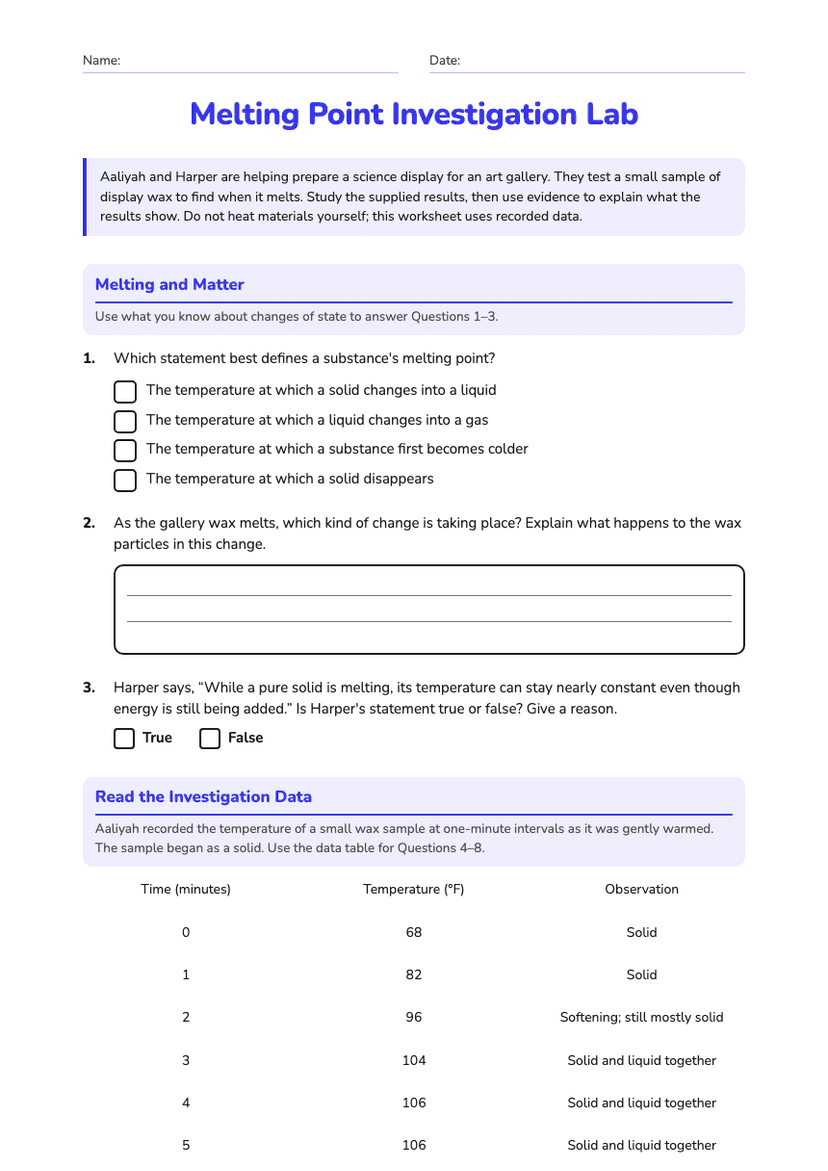
Melting Point Investigation Lab
Free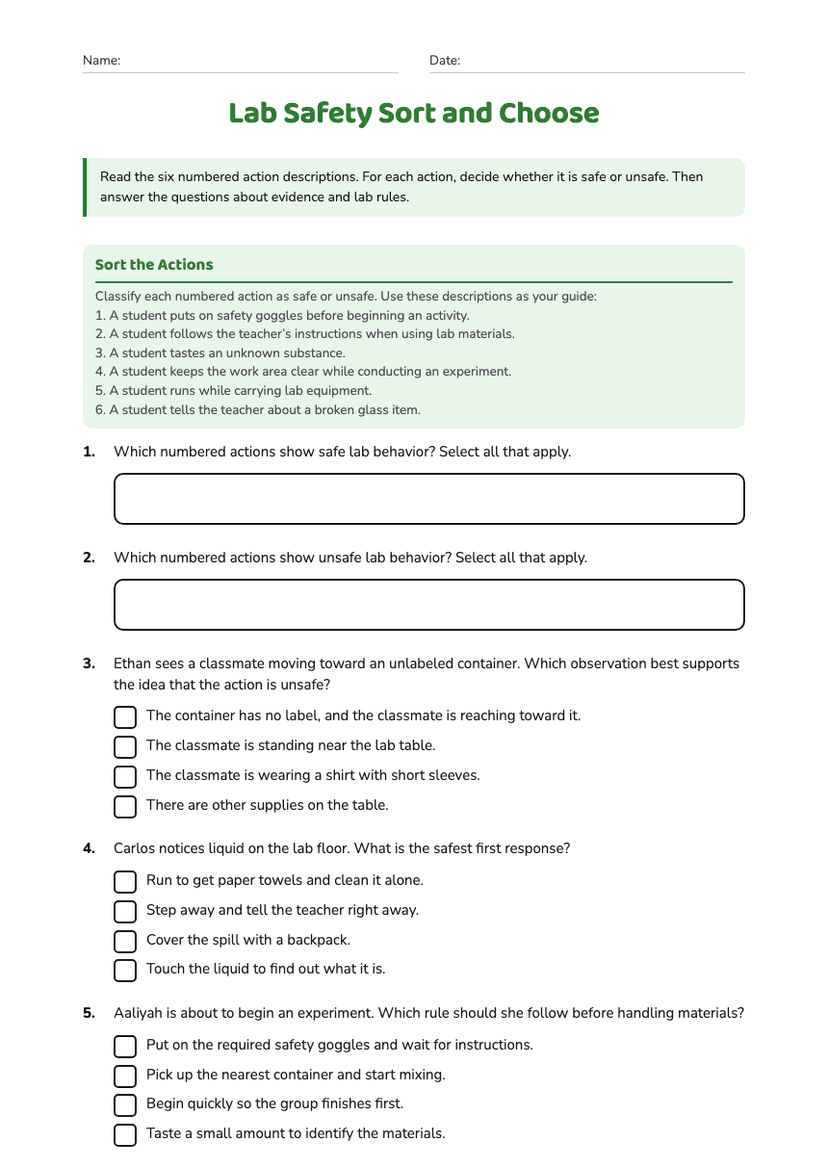
Lab Safety Sort and Choose
Free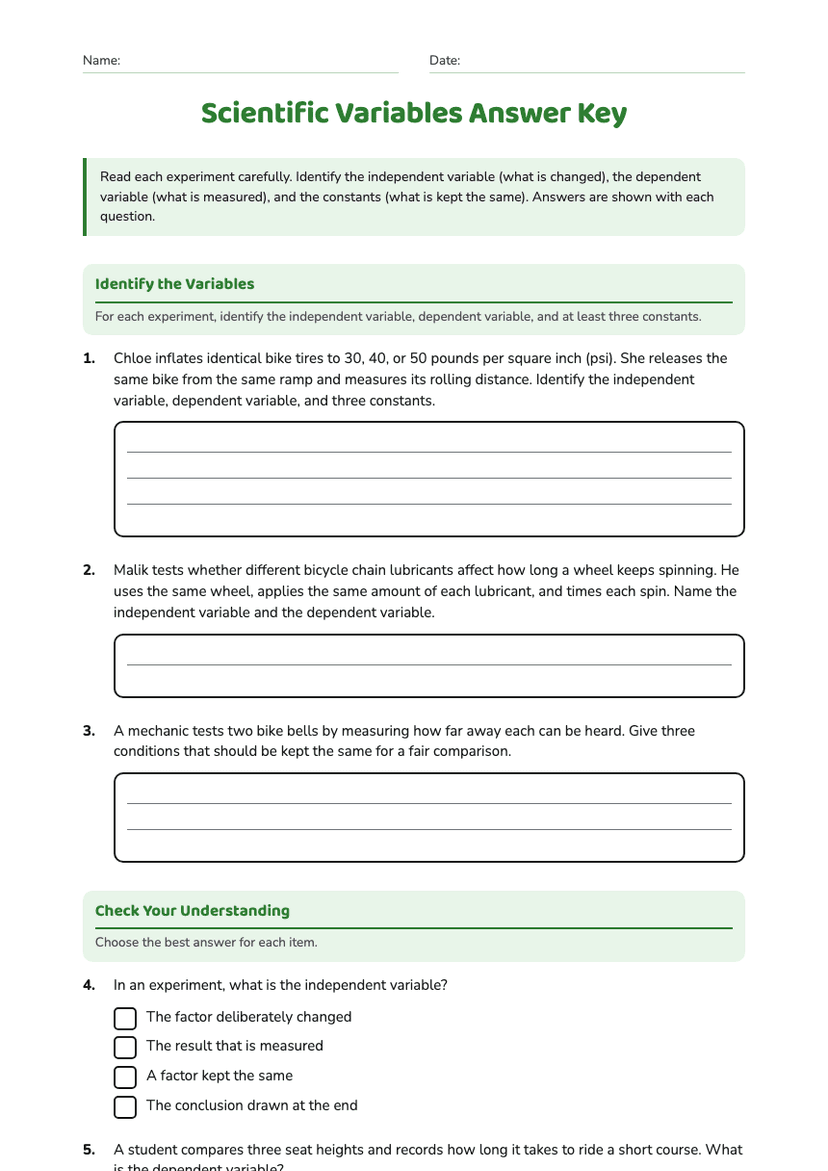
Scientific Variables Answer Key
Free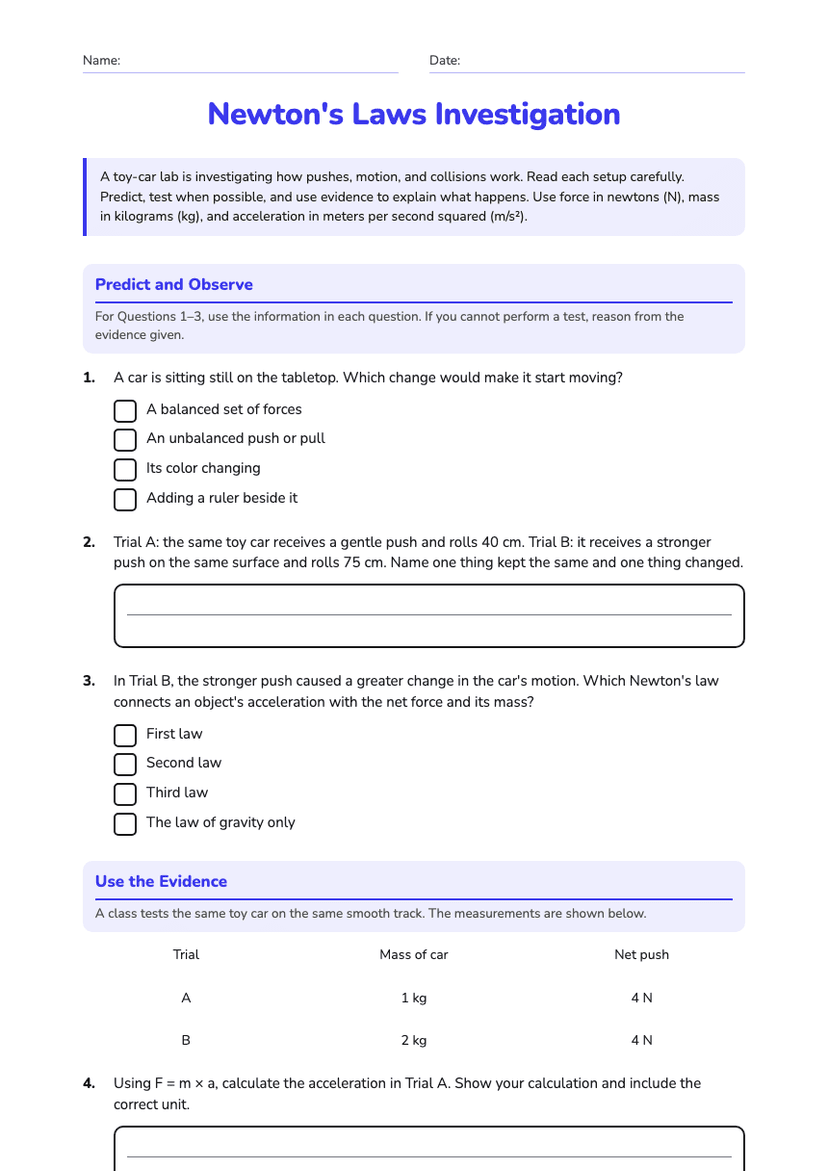
Newton's Laws Investigation
Free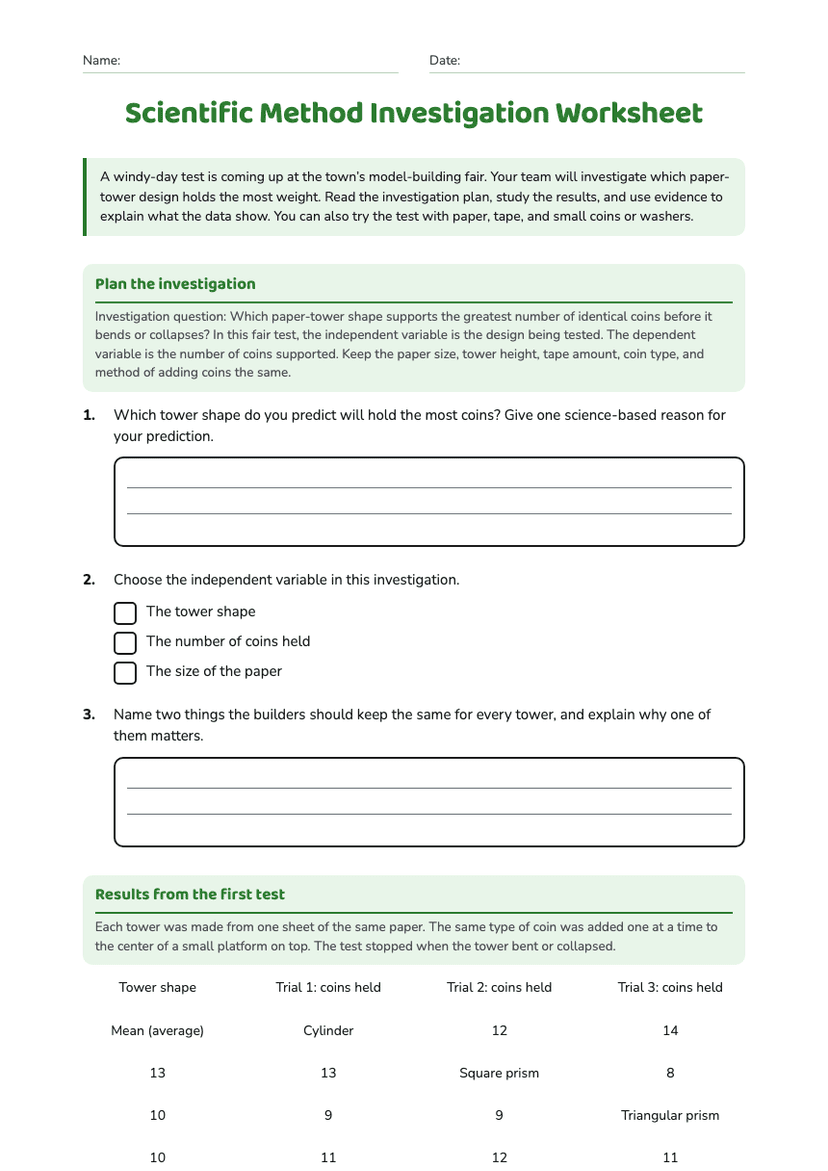
Scientific Method Investigation Worksheet
Free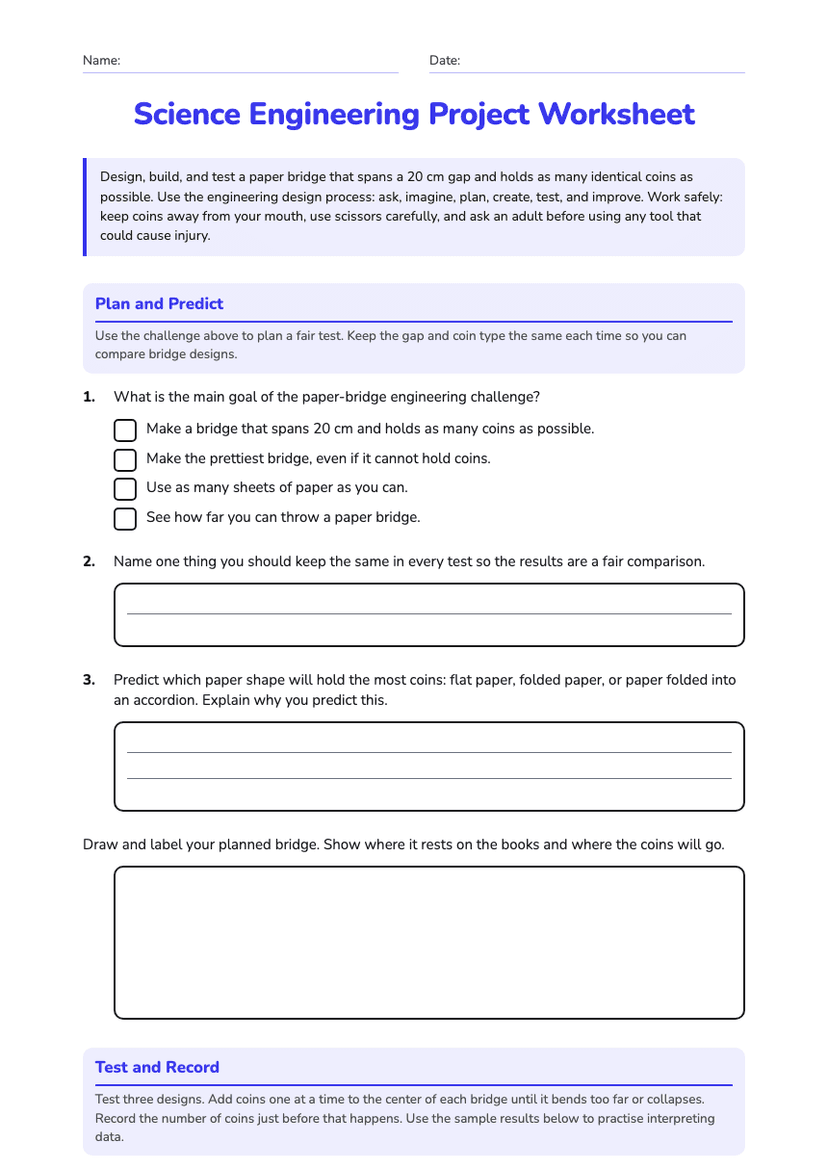
Science Engineering Project Worksheet
Free
Science Skills Assessment
Free