Social StudiesFreePrintable

Westward Expansion Insights

A free social studies worksheet ready for your classroom. Open in Kuraplan to grab the print-ready PDF, customize it for your students, or generate a fresh version in seconds.
Westward Expansion Insights worksheet preview
Name:Date:

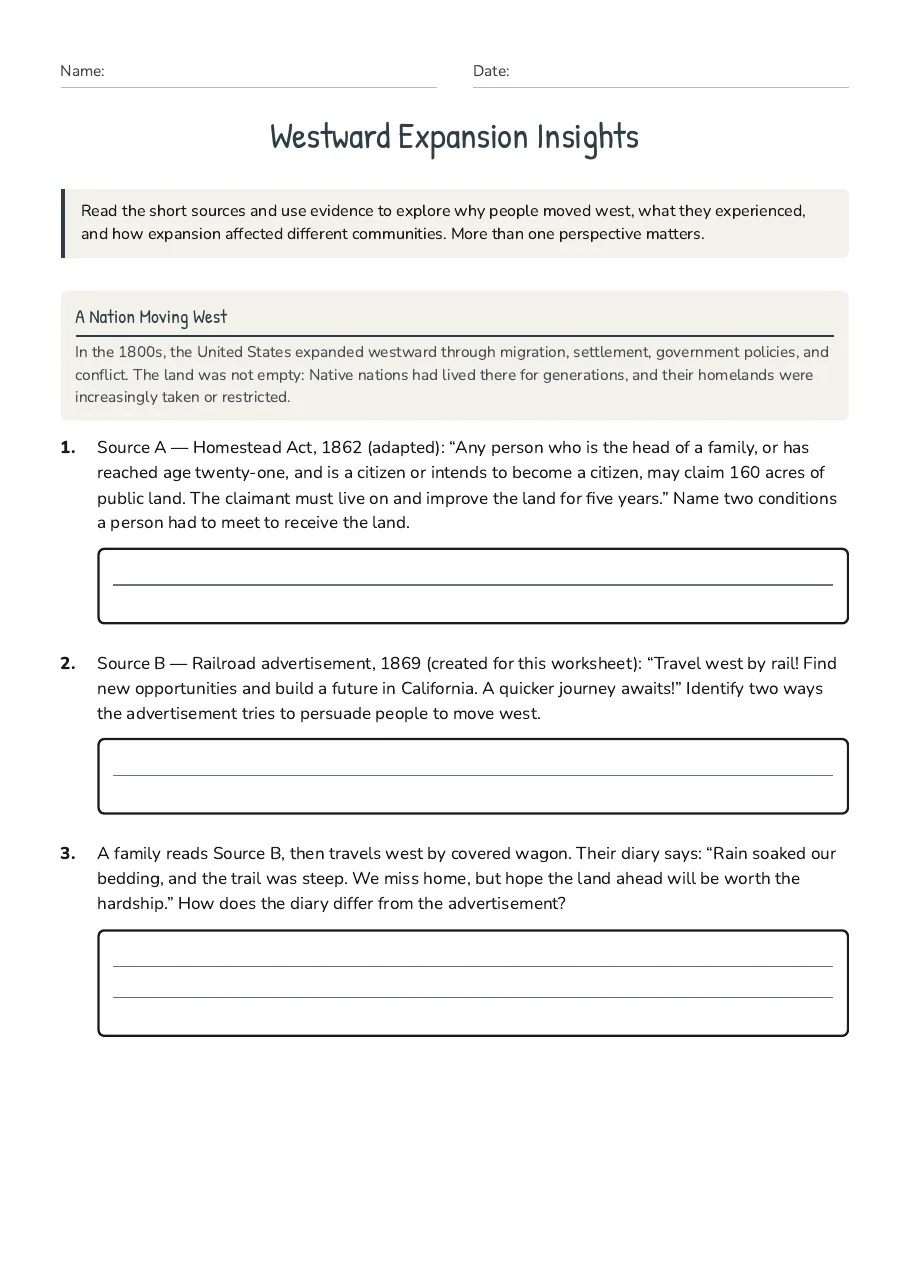
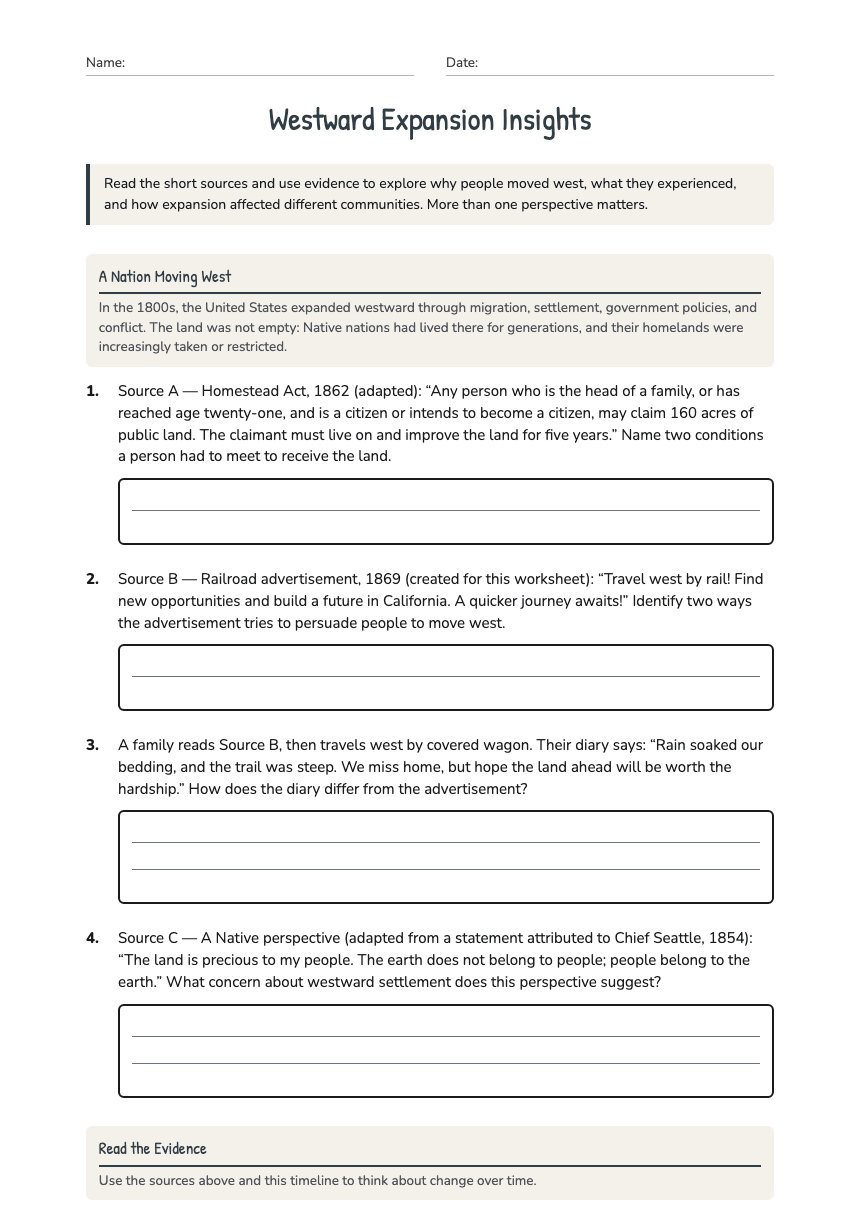
Westward Expansion Insights

Read the short sources and use evidence to explore why people moved west, what they experienced, and how expansion affected different communities. More than one perspective matters.

A Nation Moving West

In the 1800s, the United States expanded westward through migration, settlement, government policies, and conflict. The land was not empty: Native nations had lived there for generations, and their homelands were increasingly taken or restricted.

1.Source A — Homestead Act, 1862 (adapted): “Any person who is the head of a family, or has reached age twenty-one, and is a citizen or intends to become a citizen, may claim 160 acres of public land. The claimant must live on and improve the land for five years.” Name two conditions a person had to meet to receive the land.
2.Source B — Railroad advertisement, 1869 (created for this worksheet): “Travel west by rail! Find new opportunities and build a future in California. A quicker journey awaits!” Identify two ways the advertisement tries to persuade people to move west.
3.A family reads Source B, then travels west by covered wagon. Their diary says: “Rain soaked our bedding, and the trail was steep. We miss home, but hope the land ahead will be worth the hardship.” How does the diary differ from the advertisement?
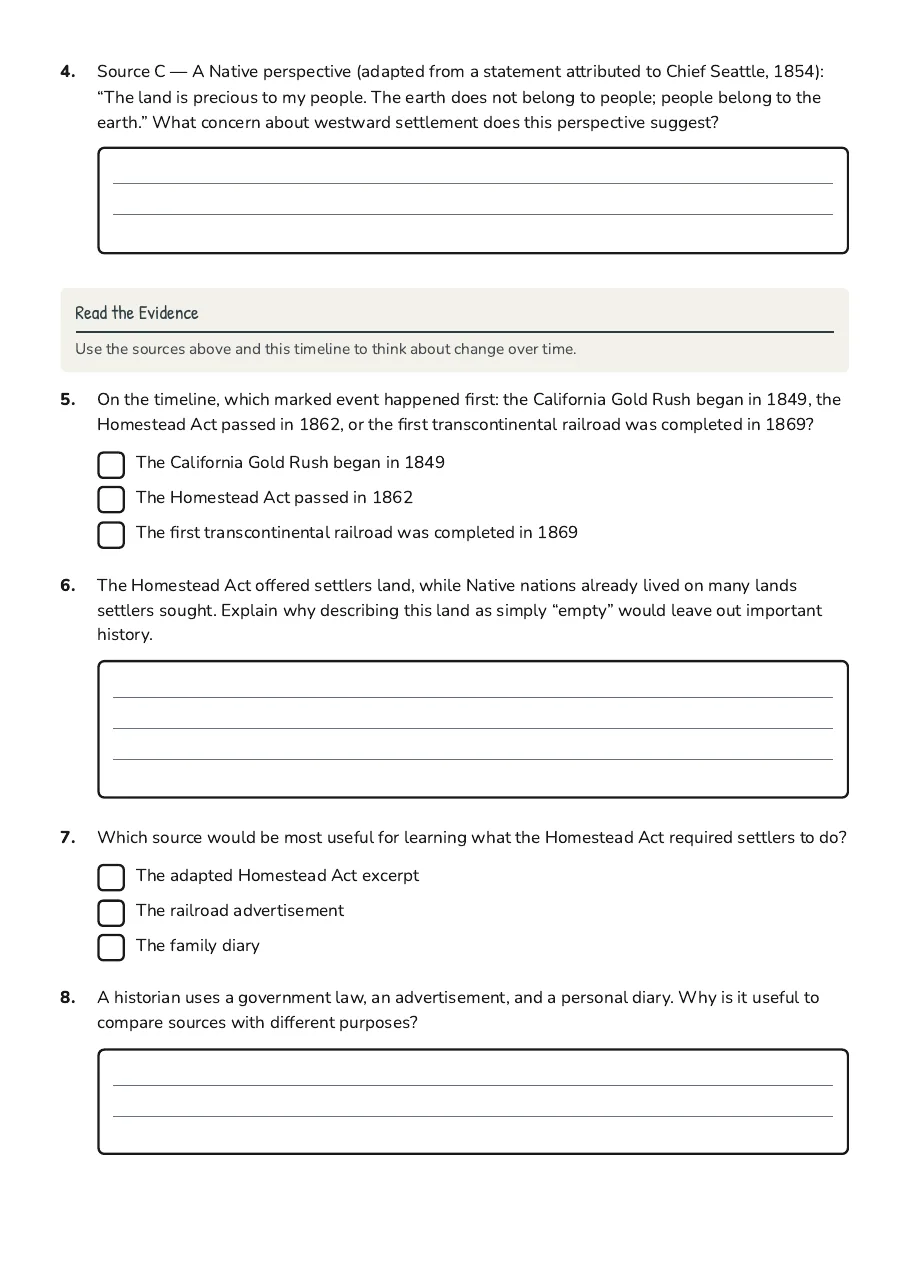
4.Source C — A Native perspective (adapted from a statement attributed to Chief Seattle, 1854): “The land is precious to my people. The earth does not belong to people; people belong to the earth.” What concern about westward settlement does this perspective suggest?

Read the Evidence

Use the sources above and this timeline to think about change over time.

5.On the timeline, which marked event happened first: the California Gold Rush began in 1849, the Homestead Act passed in 1862, or the first transcontinental railroad was completed in 1869?
  • The California Gold Rush began in 1849
  • The Homestead Act passed in 1862
  • The first transcontinental railroad was completed in 1869
6.The Homestead Act offered settlers land, while Native nations already lived on many lands settlers sought. Explain why describing this land as simply “empty” would leave out important history.
7.Which source would be most useful for learning what the Homestead Act required settlers to do?
  • The adapted Homestead Act excerpt
  • The railroad advertisement
  • The family diary
8.A historian uses a government law, an advertisement, and a personal diary. Why is it useful to compare sources with different purposes?
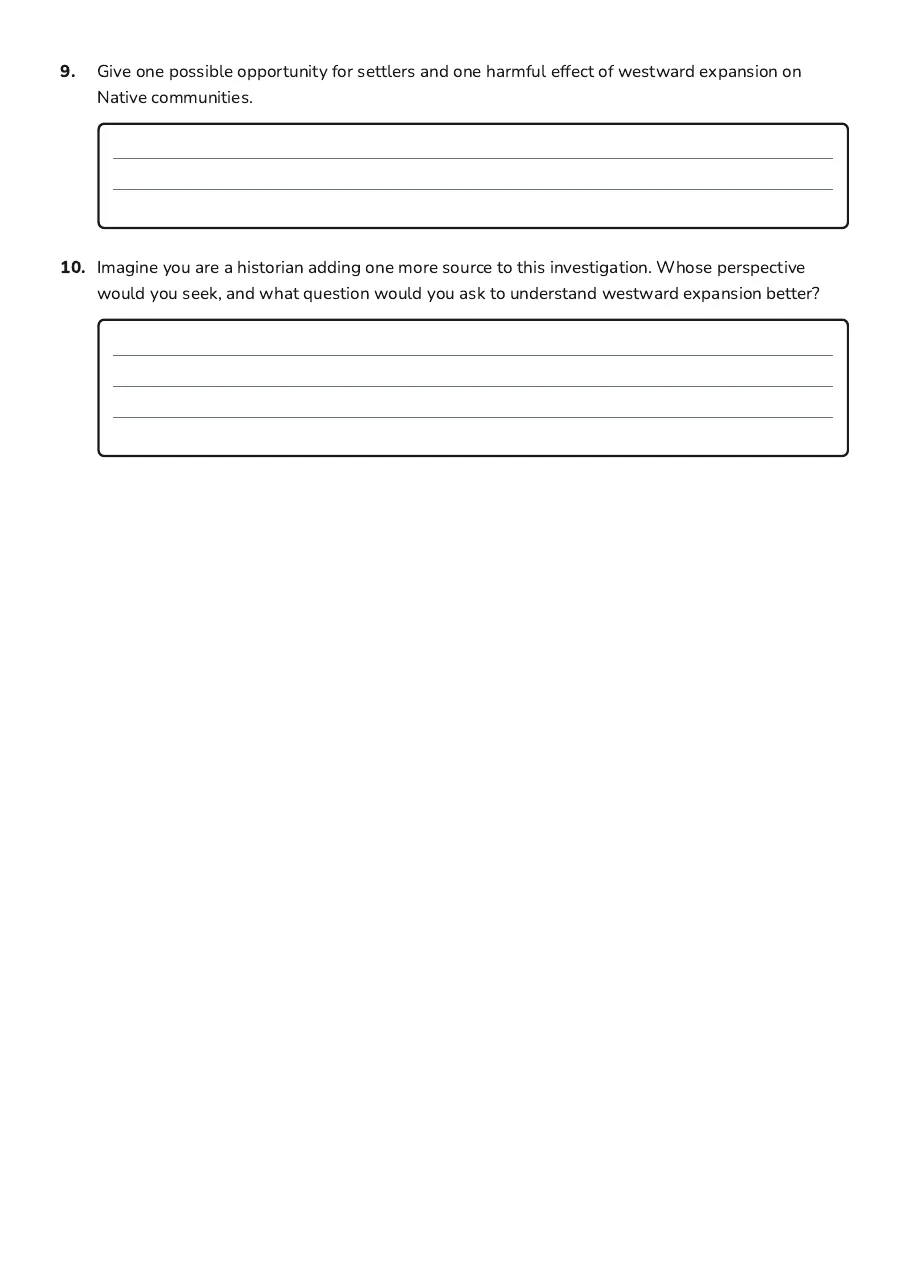
9.Give one possible opportunity for settlers and one harmful effect of westward expansion on Native communities.
10.Imagine you are a historian adding one more source to this investigation. Whose perspective would you seek, and what question would you ask to understand westward expansion better?

3 printable pages

  • Westward Expansion Insights, page 1 of 3: A Nation Moving West

    Page 1

  • Westward Expansion Insights, page 2 of 3: Read the Evidence

    Page 2

  • Westward Expansion Insights, page 3 of 3: 9. Give one possible opportunity for settlers and one harmful effect of westward…

    Page 3

About This Worksheet

Free in Kuraplan

Sign up free, grab the PDF, and customize it for your class.

Print-Ready

Formatted for standard paper. Clean layout, easy to read.

AI-Generated

Created with Kuraplan's AI, designed for real classroom use.

For Teachers & Parents

Use in classrooms, for homework, tutoring, or homeschool.

Need a custom version of this worksheet?

Kuraplan's AI generates custom worksheets in seconds — differentiated for every learner, aligned to your curriculum.

Generate Custom Worksheets — Free
No credit card Curriculum-aligned Under 60 seconds