Algorithmic Bias Case Studies
A free social studies worksheet ready for your classroom. Open in Kuraplan to grab the print-ready PDF, customize it for your students, or generate a fresh version in seconds.
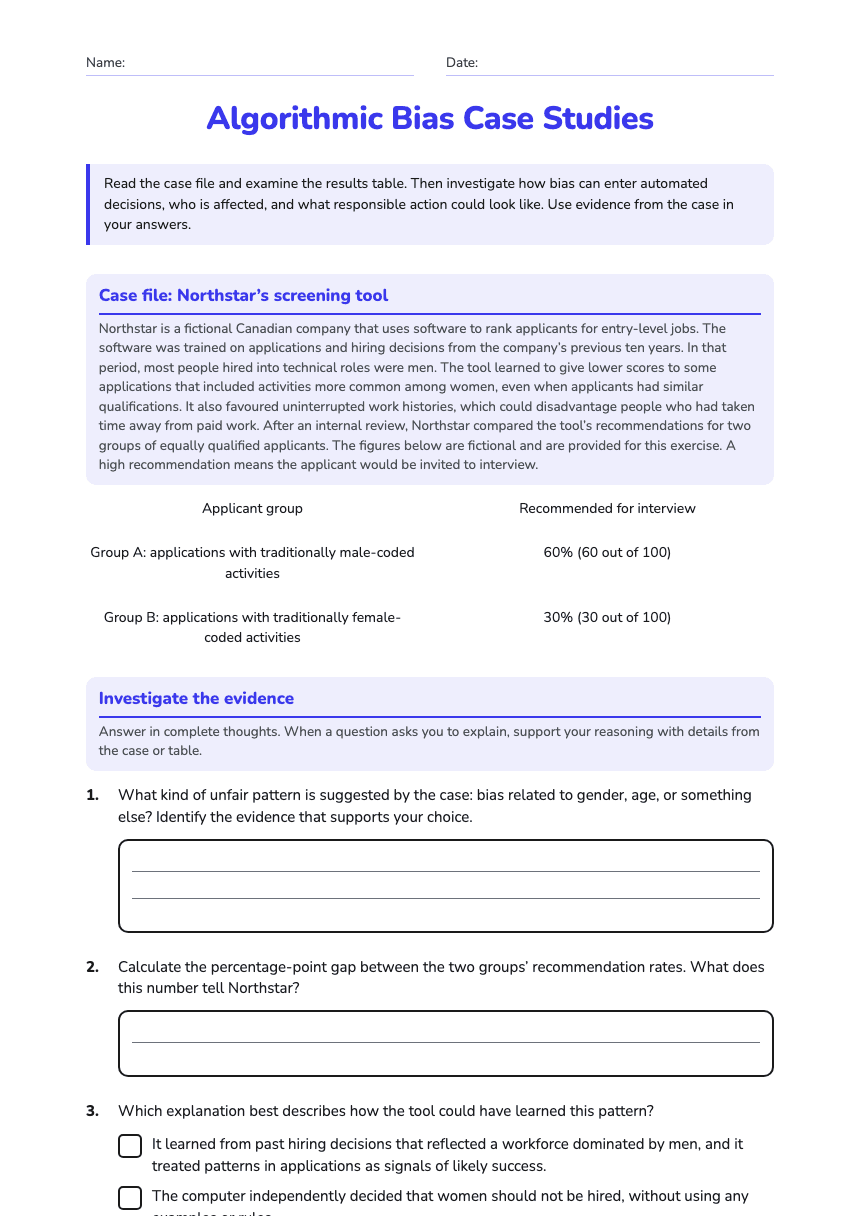
Algorithmic Bias Case Studies
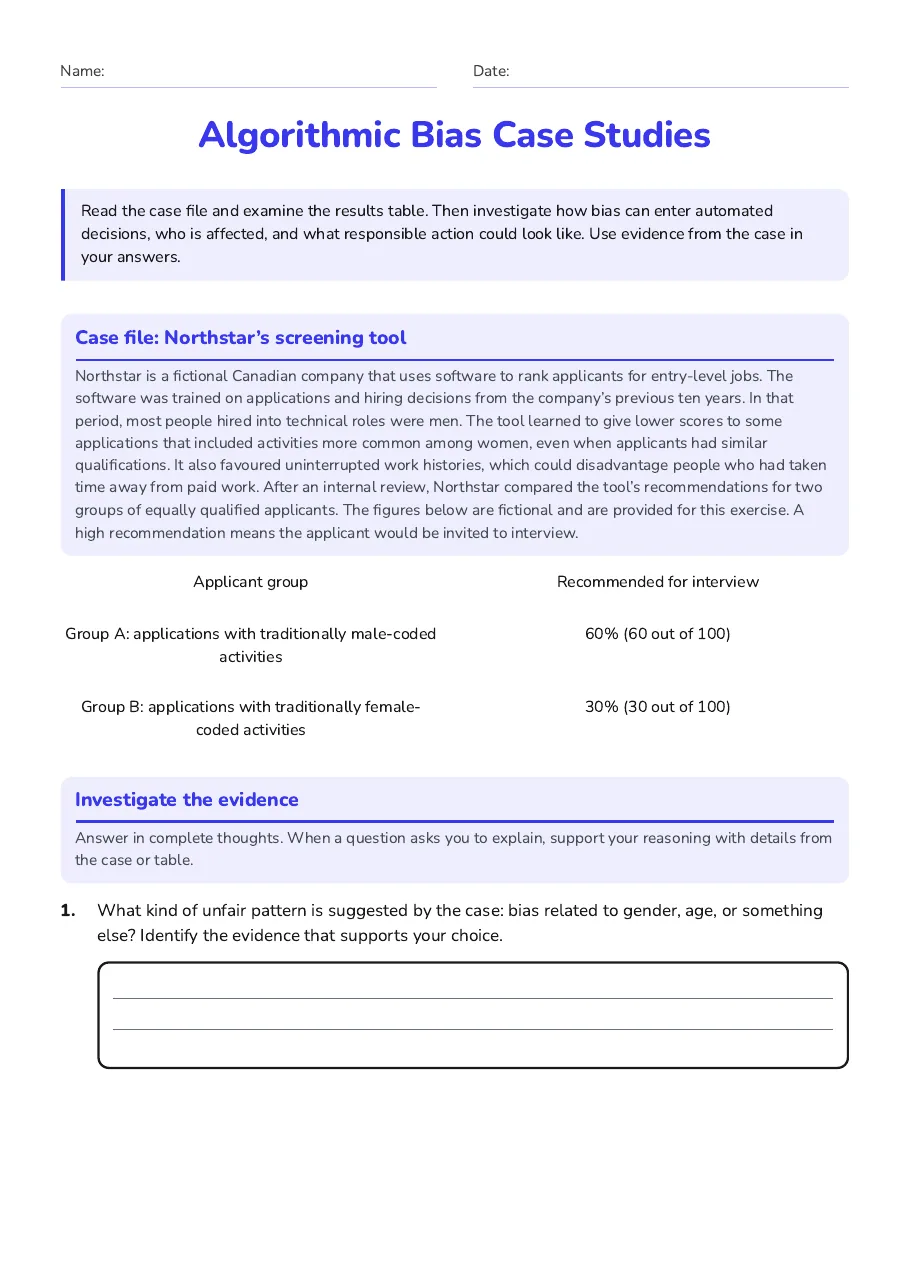
Case file: Northstar’s screening tool
Northstar is a fictional Canadian company that uses software to rank applicants for entry-level jobs. The software was trained on applications and hiring decisions from the company’s previous ten years. In that period, most people hired into technical roles were men. The tool learned to give lower scores to some applications that included activities more common among women, even when applicants had similar qualifications. It also favoured uninterrupted work histories, which could disadvantage people who had taken time away from paid work. After an internal review, Northstar compared the tool’s recommendations for two groups of equally qualified applicants. The figures below are fictional and are provided for this exercise. A high recommendation means the applicant would be invited to interview.
Applicant group
Recommended for interview
Group A: applications with traditionally male-coded activities
60% (60 out of 100)
Group B: applications with traditionally female-coded activities
30% (30 out of 100)
Investigate the evidence
Answer in complete thoughts. When a question asks you to explain, support your reasoning with details from the case or table.
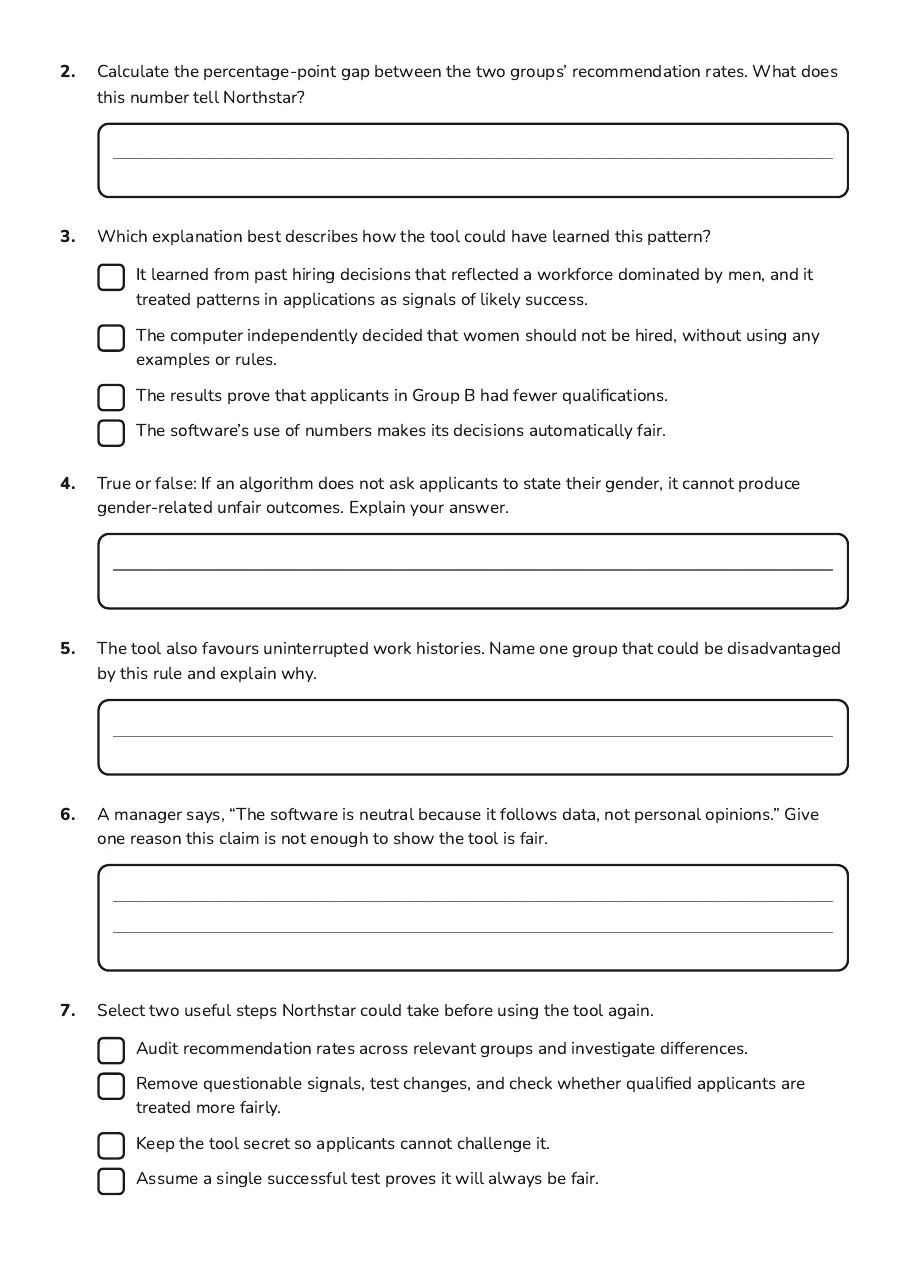
- It learned from past hiring decisions that reflected a workforce dominated by men, and it treated patterns in applications as signals of likely success.
- The computer independently decided that women should not be hired, without using any examples or rules.
- The results prove that applicants in Group B had fewer qualifications.
- The software’s use of numbers makes its decisions automatically fair.
- Audit recommendation rates across relevant groups and investigate differences.
- Remove questionable signals, test changes, and check whether qualified applicants are treated more fairly.
- Keep the tool secret so applicants cannot challenge it.
- Assume a single successful test proves it will always be fair.
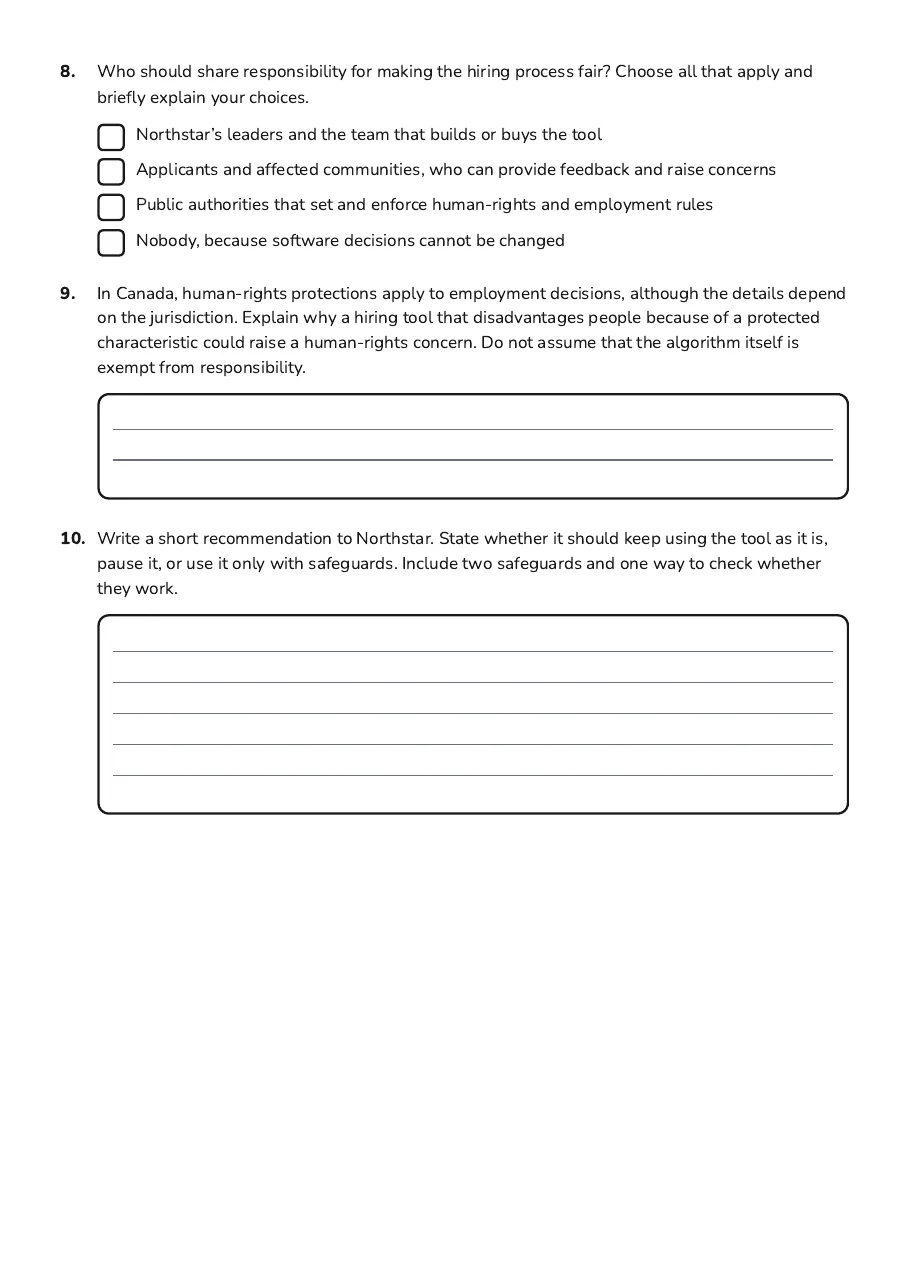
- Northstar’s leaders and the team that builds or buys the tool
- Applicants and affected communities, who can provide feedback and raise concerns
- Public authorities that set and enforce human-rights and employment rules
- Nobody, because software decisions cannot be changed
3 printable pages
Page 1
Page 2
Page 3
About This Worksheet
Free in Kuraplan
Sign up free, grab the PDF, and customize it for your class.
Print-Ready
Formatted for standard paper. Clean layout, easy to read.
AI-Generated
Created with Kuraplan's AI, designed for real classroom use.
For Teachers & Parents
Use in classrooms, for homework, tutoring, or homeschool.
Need a custom version of this worksheet?
Kuraplan's AI generates custom worksheets in seconds — differentiated for every learner, aligned to your curriculum.
Generate Custom Worksheets — Free