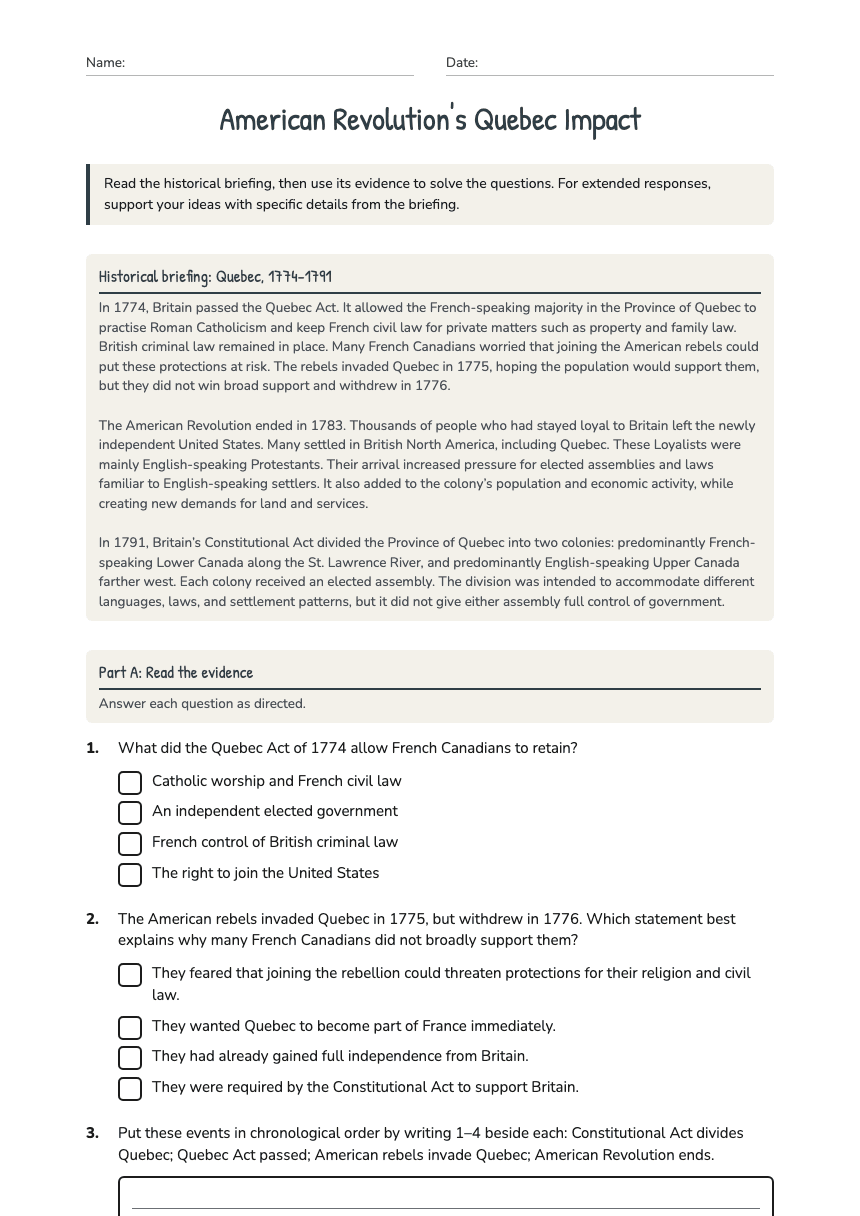
American Revolution's Quebec Impact
A free social studies worksheet ready for your classroom. Open in Kuraplan to grab the print-ready PDF, customize it for your students, or generate a fresh version in seconds.
American Revolution's Quebec Impact
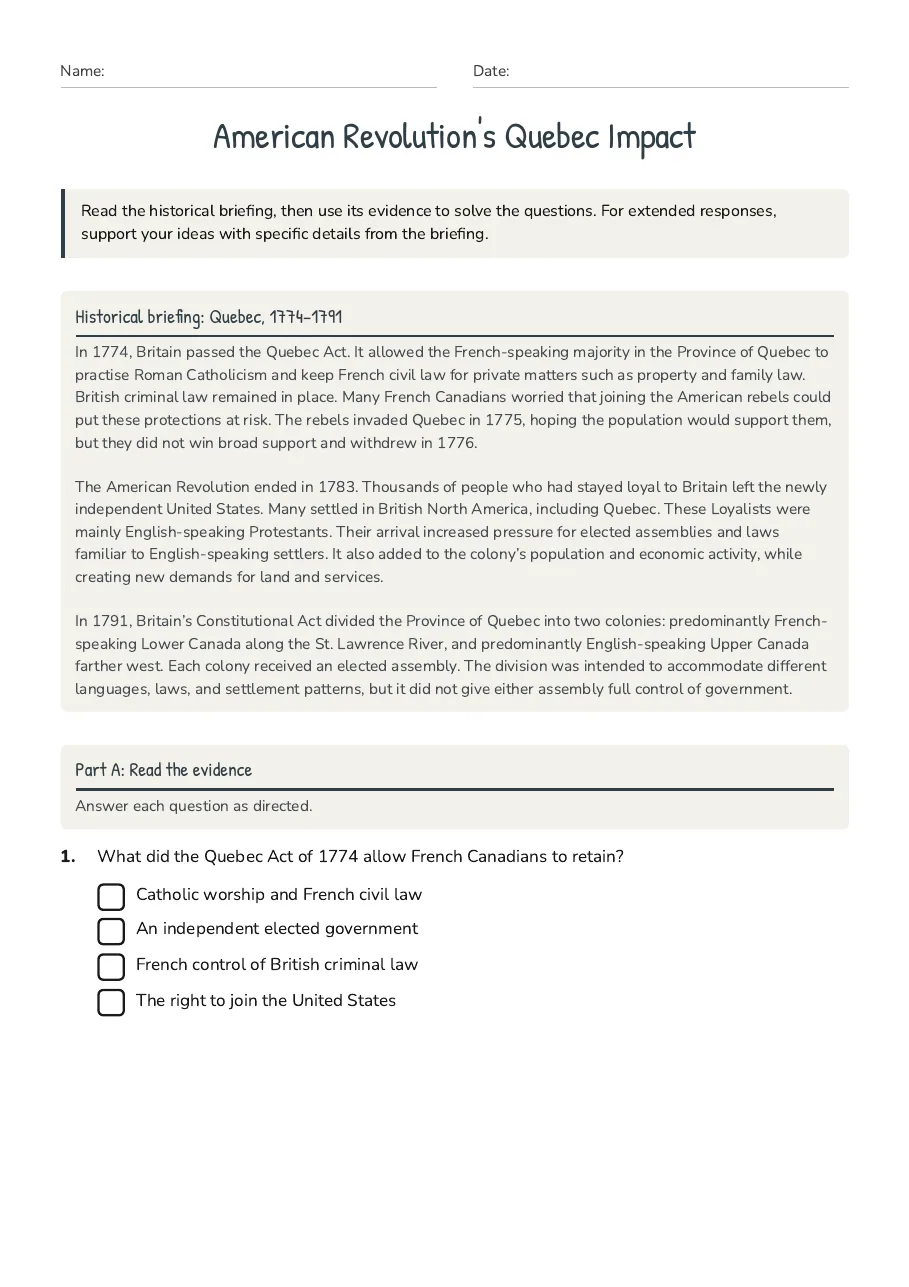
Historical briefing: Quebec, 1774–1791
In 1774, Britain passed the Quebec Act. It allowed the French-speaking majority in the Province of Quebec to practise Roman Catholicism and keep French civil law for private matters such as property and family law. British criminal law remained in place. Many French Canadians worried that joining the American rebels could put these protections at risk. The rebels invaded Quebec in 1775, hoping the population would support them, but they did not win broad support and withdrew in 1776. The American Revolution ended in 1783. Thousands of people who had stayed loyal to Britain left the newly independent United States. Many settled in British North America, including Quebec. These Loyalists were mainly English-speaking Protestants. Their arrival increased pressure for elected assemblies and laws familiar to English-speaking settlers. It also added to the colony’s population and economic activity, while creating new demands for land and services. In 1791, Britain’s Constitutional Act divided the Province of Quebec into two colonies: predominantly French-speaking Lower Canada along the St. Lawrence River, and predominantly English-speaking Upper Canada farther west. Each colony received an elected assembly. The division was intended to accommodate different languages, laws, and settlement patterns, but it did not give either assembly full control of government.
Part A: Read the evidence
Answer each question as directed.
- Catholic worship and French civil law
- An independent elected government
- French control of British criminal law
- The right to join the United States
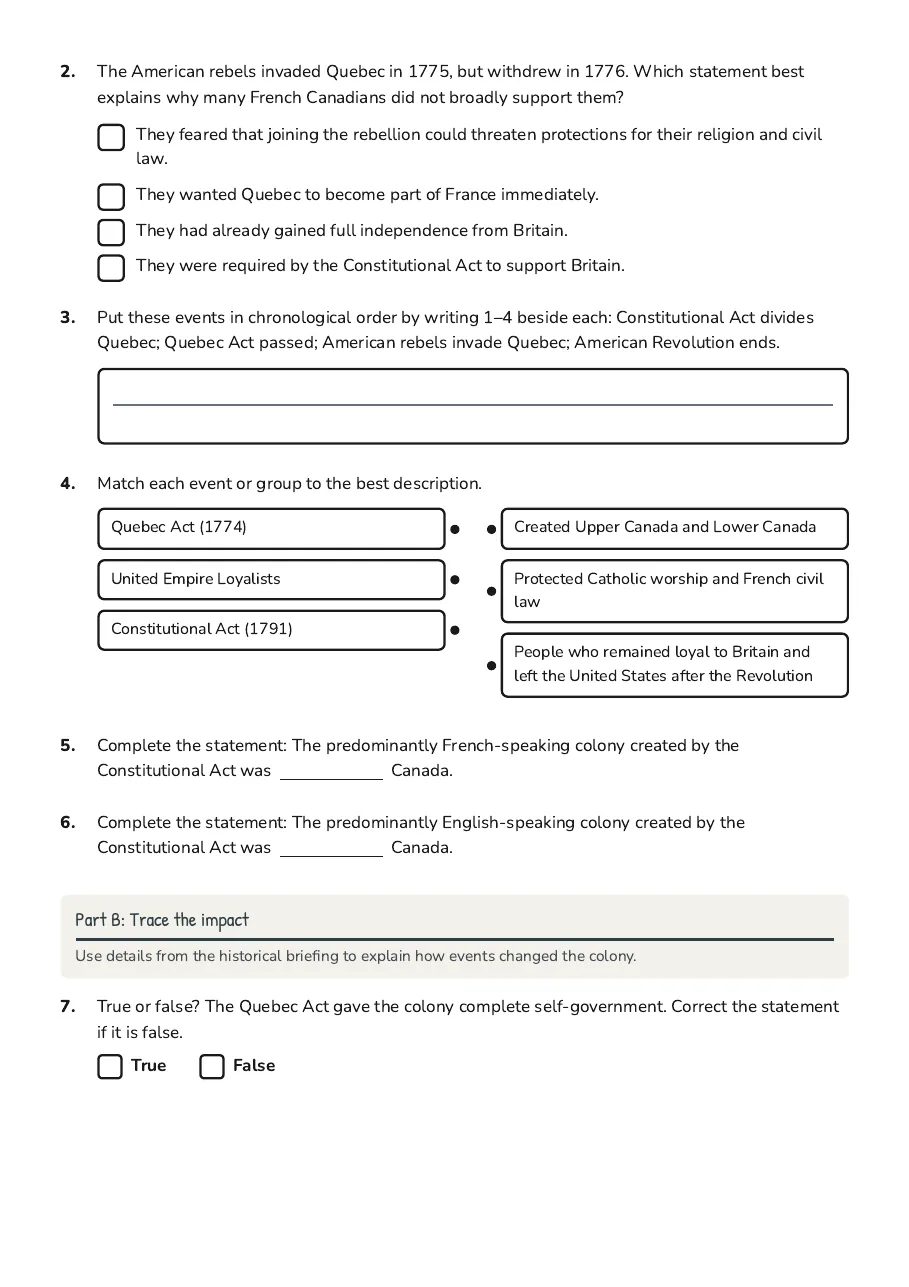
- They feared that joining the rebellion could threaten protections for their religion and civil law.
- They wanted Quebec to become part of France immediately.
- They had already gained full independence from Britain.
- They were required by the Constitutional Act to support Britain.
- Quebec Act (1774)
- United Empire Loyalists
- Constitutional Act (1791)
- Created Upper Canada and Lower Canada
- Protected Catholic worship and French civil law
- People who remained loyal to Britain and left the United States after the Revolution
Part B: Trace the impact
Use details from the historical briefing to explain how events changed the colony.
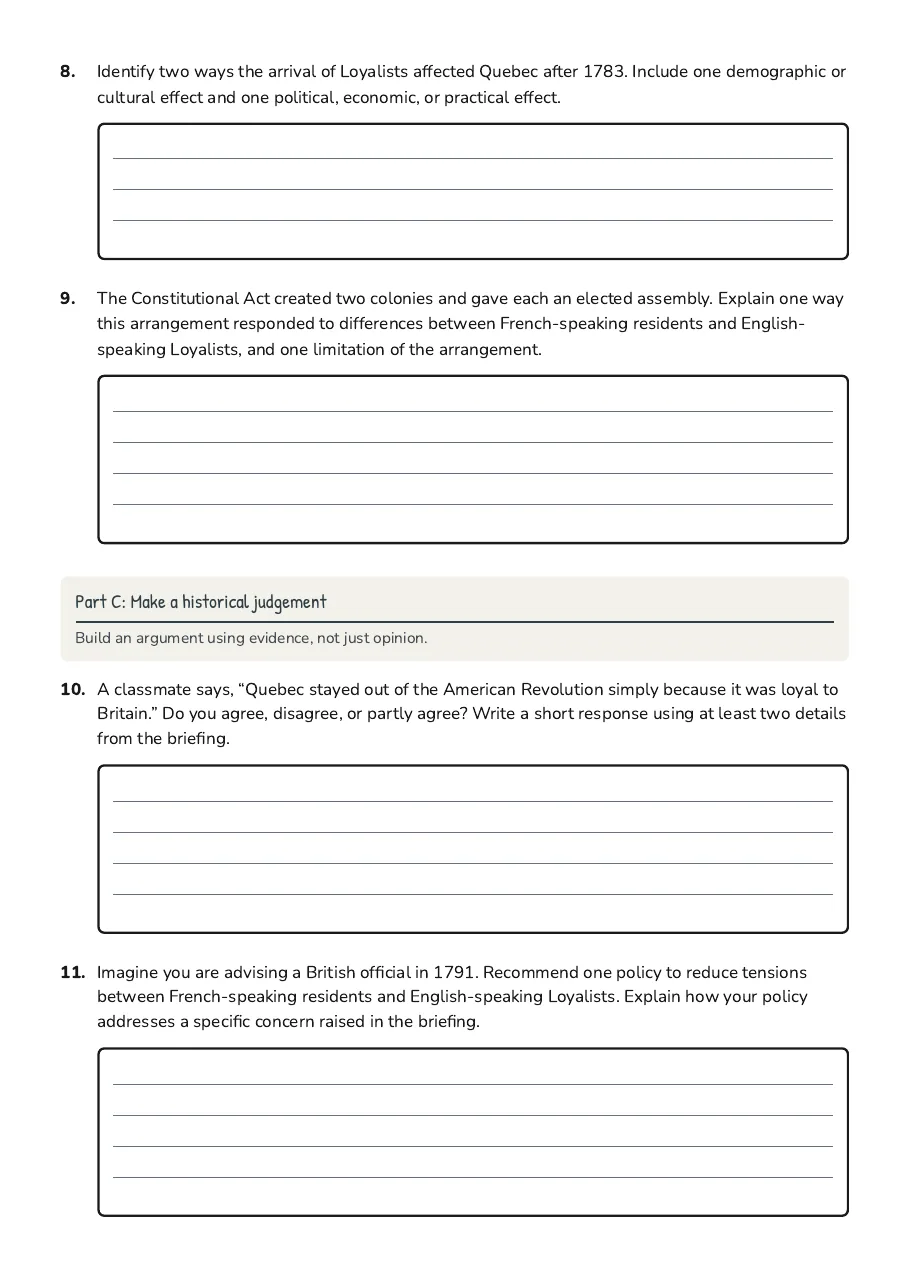
Part C: Make a historical judgement
Build an argument using evidence, not just opinion.
3 printable pages
Page 1
Page 2
Page 3
About This Worksheet
Free in Kuraplan
Sign up free, grab the PDF, and customize it for your class.
Print-Ready
Formatted for standard paper. Clean layout, easy to read.
AI-Generated
Created with Kuraplan's AI, designed for real classroom use.
For Teachers & Parents
Use in classrooms, for homework, tutoring, or homeschool.
Need a custom version of this worksheet?
Kuraplan's AI generates custom worksheets in seconds — differentiated for every learner, aligned to your curriculum.
Generate Custom Worksheets — Free