Australian Constitution Fundamentals
A free social sciences worksheet ready for your classroom. Open in Kuraplan to grab the print-ready PDF, customize it for your students, or generate a fresh version in seconds.
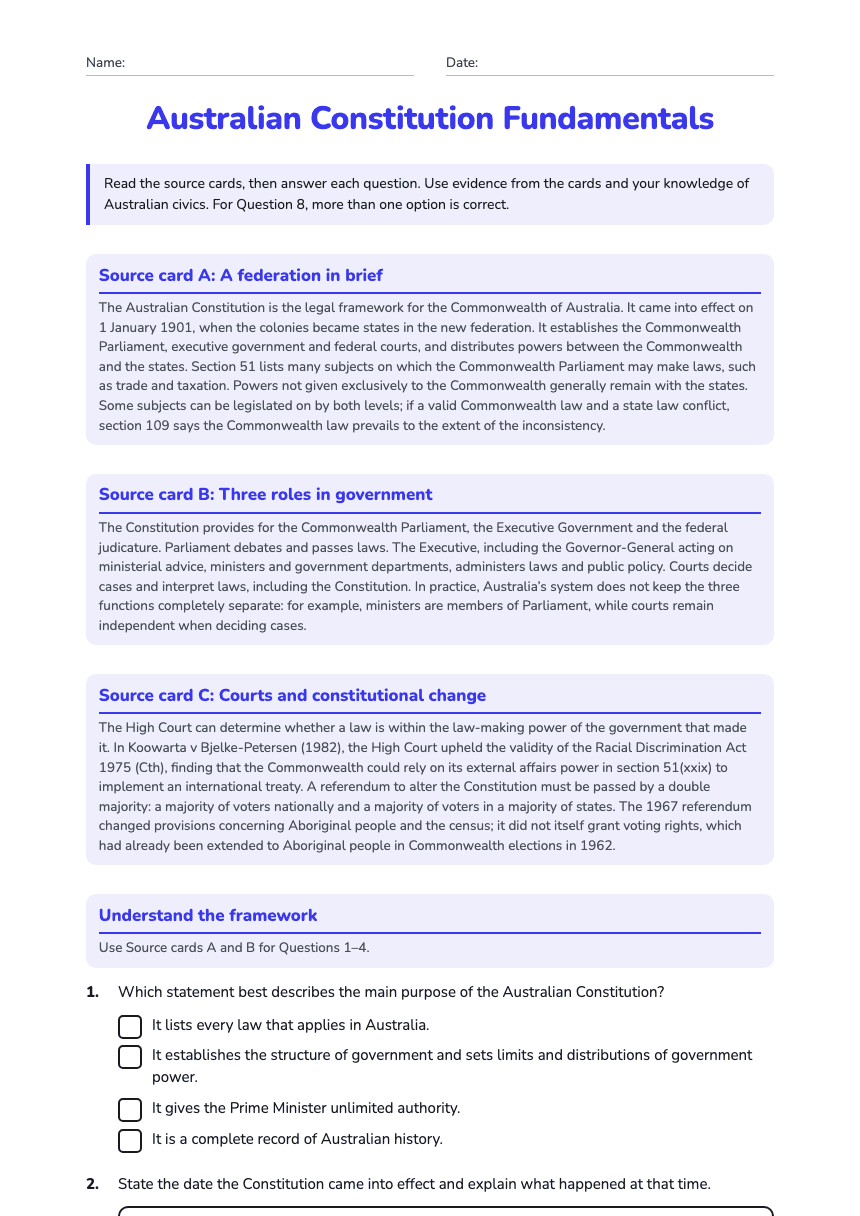
Australian Constitution Fundamentals
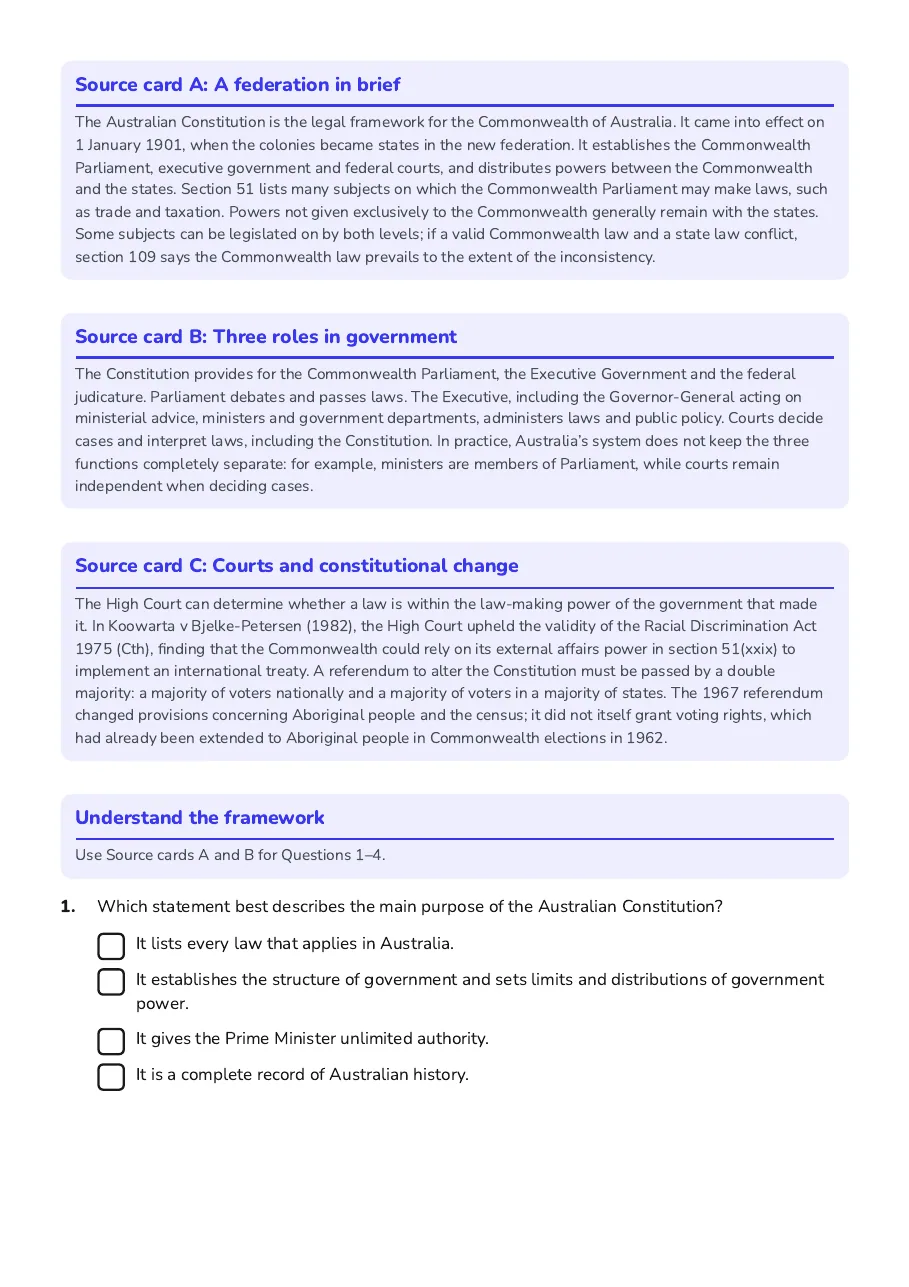
Source card A: A federation in brief
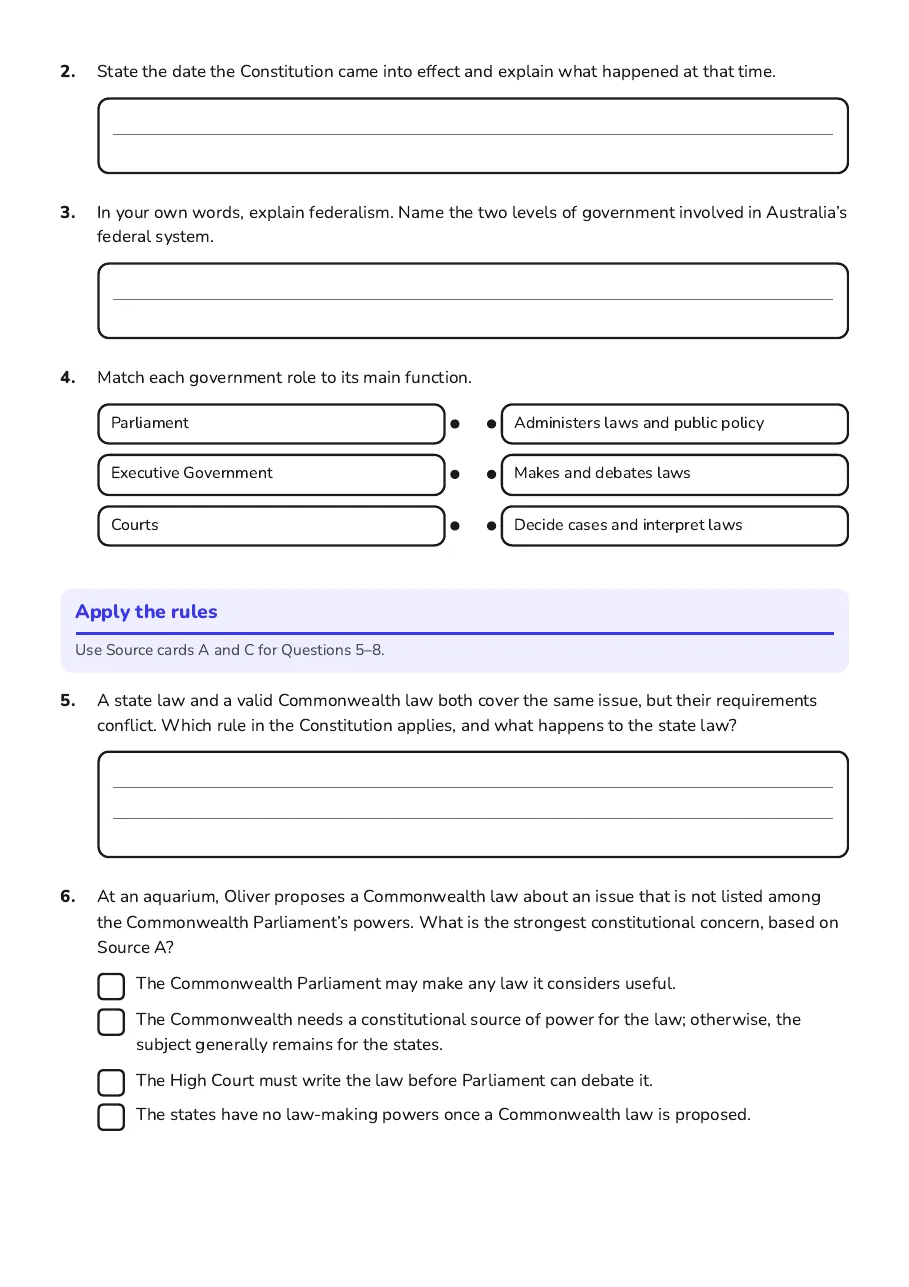
The Australian Constitution is the legal framework for the Commonwealth of Australia. It came into effect on 1 January 1901, when the colonies became states in the new federation. It establishes the Commonwealth Parliament, executive government and federal courts, and distributes powers between the Commonwealth and the states. Section 51 lists many subjects on which the Commonwealth Parliament may make laws, such as trade and taxation. Powers not given exclusively to the Commonwealth generally remain with the states. Some subjects can be legislated on by both levels; if a valid Commonwealth law and a state law conflict, section 109 says the Commonwealth law prevails to the extent of the inconsistency.
Source card B: Three roles in government
The Constitution provides for the Commonwealth Parliament, the Executive Government and the federal judicature. Parliament debates and passes laws. The Executive, including the Governor-General acting on ministerial advice, ministers and government departments, administers laws and public policy. Courts decide cases and interpret laws, including the Constitution. In practice, Australia’s system does not keep the three functions completely separate: for example, ministers are members of Parliament, while courts remain independent when deciding cases.
Source card C: Courts and constitutional change
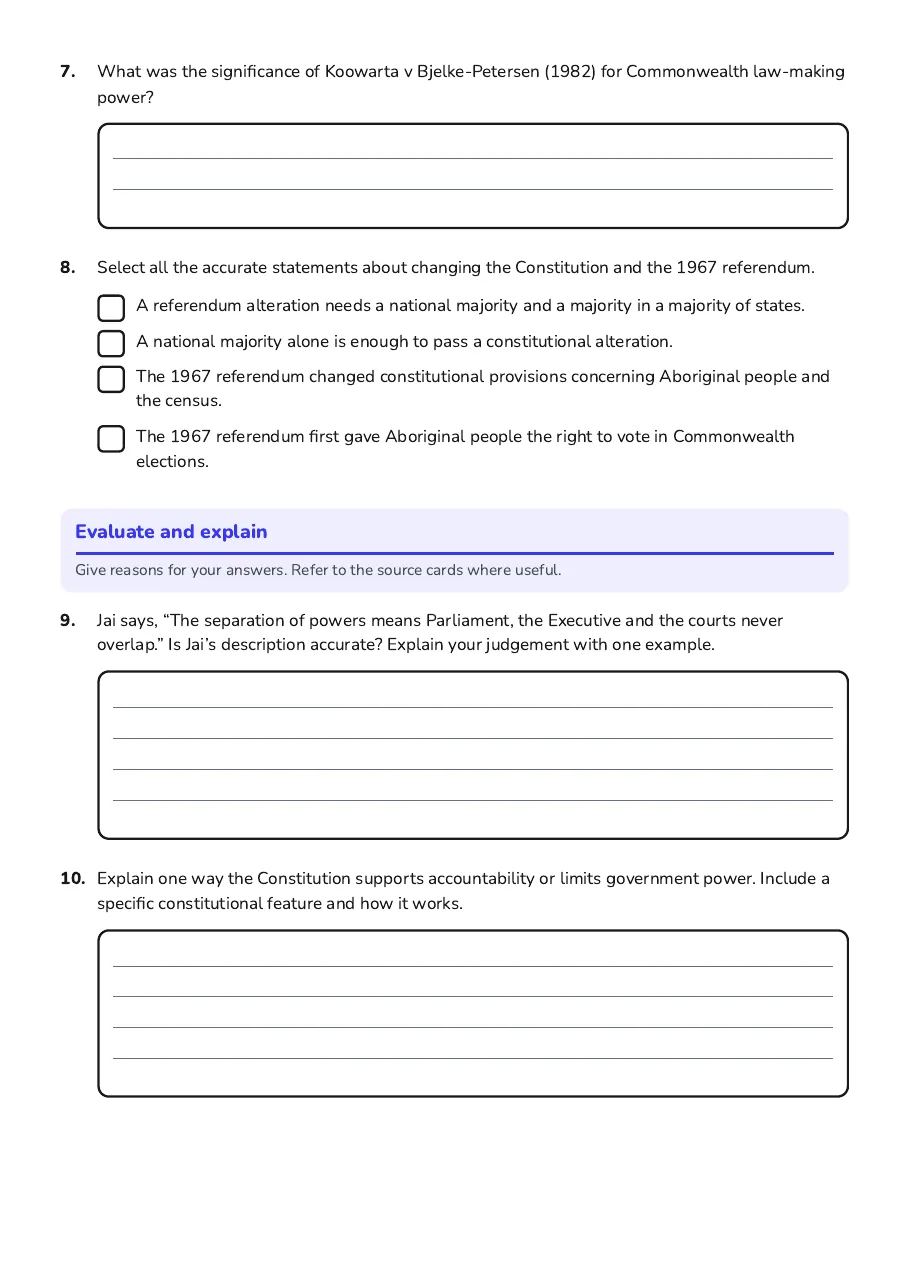
The High Court can determine whether a law is within the law-making power of the government that made it. In Koowarta v Bjelke-Petersen (1982), the High Court upheld the validity of the Racial Discrimination Act 1975 (Cth), finding that the Commonwealth could rely on its external affairs power in section 51(xxix) to implement an international treaty. A referendum to alter the Constitution must be passed by a double majority: a majority of voters nationally and a majority of voters in a majority of states. The 1967 referendum changed provisions concerning Aboriginal people and the census; it did not itself grant voting rights, which had already been extended to Aboriginal people in Commonwealth elections in 1962.
Understand the framework
Use Source cards A and B for Questions 1–4.
- It lists every law that applies in Australia.
- It establishes the structure of government and sets limits and distributions of government power.
- It gives the Prime Minister unlimited authority.
- It is a complete record of Australian history.
- Parliament
- Executive Government
- Courts
- Administers laws and public policy
- Makes and debates laws
- Decide cases and interpret laws
Apply the rules
Use Source cards A and C for Questions 5–8.
- The Commonwealth Parliament may make any law it considers useful.
- The Commonwealth needs a constitutional source of power for the law; otherwise, the subject generally remains for the states.
- The High Court must write the law before Parliament can debate it.
- The states have no law-making powers once a Commonwealth law is proposed.
- A referendum alteration needs a national majority and a majority in a majority of states.
- A national majority alone is enough to pass a constitutional alteration.
- The 1967 referendum changed constitutional provisions concerning Aboriginal people and the census.
- The 1967 referendum first gave Aboriginal people the right to vote in Commonwealth elections.
Evaluate and explain
Give reasons for your answers. Refer to the source cards where useful.
4 printable pages
Page 1
Page 2
Page 3
Page 4
About This Worksheet
Free in Kuraplan
Sign up free, grab the PDF, and customize it for your class.
Print-Ready
Formatted for standard paper. Clean layout, easy to read.
AI-Generated
Created with Kuraplan's AI, designed for real classroom use.
For Teachers & Parents
Use in classrooms, for homework, tutoring, or homeschool.
Need a custom version of this worksheet?
Kuraplan's AI generates custom worksheets in seconds — differentiated for every learner, aligned to your curriculum.
Generate Custom Worksheets — FreeMore Social Sciences Worksheets
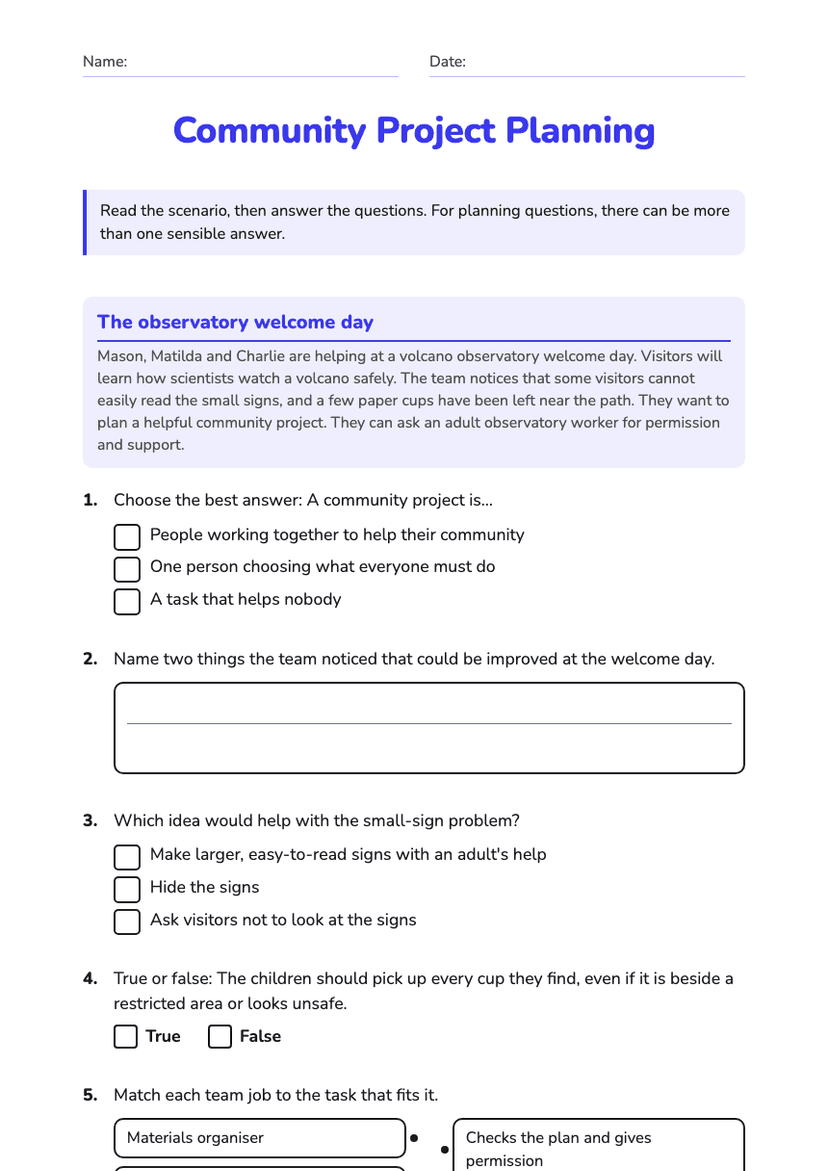
Community Project Planning
Free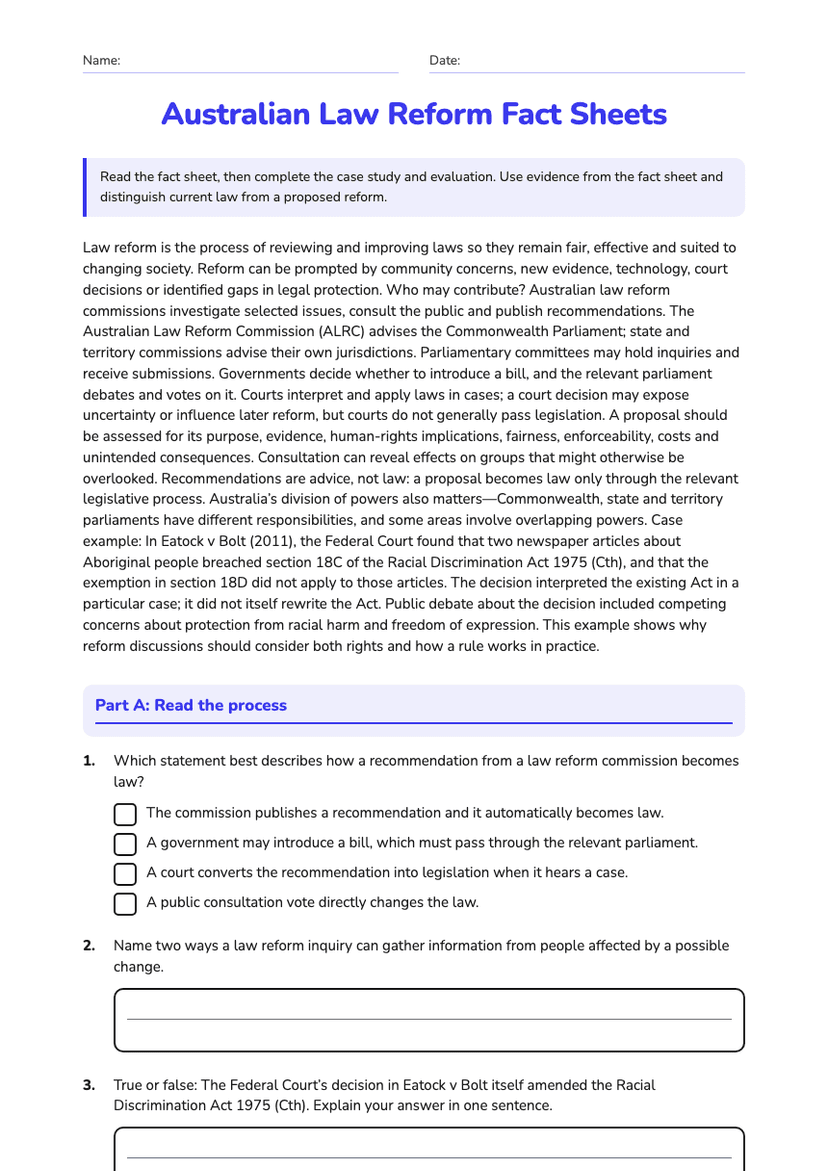
Australian Law Reform Fact Sheets
Free
Human Rights Debate Rubric
Free
Australian Referendums Constitutional Process
Free
Media and Law Reform
Free
Commonwealth Constitution Overview
Free
Rights and Responsibilities Organiser
Free