British Colonisation Readers
A free english worksheet ready for your classroom. Open in Kuraplan to grab the print-ready PDF, customize it for your students, or generate a fresh version in seconds.
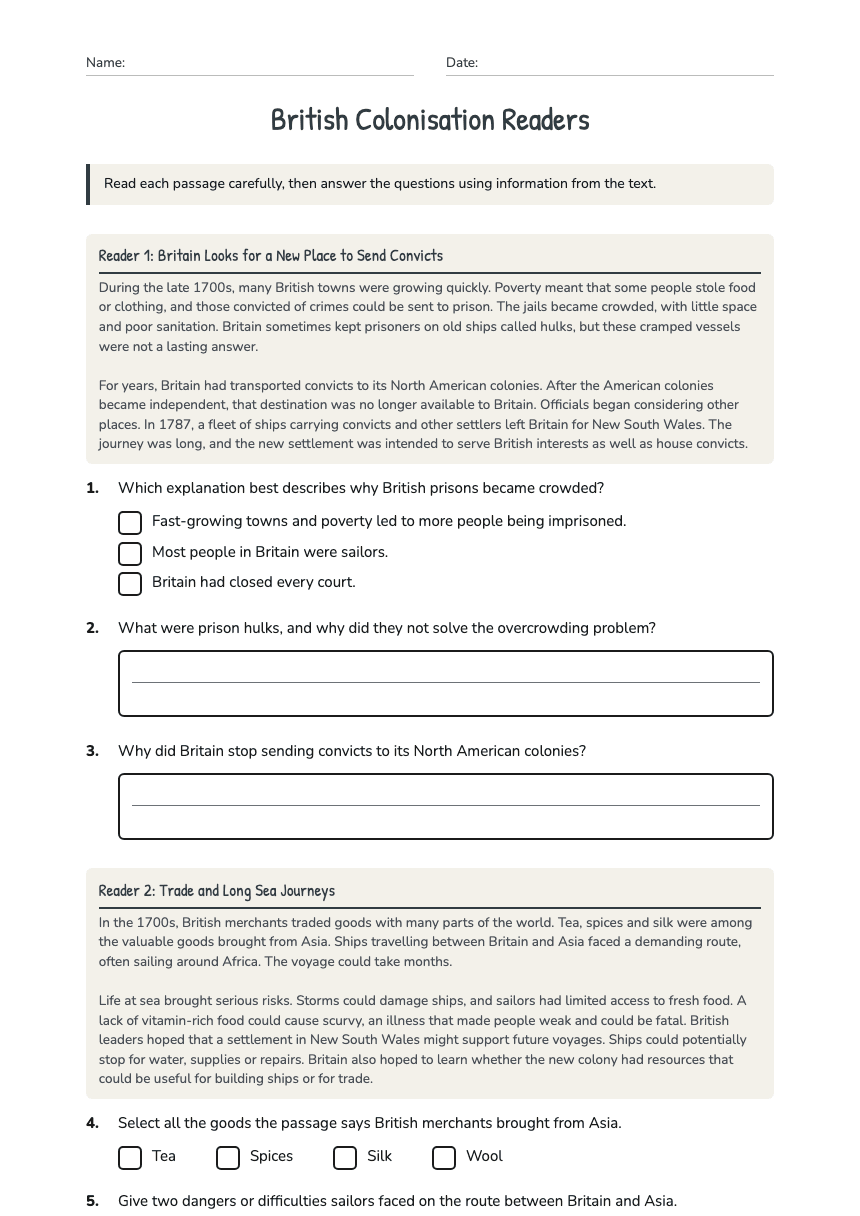
British Colonisation Readers
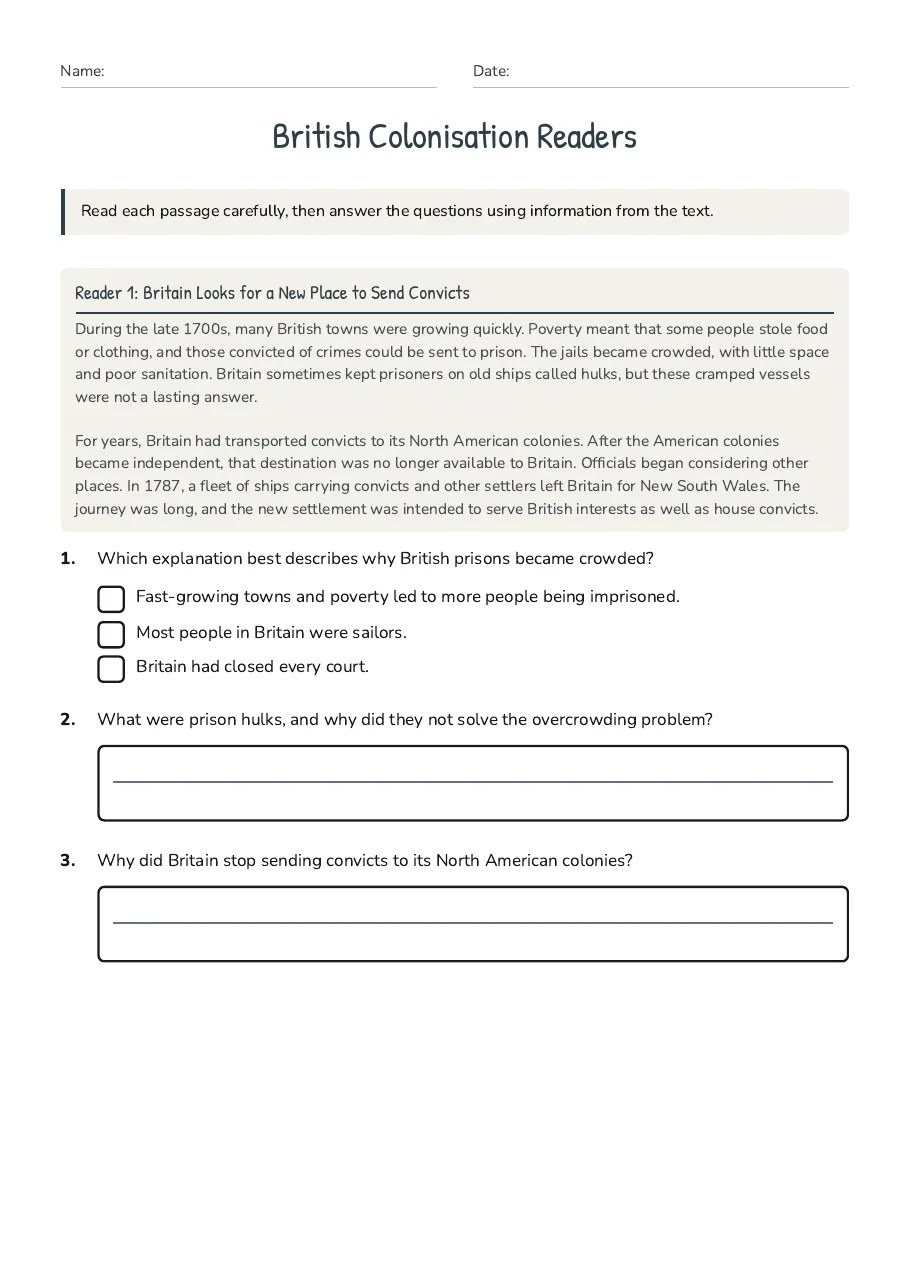
Reader 1: Britain Looks for a New Place to Send Convicts
During the late 1700s, many British towns were growing quickly. Poverty meant that some people stole food or clothing, and those convicted of crimes could be sent to prison. The jails became crowded, with little space and poor sanitation. Britain sometimes kept prisoners on old ships called hulks, but these cramped vessels were not a lasting answer. For years, Britain had transported convicts to its North American colonies. After the American colonies became independent, that destination was no longer available to Britain. Officials began considering other places. In 1787, a fleet of ships carrying convicts and other settlers left Britain for New South Wales. The journey was long, and the new settlement was intended to serve British interests as well as house convicts.
- Fast-growing towns and poverty led to more people being imprisoned.
- Most people in Britain were sailors.
- Britain had closed every court.
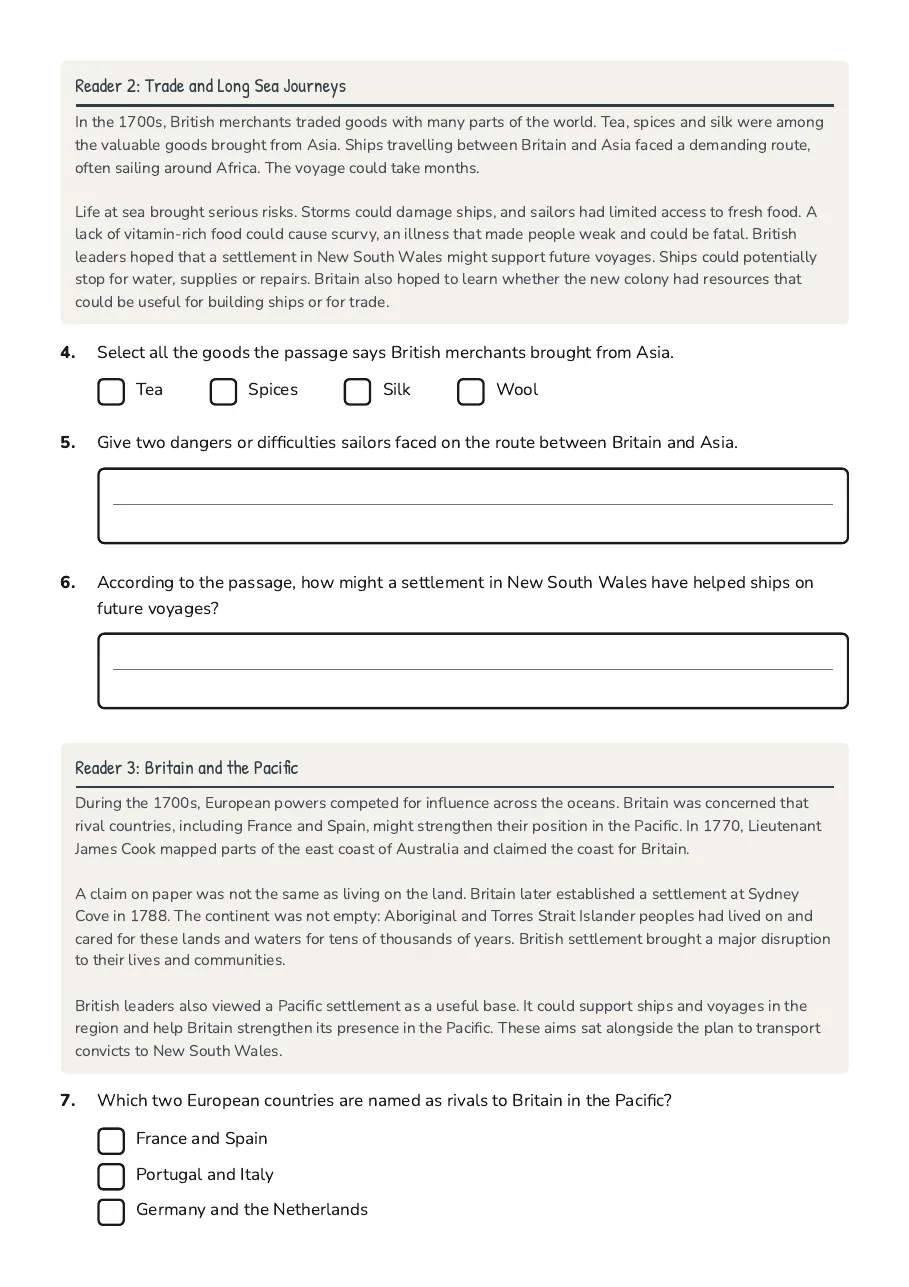
Reader 2: Trade and Long Sea Journeys
In the 1700s, British merchants traded goods with many parts of the world. Tea, spices and silk were among the valuable goods brought from Asia. Ships travelling between Britain and Asia faced a demanding route, often sailing around Africa. The voyage could take months. Life at sea brought serious risks. Storms could damage ships, and sailors had limited access to fresh food. A lack of vitamin-rich food could cause scurvy, an illness that made people weak and could be fatal. British leaders hoped that a settlement in New South Wales might support future voyages. Ships could potentially stop for water, supplies or repairs. Britain also hoped to learn whether the new colony had resources that could be useful for building ships or for trade.
- Tea
- Spices
- Silk
- Wool
Reader 3: Britain and the Pacific
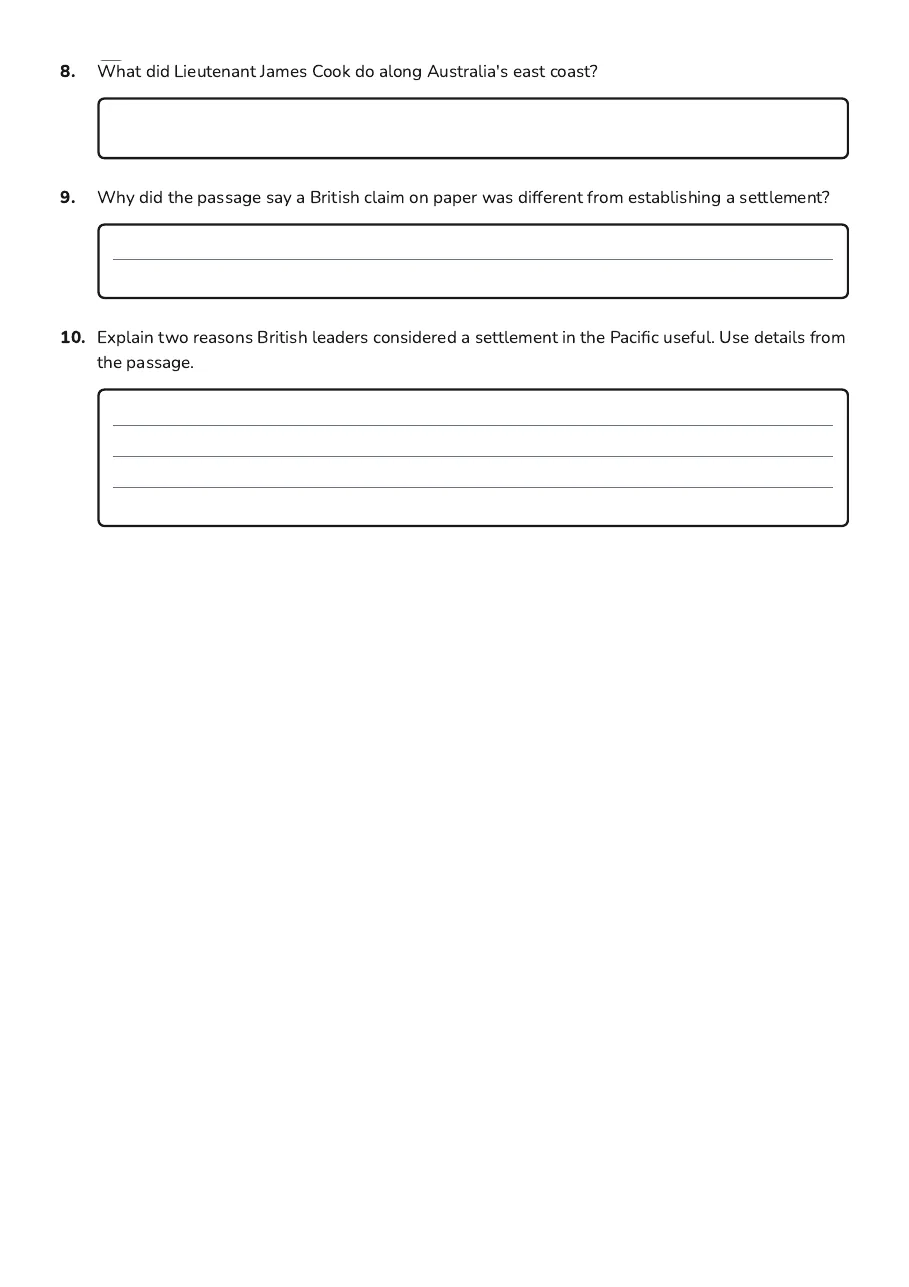
During the 1700s, European powers competed for influence across the oceans. Britain was concerned that rival countries, including France and Spain, might strengthen their position in the Pacific. In 1770, Lieutenant James Cook mapped parts of the east coast of Australia and claimed the coast for Britain. A claim on paper was not the same as living on the land. Britain later established a settlement at Sydney Cove in 1788. The continent was not empty: Aboriginal and Torres Strait Islander peoples had lived on and cared for these lands and waters for tens of thousands of years. British settlement brought a major disruption to their lives and communities. British leaders also viewed a Pacific settlement as a useful base. It could support ships and voyages in the region and help Britain strengthen its presence in the Pacific. These aims sat alongside the plan to transport convicts to New South Wales.
- France and Spain
- Portugal and Italy
- Germany and the Netherlands
3 printable pages
Page 1
Page 2
Page 3
About This Worksheet
Free in Kuraplan
Sign up free, grab the PDF, and customize it for your class.
Print-Ready
Formatted for standard paper. Clean layout, easy to read.
AI-Generated
Created with Kuraplan's AI, designed for real classroom use.
For Teachers & Parents
Use in classrooms, for homework, tutoring, or homeschool.
Need a custom version of this worksheet?
Kuraplan's AI generates custom worksheets in seconds — differentiated for every learner, aligned to your curriculum.
Generate Custom Worksheets — Free