TechnologyFreePrintable
Centre Pivot Irrigation Systems
A free technology worksheet ready for your classroom. Open in Kuraplan to grab the print-ready PDF, customize it for your students, or generate a fresh version in seconds.
Name:Date:
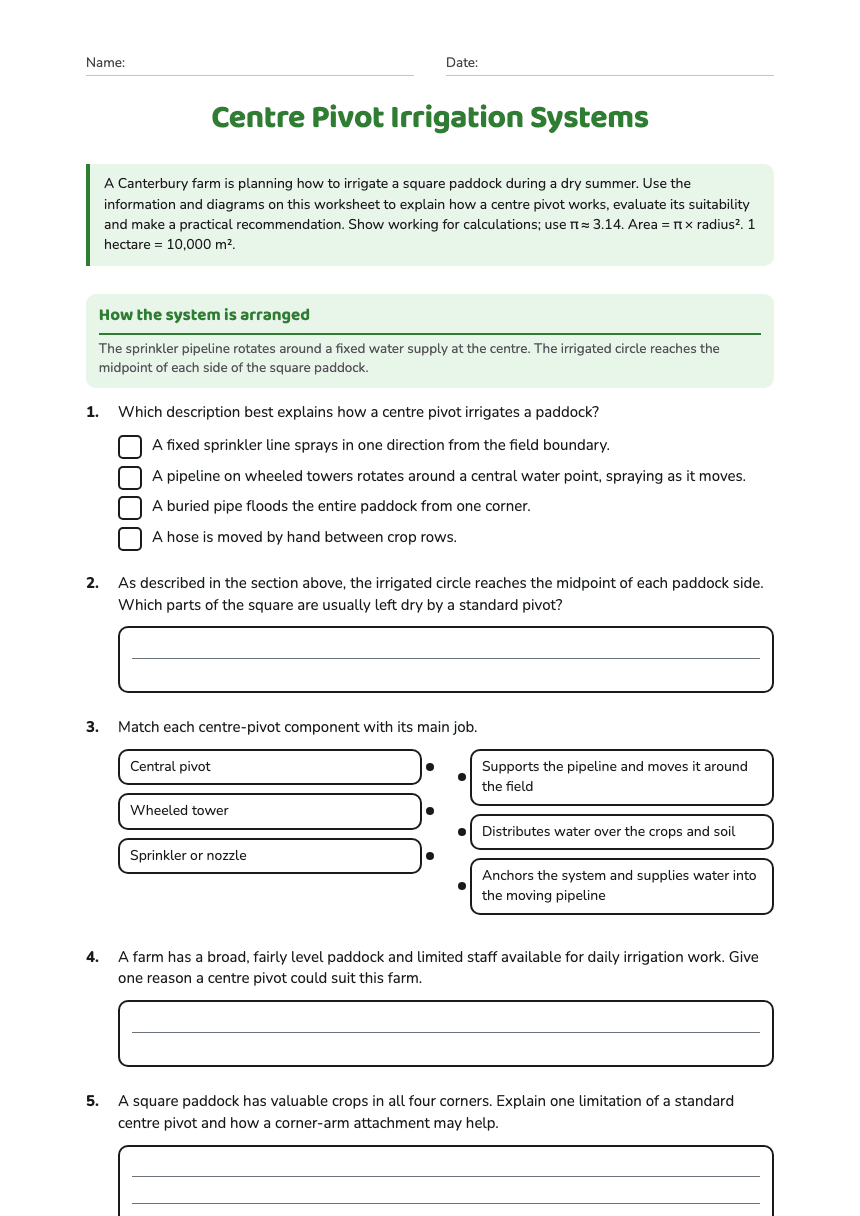
Centre Pivot Irrigation Systems
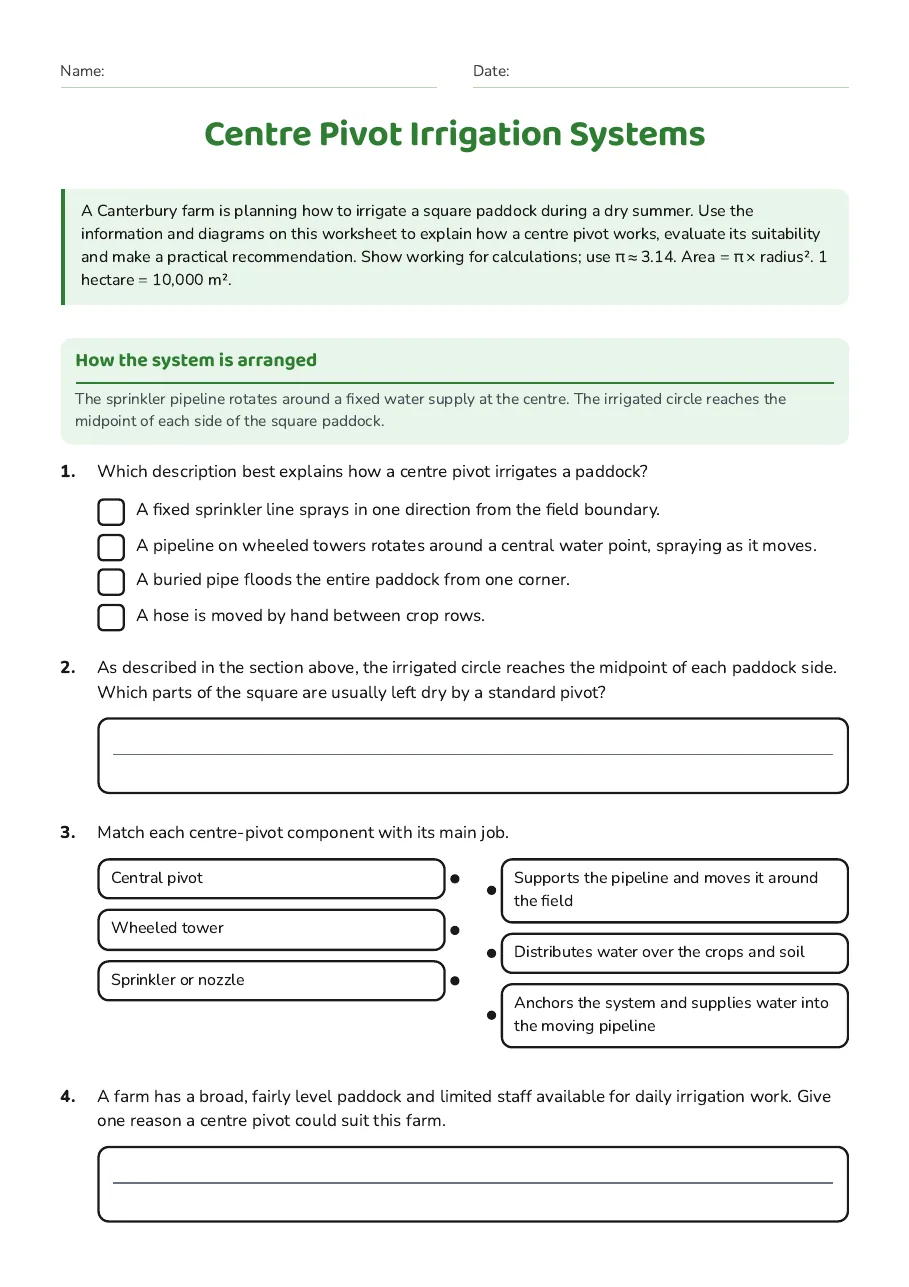
A Canterbury farm is planning how to irrigate a square paddock during a dry summer. Use the information and diagrams on this worksheet to explain how a centre pivot works, evaluate its suitability and make a practical recommendation. Show working for calculations; use π ≈ 3.14. Area = π × radius². 1 hectare = 10,000 m².
How the system is arranged
The sprinkler pipeline rotates around a fixed water supply at the centre. The irrigated circle reaches the midpoint of each side of the square paddock.
1.Which description best explains how a centre pivot irrigates a paddock?
- A fixed sprinkler line sprays in one direction from the field boundary.
- A pipeline on wheeled towers rotates around a central water point, spraying as it moves.
- A buried pipe floods the entire paddock from one corner.
- A hose is moved by hand between crop rows.
2.As described in the section above, the irrigated circle reaches the midpoint of each paddock side. Which parts of the square are usually left dry by a standard pivot?
3.Match each centre-pivot component with its main job.
- Central pivot
- Wheeled tower
- Sprinkler or nozzle
- Supports the pipeline and moves it around the field
- Distributes water over the crops and soil
- Anchors the system and supplies water into the moving pipeline
4.A farm has a broad, fairly level paddock and limited staff available for daily irrigation work. Give one reason a centre pivot could suit this farm.
5.A square paddock has valuable crops in all four corners. Explain one limitation of a standard centre pivot and how a corner-arm attachment may help.
Calculate and recommend
Use the stated measurements and formula. Include units and round sensibly.
6.A centre pivot has a radius of 250 m. Calculate its irrigated area in square metres, then convert the result to hectares. Use π ≈ 3.14 and 1 ha = 10,000 m².
7.The paddock is a 500 m × 500 m square. Find its total area in hectares. Then estimate how much of the paddock lies outside the pivot's circular irrigated area. Use your result from Question 6.
8.The operator wants to apply 20 mm of water across the 19.625 ha irrigated area. Convert 20 mm to metres, then estimate the volume of water needed. Use volume = area × depth and 1 ha = 10,000 m².
9.After irrigation, a farmer notices that one section of the crop is much drier than the rest. Suggest two possible checks or adjustments to improve water distribution.
10.In 3–4 sentences, recommend whether the farm should use a centre pivot on the square paddock. Refer to how it works, one benefit, one limitation and a practical way to address the limitation.
About This Worksheet
Free in Kuraplan
Sign up free, grab the PDF, and customize it for your class.
Print-Ready
Formatted for standard paper. Clean layout, easy to read.
AI-Generated
Created with Kuraplan's AI, designed for real classroom use.
For Teachers & Parents
Use in classrooms, for homework, tutoring, or homeschool.
Need a custom version of this worksheet?
Kuraplan's AI generates custom worksheets in seconds — differentiated for every learner, aligned to your curriculum.
Generate Custom Worksheets — Free No credit card Curriculum-aligned Under 60 seconds