ScienceFreePrintable
Chemical Changes: Decomposition Reactions
A free science worksheet ready for your classroom. Open in Kuraplan to grab the print-ready PDF, customize it for your students, or generate a fresh version in seconds.
Name:Date:
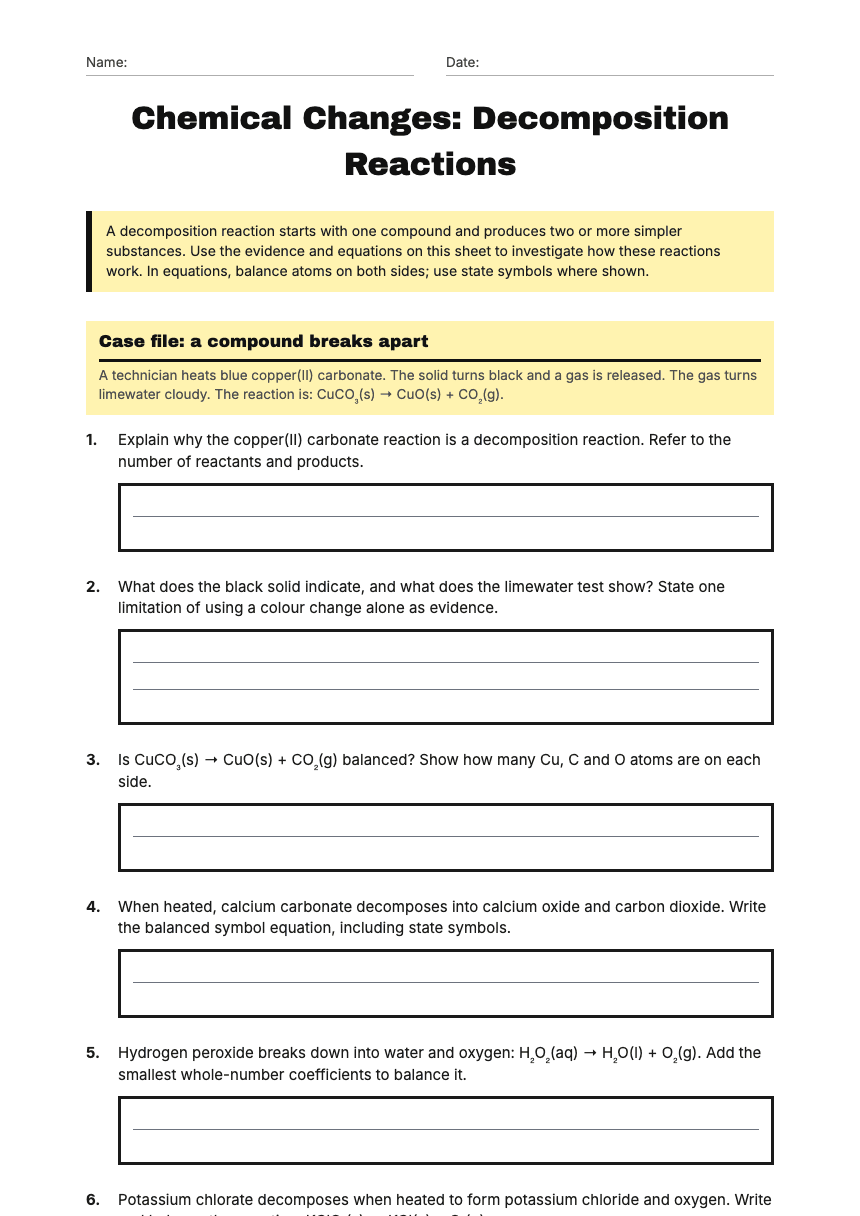
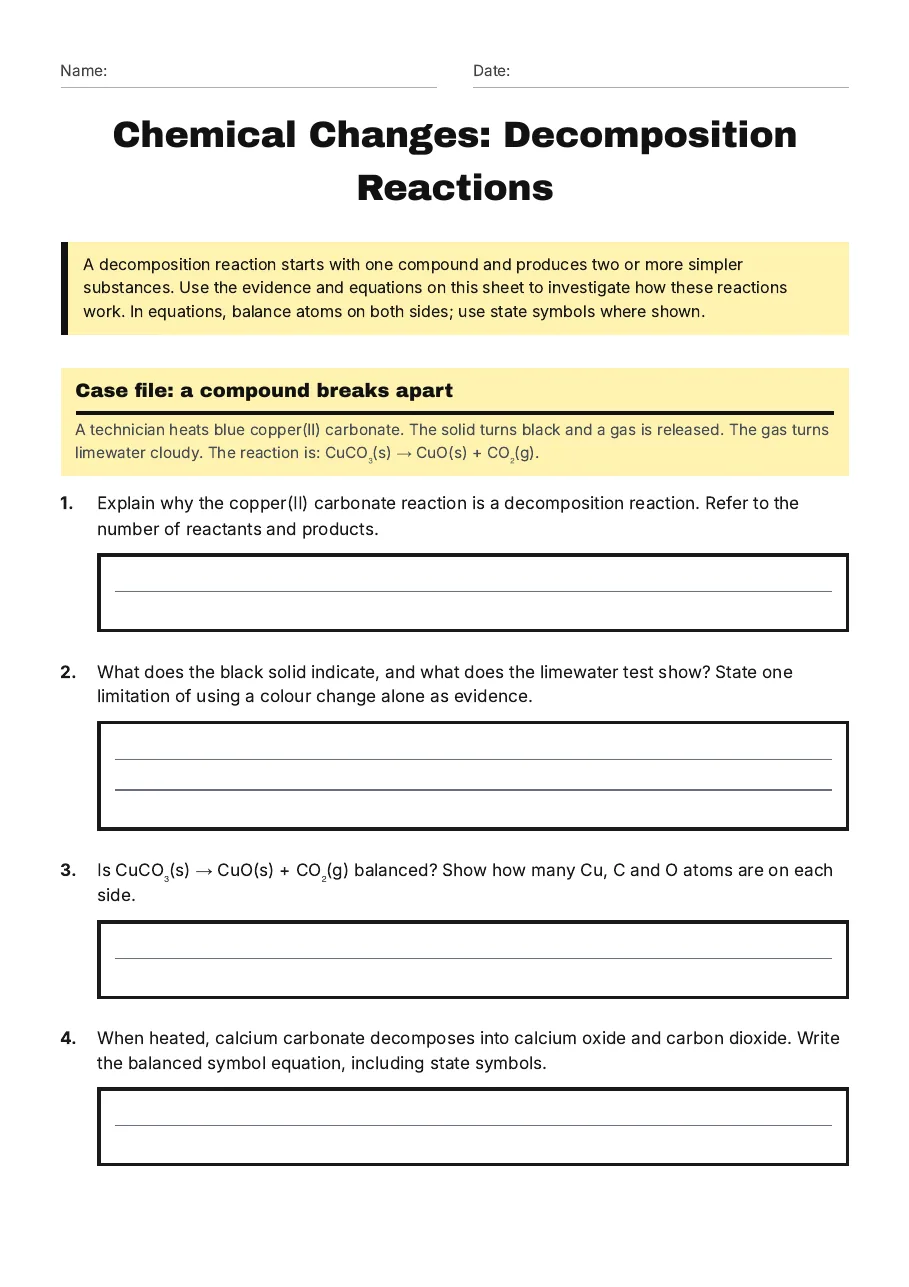
Chemical Changes: Decomposition Reactions
A decomposition reaction starts with one compound and produces two or more simpler substances. Use the evidence and equations on this sheet to investigate how these reactions work. In equations, balance atoms on both sides; use state symbols where shown.
Case file: a compound breaks apart
A technician heats blue copper(II) carbonate. The solid turns black and a gas is released. The gas turns limewater cloudy. The reaction is: CuCO₃(s) → CuO(s) + CO₂(g).
1.Explain why the copper(II) carbonate reaction is a decomposition reaction. Refer to the number of reactants and products.
2.What does the black solid indicate, and what does the limewater test show? State one limitation of using a colour change alone as evidence.
3.Is CuCO₃(s) → CuO(s) + CO₂(g) balanced? Show how many Cu, C and O atoms are on each side.
4.When heated, calcium carbonate decomposes into calcium oxide and carbon dioxide. Write the balanced symbol equation, including state symbols.
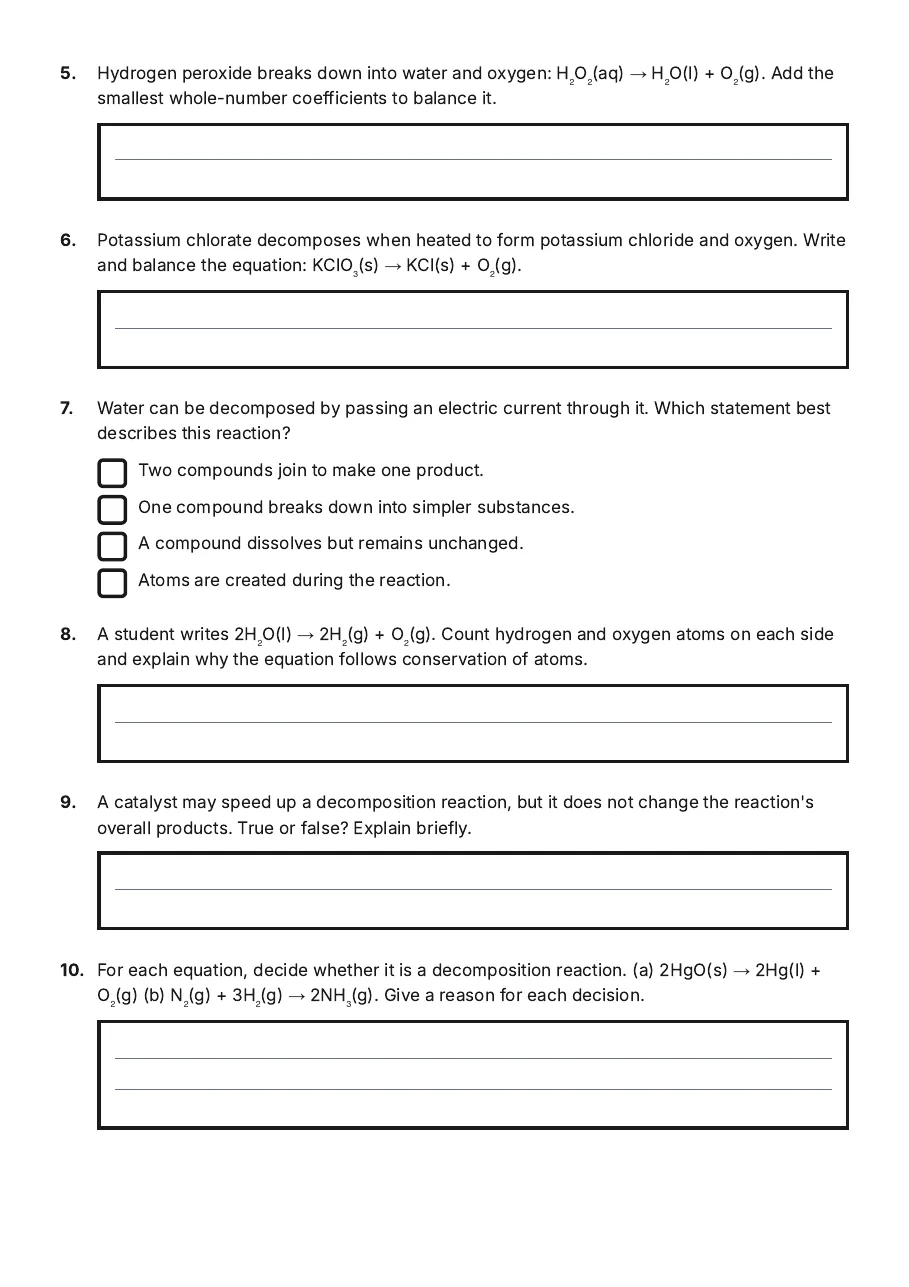
5.Hydrogen peroxide breaks down into water and oxygen: H₂O₂(aq) → H₂O(l) + O₂(g). Add the smallest whole-number coefficients to balance it.
6.Potassium chlorate decomposes when heated to form potassium chloride and oxygen. Write and balance the equation: KClO₃(s) → KCl(s) + O₂(g).
7.Water can be decomposed by passing an electric current through it. Which statement best describes this reaction?
- Two compounds join to make one product.
- One compound breaks down into simpler substances.
- A compound dissolves but remains unchanged.
- Atoms are created during the reaction.
8.A student writes 2H₂O(l) → 2H₂(g) + O₂(g). Count hydrogen and oxygen atoms on each side and explain why the equation follows conservation of atoms.
9.A catalyst may speed up a decomposition reaction, but it does not change the reaction's overall products. True or false? Explain briefly.
10.For each equation, decide whether it is a decomposition reaction. (a) 2HgO(s) → 2Hg(l) + O₂(g) (b) N₂(g) + 3H₂(g) → 2NH₃(g). Give a reason for each decision.
11.A carbonate rock is heated in an industrial kiln, producing a metal oxide and carbon dioxide. Suggest the general word equation for this type of decomposition and name the energy source that drives it.
3 printable pages
Page 1
Page 2

Page 3
About This Worksheet
Free in Kuraplan
Sign up free, grab the PDF, and customize it for your class.
Print-Ready
Formatted for standard paper. Clean layout, easy to read.
AI-Generated
Created with Kuraplan's AI, designed for real classroom use.
For Teachers & Parents
Use in classrooms, for homework, tutoring, or homeschool.
Need a custom version of this worksheet?
Kuraplan's AI generates custom worksheets in seconds — differentiated for every learner, aligned to your curriculum.
Generate Custom Worksheets — Free No credit card Curriculum-aligned Under 60 seconds
More Science Worksheets
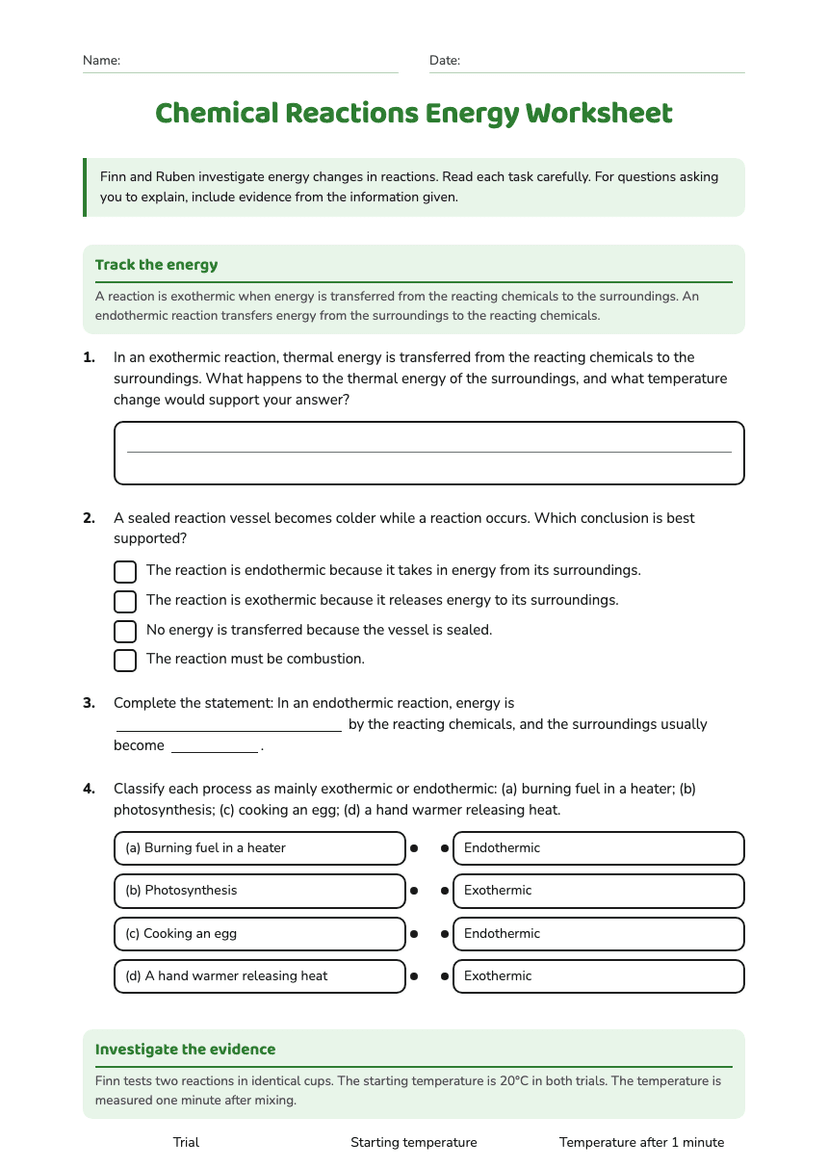
Chemical Reactions Energy Worksheet
Free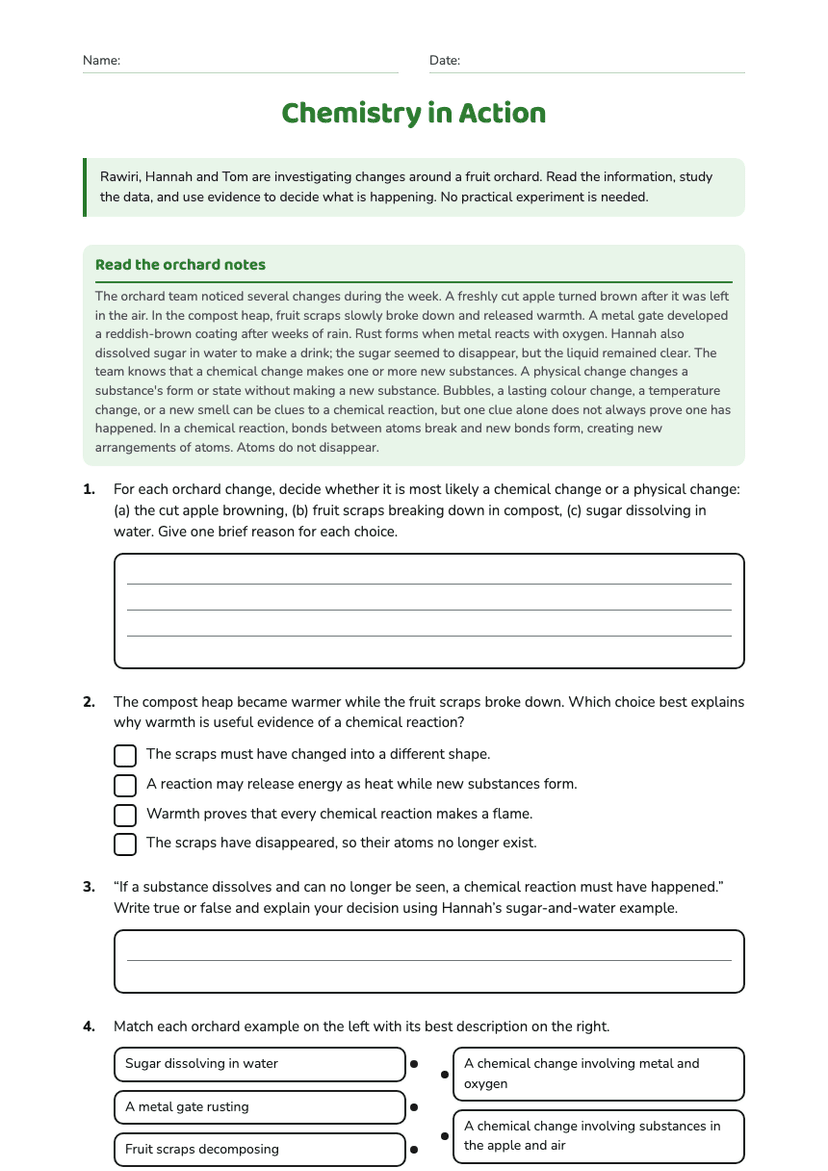
Year 7
Chemistry in Action
Free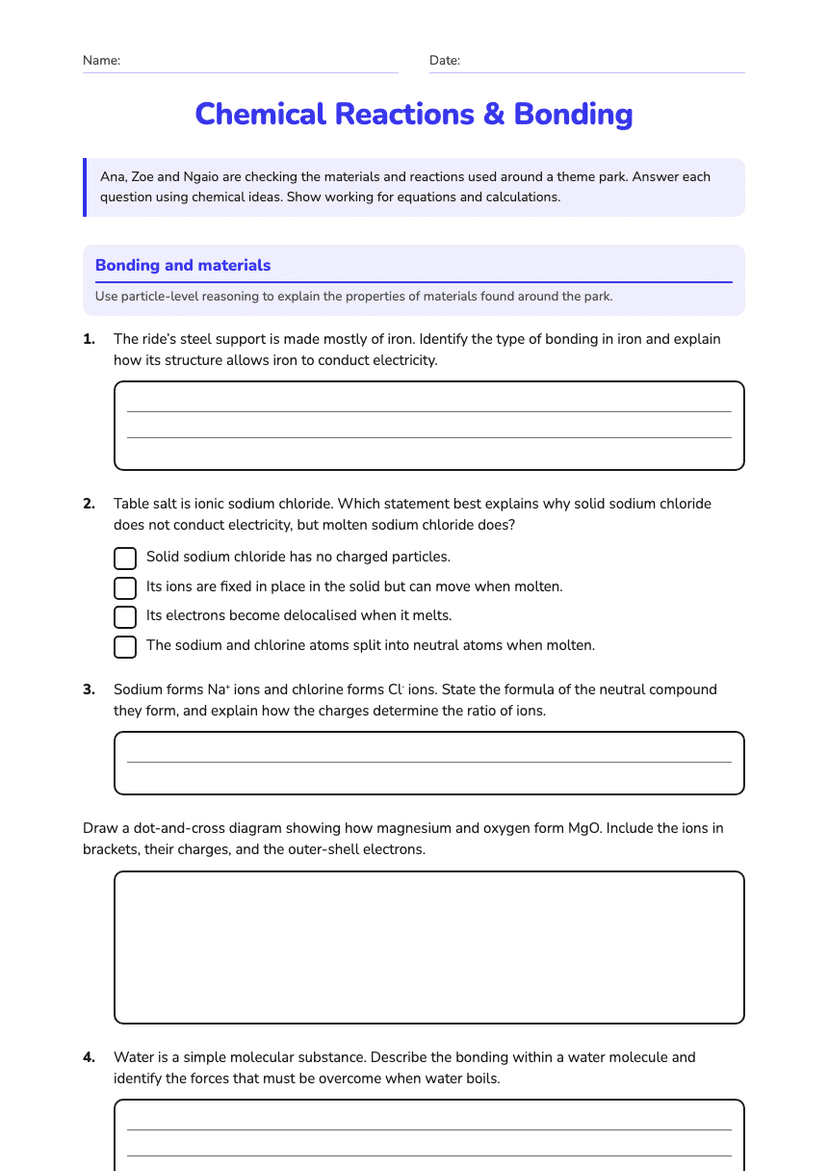
Year 11
Chemical Reactions & Bonding
Free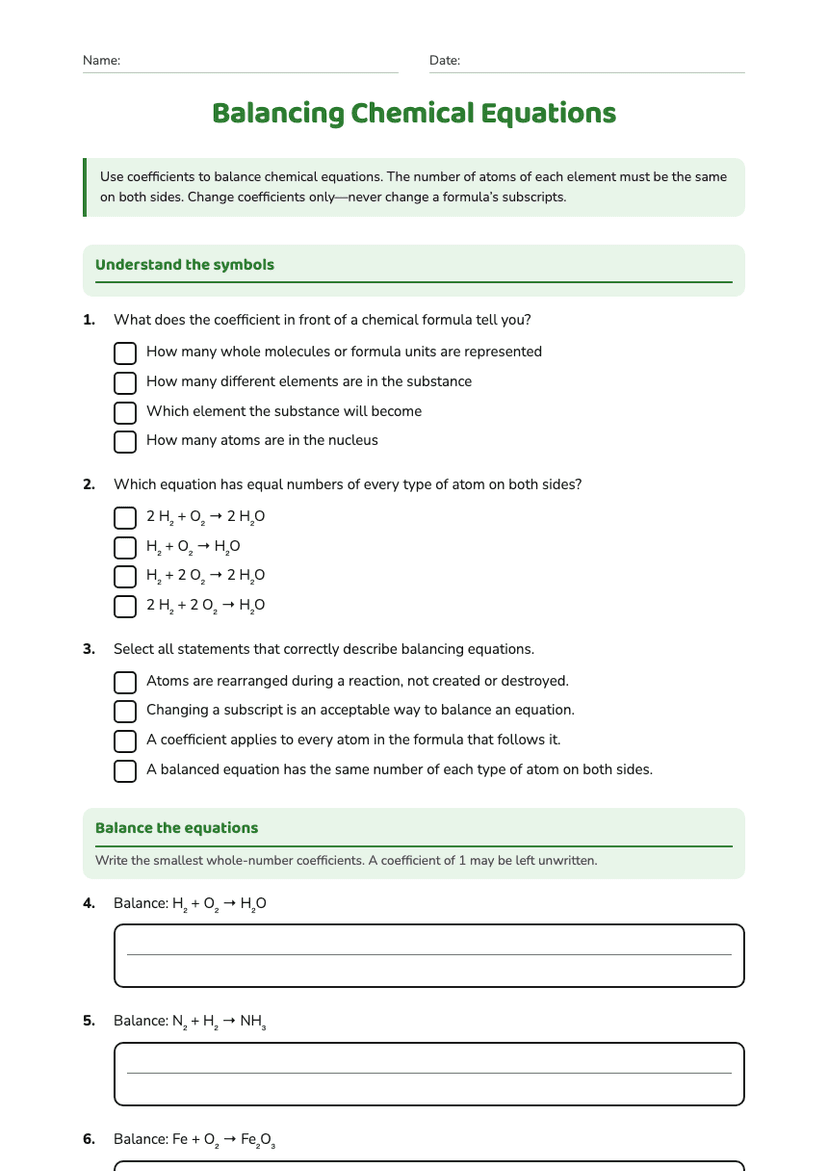
Year 7–8
Balancing Chemical Equations
Free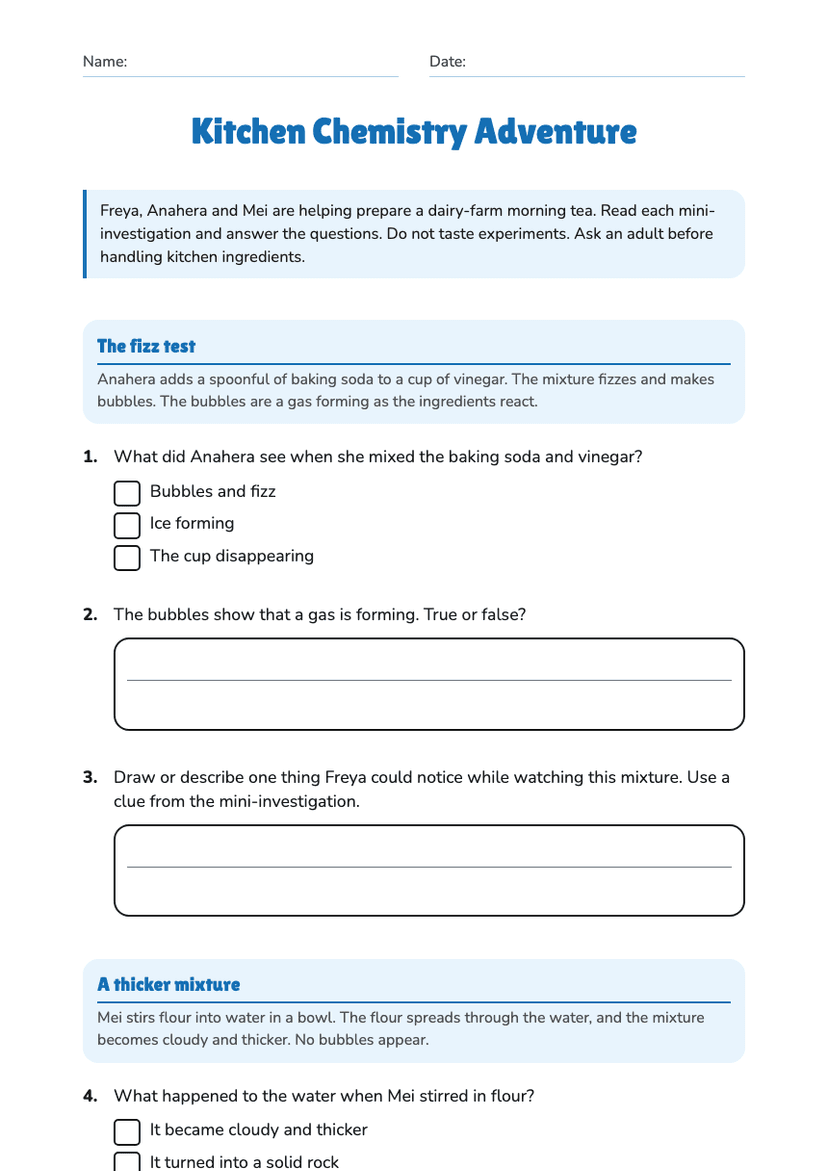
Year 2
Kitchen Chemistry Adventure
Free
Year 11
Chemical Reactions Introduction
Free
Year 9
Element Flashcards Worksheet
Free
Year 7–8