MathsFreePrintable
Classifying Triangles and Pyramids
A free maths worksheet ready for your classroom. Open in Kuraplan to grab the print-ready PDF, customize it for your students, or generate a fresh version in seconds.
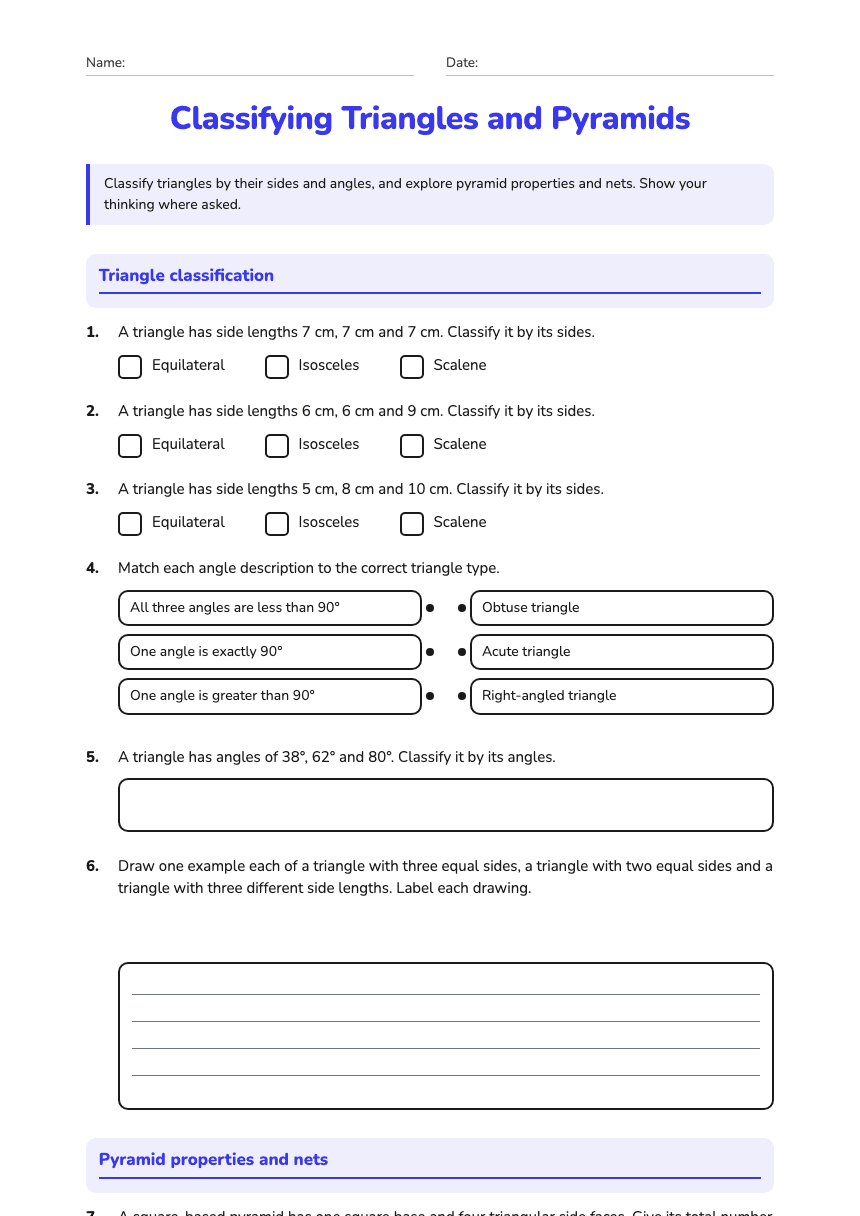
Name:Date:
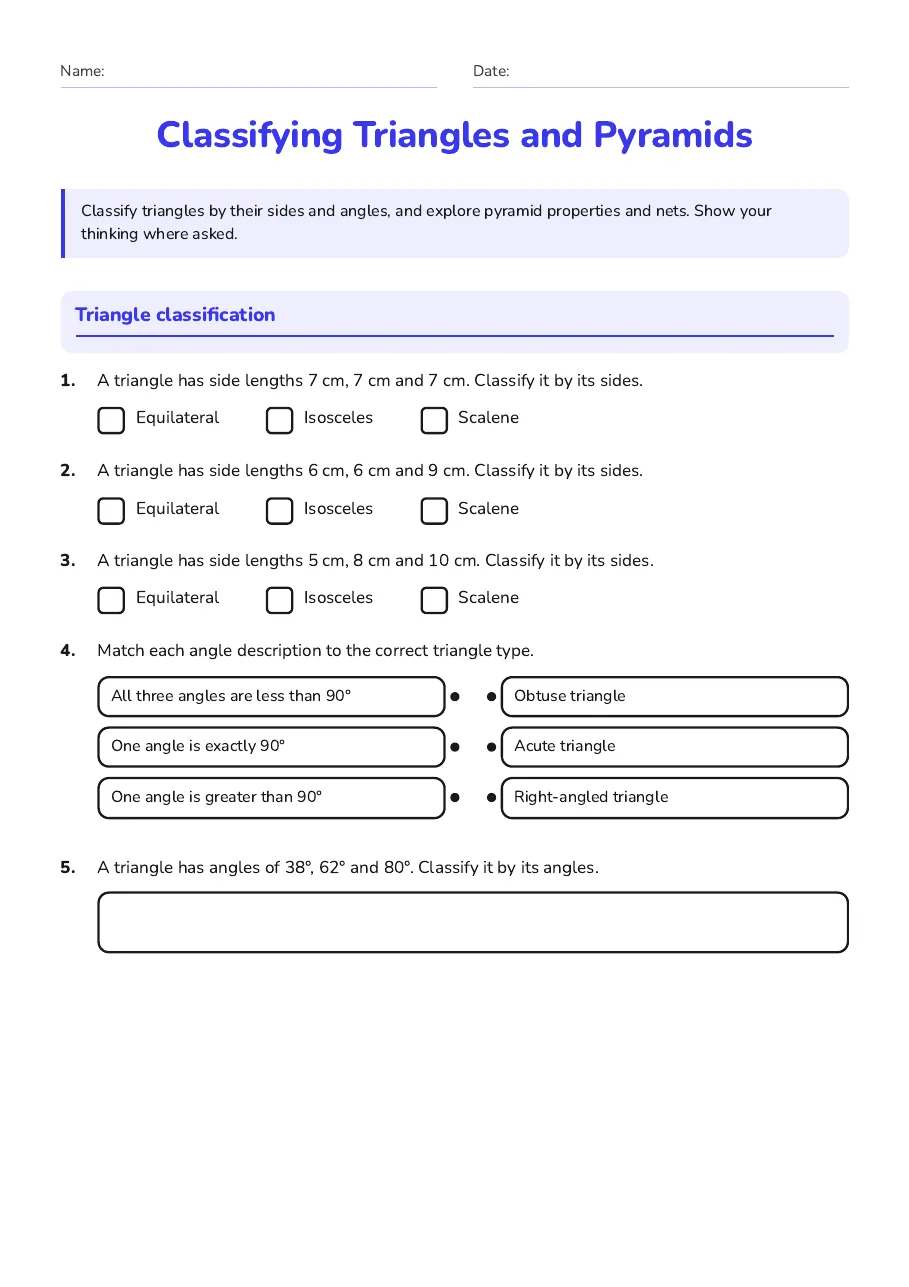
Classifying Triangles and Pyramids
Classify triangles by their sides and angles, and explore pyramid properties and nets. Show your thinking where asked.
Triangle classification
1.A triangle has side lengths 7 cm, 7 cm and 7 cm. Classify it by its sides.
- Equilateral
- Isosceles
- Scalene
2.A triangle has side lengths 6 cm, 6 cm and 9 cm. Classify it by its sides.
- Equilateral
- Isosceles
- Scalene
3.A triangle has side lengths 5 cm, 8 cm and 10 cm. Classify it by its sides.
- Equilateral
- Isosceles
- Scalene
4.Match each angle description to the correct triangle type.
- All three angles are less than 90°
- One angle is exactly 90°
- One angle is greater than 90°
- Obtuse triangle
- Acute triangle
- Right-angled triangle
5.A triangle has angles of 38°, 62° and 80°. Classify it by its angles.
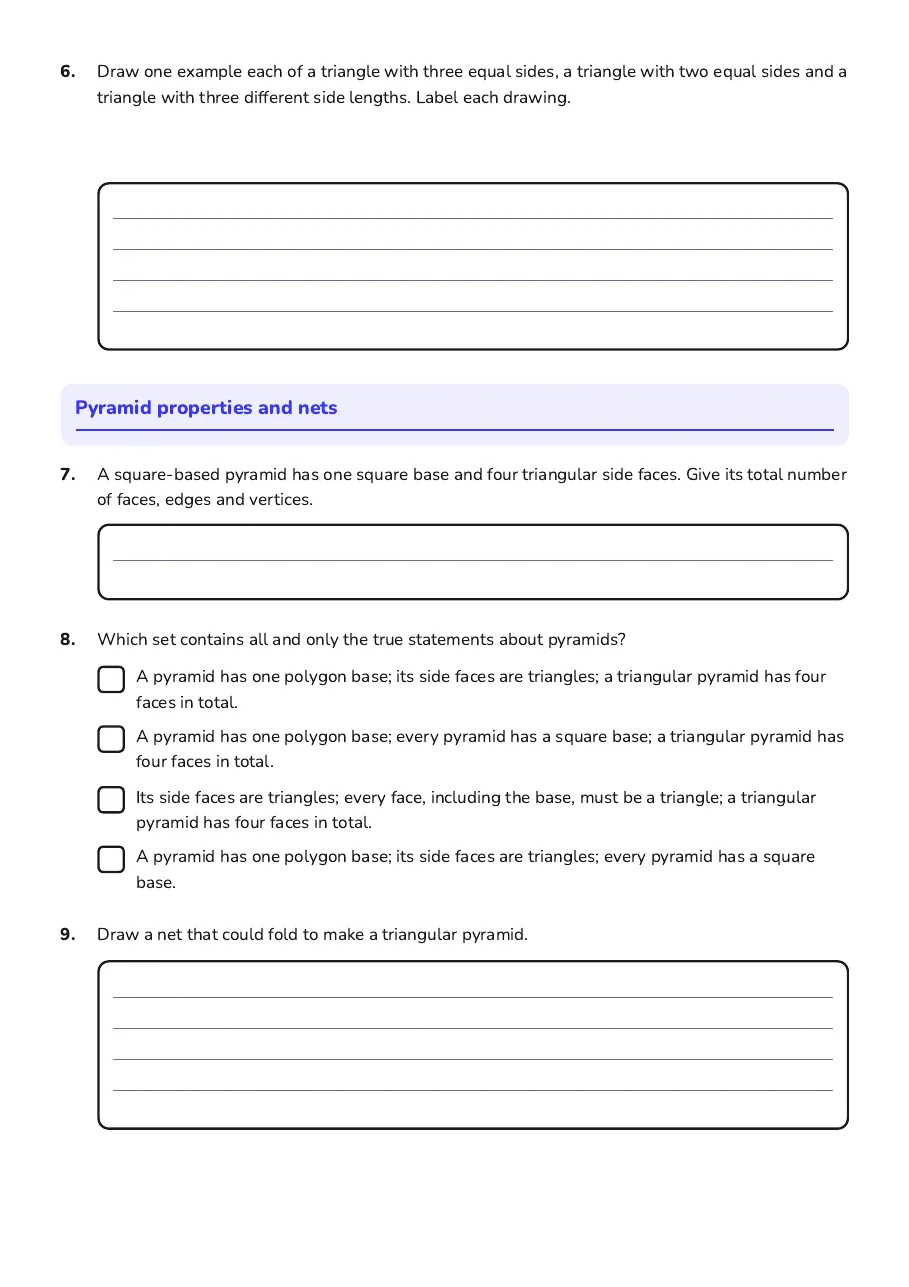
6.Draw one example each of a triangle with three equal sides, a triangle with two equal sides and a triangle with three different side lengths. Label each drawing.
Pyramid properties and nets
7.A square-based pyramid has one square base and four triangular side faces. Give its total number of faces, edges and vertices.
8.Which set contains all and only the true statements about pyramids?
- A pyramid has one polygon base; its side faces are triangles; a triangular pyramid has four faces in total.
- A pyramid has one polygon base; every pyramid has a square base; a triangular pyramid has four faces in total.
- Its side faces are triangles; every face, including the base, must be a triangle; a triangular pyramid has four faces in total.
- A pyramid has one polygon base; its side faces are triangles; every pyramid has a square base.
9.Draw a net that could fold to make a triangular pyramid.
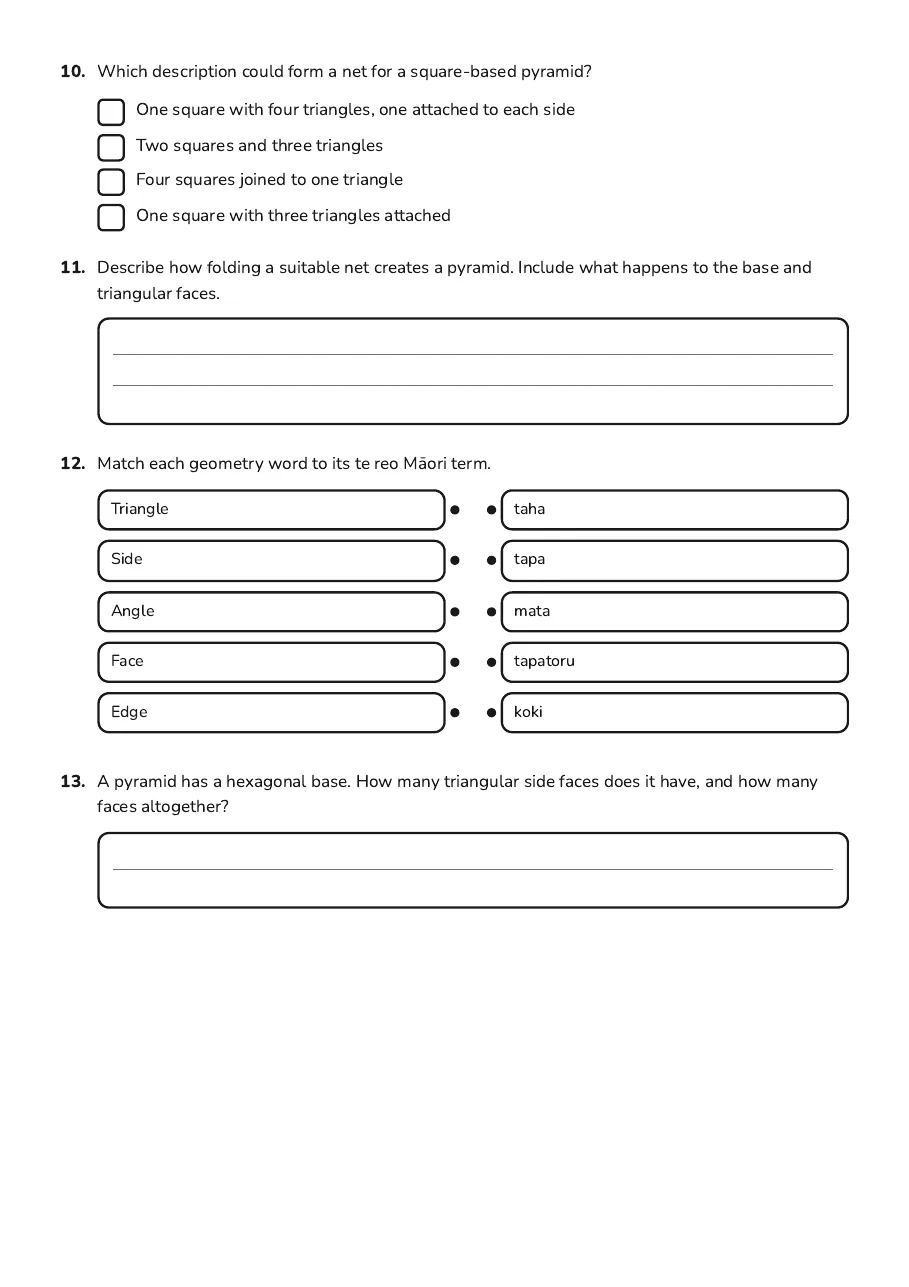
10.Which description could form a net for a square-based pyramid?
- One square with four triangles, one attached to each side
- Two squares and three triangles
- Four squares joined to one triangle
- One square with three triangles attached
11.Describe how folding a suitable net creates a pyramid. Include what happens to the base and triangular faces.
12.Match each geometry word to its te reo Māori term.
- Triangle
- Side
- Angle
- Face
- Edge
- taha
- tapa
- mata
- tapatoru
- koki
13.A pyramid has a hexagonal base. How many triangular side faces does it have, and how many faces altogether?
3 printable pages
Page 1
Page 2
Page 3
About This Worksheet
Free in Kuraplan
Sign up free, grab the PDF, and customize it for your class.
Print-Ready
Formatted for standard paper. Clean layout, easy to read.
AI-Generated
Created with Kuraplan's AI, designed for real classroom use.
For Teachers & Parents
Use in classrooms, for homework, tutoring, or homeschool.
Need a custom version of this worksheet?
Kuraplan's AI generates custom worksheets in seconds — differentiated for every learner, aligned to your curriculum.
Generate Custom Worksheets — Free No credit card Curriculum-aligned Under 60 seconds