A free english worksheet ready for your classroom. Open in Kuraplan to grab the print-ready PDF, customize it for your students, or generate a fresh version in seconds.
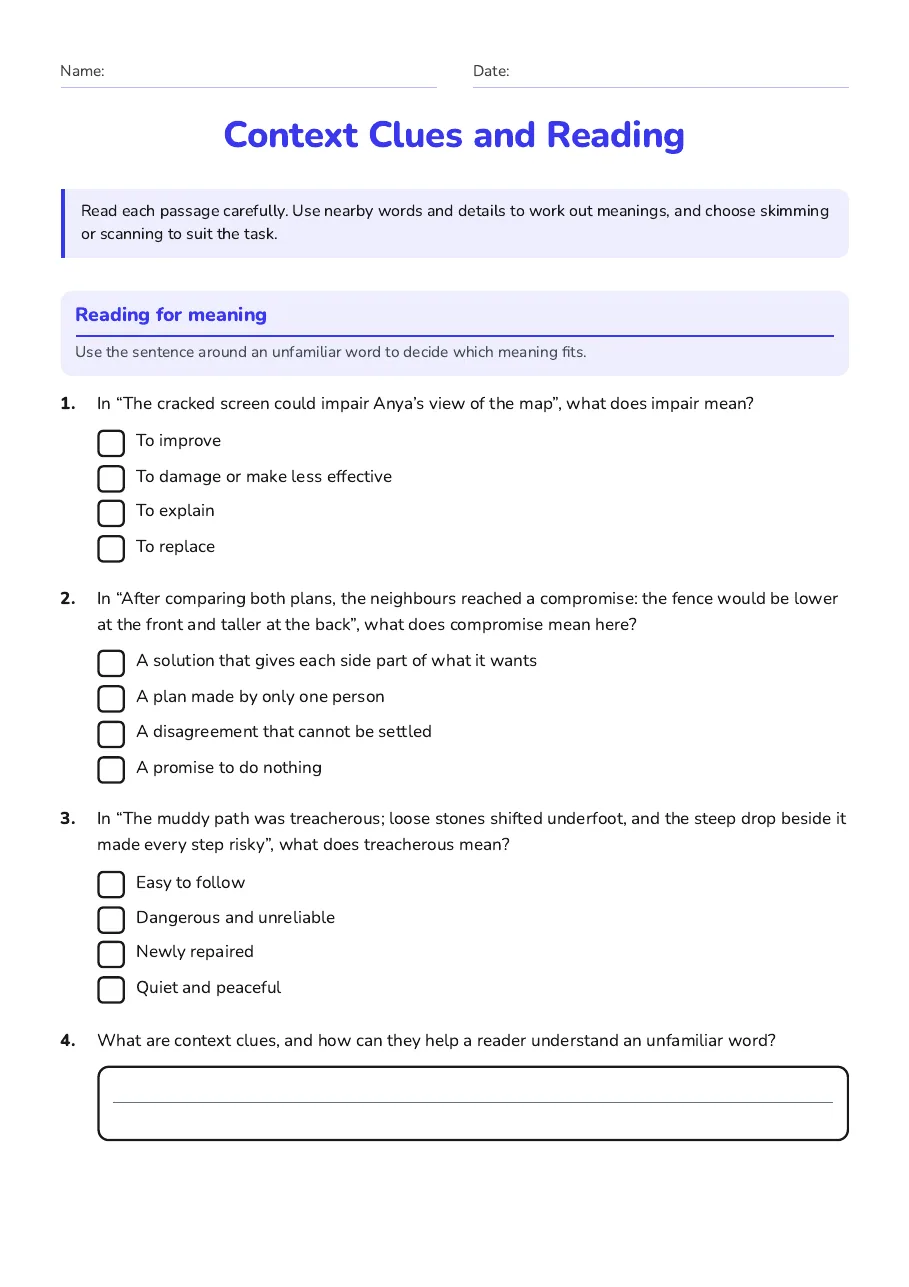
Read each passage carefully. Use nearby words and details to work out meanings, and choose skimming or scanning to suit the task.
Reading for meaning
Use the sentence around an unfamiliar word to decide which meaning fits.
1.In “The cracked screen could impair Anya’s view of the map”, what does impair mean?
To improve
To damage or make less effective
To explain
To replace
2.In “After comparing both plans, the neighbours reached a compromise: the fence would be lower at the front and taller at the back”, what does compromise mean here?
A solution that gives each side part of what it wants
A plan made by only one person
A disagreement that cannot be settled
A promise to do nothing
3.In “The muddy path was treacherous; loose stones shifted underfoot, and the steep drop beside it made every step risky”, what does treacherous mean?
Easy to follow
Dangerous and unreliable
Newly repaired
Quiet and peaceful
4.What are context clues, and how can they help a reader understand an unfamiliar word?
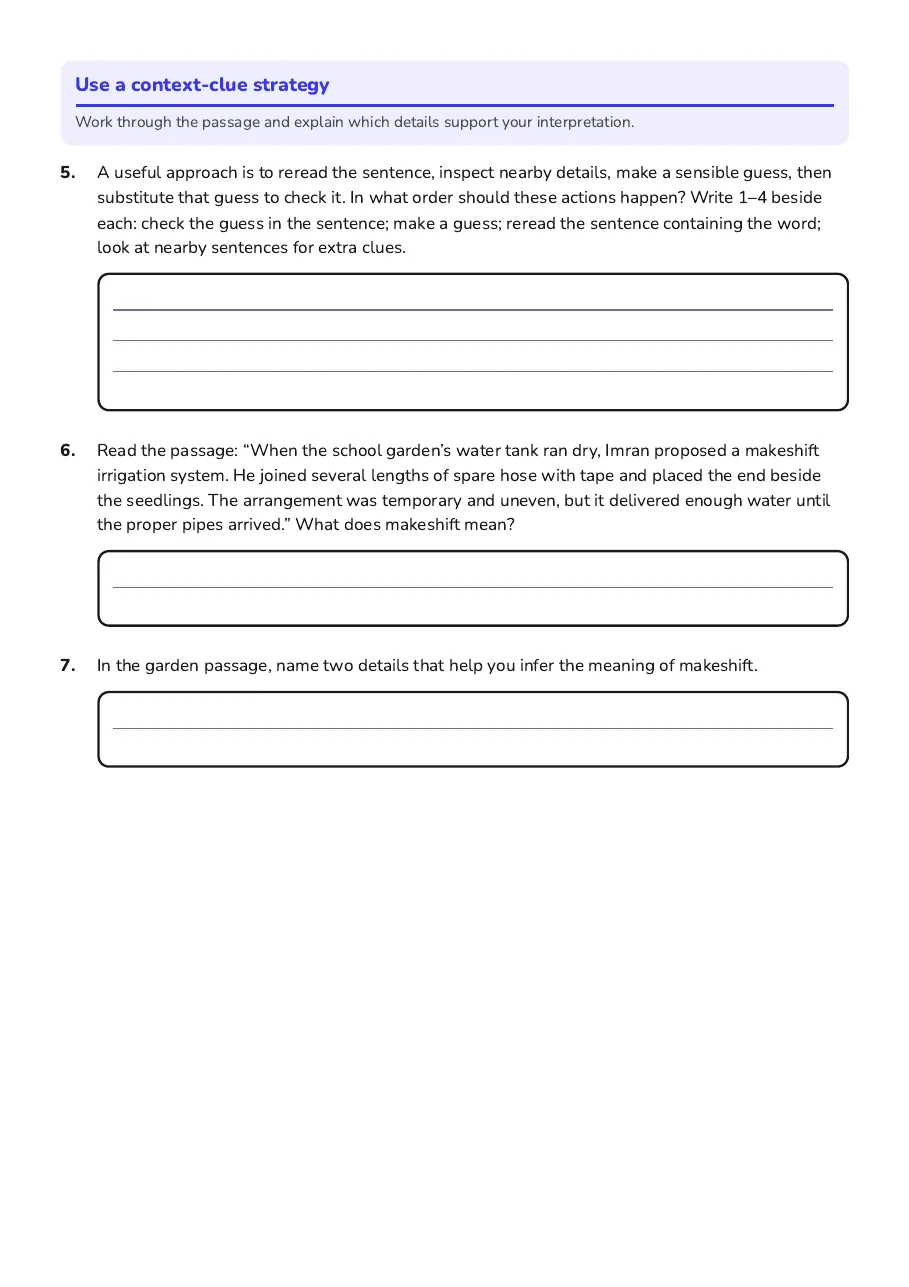
Use a context-clue strategy
Work through the passage and explain which details support your interpretation.
5.A useful approach is to reread the sentence, inspect nearby details, make a sensible guess, then substitute that guess to check it. In what order should these actions happen? Write 1–4 beside each: check the guess in the sentence; make a guess; reread the sentence containing the word; look at nearby sentences for extra clues.
6.Read the passage: “When the school garden’s water tank ran dry, Imran proposed a makeshift irrigation system. He joined several lengths of spare hose with tape and placed the end beside the seedlings. The arrangement was temporary and uneven, but it delivered enough water until the proper pipes arrived.” What does makeshift mean?
7.In the garden passage, name two details that help you infer the meaning of makeshift.
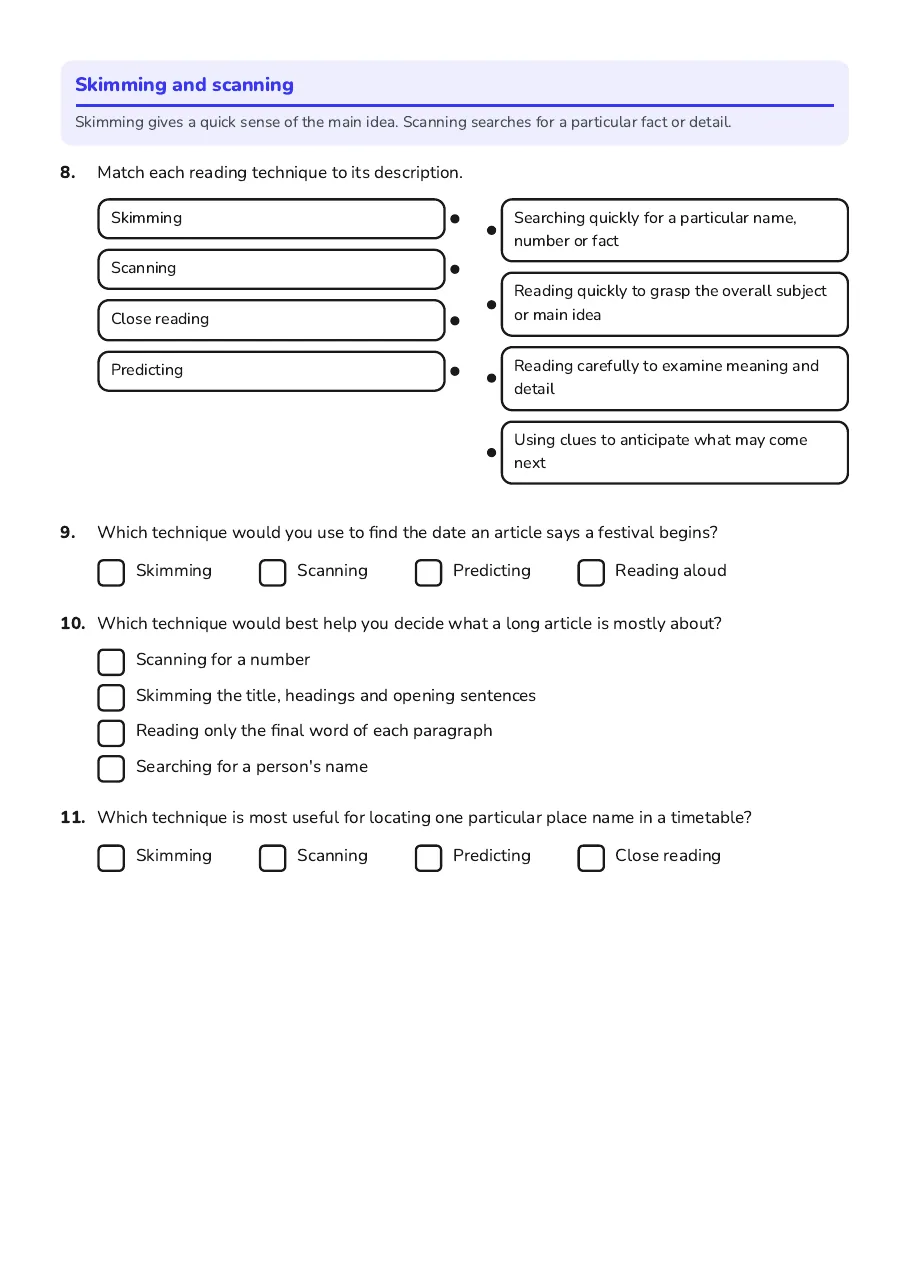
Skimming and scanning
Skimming gives a quick sense of the main idea. Scanning searches for a particular fact or detail.
8.Match each reading technique to its description.
Skimming
Scanning
Close reading
Predicting
Searching quickly for a particular name, number or fact
Reading quickly to grasp the overall subject or main idea
Reading carefully to examine meaning and detail
Using clues to anticipate what may come next
9.Which technique would you use to find the date an article says a festival begins?
Skimming
Scanning
Predicting
Reading aloud
10.Which technique would best help you decide what a long article is mostly about?
Scanning for a number
Skimming the title, headings and opening sentences
Reading only the final word of each paragraph
Searching for a person's name
11.Which technique is most useful for locating one particular place name in a timetable?
Skimming
Scanning
Predicting
Close reading
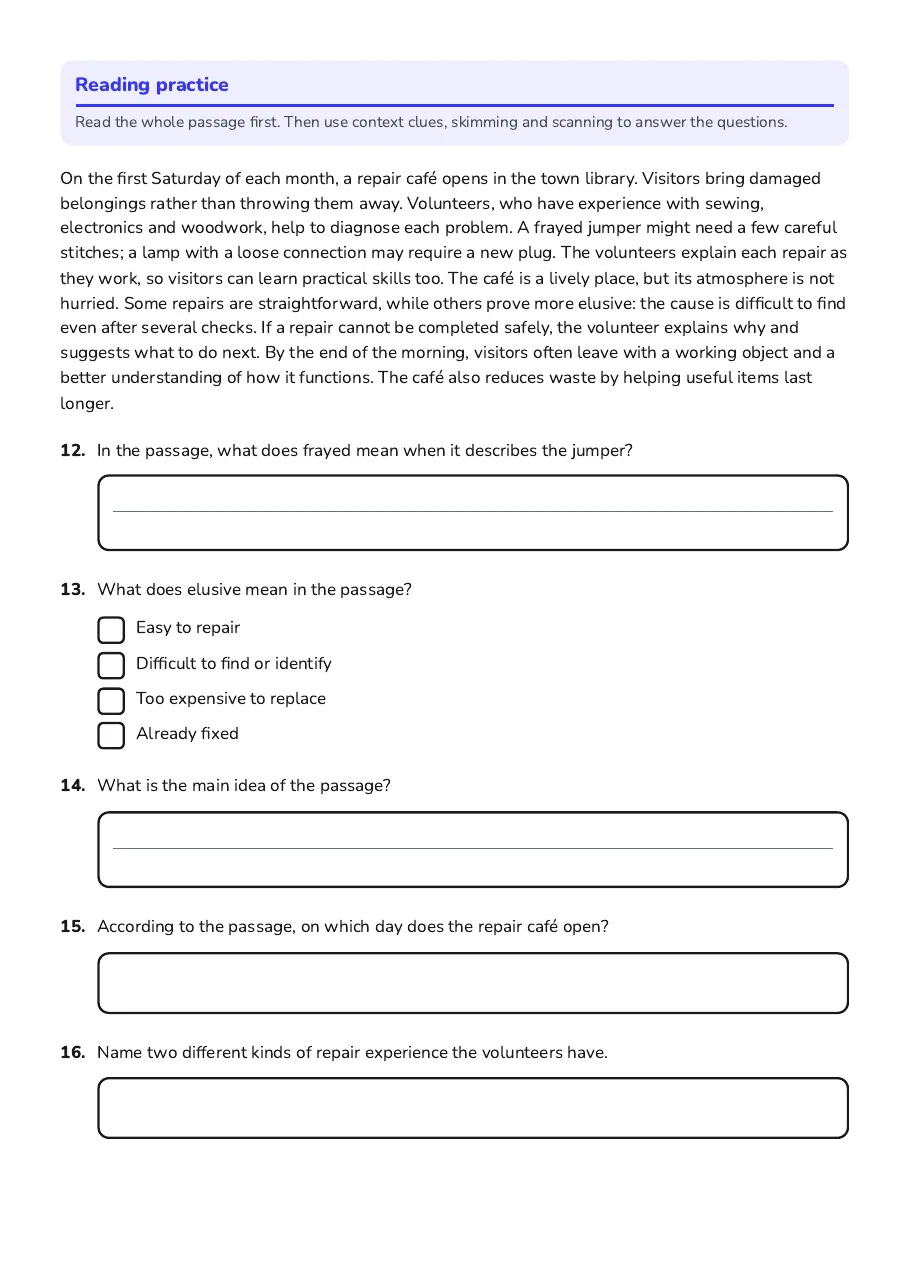
Reading practice
Read the whole passage first. Then use context clues, skimming and scanning to answer the questions.
On the first Saturday of each month, a repair café opens in the town library. Visitors bring damaged belongings rather than throwing them away. Volunteers, who have experience with sewing, electronics and woodwork, help to diagnose each problem. A frayed jumper might need a few careful stitches; a lamp with a loose connection may require a new plug. The volunteers explain each repair as they work, so visitors can learn practical skills too.
The café is a lively place, but its atmosphere is not hurried. Some repairs are straightforward, while others prove more elusive: the cause is difficult to find even after several checks. If a repair cannot be completed safely, the volunteer explains why and suggests what to do next. By the end of the morning, visitors often leave with a working object and a better understanding of how it functions. The café also reduces waste by helping useful items last longer.
12.In the passage, what does frayed mean when it describes the jumper?
13.What does elusive mean in the passage?
Easy to repair
Difficult to find or identify
Too expensive to replace
Already fixed
14.What is the main idea of the passage?
15.According to the passage, on which day does the repair café open?
16.Name two different kinds of repair experience the volunteers have.
17.Why might a volunteer recommend what to do next instead of completing a repair?
18.The word straightforward is used to describe some repairs. Which meaning fits best?
Simple and easy to understand or do
Dangerous to attempt
Unusual and surprising
Impossible to finish
19.Give one detail from the passage that shows the café helps the environment.
20.Write a sentence using advocate to mean someone who publicly supports an idea or cause. Include a clue that makes this meaning clear.
21.In one or two sentences, explain how you could use skimming and scanning when researching a topic online.