A free english worksheet ready for your classroom. Open in Kuraplan to grab the print-ready PDF, customize it for your students, or generate a fresh version in seconds.
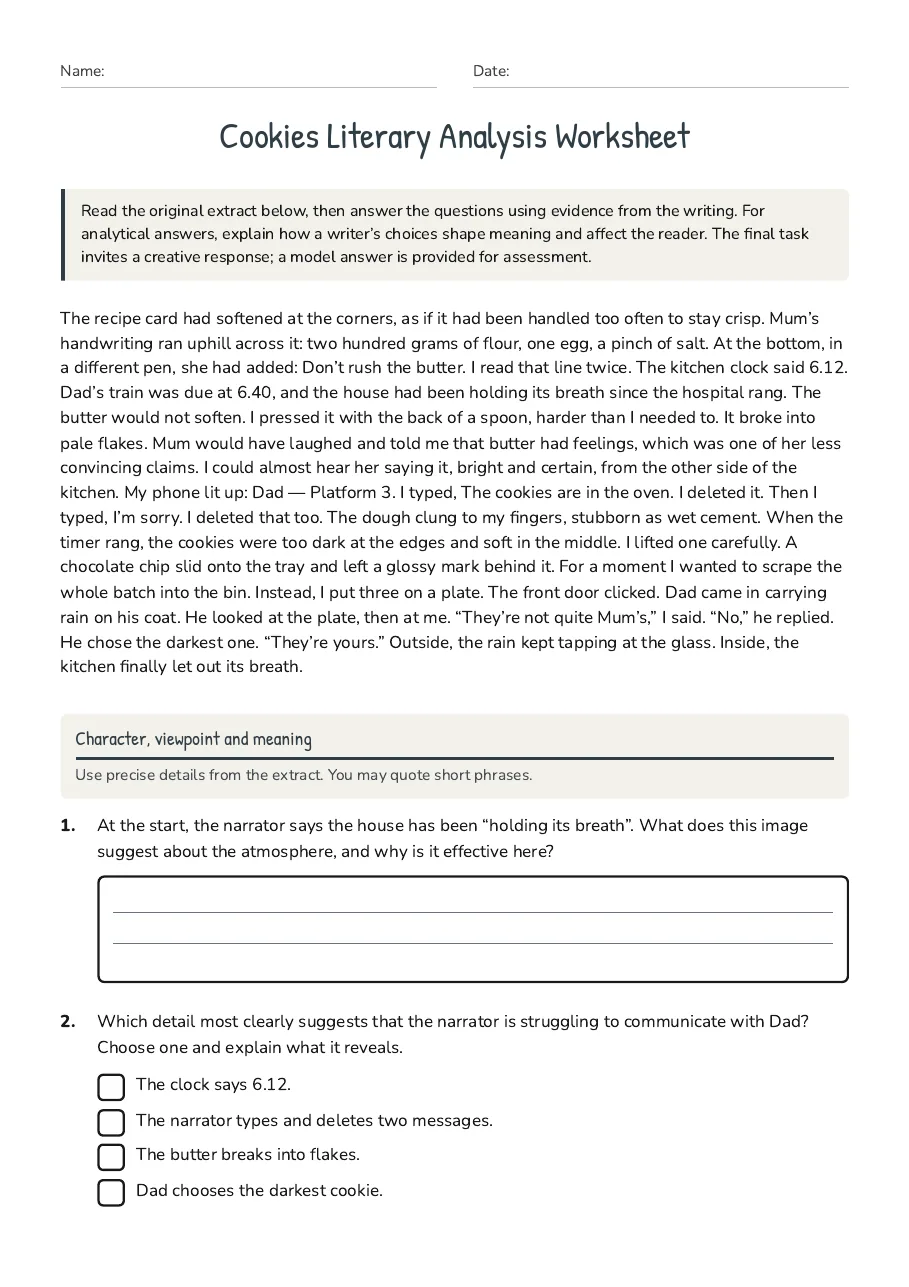
Read the original extract below, then answer the questions using evidence from the writing. For analytical answers, explain how a writer’s choices shape meaning and affect the reader. The final task invites a creative response; a model answer is provided for assessment.
The recipe card had softened at the corners, as if it had been handled too often to stay crisp. Mum’s handwriting ran uphill across it: two hundred grams of flour, one egg, a pinch of salt. At the bottom, in a different pen, she had added: Don’t rush the butter.
I read that line twice. The kitchen clock said 6.12. Dad’s train was due at 6.40, and the house had been holding its breath since the hospital rang.
The butter would not soften. I pressed it with the back of a spoon, harder than I needed to. It broke into pale flakes. Mum would have laughed and told me that butter had feelings, which was one of her less convincing claims. I could almost hear her saying it, bright and certain, from the other side of the kitchen.
My phone lit up: Dad — Platform 3. I typed, The cookies are in the oven. I deleted it. Then I typed, I’m sorry. I deleted that too. The dough clung to my fingers, stubborn as wet cement.
When the timer rang, the cookies were too dark at the edges and soft in the middle. I lifted one carefully. A chocolate chip slid onto the tray and left a glossy mark behind it. For a moment I wanted to scrape the whole batch into the bin. Instead, I put three on a plate.
The front door clicked. Dad came in carrying rain on his coat. He looked at the plate, then at me.
“They’re not quite Mum’s,” I said.
“No,” he replied. He chose the darkest one. “They’re yours.”
Outside, the rain kept tapping at the glass. Inside, the kitchen finally let out its breath.
Character, viewpoint and meaning
Use precise details from the extract. You may quote short phrases.
1.At the start, the narrator says the house has been “holding its breath”. What does this image suggest about the atmosphere, and why is it effective here?
2.Which detail most clearly suggests that the narrator is struggling to communicate with Dad? Choose one and explain what it reveals.
The clock says 6.12.
The narrator types and deletes two messages.
The butter breaks into flakes.
Dad chooses the darkest cookie.
3.The story is told in the first person. How does this viewpoint shape what the reader understands about Mum and the narrator’s feelings? Support your answer with one detail.
4.Which interpretation of the recipe card is best supported by the extract?
It is a practical object with no emotional importance.
It connects the narrator to Mum and to a familiar shared routine.
It proves that the narrator is an expert baker.
It represents Dad’s dislike of cooking.
5.Explain how the narrator’s attitude towards the cookies changes between wanting to throw the batch away and placing three on a plate. What might this change suggest?
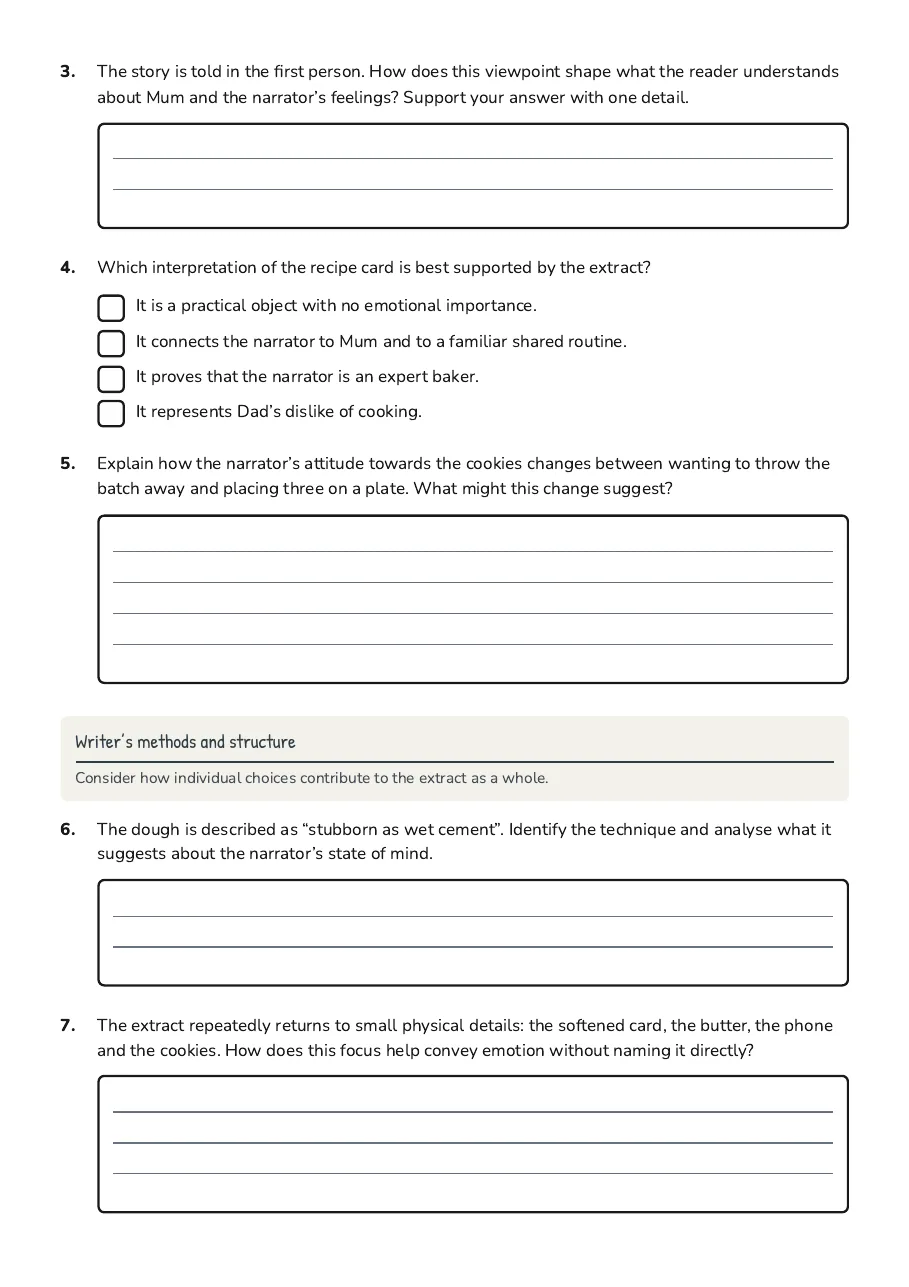
Writer’s methods and structure
Consider how individual choices contribute to the extract as a whole.
6.The dough is described as “stubborn as wet cement”. Identify the technique and analyse what it suggests about the narrator’s state of mind.
7.The extract repeatedly returns to small physical details: the softened card, the butter, the phone and the cookies. How does this focus help convey emotion without naming it directly?
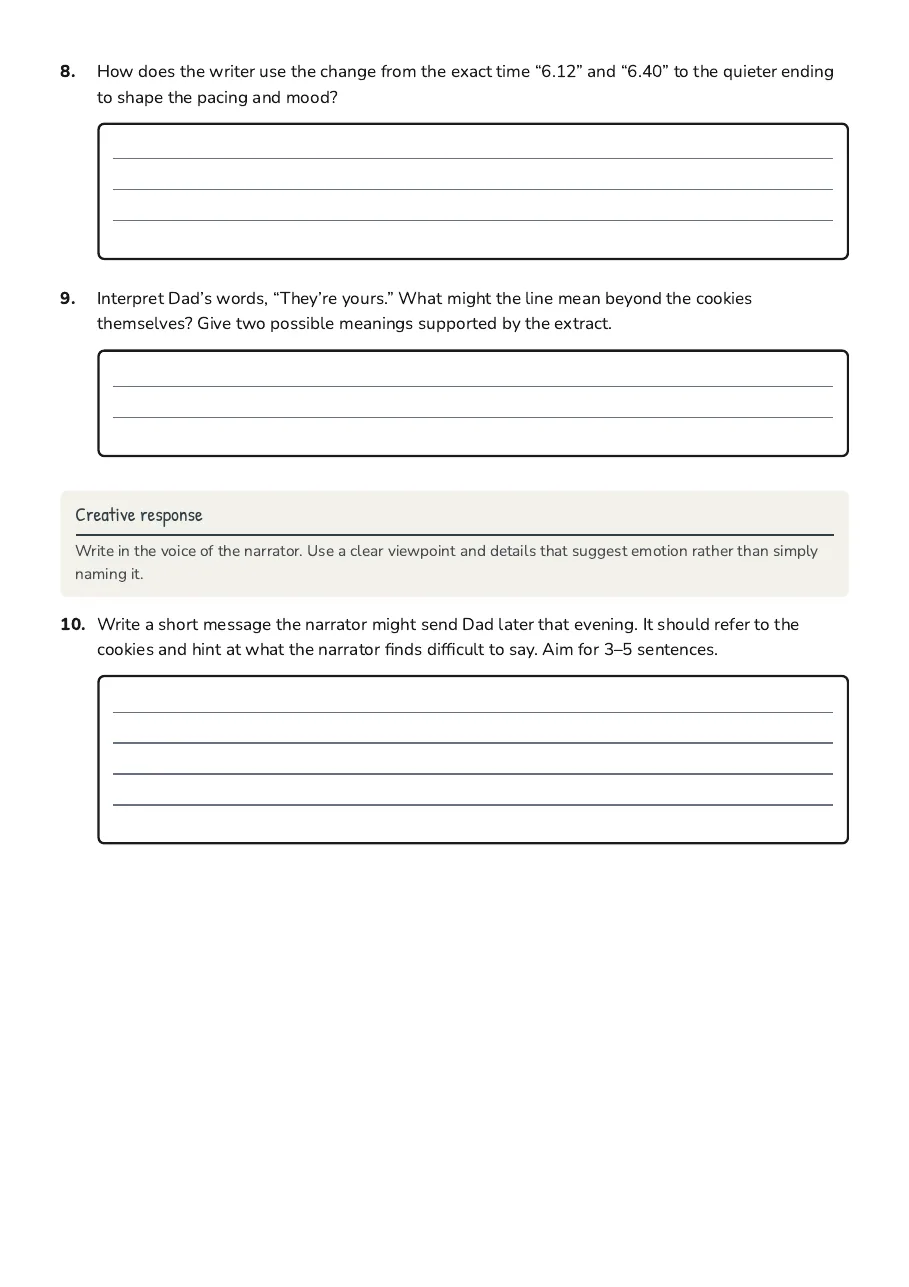
8.How does the writer use the change from the exact time “6.12” and “6.40” to the quieter ending to shape the pacing and mood?
9.Interpret Dad’s words, “They’re yours.” What might the line mean beyond the cookies themselves? Give two possible meanings supported by the extract.
Creative response
Write in the voice of the narrator. Use a clear viewpoint and details that suggest emotion rather than simply naming it.
10.Write a short message the narrator might send Dad later that evening. It should refer to the cookies and hint at what the narrator finds difficult to say. Aim for 3–5 sentences.