ScienceFreePrintable

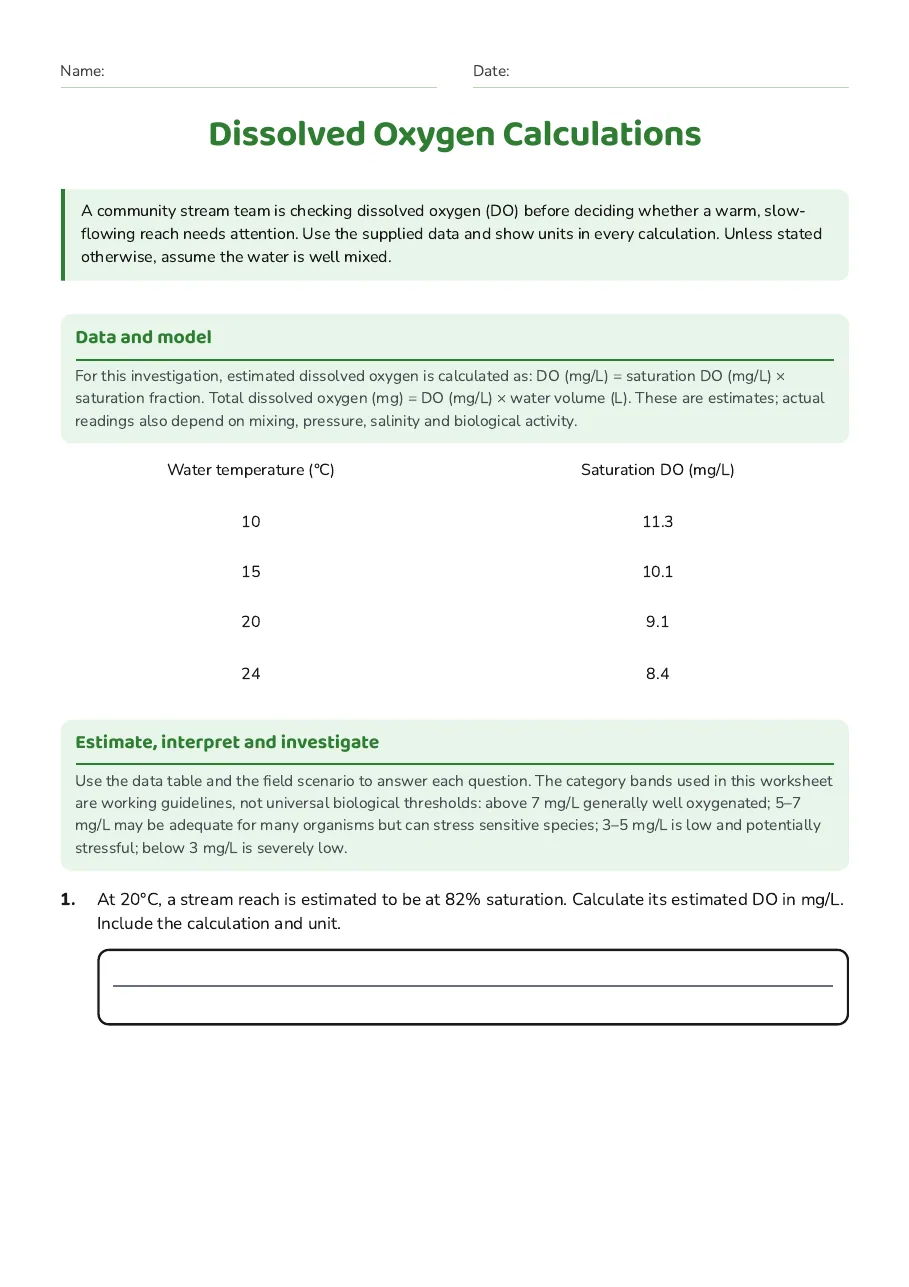
Dissolved Oxygen Calculations

A free science worksheet ready for your classroom. Open in Kuraplan to grab the print-ready PDF, customize it for your students, or generate a fresh version in seconds.
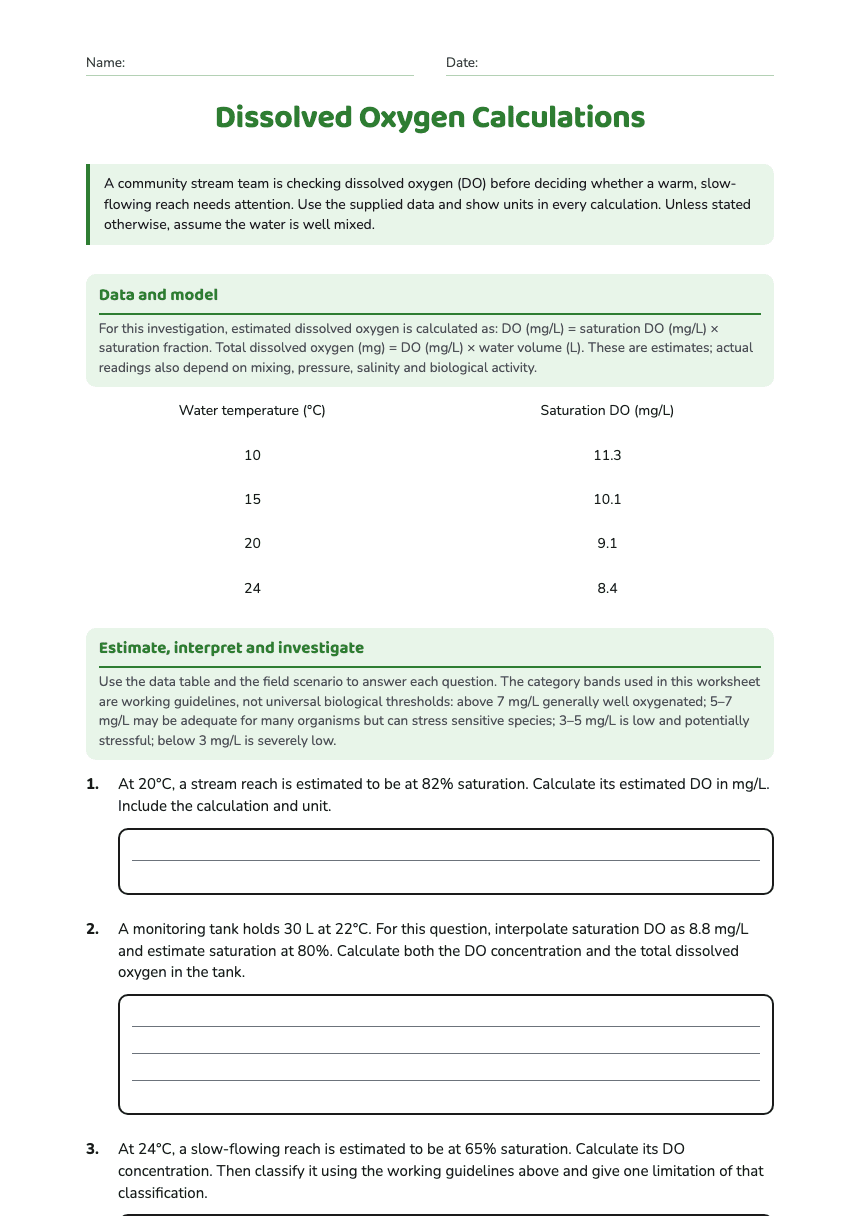
Dissolved Oxygen Calculations worksheet preview
Name:Date:

Dissolved Oxygen Calculations

A community stream team is checking dissolved oxygen (DO) before deciding whether a warm, slow-flowing reach needs attention. Use the supplied data and show units in every calculation. Unless stated otherwise, assume the water is well mixed.

Data and model

For this investigation, estimated dissolved oxygen is calculated as: DO (mg/L) = saturation DO (mg/L) × saturation fraction. Total dissolved oxygen (mg) = DO (mg/L) × water volume (L). These are estimates; actual readings also depend on mixing, pressure, salinity and biological activity.

Water temperature (°C)

Saturation DO (mg/L)

10

11.3

15

10.1

20

9.1

24

8.4

Estimate, interpret and investigate

Use the data table and the field scenario to answer each question. The category bands used in this worksheet are working guidelines, not universal biological thresholds: above 7 mg/L generally well oxygenated; 5–7 mg/L may be adequate for many organisms but can stress sensitive species; 3–5 mg/L is low and potentially stressful; below 3 mg/L is severely low.

1.At 20°C, a stream reach is estimated to be at 82% saturation. Calculate its estimated DO in mg/L. Include the calculation and unit.
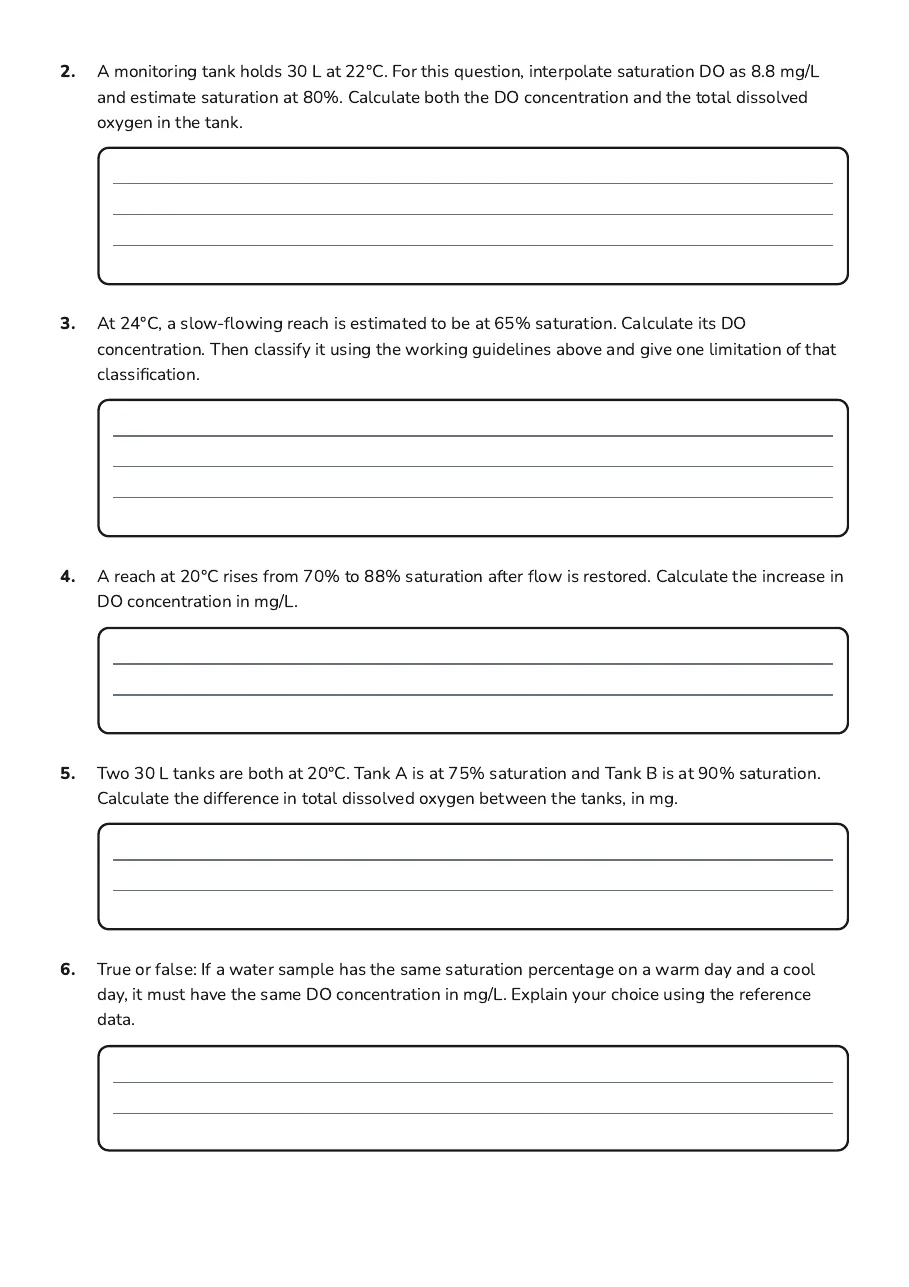
2.A monitoring tank holds 30 L at 22°C. For this question, interpolate saturation DO as 8.8 mg/L and estimate saturation at 80%. Calculate both the DO concentration and the total dissolved oxygen in the tank.
3.At 24°C, a slow-flowing reach is estimated to be at 65% saturation. Calculate its DO concentration. Then classify it using the working guidelines above and give one limitation of that classification.
4.A reach at 20°C rises from 70% to 88% saturation after flow is restored. Calculate the increase in DO concentration in mg/L.
5.Two 30 L tanks are both at 20°C. Tank A is at 75% saturation and Tank B is at 90% saturation. Calculate the difference in total dissolved oxygen between the tanks, in mg.
6.True or false: If a water sample has the same saturation percentage on a warm day and a cool day, it must have the same DO concentration in mg/L. Explain your choice using the reference data.
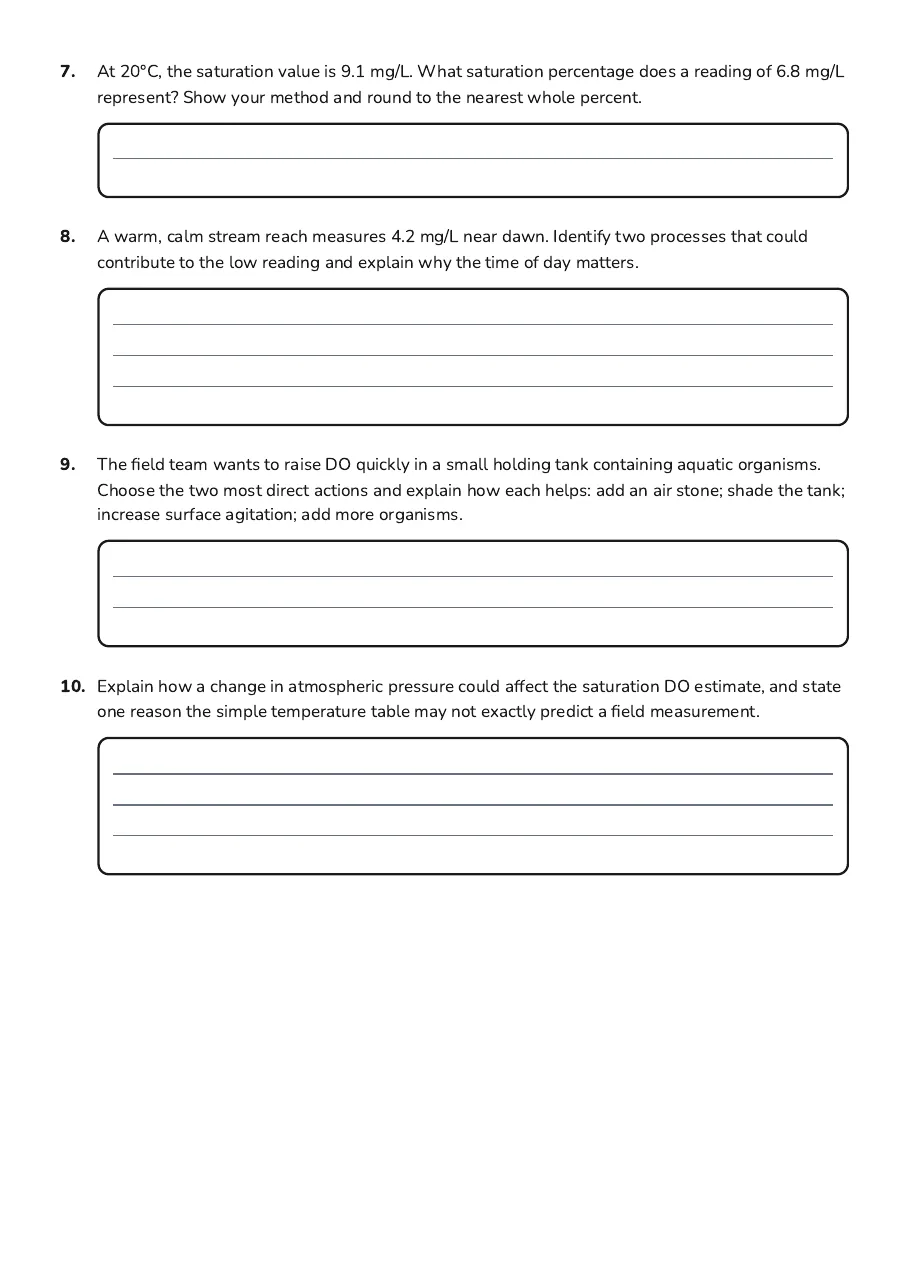
7.At 20°C, the saturation value is 9.1 mg/L. What saturation percentage does a reading of 6.8 mg/L represent? Show your method and round to the nearest whole percent.
8.A warm, calm stream reach measures 4.2 mg/L near dawn. Identify two processes that could contribute to the low reading and explain why the time of day matters.
9.The field team wants to raise DO quickly in a small holding tank containing aquatic organisms. Choose the two most direct actions and explain how each helps: add an air stone; shade the tank; increase surface agitation; add more organisms.
10.Explain how a change in atmospheric pressure could affect the saturation DO estimate, and state one reason the simple temperature table may not exactly predict a field measurement.

3 printable pages

  • Dissolved Oxygen Calculations, page 1 of 3: Data and model, Estimate, interpret and investigate

    Page 1

  • Dissolved Oxygen Calculations, page 2 of 3: 2. A monitoring tank holds 30 L at 22°C. For this question, interpolate saturation DO as…

    Page 2

  • Dissolved Oxygen Calculations, page 3 of 3: 7. At 20°C, the saturation value is 9.1 mg/L. What saturation percentage does a reading…

    Page 3

About This Worksheet

Free in Kuraplan

Sign up free, grab the PDF, and customize it for your class.

Print-Ready

Formatted for standard paper. Clean layout, easy to read.

AI-Generated

Created with Kuraplan's AI, designed for real classroom use.

For Teachers & Parents

Use in classrooms, for homework, tutoring, or homeschool.

Need a custom version of this worksheet?

Kuraplan's AI generates custom worksheets in seconds — differentiated for every learner, aligned to your curriculum.

Generate Custom Worksheets — Free
No credit card Curriculum-aligned Under 60 seconds