ScienceFreePrintable
Electrochemical Cell Potentials
A free science worksheet ready for your classroom. Open in Kuraplan to grab the print-ready PDF, customize it for your students, or generate a fresh version in seconds.

Name:Date:
Electrochemical Cell Potentials
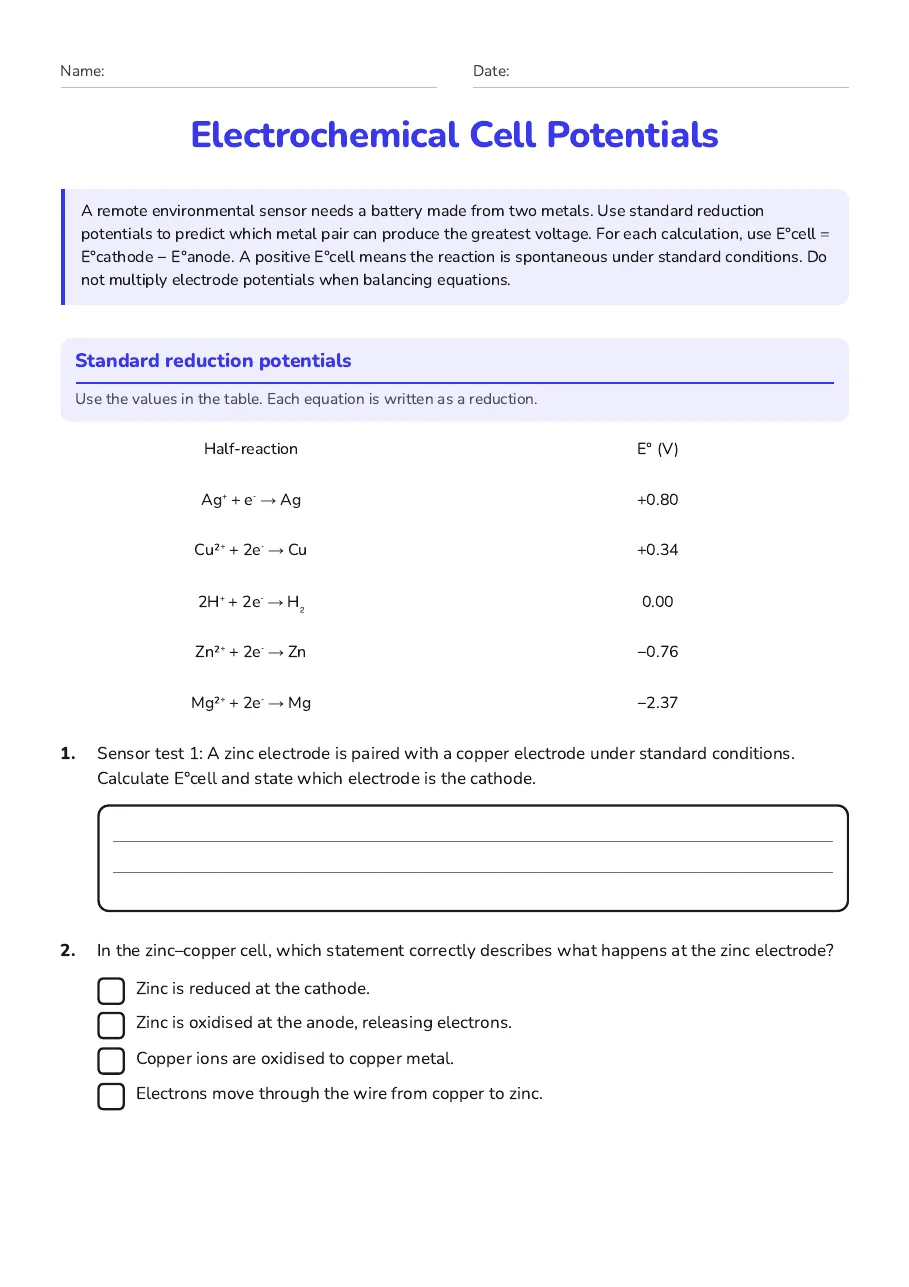
A remote environmental sensor needs a battery made from two metals. Use standard reduction potentials to predict which metal pair can produce the greatest voltage. For each calculation, use E°cell = E°cathode − E°anode. A positive E°cell means the reaction is spontaneous under standard conditions. Do not multiply electrode potentials when balancing equations.
Standard reduction potentials
Use the values in the table. Each equation is written as a reduction.
Half-reaction
E° (V)
Ag⁺ + e⁻ → Ag
+0.80
Cu²⁺ + 2e⁻ → Cu
+0.34
2H⁺ + 2e⁻ → H₂
0.00
Zn²⁺ + 2e⁻ → Zn
−0.76
Mg²⁺ + 2e⁻ → Mg
−2.37
1.Sensor test 1: A zinc electrode is paired with a copper electrode under standard conditions. Calculate E°cell and state which electrode is the cathode.
2.In the zinc–copper cell, which statement correctly describes what happens at the zinc electrode?
- Zinc is reduced at the cathode.
- Zinc is oxidised at the anode, releasing electrons.
- Copper ions are oxidised to copper metal.
- Electrons move through the wire from copper to zinc.
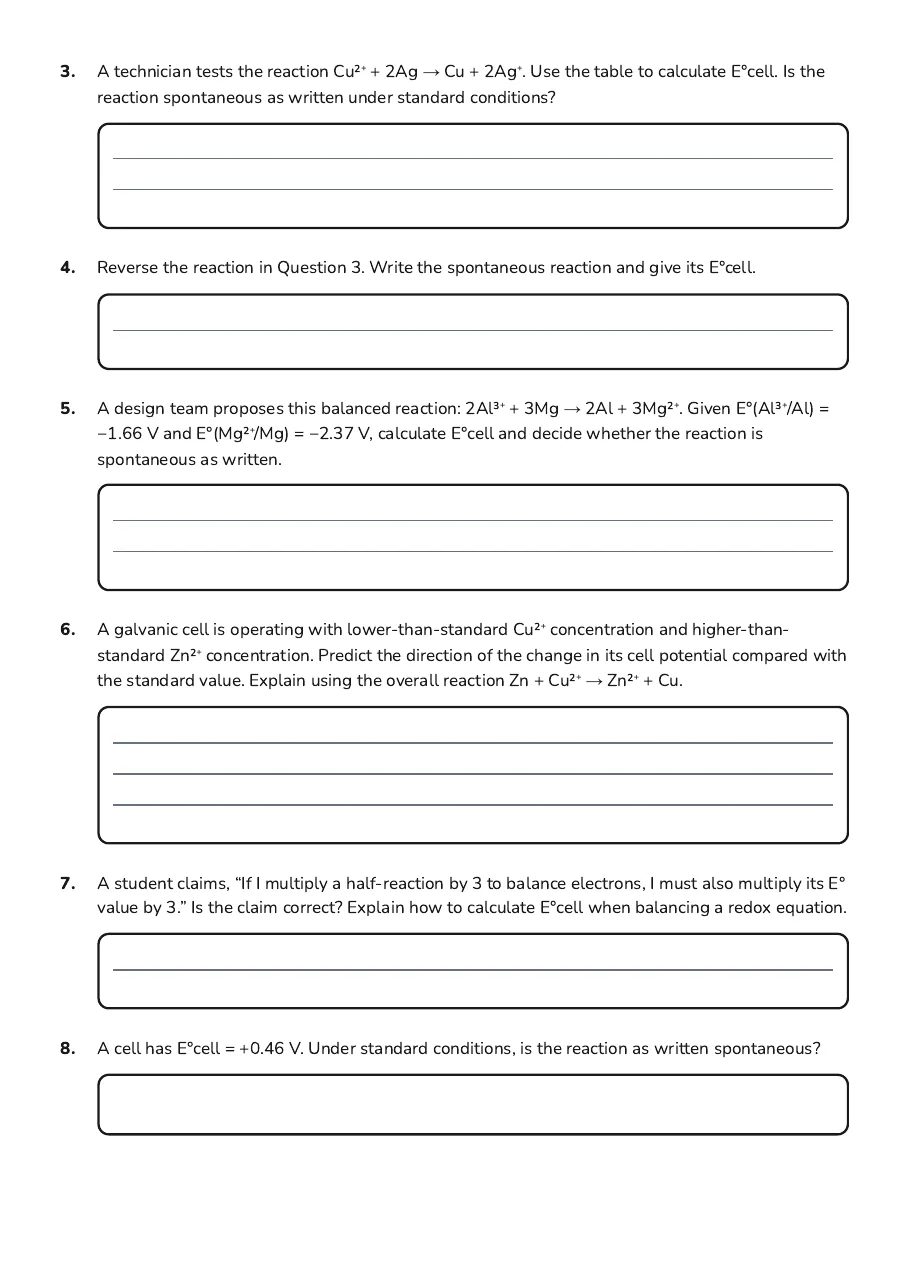
3.A technician tests the reaction Cu²⁺ + 2Ag → Cu + 2Ag⁺. Use the table to calculate E°cell. Is the reaction spontaneous as written under standard conditions?
4.Reverse the reaction in Question 3. Write the spontaneous reaction and give its E°cell.
5.A design team proposes this balanced reaction: 2Al³⁺ + 3Mg → 2Al + 3Mg²⁺. Given E°(Al³⁺/Al) = −1.66 V and E°(Mg²⁺/Mg) = −2.37 V, calculate E°cell and decide whether the reaction is spontaneous as written.
6.A galvanic cell is operating with lower-than-standard Cu²⁺ concentration and higher-than-standard Zn²⁺ concentration. Predict the direction of the change in its cell potential compared with the standard value. Explain using the overall reaction Zn + Cu²⁺ → Zn²⁺ + Cu.
7.A student claims, “If I multiply a half-reaction by 3 to balance electrons, I must also multiply its E° value by 3.” Is the claim correct? Explain how to calculate E°cell when balancing a redox equation.
8.A cell has E°cell = +0.46 V. Under standard conditions, is the reaction as written spontaneous?
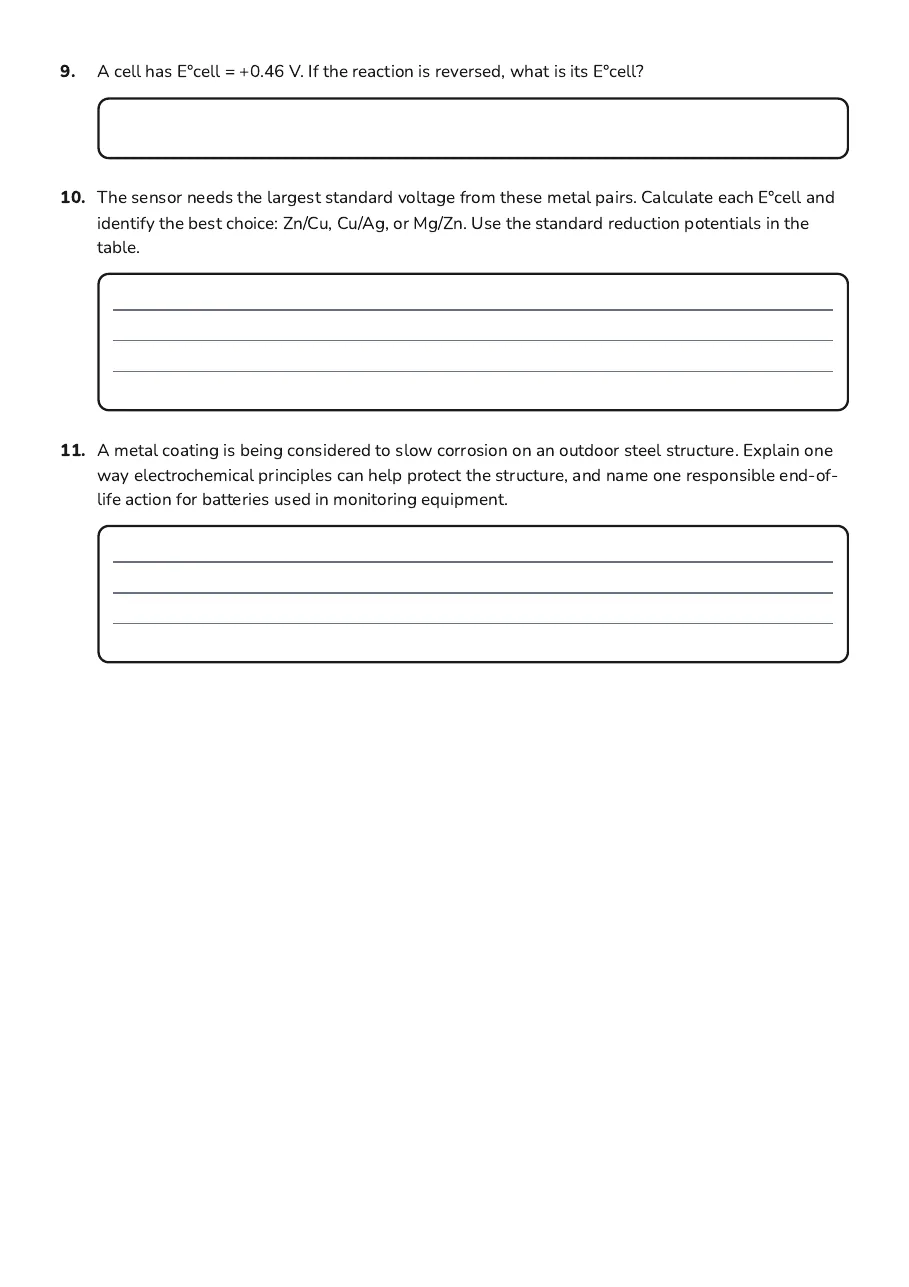
9.A cell has E°cell = +0.46 V. If the reaction is reversed, what is its E°cell?
10.The sensor needs the largest standard voltage from these metal pairs. Calculate each E°cell and identify the best choice: Zn/Cu, Cu/Ag, or Mg/Zn. Use the standard reduction potentials in the table.
11.A metal coating is being considered to slow corrosion on an outdoor steel structure. Explain one way electrochemical principles can help protect the structure, and name one responsible end-of-life action for batteries used in monitoring equipment.
3 printable pages
Page 1
Page 2
Page 3
About This Worksheet
Free in Kuraplan
Sign up free, grab the PDF, and customize it for your class.
Print-Ready
Formatted for standard paper. Clean layout, easy to read.
AI-Generated
Created with Kuraplan's AI, designed for real classroom use.
For Teachers & Parents
Use in classrooms, for homework, tutoring, or homeschool.
Need a custom version of this worksheet?
Kuraplan's AI generates custom worksheets in seconds — differentiated for every learner, aligned to your curriculum.
Generate Custom Worksheets — Free No credit card Curriculum-aligned Under 60 seconds
More Science Worksheets
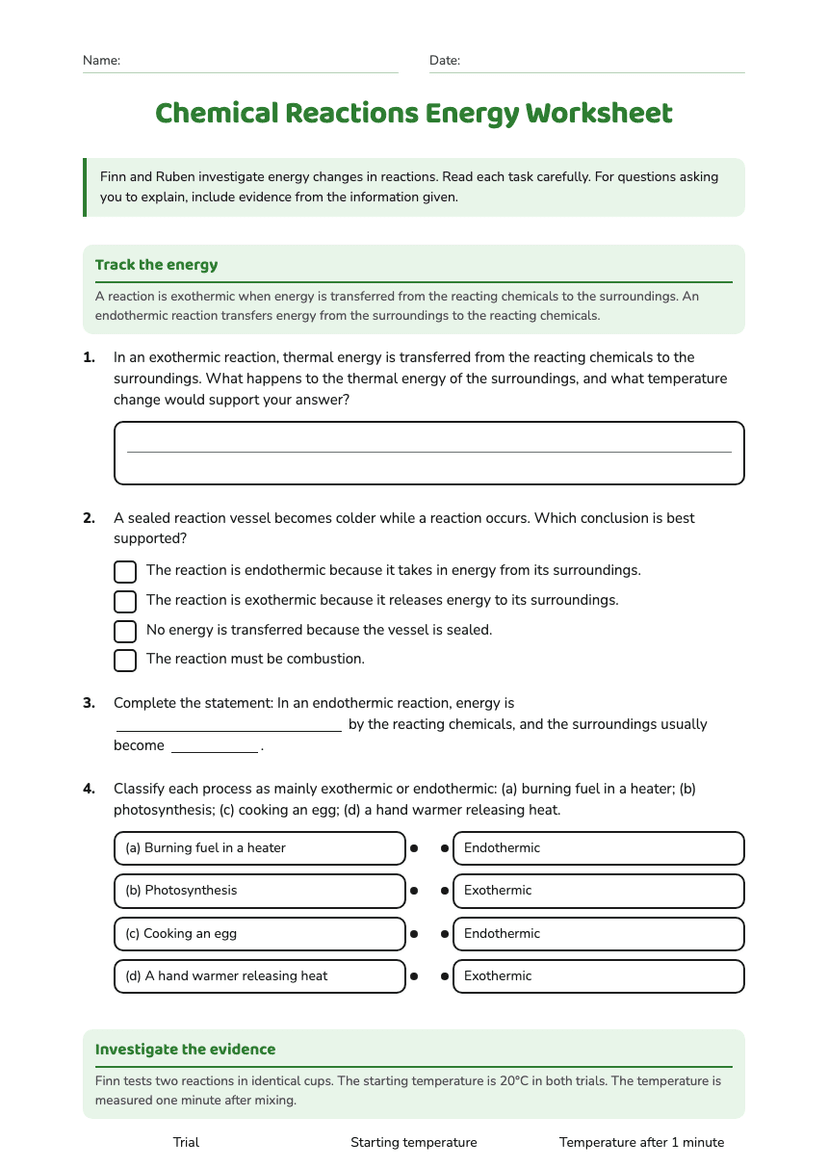
Chemical Reactions Energy Worksheet
Free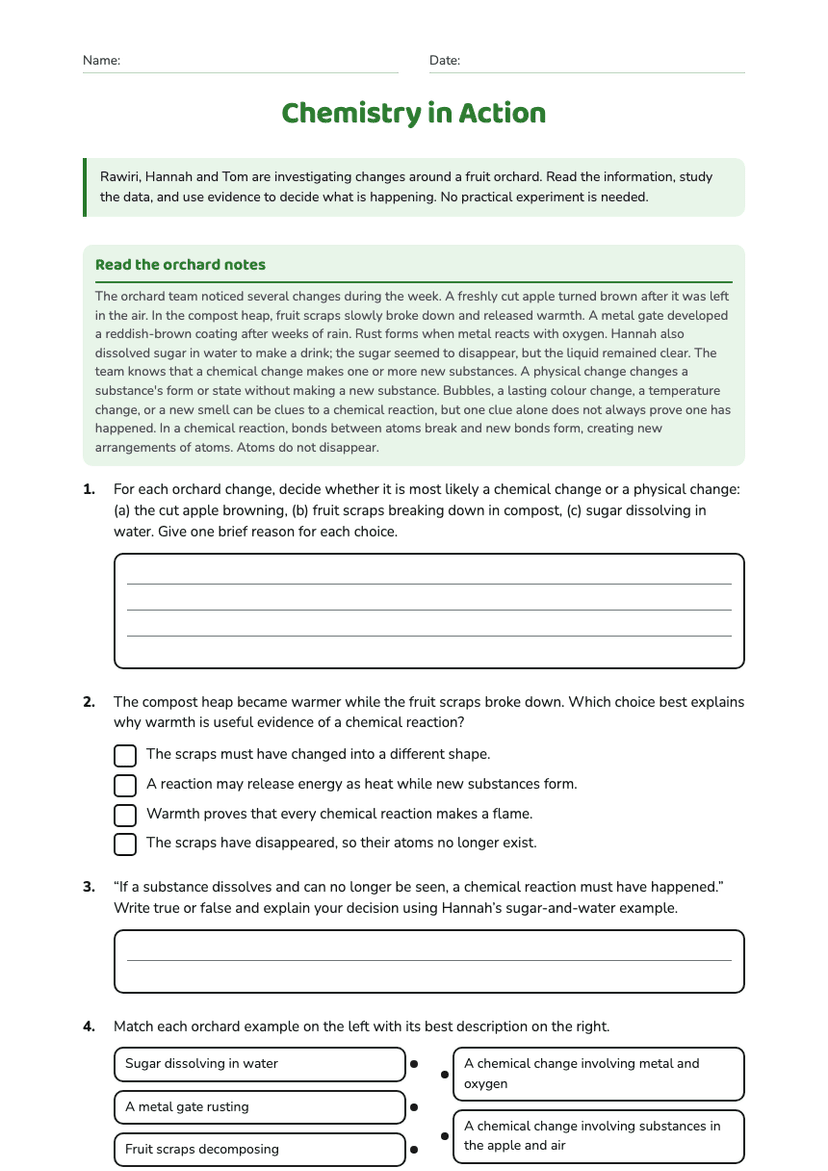
Year 7
Chemistry in Action
Free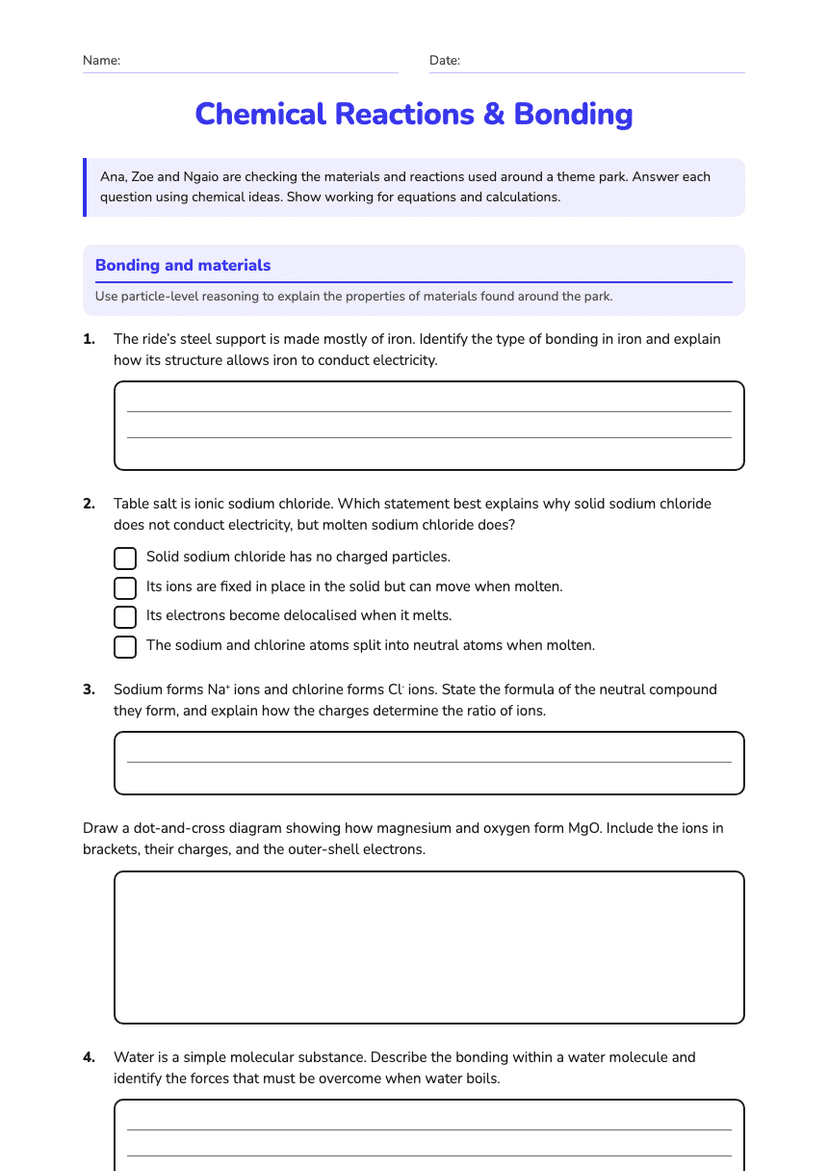
Year 11
Chemical Reactions & Bonding
Free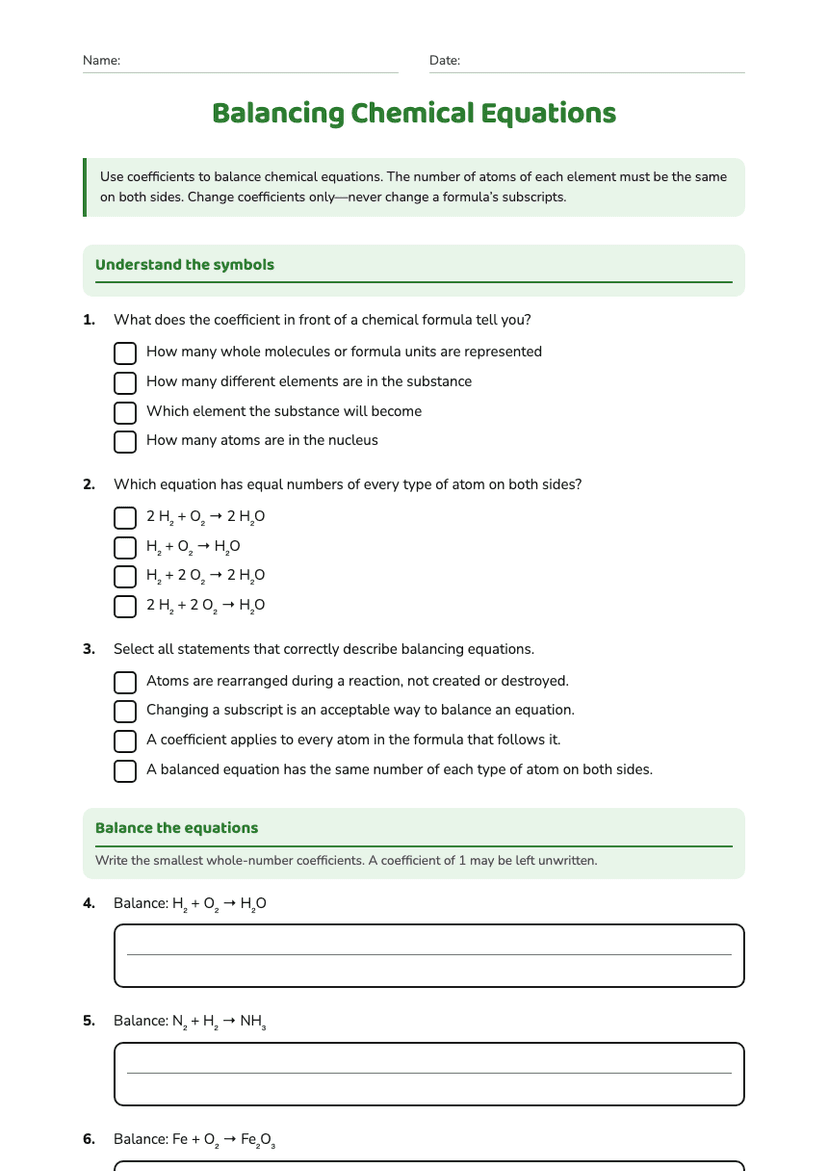
Year 7–8
Balancing Chemical Equations
Free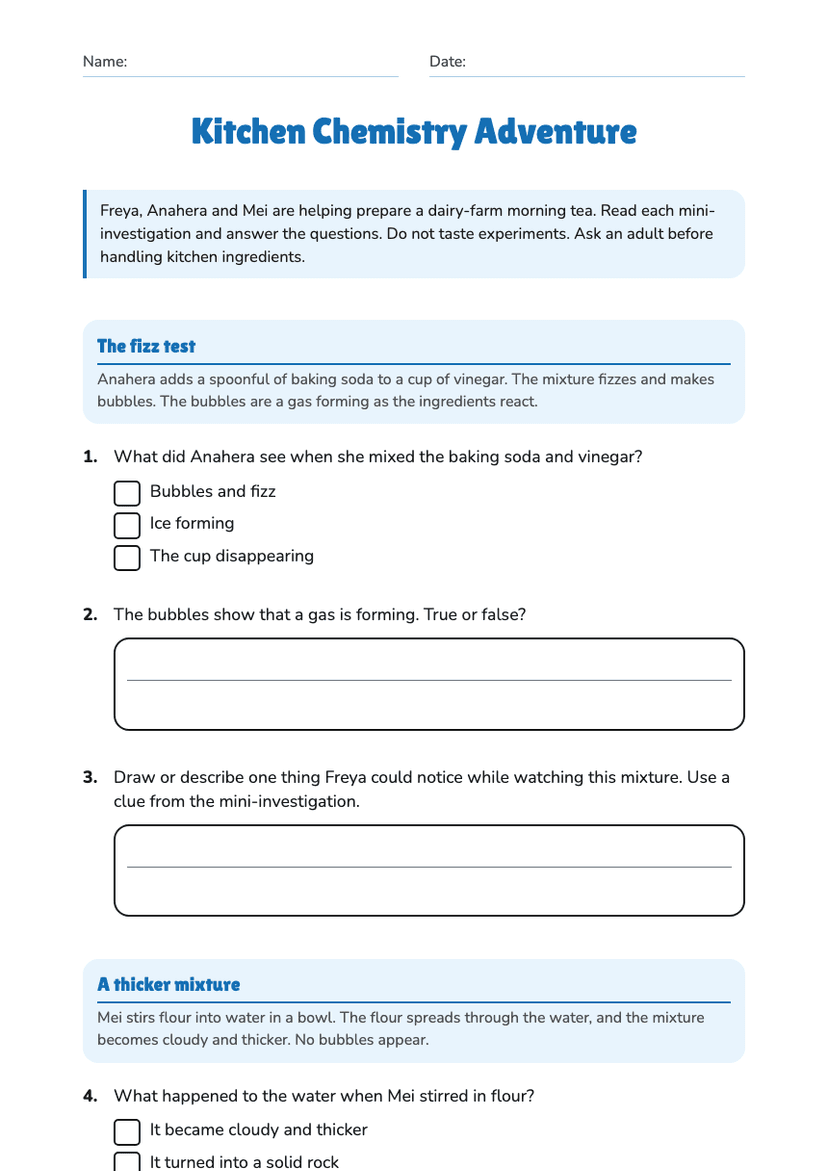
Year 2
Kitchen Chemistry Adventure
Free
Year 11
Chemical Reactions Introduction
Free
Year 9
Element Flashcards Worksheet
Free
Year 7–8