ScienceFreePrintable

Electrochemistry Redox Applications

A free science worksheet ready for your classroom. Open in Kuraplan to grab the print-ready PDF, customize it for your students, or generate a fresh version in seconds.
Electrochemistry Redox Applications worksheet preview
Name:Date:

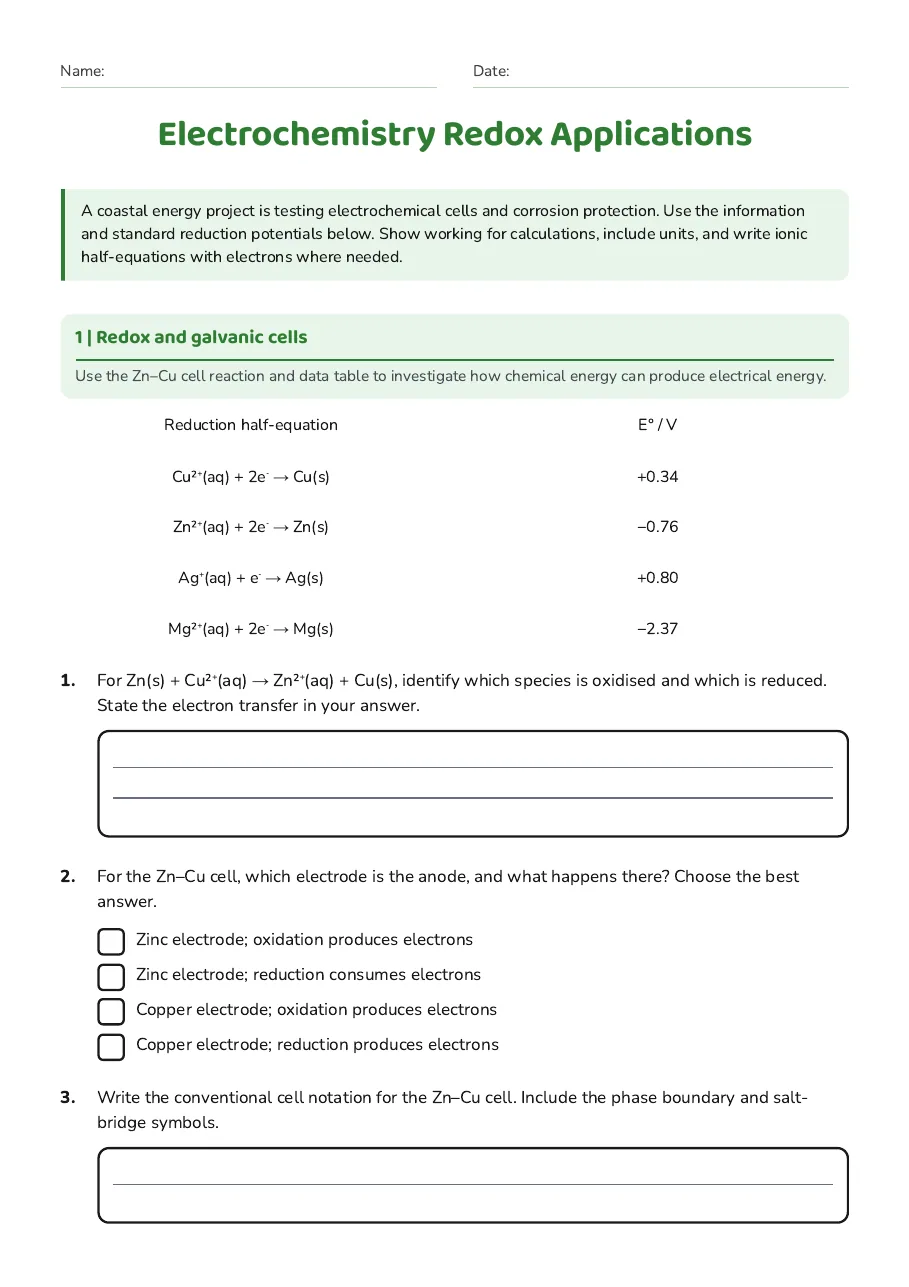
Electrochemistry Redox Applications

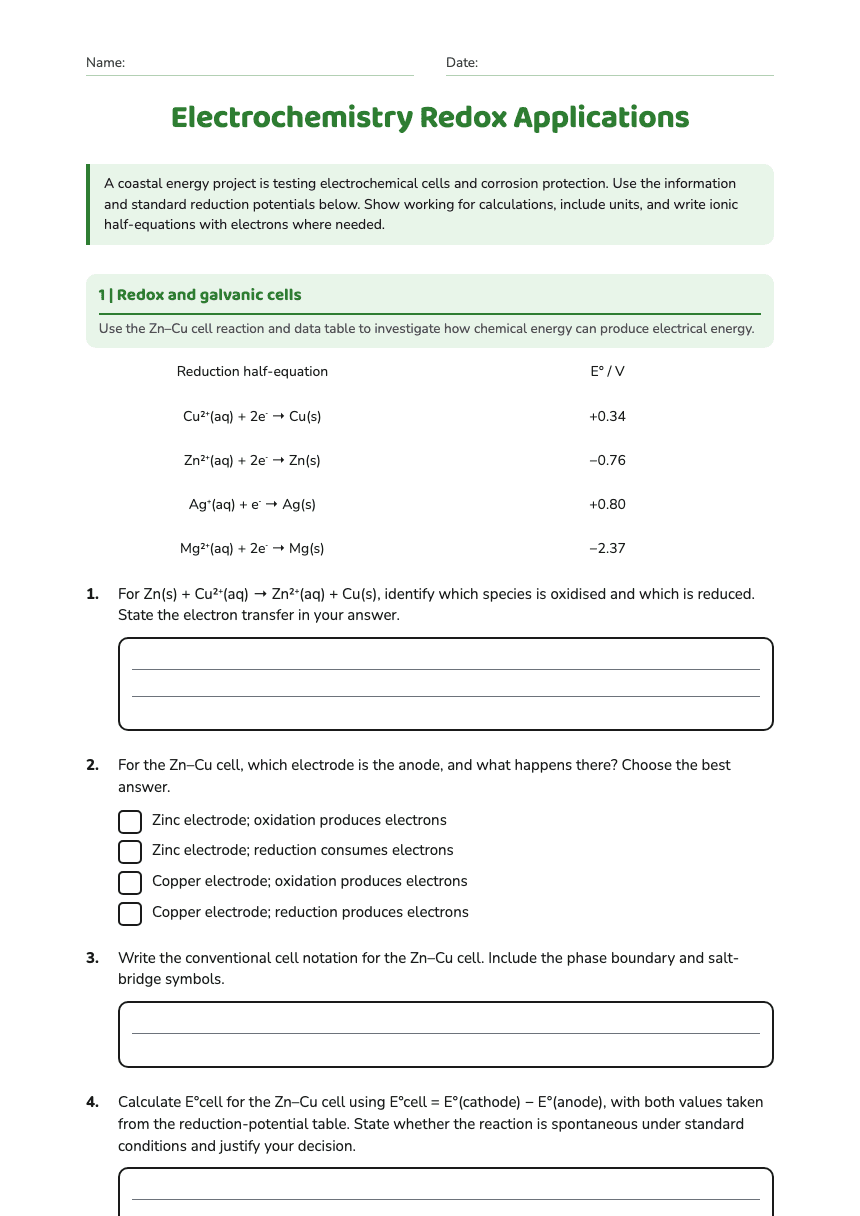
A coastal energy project is testing electrochemical cells and corrosion protection. Use the information and standard reduction potentials below. Show working for calculations, include units, and write ionic half-equations with electrons where needed.

1 | Redox and galvanic cells

Use the Zn–Cu cell reaction and data table to investigate how chemical energy can produce electrical energy.

Reduction half-equation

E° / V

Cu²⁺(aq) + 2e⁻ → Cu(s)

+0.34

Zn²⁺(aq) + 2e⁻ → Zn(s)

−0.76

Ag⁺(aq) + e⁻ → Ag(s)

+0.80

Mg²⁺(aq) + 2e⁻ → Mg(s)

−2.37

1.For Zn(s) + Cu²⁺(aq) → Zn²⁺(aq) + Cu(s), identify which species is oxidised and which is reduced. State the electron transfer in your answer.
2.For the Zn–Cu cell, which electrode is the anode, and what happens there? Choose the best answer.
  • Zinc electrode; oxidation produces electrons
  • Zinc electrode; reduction consumes electrons
  • Copper electrode; oxidation produces electrons
  • Copper electrode; reduction produces electrons
3.Write the conventional cell notation for the Zn–Cu cell. Include the phase boundary and salt-bridge symbols.
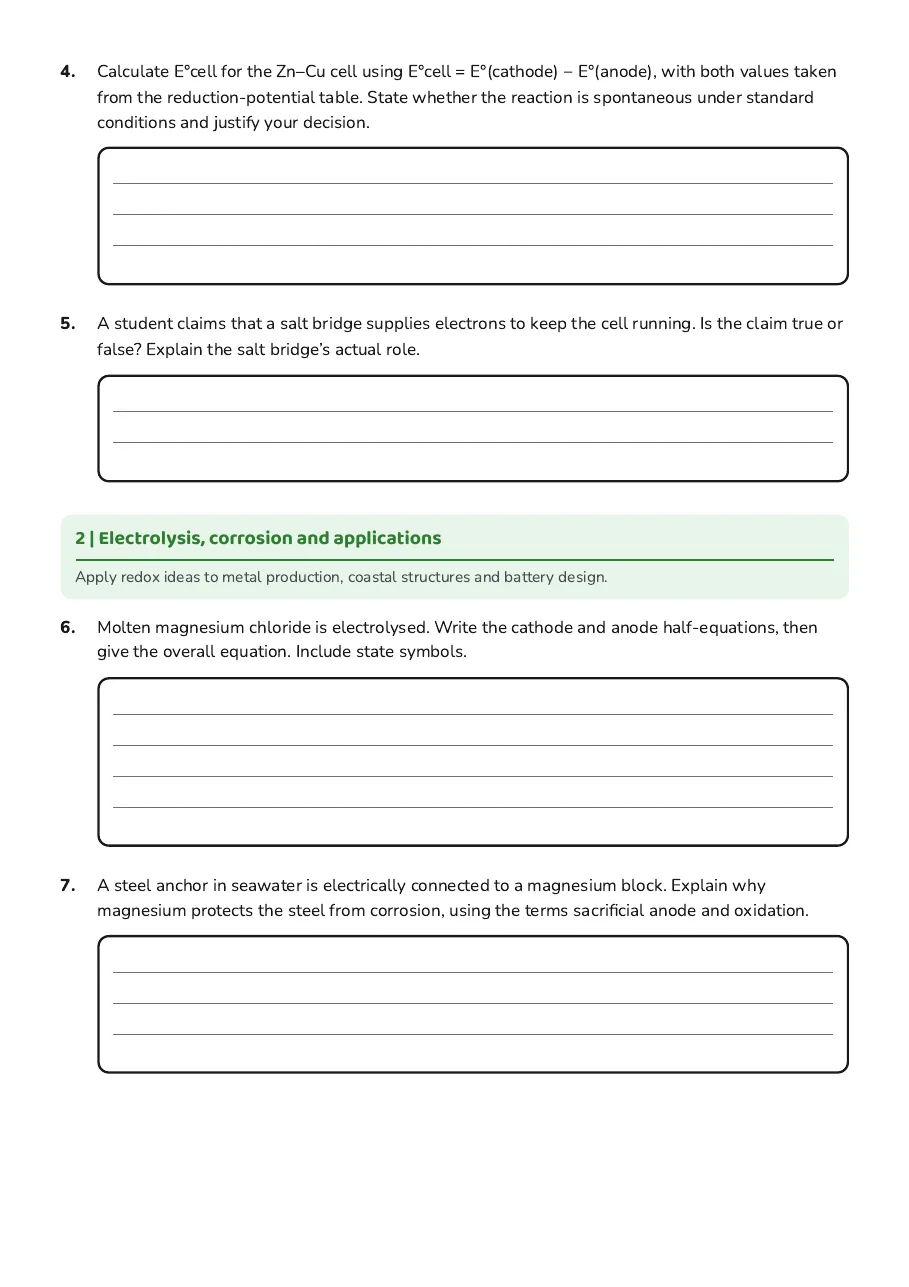
4.Calculate E°cell for the Zn–Cu cell using E°cell = E°(cathode) − E°(anode), with both values taken from the reduction-potential table. State whether the reaction is spontaneous under standard conditions and justify your decision.
5.A student claims that a salt bridge supplies electrons to keep the cell running. Is the claim true or false? Explain the salt bridge’s actual role.

2 | Electrolysis, corrosion and applications

Apply redox ideas to metal production, coastal structures and battery design.

6.Molten magnesium chloride is electrolysed. Write the cathode and anode half-equations, then give the overall equation. Include state symbols.
7.A steel anchor in seawater is electrically connected to a magnesium block. Explain why magnesium protects the steel from corrosion, using the terms sacrificial anode and oxidation.
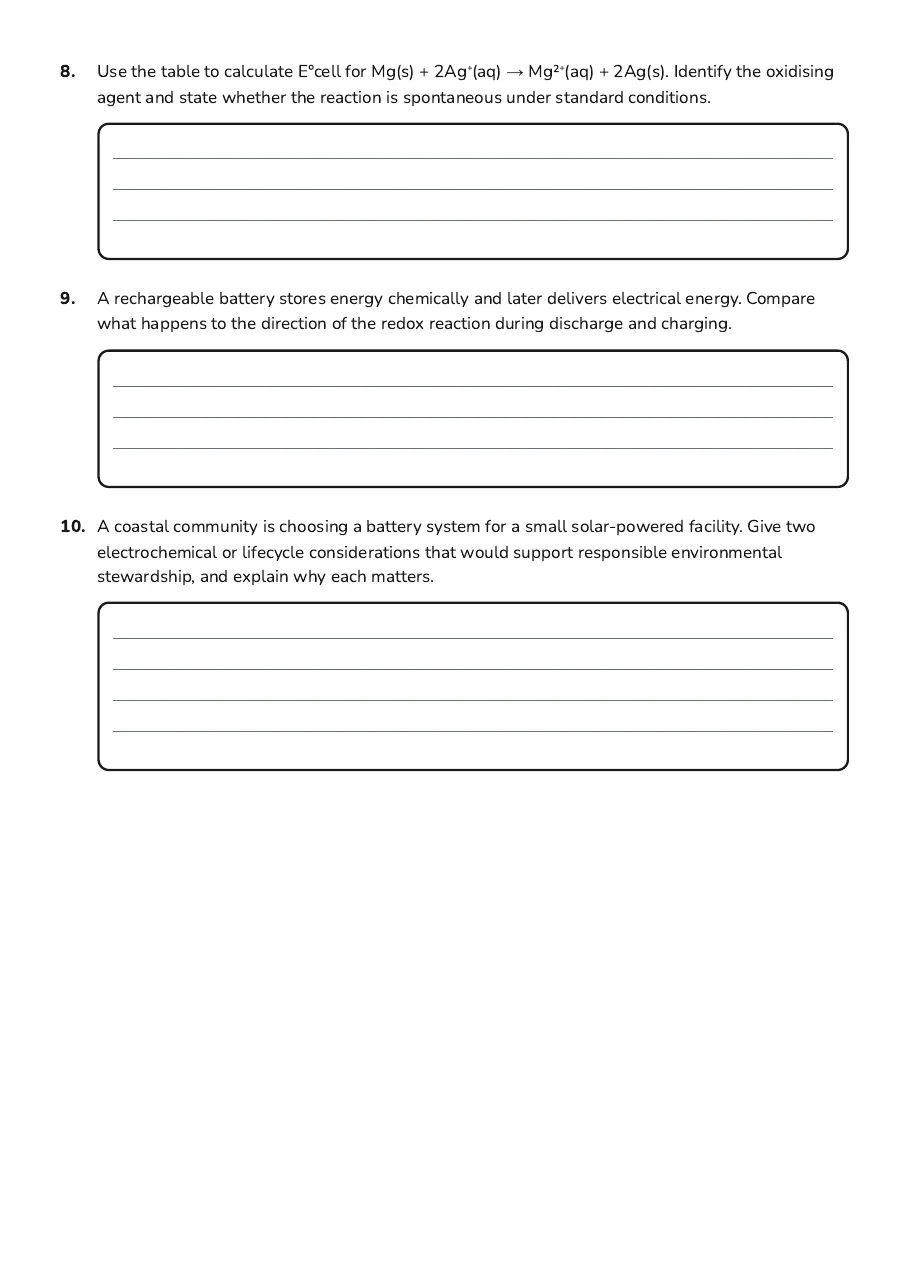
8.Use the table to calculate E°cell for Mg(s) + 2Ag⁺(aq) → Mg²⁺(aq) + 2Ag(s). Identify the oxidising agent and state whether the reaction is spontaneous under standard conditions.
9.A rechargeable battery stores energy chemically and later delivers electrical energy. Compare what happens to the direction of the redox reaction during discharge and charging.
10.A coastal community is choosing a battery system for a small solar-powered facility. Give two electrochemical or lifecycle considerations that would support responsible environmental stewardship, and explain why each matters.

3 printable pages

  • Electrochemistry Redox Applications, page 1 of 3: 1 | Redox and galvanic cells

    Page 1

  • Electrochemistry Redox Applications, page 2 of 3: 2 | Electrolysis, corrosion and applications

    Page 2

  • Electrochemistry Redox Applications, page 3 of 3: 8. Use the table to calculate E°cell for Mg(s) + 2Ag⁺(aq) → Mg²⁺(aq) + 2Ag(s). Identify…

    Page 3

About This Worksheet

Free in Kuraplan

Sign up free, grab the PDF, and customize it for your class.

Print-Ready

Formatted for standard paper. Clean layout, easy to read.

AI-Generated

Created with Kuraplan's AI, designed for real classroom use.

For Teachers & Parents

Use in classrooms, for homework, tutoring, or homeschool.

Need a custom version of this worksheet?

Kuraplan's AI generates custom worksheets in seconds — differentiated for every learner, aligned to your curriculum.

Generate Custom Worksheets — Free
No credit card Curriculum-aligned Under 60 seconds