EnglishFreePrintable

Formal vs Informal Language

A free english worksheet ready for your classroom. Open in Kuraplan to grab the print-ready PDF, customize it for your students, or generate a fresh version in seconds.
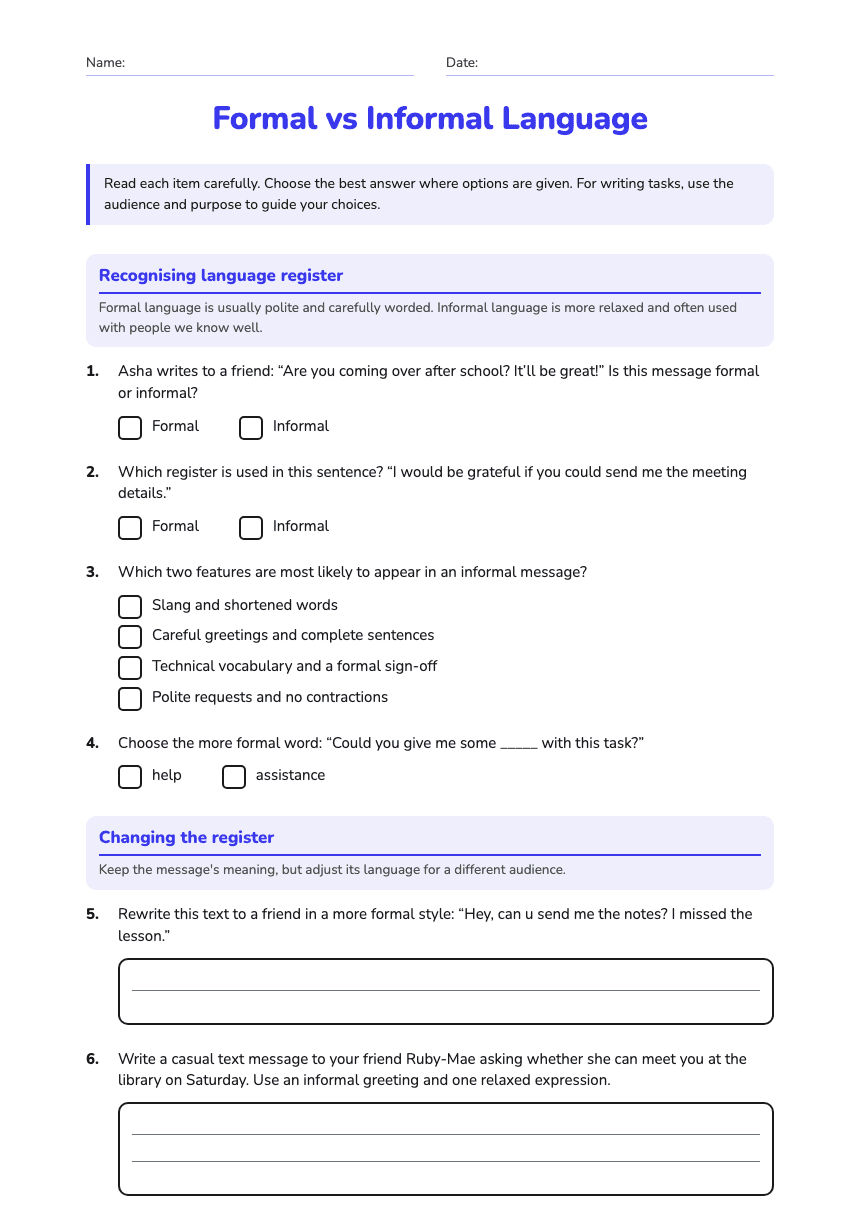
Formal vs Informal Language worksheet preview
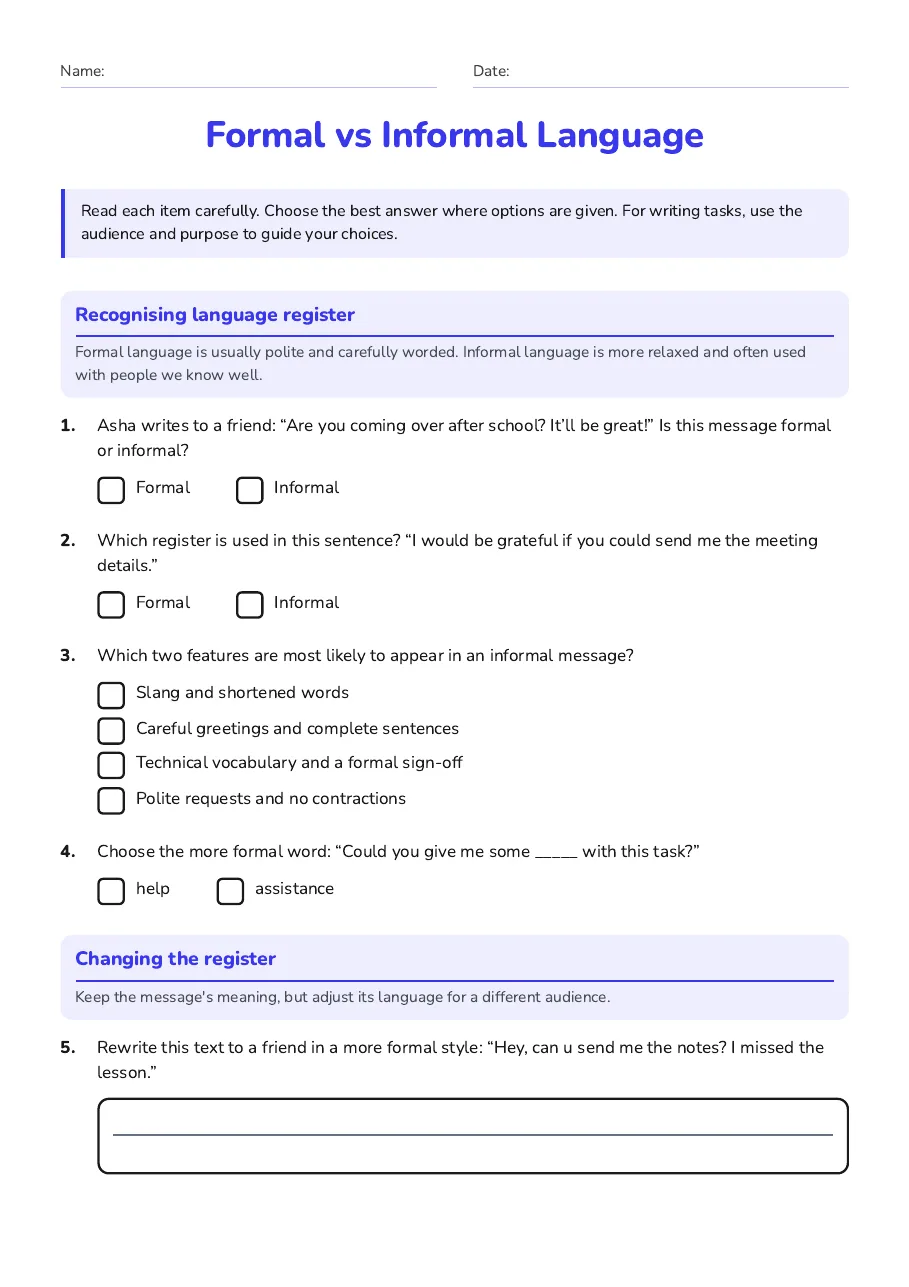
Name:Date:

Formal vs Informal Language

Read each item carefully. Choose the best answer where options are given. For writing tasks, use the audience and purpose to guide your choices.

Recognising language register

Formal language is usually polite and carefully worded. Informal language is more relaxed and often used with people we know well.

1.Asha writes to a friend: “Are you coming over after school? It’ll be great!” Is this message formal or informal?
  • Formal
  • Informal
2.Which register is used in this sentence? “I would be grateful if you could send me the meeting details.”
  • Formal
  • Informal
3.Which two features are most likely to appear in an informal message?
  • Slang and shortened words
  • Careful greetings and complete sentences
  • Technical vocabulary and a formal sign-off
  • Polite requests and no contractions
4.Choose the more formal word: “Could you give me some _____ with this task?”
  • help
  • assistance

Changing the register

Keep the message's meaning, but adjust its language for a different audience.

5.Rewrite this text to a friend in a more formal style: “Hey, can u send me the notes? I missed the lesson.”
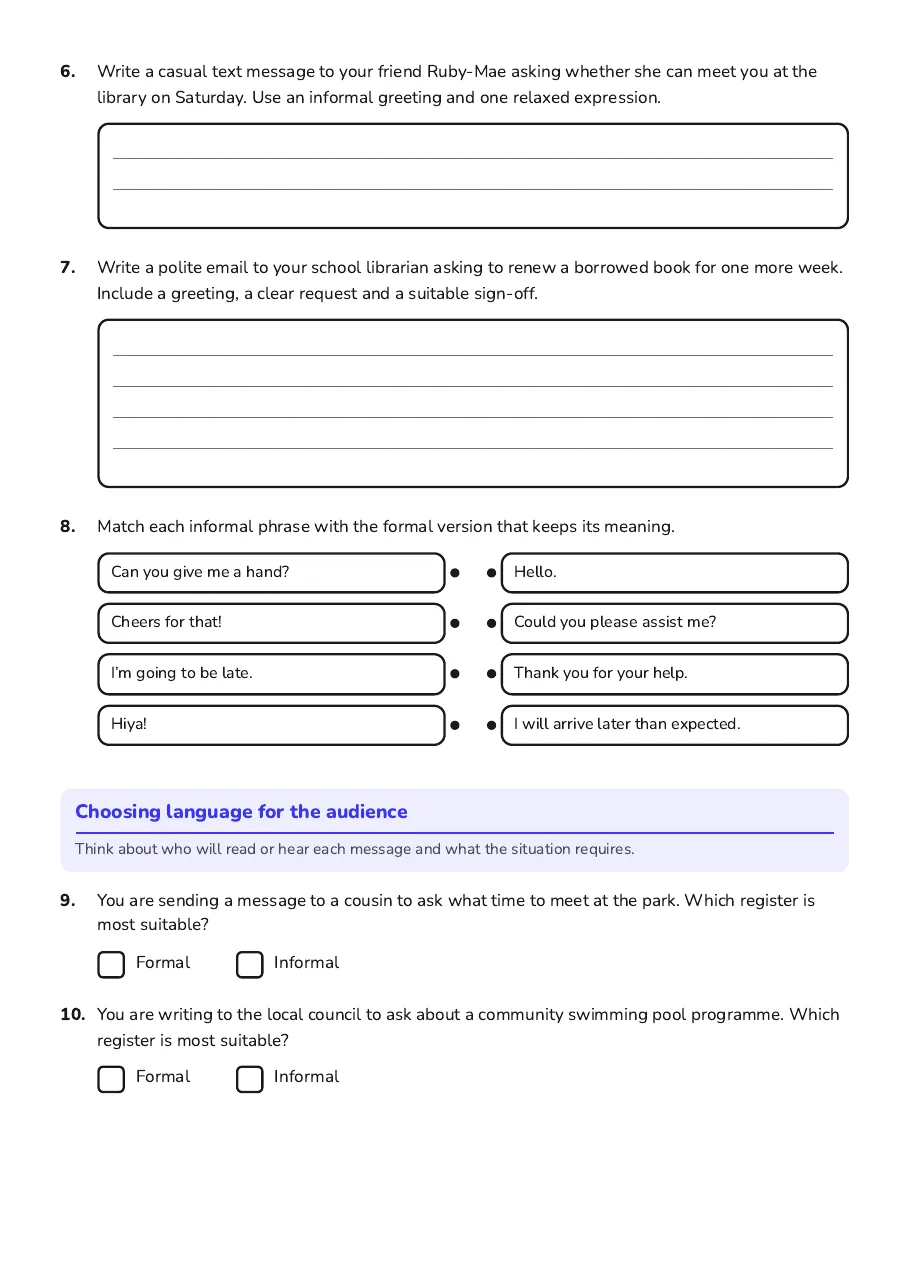
6.Write a casual text message to your friend Ruby-Mae asking whether she can meet you at the library on Saturday. Use an informal greeting and one relaxed expression.
7.Write a polite email to your school librarian asking to renew a borrowed book for one more week. Include a greeting, a clear request and a suitable sign-off.
8.Match each informal phrase with the formal version that keeps its meaning.
  • Can you give me a hand?
  • Cheers for that!
  • I’m going to be late.
  • Hiya!
  • Hello.
  • Could you please assist me?
  • Thank you for your help.
  • I will arrive later than expected.

Choosing language for the audience

Think about who will read or hear each message and what the situation requires.

9.You are sending a message to a cousin to ask what time to meet at the park. Which register is most suitable?
  • Formal
  • Informal
10.You are writing to the local council to ask about a community swimming pool programme. Which register is most suitable?
  • Formal
  • Informal
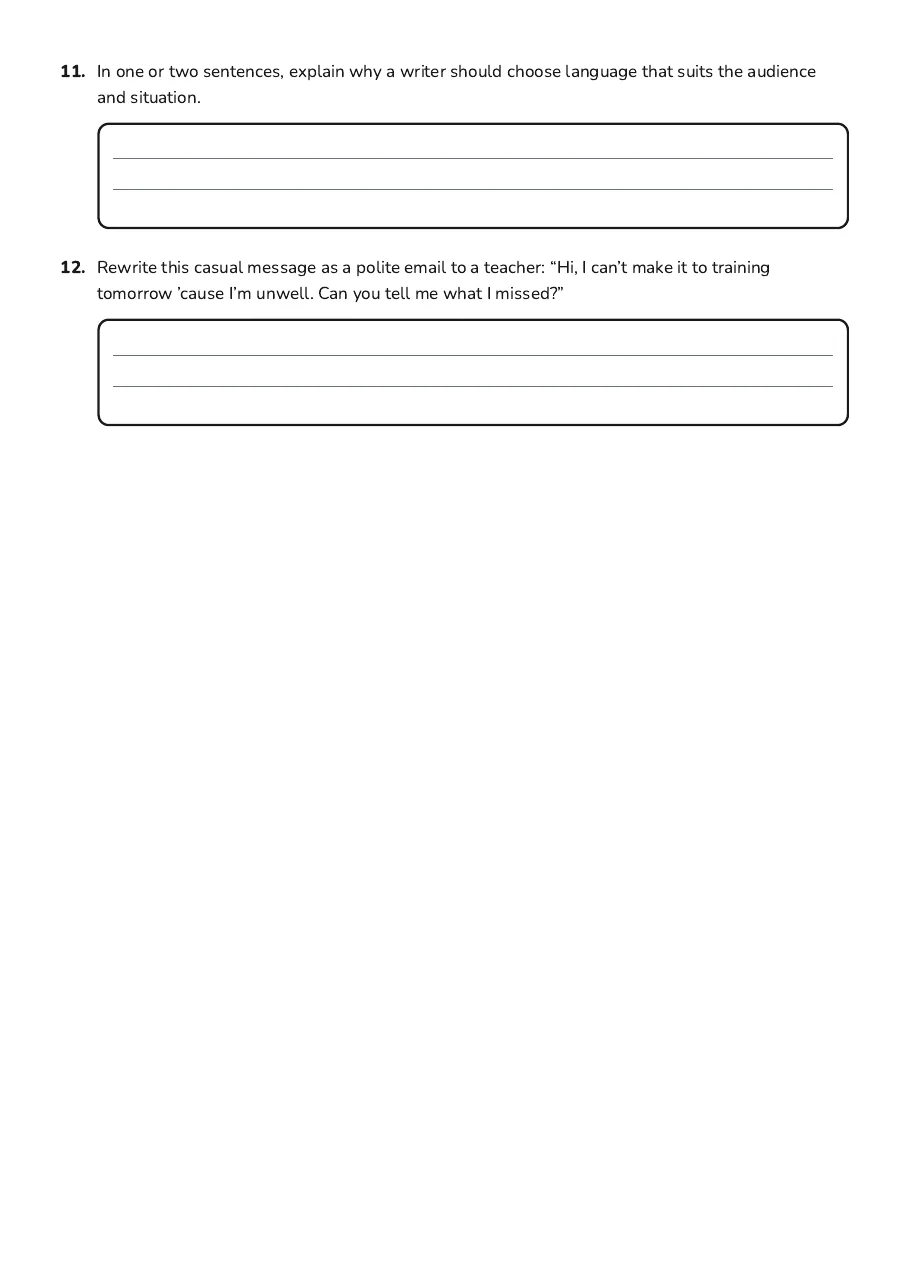
11.In one or two sentences, explain why a writer should choose language that suits the audience and situation.
12.Rewrite this casual message as a polite email to a teacher: “Hi, I can’t make it to training tomorrow ’cause I’m unwell. Can you tell me what I missed?”

3 printable pages

  • Formal vs Informal Language, page 1 of 3: Recognising language register, Changing the register

    Page 1

  • Formal vs Informal Language, page 2 of 3: Choosing language for the audience

    Page 2

  • Formal vs Informal Language, page 3 of 3: 11. In one or two sentences, explain why a writer should choose language that suits the…

    Page 3

About This Worksheet

Free in Kuraplan

Sign up free, grab the PDF, and customize it for your class.

Print-Ready

Formatted for standard paper. Clean layout, easy to read.

AI-Generated

Created with Kuraplan's AI, designed for real classroom use.

For Teachers & Parents

Use in classrooms, for homework, tutoring, or homeschool.

Need a custom version of this worksheet?

Kuraplan's AI generates custom worksheets in seconds — differentiated for every learner, aligned to your curriculum.

Generate Custom Worksheets — Free
No credit card Curriculum-aligned Under 60 seconds