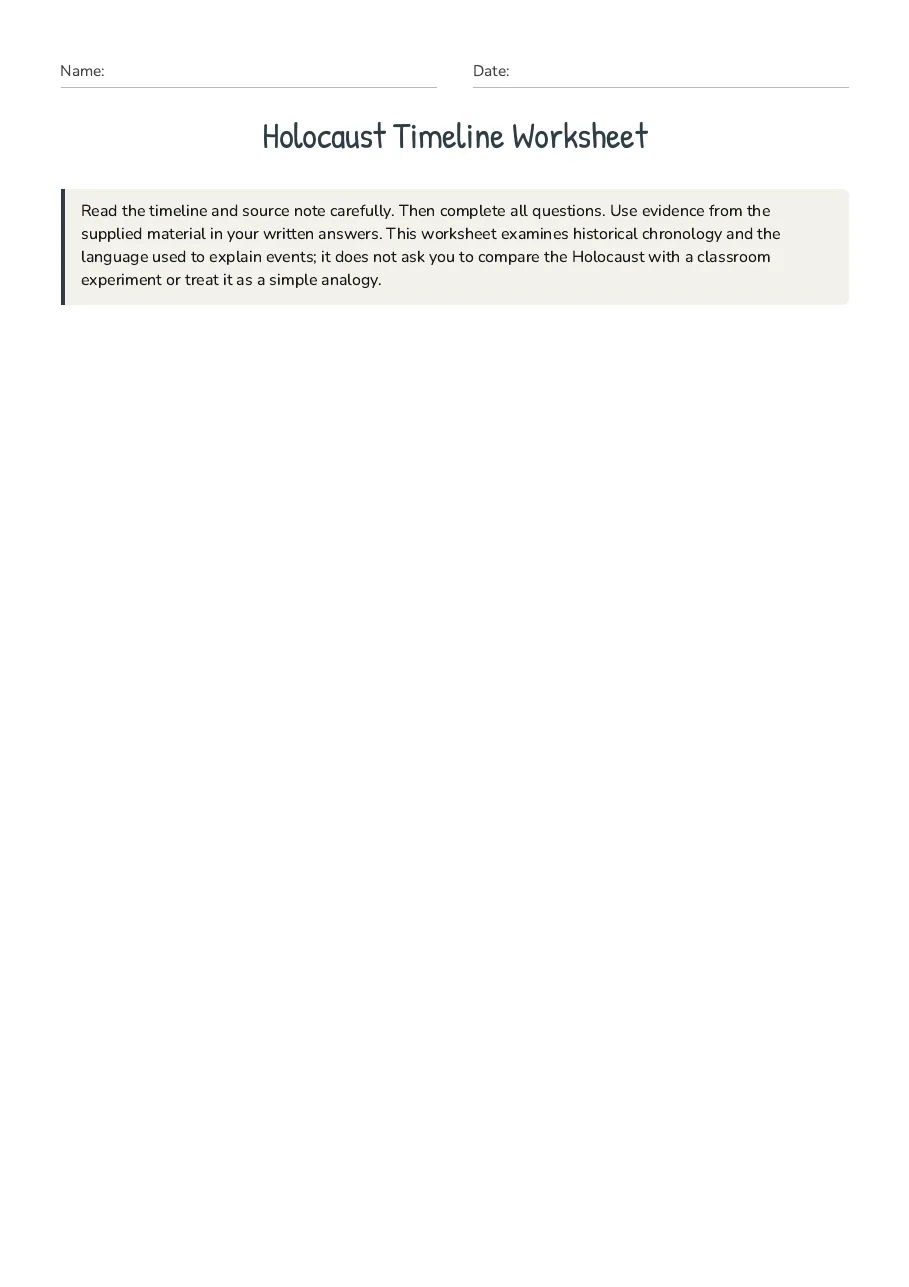
Holocaust Timeline Worksheet
A free english worksheet ready for your classroom. Open in Kuraplan to grab the print-ready PDF, customize it for your students, or generate a fresh version in seconds.

Holocaust Timeline Worksheet
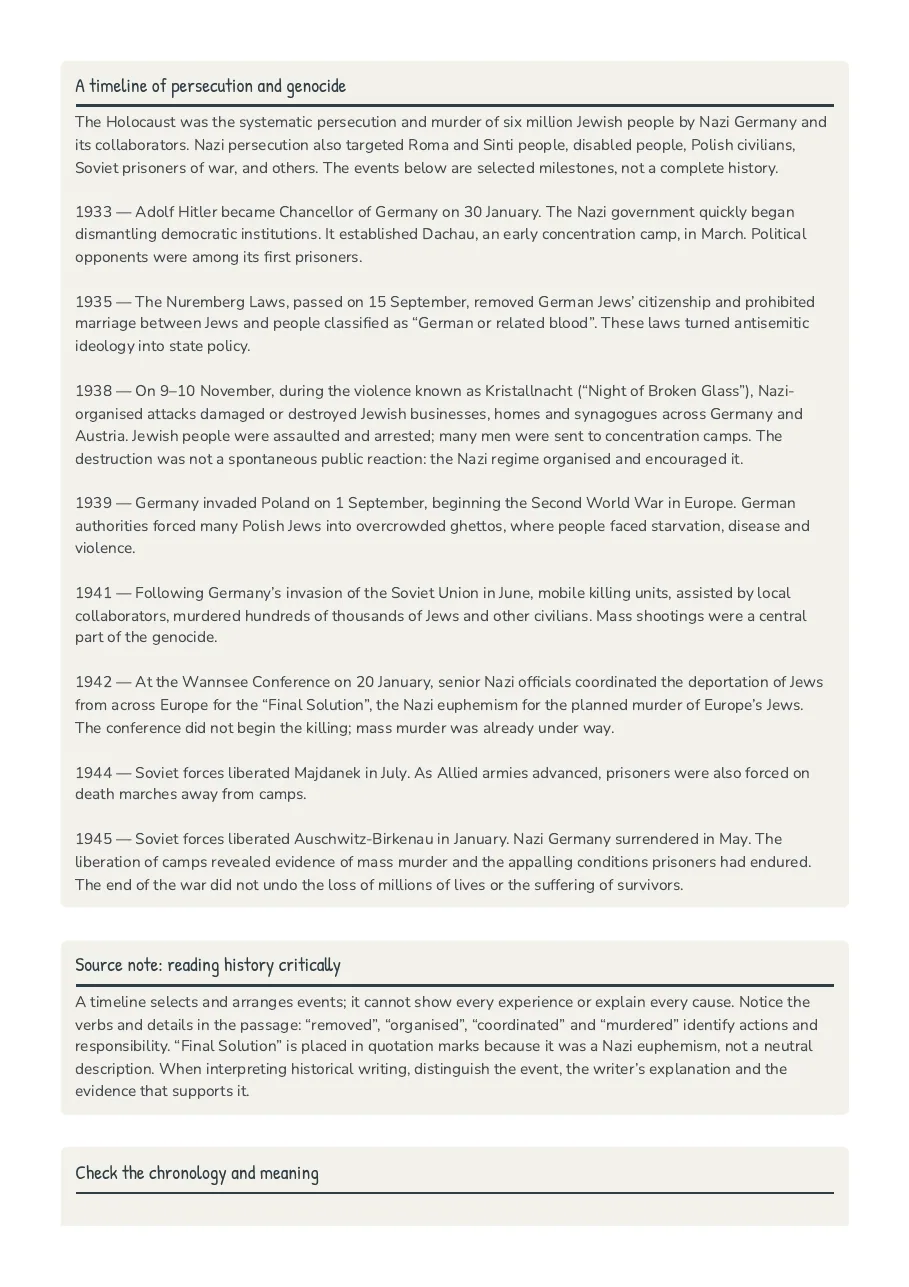
A timeline of persecution and genocide
The Holocaust was the systematic persecution and murder of six million Jewish people by Nazi Germany and its collaborators. Nazi persecution also targeted Roma and Sinti people, disabled people, Polish civilians, Soviet prisoners of war, and others. The events below are selected milestones, not a complete history. 1933 — Adolf Hitler became Chancellor of Germany on 30 January. The Nazi government quickly began dismantling democratic institutions. It established Dachau, an early concentration camp, in March. Political opponents were among its first prisoners. 1935 — The Nuremberg Laws, passed on 15 September, removed German Jews’ citizenship and prohibited marriage between Jews and people classified as “German or related blood”. These laws turned antisemitic ideology into state policy. 1938 — On 9–10 November, during the violence known as Kristallnacht (“Night of Broken Glass”), Nazi-organised attacks damaged or destroyed Jewish businesses, homes and synagogues across Germany and Austria. Jewish people were assaulted and arrested; many men were sent to concentration camps. The destruction was not a spontaneous public reaction: the Nazi regime organised and encouraged it. 1939 — Germany invaded Poland on 1 September, beginning the Second World War in Europe. German authorities forced many Polish Jews into overcrowded ghettos, where people faced starvation, disease and violence. 1941 — Following Germany’s invasion of the Soviet Union in June, mobile killing units, assisted by local collaborators, murdered hundreds of thousands of Jews and other civilians. Mass shootings were a central part of the genocide. 1942 — At the Wannsee Conference on 20 January, senior Nazi officials coordinated the deportation of Jews from across Europe for the “Final Solution”, the Nazi euphemism for the planned murder of Europe’s Jews. The conference did not begin the killing; mass murder was already under way. 1944 — Soviet forces liberated Majdanek in July. As Allied armies advanced, prisoners were also forced on death marches away from camps. 1945 — Soviet forces liberated Auschwitz-Birkenau in January. Nazi Germany surrendered in May. The liberation of camps revealed evidence of mass murder and the appalling conditions prisoners had endured. The end of the war did not undo the loss of millions of lives or the suffering of survivors.
Source note: reading history critically
A timeline selects and arranges events; it cannot show every experience or explain every cause. Notice the verbs and details in the passage: “removed”, “organised”, “coordinated” and “murdered” identify actions and responsibility. “Final Solution” is placed in quotation marks because it was a Nazi euphemism, not a neutral description. When interpreting historical writing, distinguish the event, the writer’s explanation and the evidence that supports it.
Check the chronology and meaning
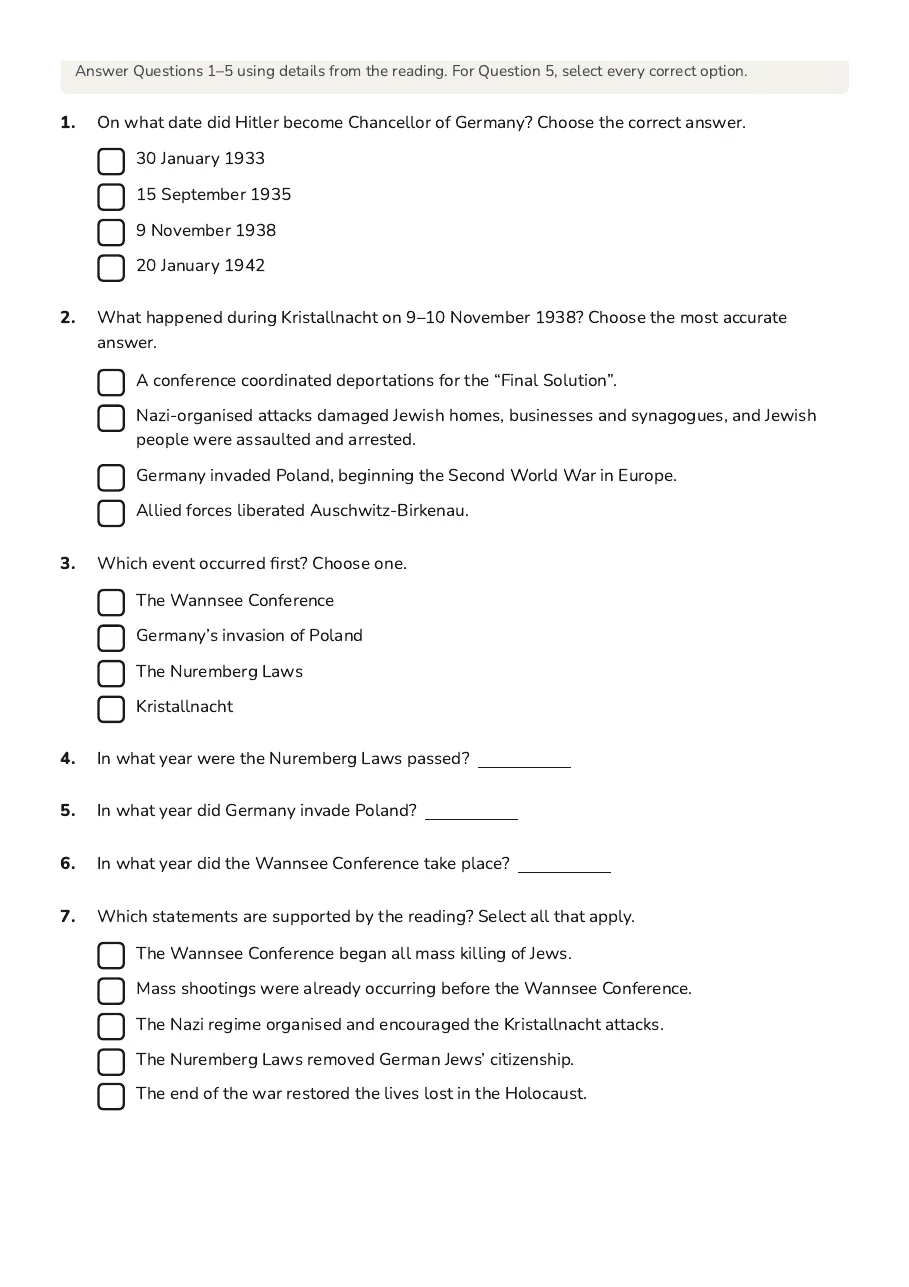
Answer Questions 1–5 using details from the reading. For Question 5, select every correct option.
- 30 January 1933
- 15 September 1935
- 9 November 1938
- 20 January 1942
- A conference coordinated deportations for the “Final Solution”.
- Nazi-organised attacks damaged Jewish homes, businesses and synagogues, and Jewish people were assaulted and arrested.
- Germany invaded Poland, beginning the Second World War in Europe.
- Allied forces liberated Auschwitz-Birkenau.
- The Wannsee Conference
- Germany’s invasion of Poland
- The Nuremberg Laws
- Kristallnacht
- The Wannsee Conference began all mass killing of Jews.
- Mass shootings were already occurring before the Wannsee Conference.
- The Nazi regime organised and encouraged the Kristallnacht attacks.
- The Nuremberg Laws removed German Jews’ citizenship.
- The end of the war restored the lives lost in the Holocaust.
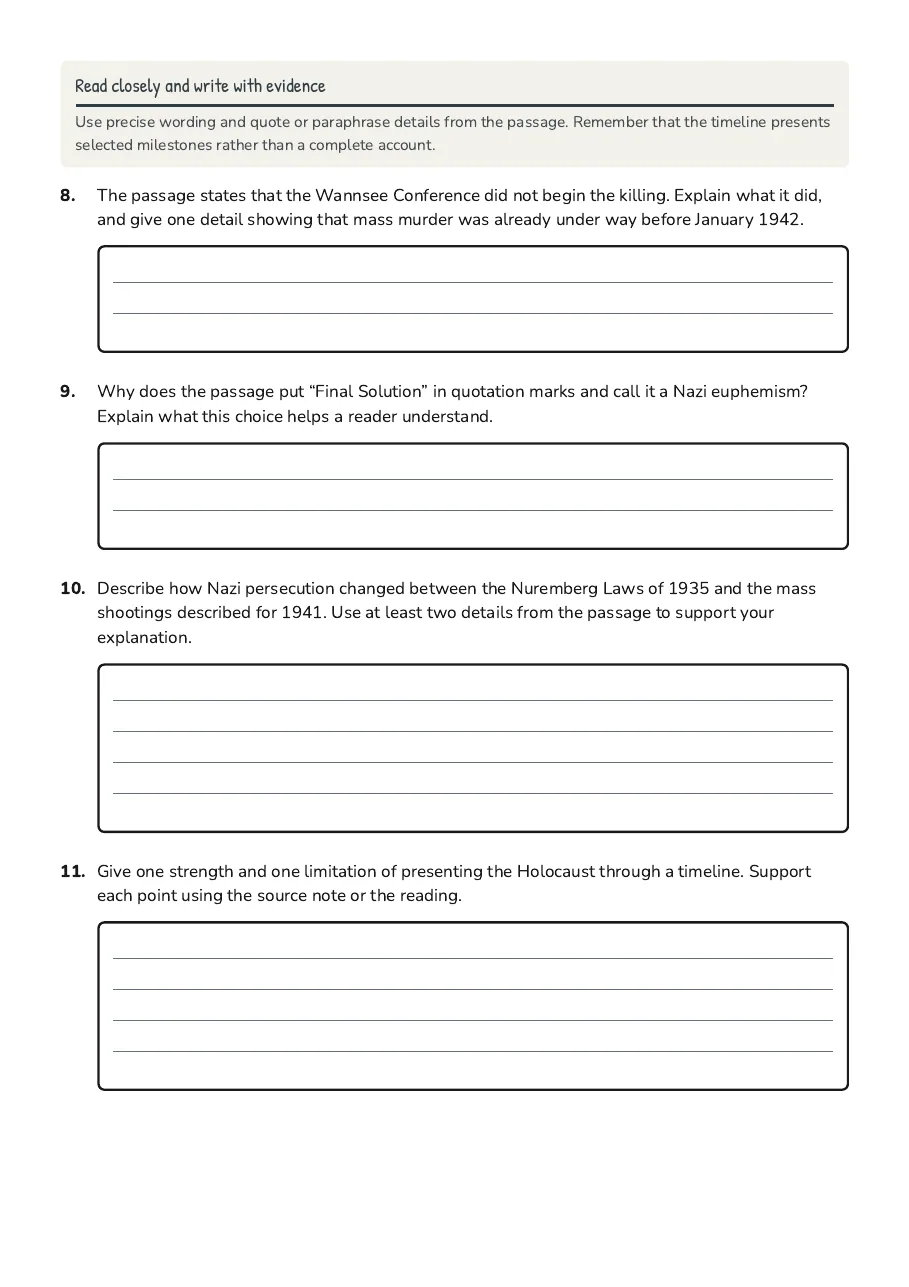
Read closely and write with evidence
Use precise wording and quote or paraphrase details from the passage. Remember that the timeline presents selected milestones rather than a complete account.
5 printable pages
Page 1
Page 2
Page 3
Page 4
Page 5
About This Worksheet
Free in Kuraplan
Sign up free, grab the PDF, and customize it for your class.
Print-Ready
Formatted for standard paper. Clean layout, easy to read.
AI-Generated
Created with Kuraplan's AI, designed for real classroom use.
For Teachers & Parents
Use in classrooms, for homework, tutoring, or homeschool.
Need a custom version of this worksheet?
Kuraplan's AI generates custom worksheets in seconds — differentiated for every learner, aligned to your curriculum.
Generate Custom Worksheets — Free