Human Rights Debate Rubric
A free social sciences worksheet ready for your classroom. Open in Kuraplan to grab the print-ready PDF, customize it for your students, or generate a fresh version in seconds.
Human Rights Debate Rubric
Scenario: safety, privacy and the station
A transport authority is considering facial-recognition cameras at major train stations. The system would compare faces with a watchlist to identify people suspected of serious offences. The authority says it could help locate suspects and respond to serious incidents. Critics are concerned about privacy, mistakes, bias and how long people’s images might be stored. No decision has been made. The debate motion is: “Facial-recognition cameras should be used at major train stations.”
Two speakers’ arguments
Hudson (supporting the motion): “A station is a crowded public place. If a carefully limited system helps identify a person suspected of a serious offence, it may help protect passengers. The authority should publish clear rules, restrict access and delete images quickly. Before adopting it, we should check independent evidence that it works accurately.” Omar (opposing the motion): “People should be able to travel without being scanned and tracked. A mistaken match could lead to someone being stopped unfairly. The authority should prove that the system is accurate for different groups and that less intrusive measures would not work. If it cannot show this, it should not use the cameras.”
Part A: Assess the arguments
Use the 1–4 scale from the instructions. Base each rating on what the speaker actually says. A high rating recognises clear reasoning, relevant support, engagement with competing concerns and respectful communication.
- 1 — The position or reasoning is difficult to identify.
- 2 — A position is present, but the reasoning is thin or unclear.
- 3 — The position and reasoning are mostly clear.
- 4 — The position is clear and the reasoning develops logically.
- Hudson, because he mentions crowded stations.
- Omar, because he raises the possibility of a mistaken match.
- Neither speaker provides a concrete piece of evidence in the excerpt.
- Both speakers provide concrete research evidence.
Part B: Give constructive feedback
Useful feedback is specific, fair and focused on what a speaker can improve. Recognise a strength before suggesting a next step.
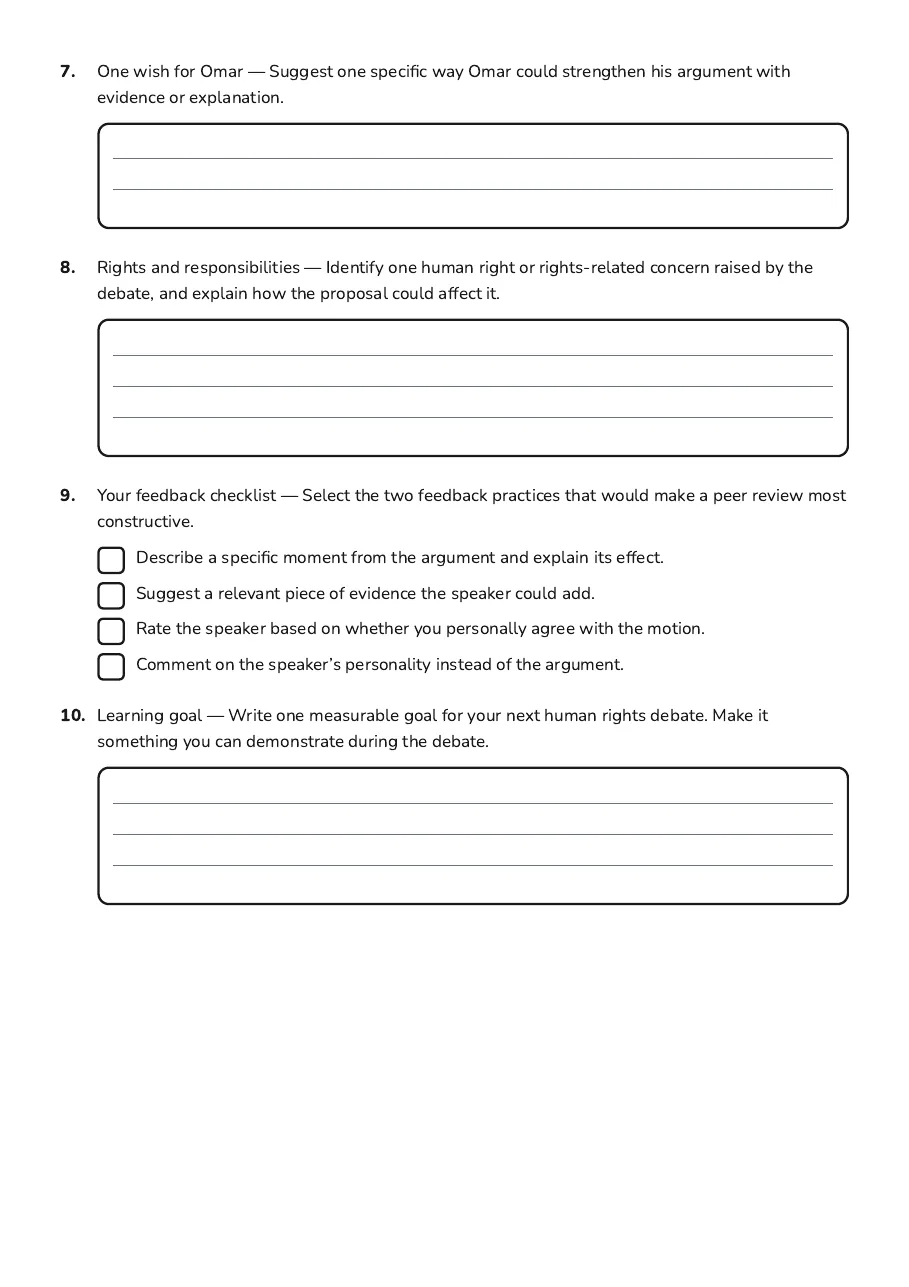
- Describe a specific moment from the argument and explain its effect.
- Suggest a relevant piece of evidence the speaker could add.
- Rate the speaker based on whether you personally agree with the motion.
- Comment on the speaker’s personality instead of the argument.
3 printable pages
Page 1
Page 2
Page 3
About This Worksheet
Free in Kuraplan
Sign up free, grab the PDF, and customize it for your class.
Print-Ready
Formatted for standard paper. Clean layout, easy to read.
AI-Generated
Created with Kuraplan's AI, designed for real classroom use.
For Teachers & Parents
Use in classrooms, for homework, tutoring, or homeschool.
Need a custom version of this worksheet?
Kuraplan's AI generates custom worksheets in seconds — differentiated for every learner, aligned to your curriculum.
Generate Custom Worksheets — FreeMore Social Sciences Worksheets
Community Project Planning
Free
Australian Law Reform Fact Sheets
Free
Australian Referendums Constitutional Process
Free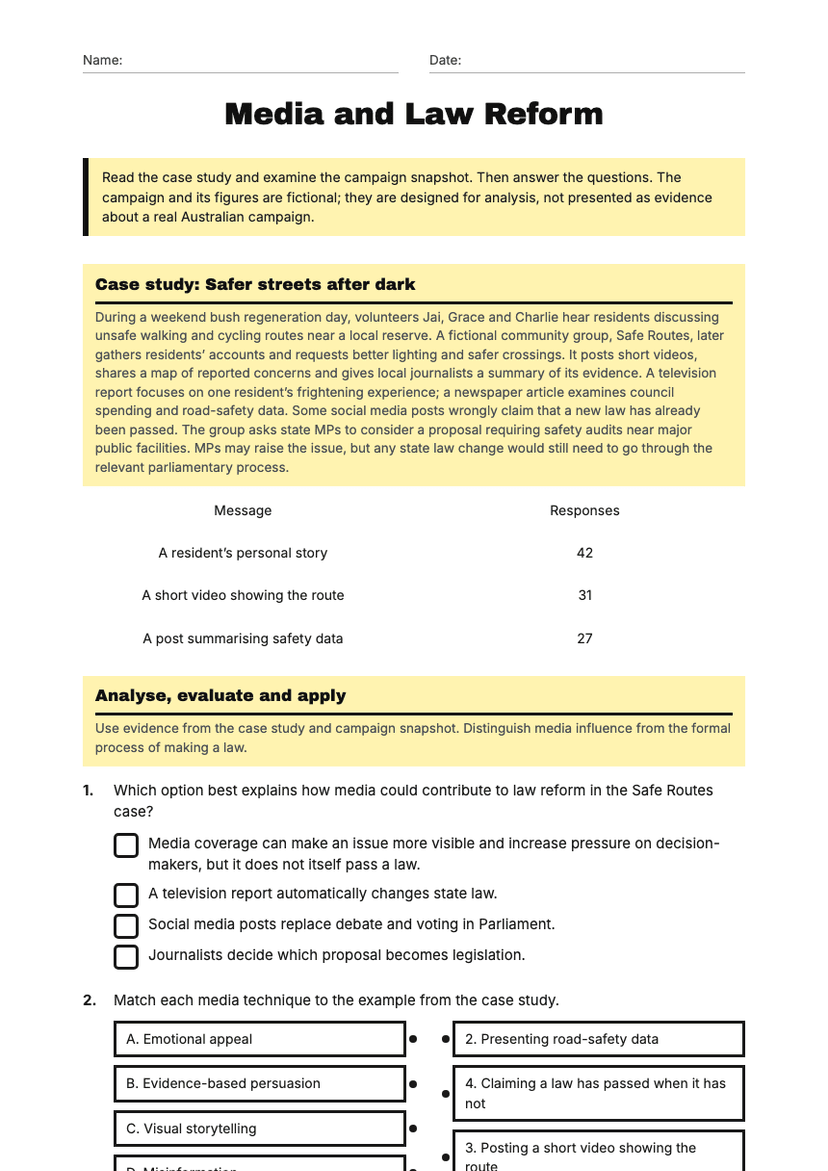
Media and Law Reform
Free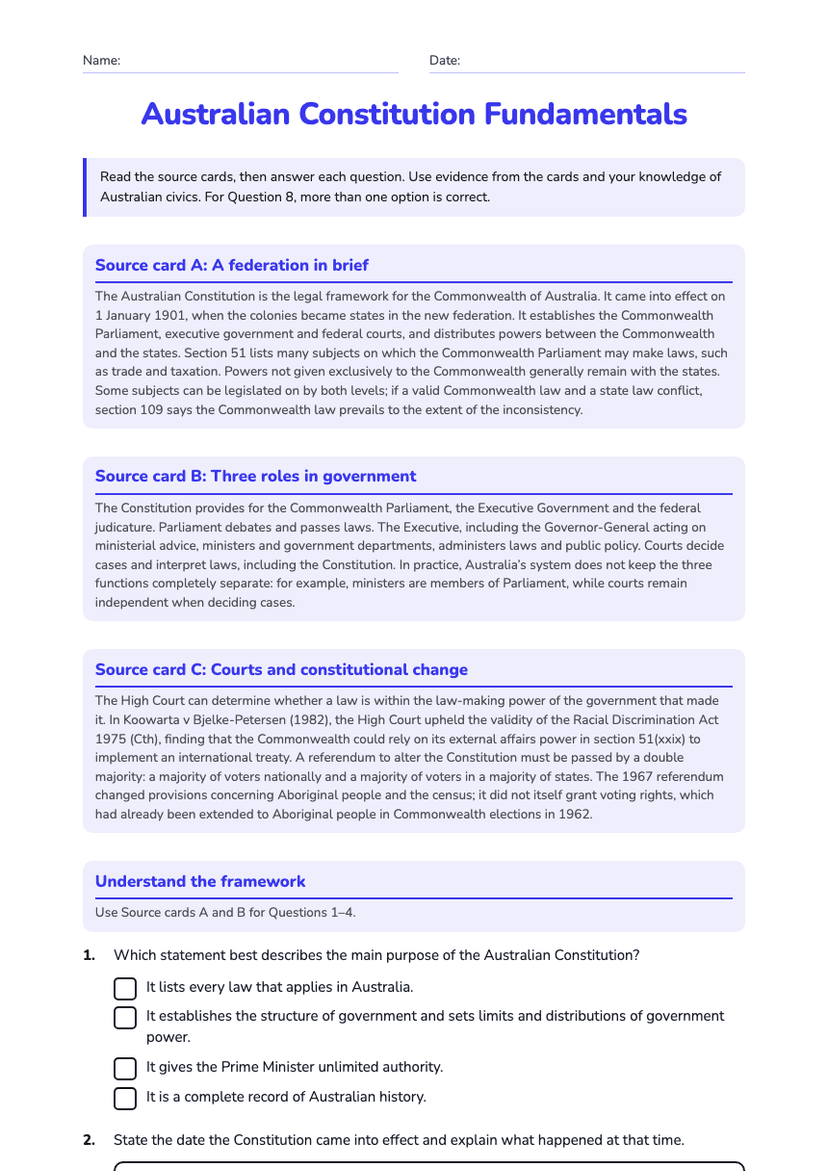
Australian Constitution Fundamentals
Free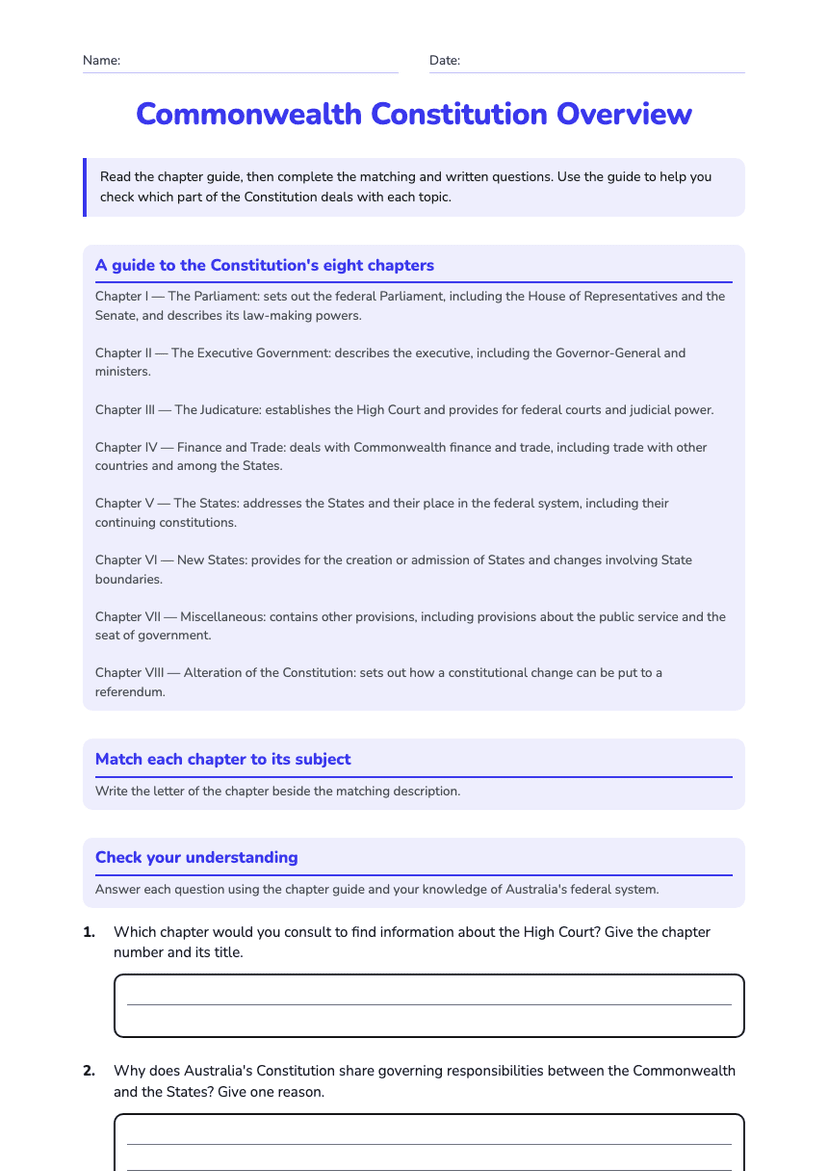
Commonwealth Constitution Overview
Free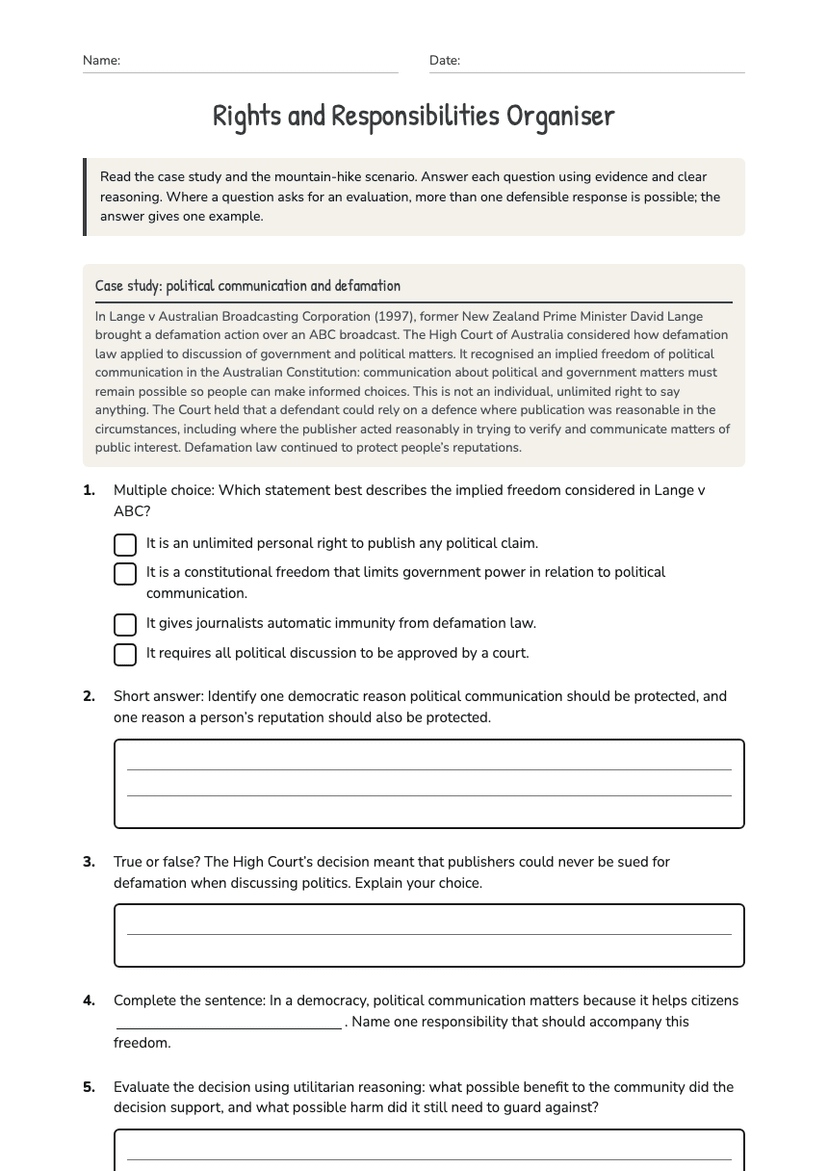
Rights and Responsibilities Organiser
Free