EnglishFreePrintable
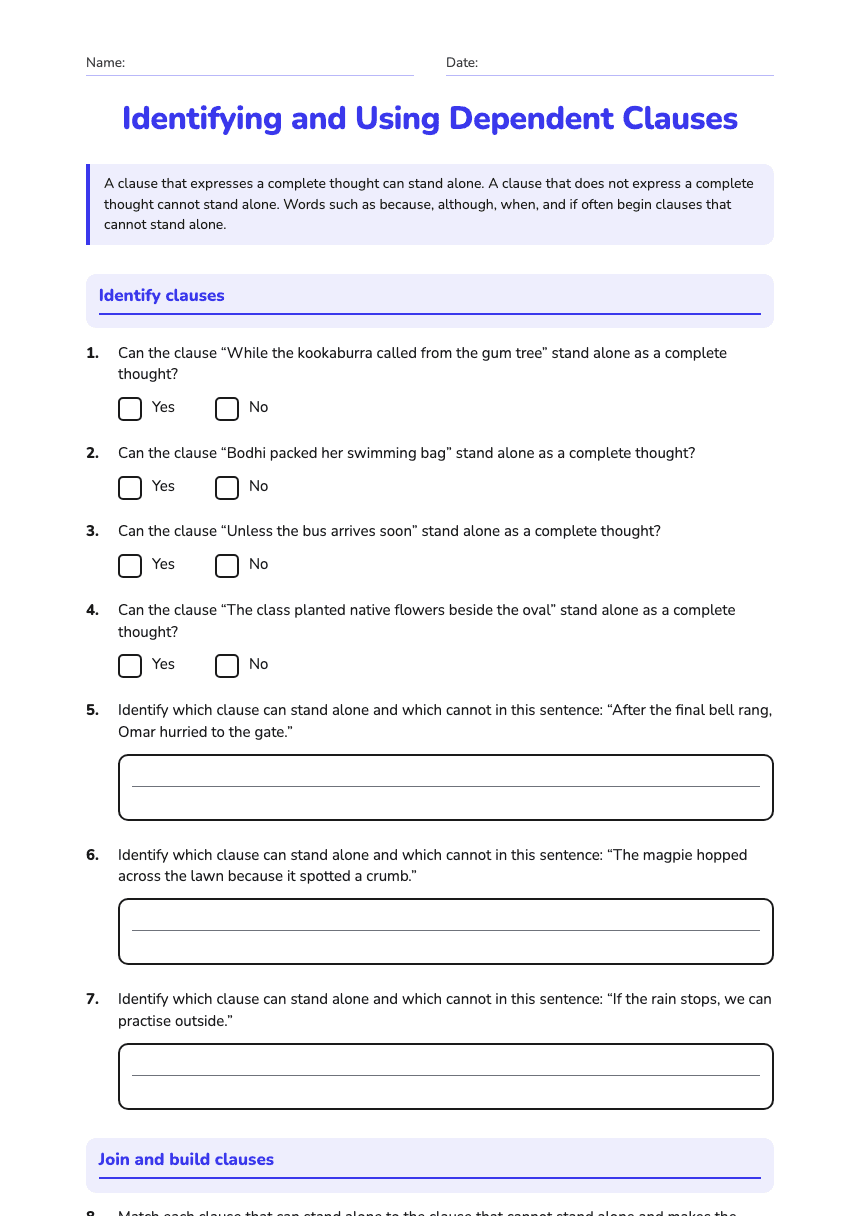
Identifying and Using Dependent Clauses
A free english worksheet ready for your classroom. Open in Kuraplan to grab the print-ready PDF, customize it for your students, or generate a fresh version in seconds.
Name:Date:
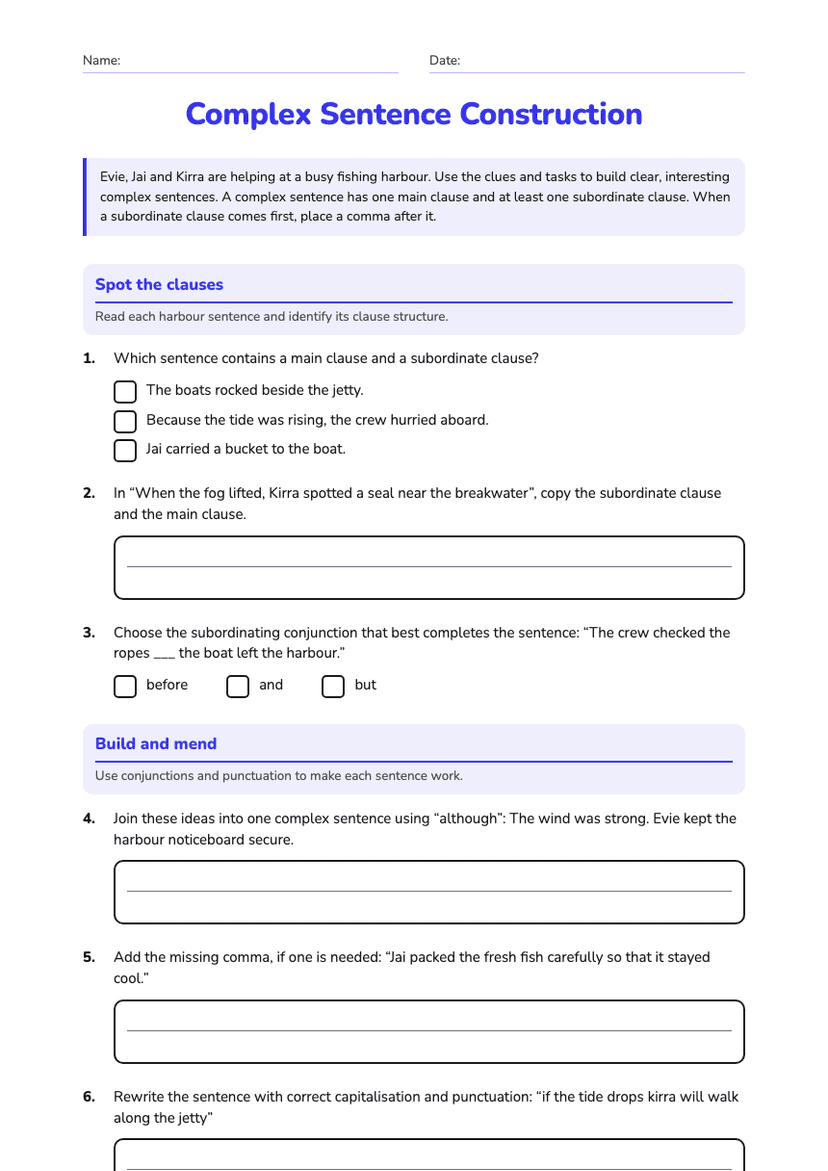
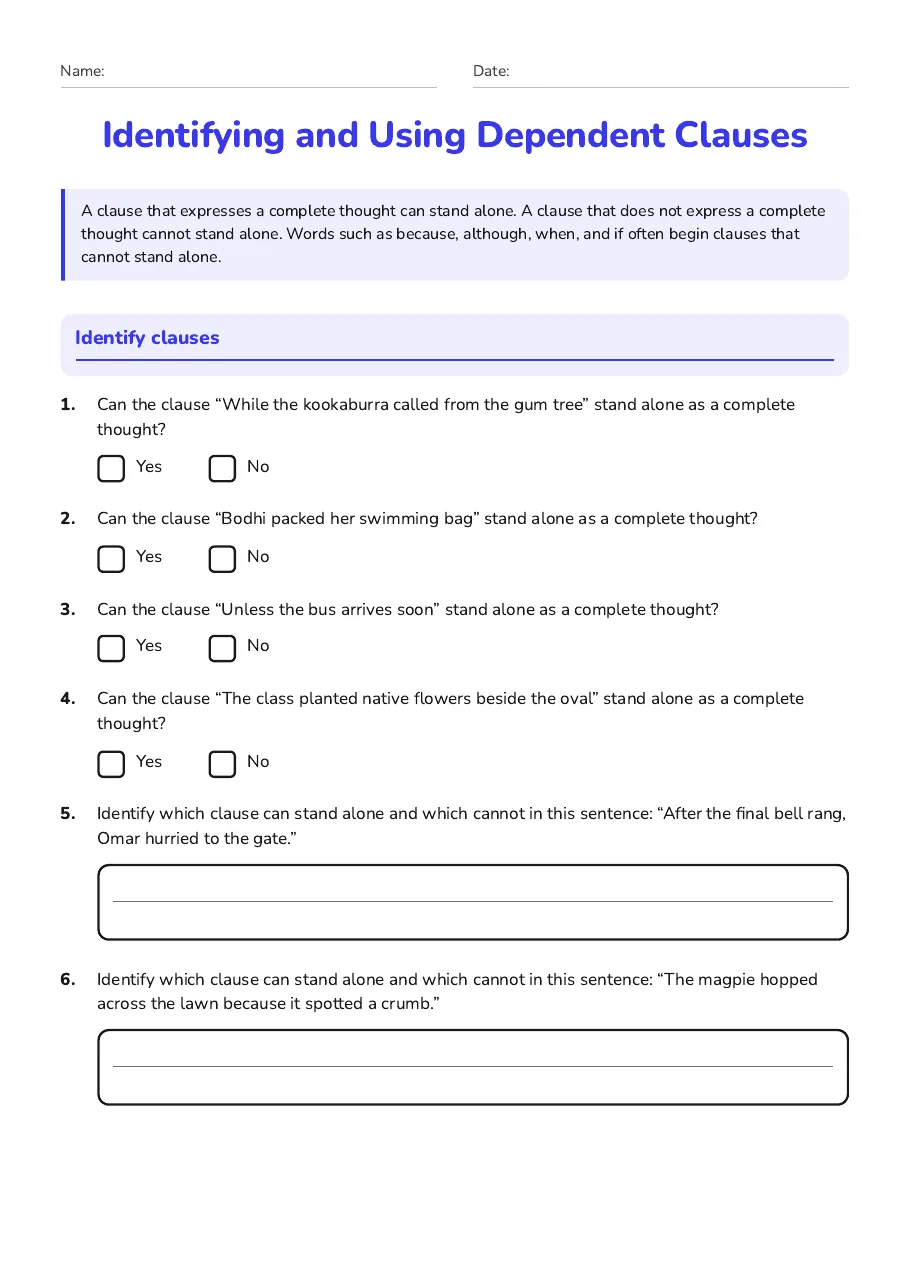
Identifying and Using Dependent Clauses
A clause that expresses a complete thought can stand alone. A clause that does not express a complete thought cannot stand alone. Words such as because, although, when, and if often begin clauses that cannot stand alone.
Identify clauses
1.Can the clause “While the kookaburra called from the gum tree” stand alone as a complete thought?
- Yes
- No
2.Can the clause “Bodhi packed her swimming bag” stand alone as a complete thought?
- Yes
- No
3.Can the clause “Unless the bus arrives soon” stand alone as a complete thought?
- Yes
- No
4.Can the clause “The class planted native flowers beside the oval” stand alone as a complete thought?
- Yes
- No
5.Identify which clause can stand alone and which cannot in this sentence: “After the final bell rang, Omar hurried to the gate.”
6.Identify which clause can stand alone and which cannot in this sentence: “The magpie hopped across the lawn because it spotted a crumb.”
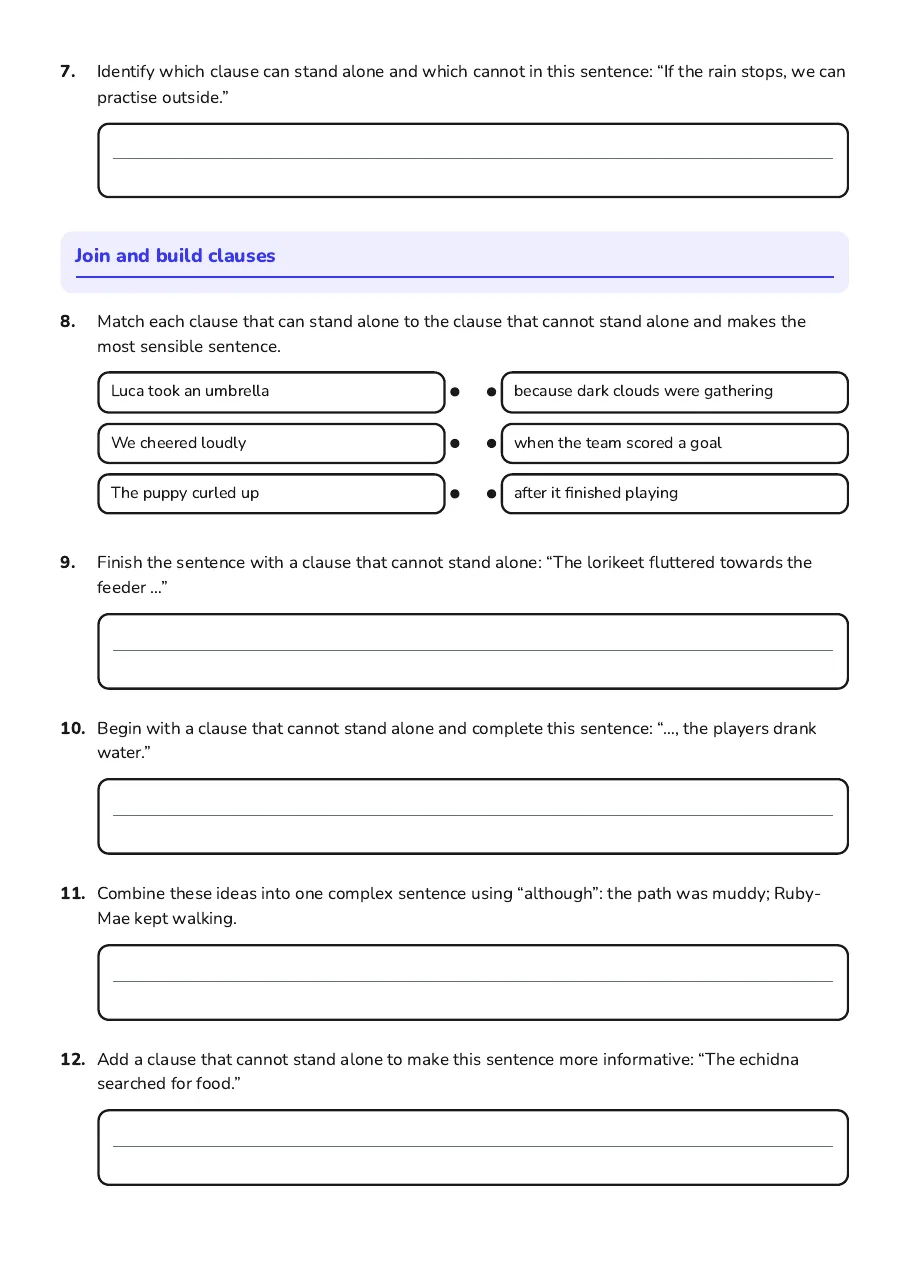
7.Identify which clause can stand alone and which cannot in this sentence: “If the rain stops, we can practise outside.”
Join and build clauses
8.Match each clause that can stand alone to the clause that cannot stand alone and makes the most sensible sentence.
- Luca took an umbrella
- We cheered loudly
- The puppy curled up
- because dark clouds were gathering
- when the team scored a goal
- after it finished playing
9.Finish the sentence with a clause that cannot stand alone: “The lorikeet fluttered towards the feeder …”
10.Begin with a clause that cannot stand alone and complete this sentence: “…, the players drank water.”
11.Combine these ideas into one complex sentence using “although”: the path was muddy; Ruby-Mae kept walking.
12.Add a clause that cannot stand alone to make this sentence more informative: “The echidna searched for food.”
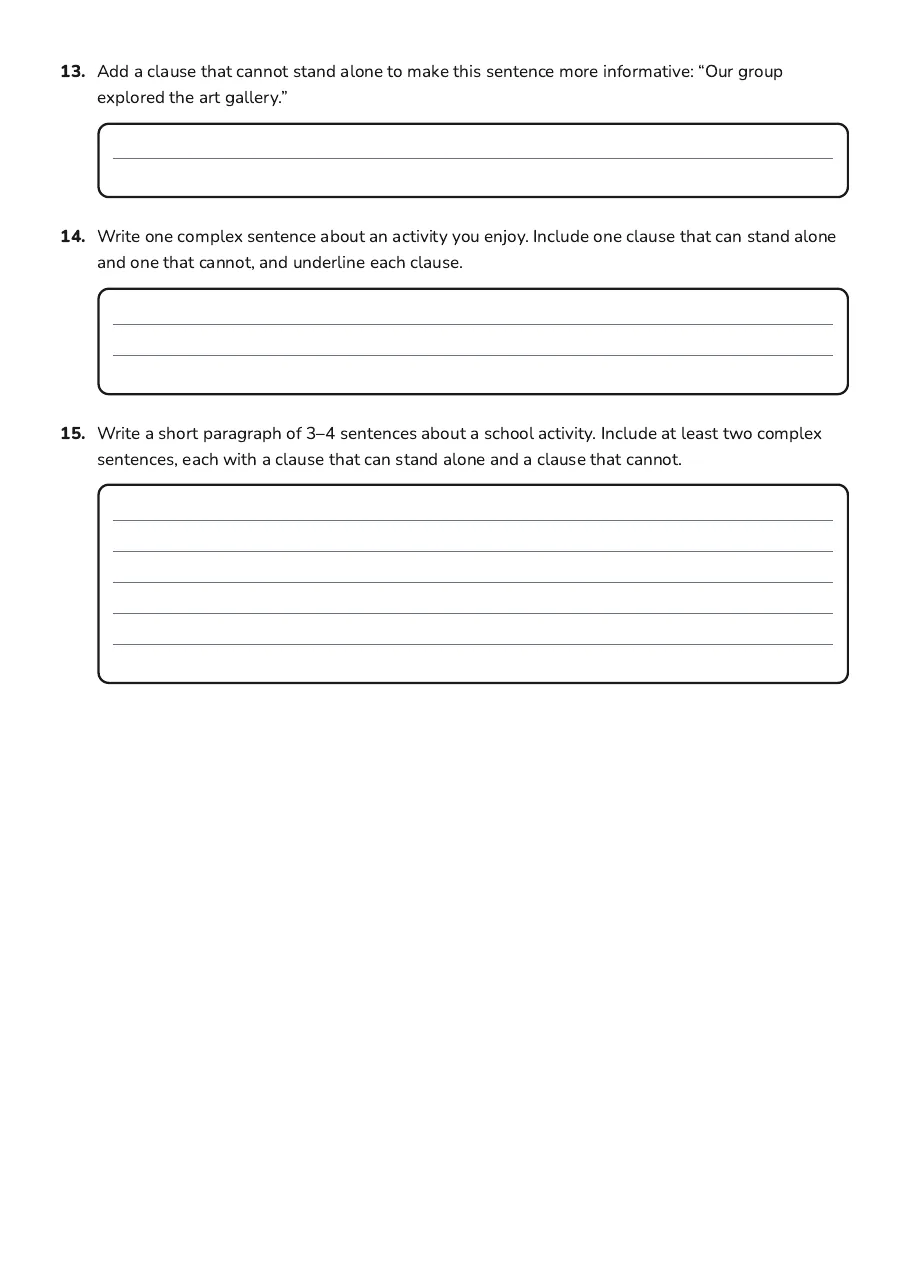
13.Add a clause that cannot stand alone to make this sentence more informative: “Our group explored the art gallery.”
14.Write one complex sentence about an activity you enjoy. Include one clause that can stand alone and one that cannot, and underline each clause.
15.Write a short paragraph of 3–4 sentences about a school activity. Include at least two complex sentences, each with a clause that can stand alone and a clause that cannot.
3 printable pages
Page 1
Page 2
Page 3
About This Worksheet
Free in Kuraplan
Sign up free, grab the PDF, and customize it for your class.
Print-Ready
Formatted for standard paper. Clean layout, easy to read.
AI-Generated
Created with Kuraplan's AI, designed for real classroom use.
For Teachers & Parents
Use in classrooms, for homework, tutoring, or homeschool.
Need a custom version of this worksheet?
Kuraplan's AI generates custom worksheets in seconds — differentiated for every learner, aligned to your curriculum.
Generate Custom Worksheets — Free No credit card Curriculum-aligned Under 60 seconds