MusicFreePrintable
Keyboard Introduction & Rhythm
A free music worksheet ready for your classroom. Open in Kuraplan to grab the print-ready PDF, customize it for your students, or generate a fresh version in seconds.

Name:Date:
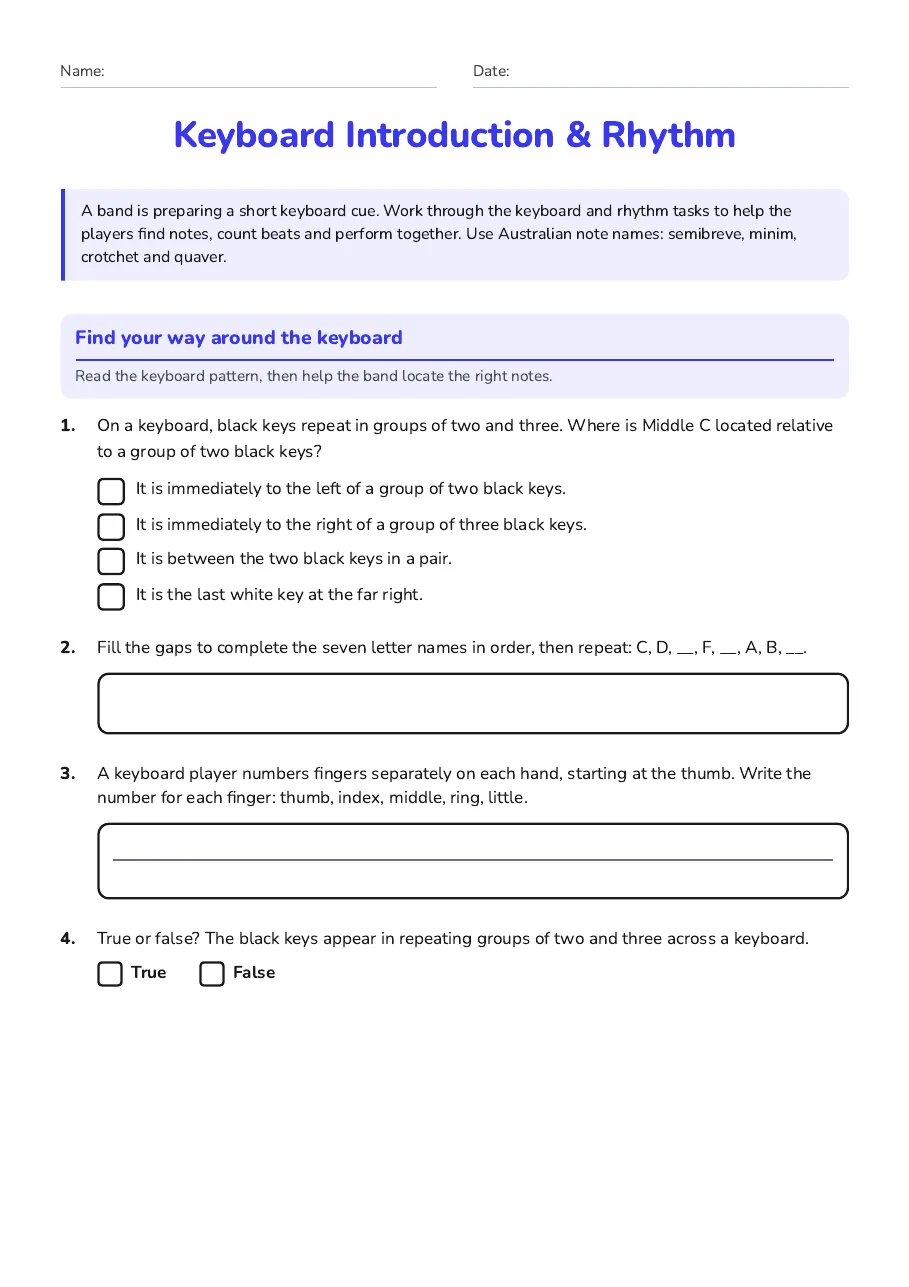
Keyboard Introduction & Rhythm
A band is preparing a short keyboard cue. Work through the keyboard and rhythm tasks to help the players find notes, count beats and perform together. Use Australian note names: semibreve, minim, crotchet and quaver.
Find your way around the keyboard
Read the keyboard pattern, then help the band locate the right notes.
1.On a keyboard, black keys repeat in groups of two and three. Where is Middle C located relative to a group of two black keys?
- It is immediately to the left of a group of two black keys.
- It is immediately to the right of a group of three black keys.
- It is between the two black keys in a pair.
- It is the last white key at the far right.
2.Fill the gaps to complete the seven letter names in order, then repeat: C, D, __, F, __, A, B, __.
3.A keyboard player numbers fingers separately on each hand, starting at the thumb. Write the number for each finger: thumb, index, middle, ring, little.
4.True or false? The black keys appear in repeating groups of two and three across a keyboard.
TrueFalse
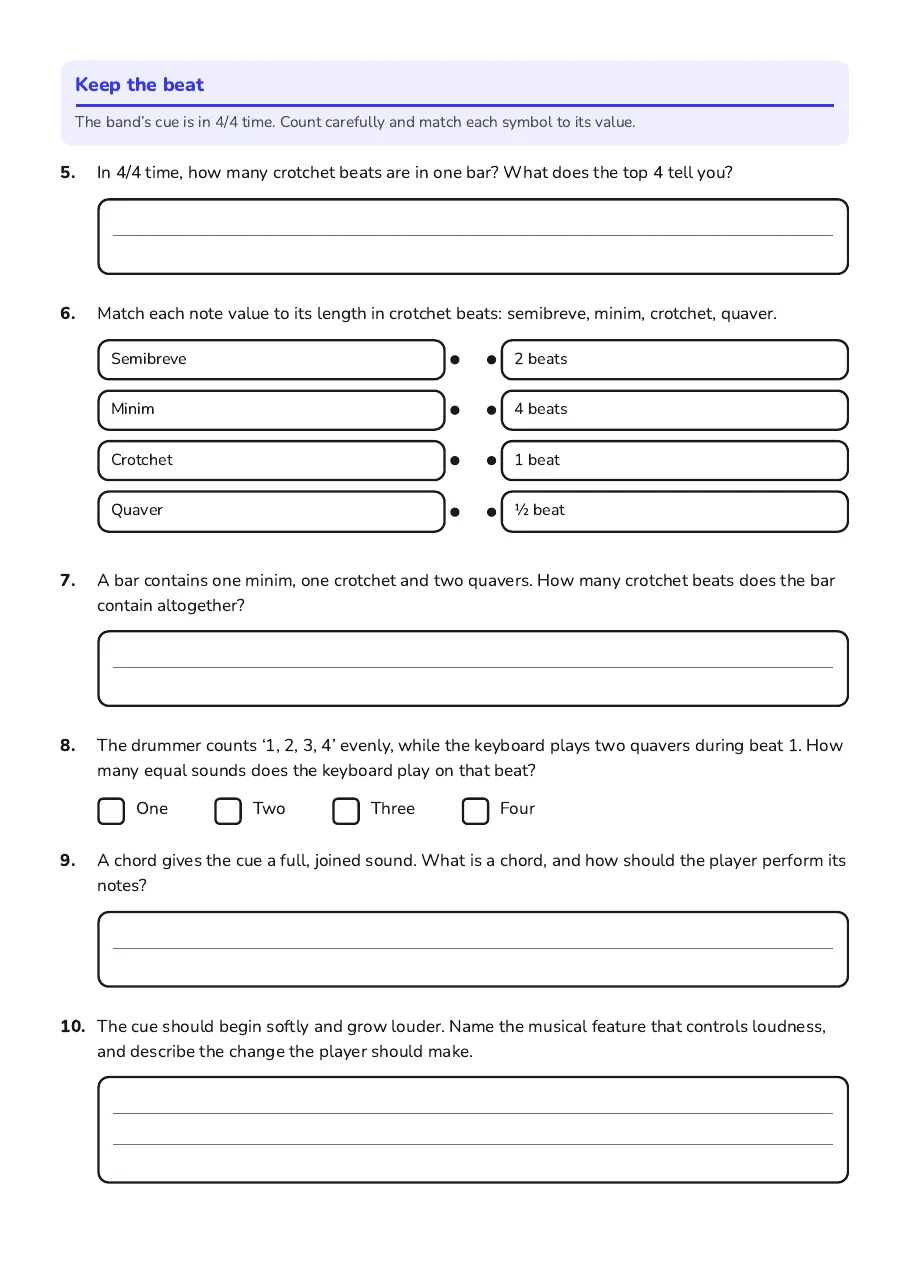
Keep the beat
The band’s cue is in 4/4 time. Count carefully and match each symbol to its value.
5.In 4/4 time, how many crotchet beats are in one bar? What does the top 4 tell you?
6.Match each note value to its length in crotchet beats: semibreve, minim, crotchet, quaver.
- Semibreve
- Minim
- Crotchet
- Quaver
- 2 beats
- 4 beats
- 1 beat
- ½ beat
7.A bar contains one minim, one crotchet and two quavers. How many crotchet beats does the bar contain altogether?
8.The drummer counts ‘1, 2, 3, 4’ evenly, while the keyboard plays two quavers during beat 1. How many equal sounds does the keyboard play on that beat?
- One
- Two
- Three
- Four
9.A chord gives the cue a full, joined sound. What is a chord, and how should the player perform its notes?
10.The cue should begin softly and grow louder. Name the musical feature that controls loudness, and describe the change the player should make.
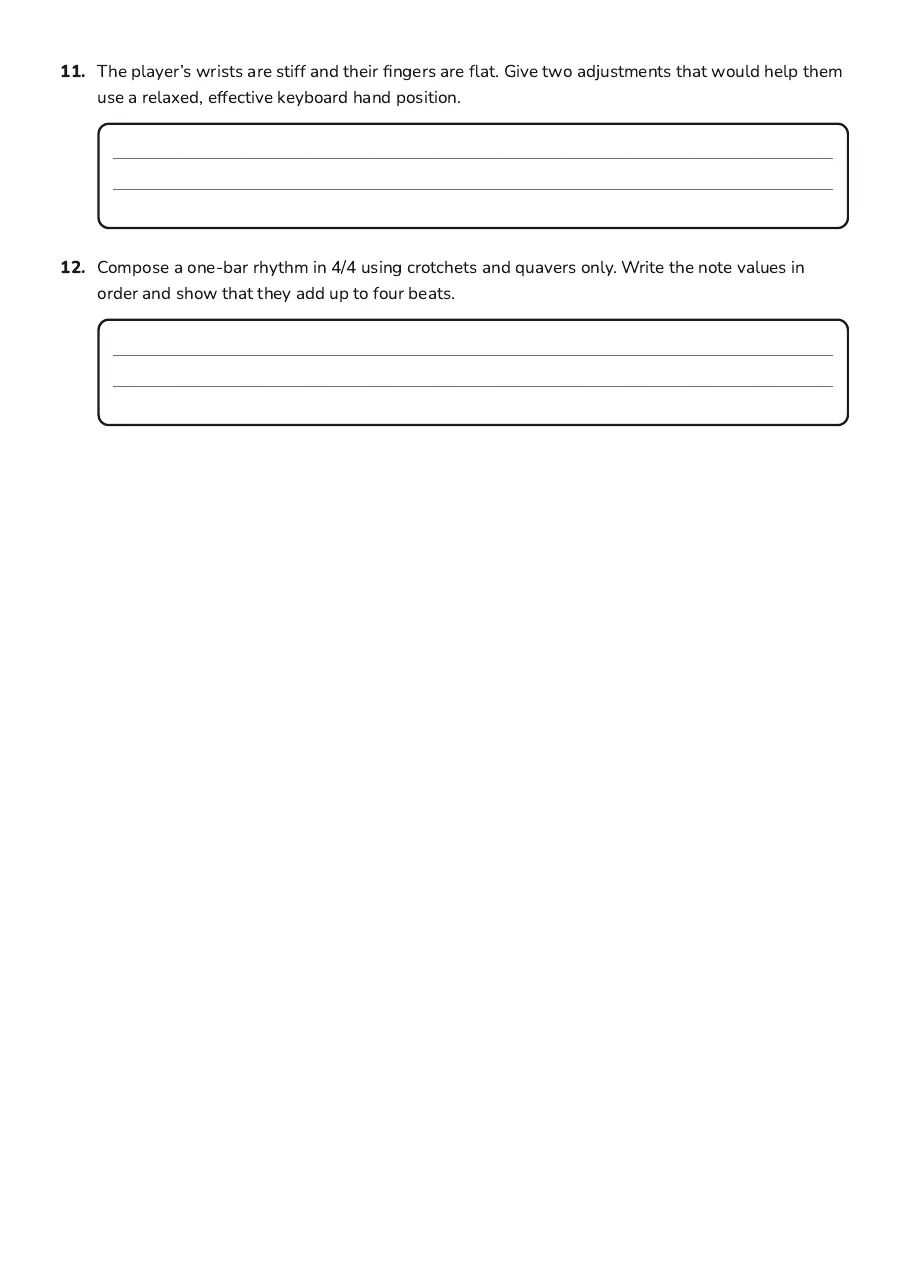
11.The player’s wrists are stiff and their fingers are flat. Give two adjustments that would help them use a relaxed, effective keyboard hand position.
12.Compose a one-bar rhythm in 4/4 using crotchets and quavers only. Write the note values in order and show that they add up to four beats.
3 printable pages
Page 1
Page 2
Page 3
About This Worksheet
Free in Kuraplan
Sign up free, grab the PDF, and customize it for your class.
Print-Ready
Formatted for standard paper. Clean layout, easy to read.
AI-Generated
Created with Kuraplan's AI, designed for real classroom use.
For Teachers & Parents
Use in classrooms, for homework, tutoring, or homeschool.
Need a custom version of this worksheet?
Kuraplan's AI generates custom worksheets in seconds — differentiated for every learner, aligned to your curriculum.
Generate Custom Worksheets — Free No credit card Curriculum-aligned Under 60 seconds
More Music Worksheets
Mental Health Matters Introduction
Free
Year 5
Poetry and Cats Introduction
Free
Year 5–6
Persuasive Introduction Writing
Free
Engaging Narrative Introductions
Free
Year 7
Creative Writing Introduction
Free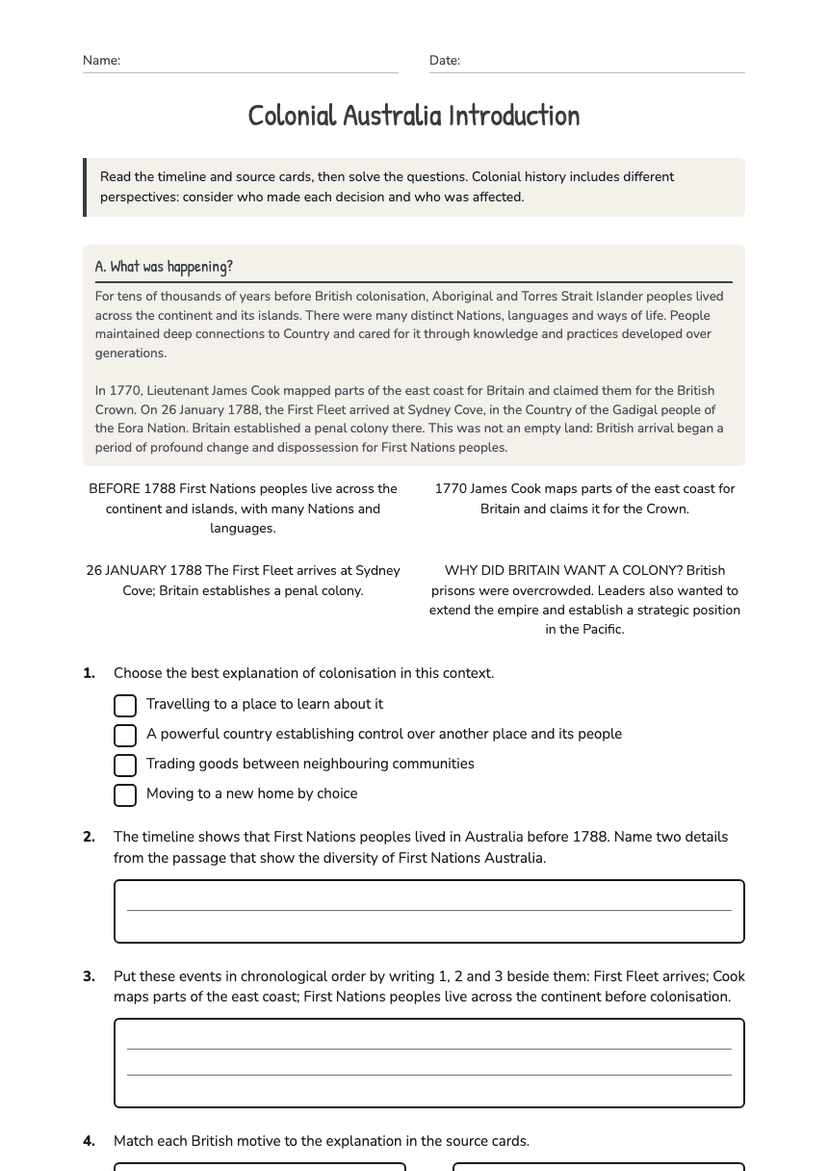
Year 5
Colonial Australia Introduction
Free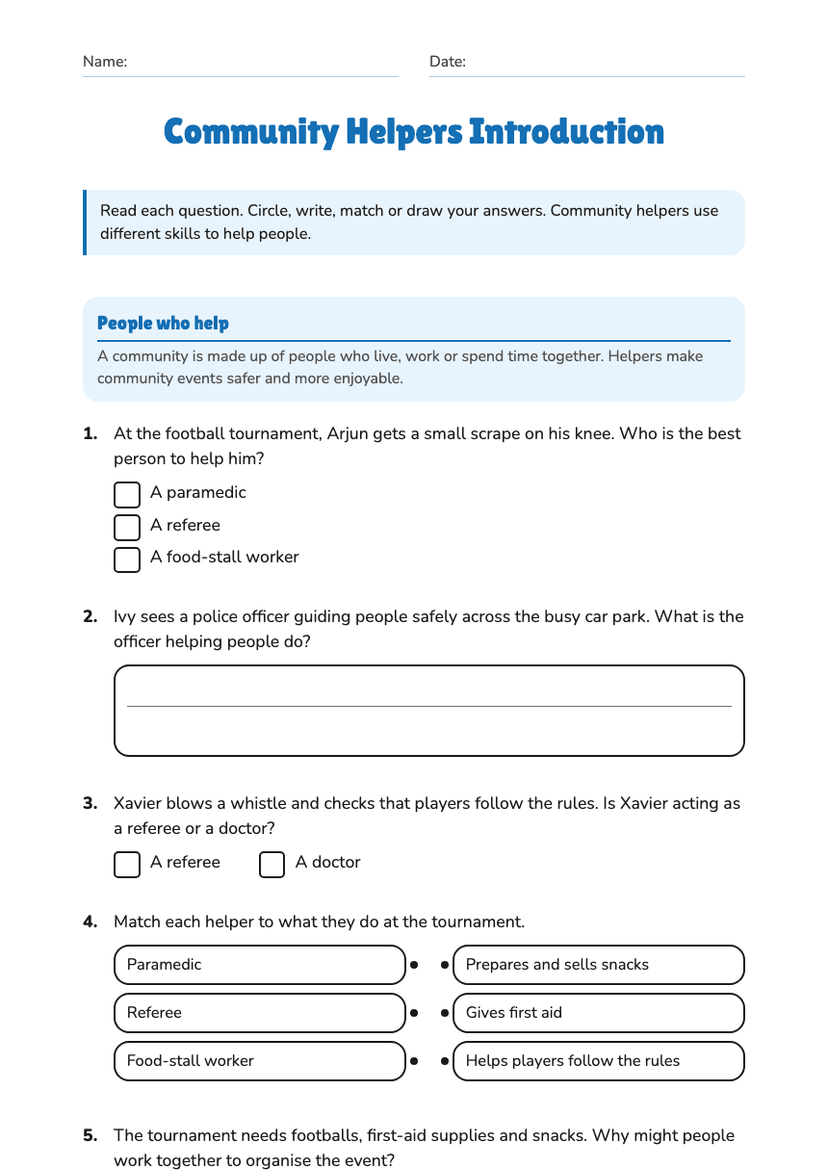
Year 1–4
Community Helpers Introduction
Free
Year 4–6