ScienceFreePrintable

Kitchen Chemistry Challenge

A free science worksheet ready for your classroom. Open in Kuraplan to grab the print-ready PDF, customize it for your students, or generate a fresh version in seconds.
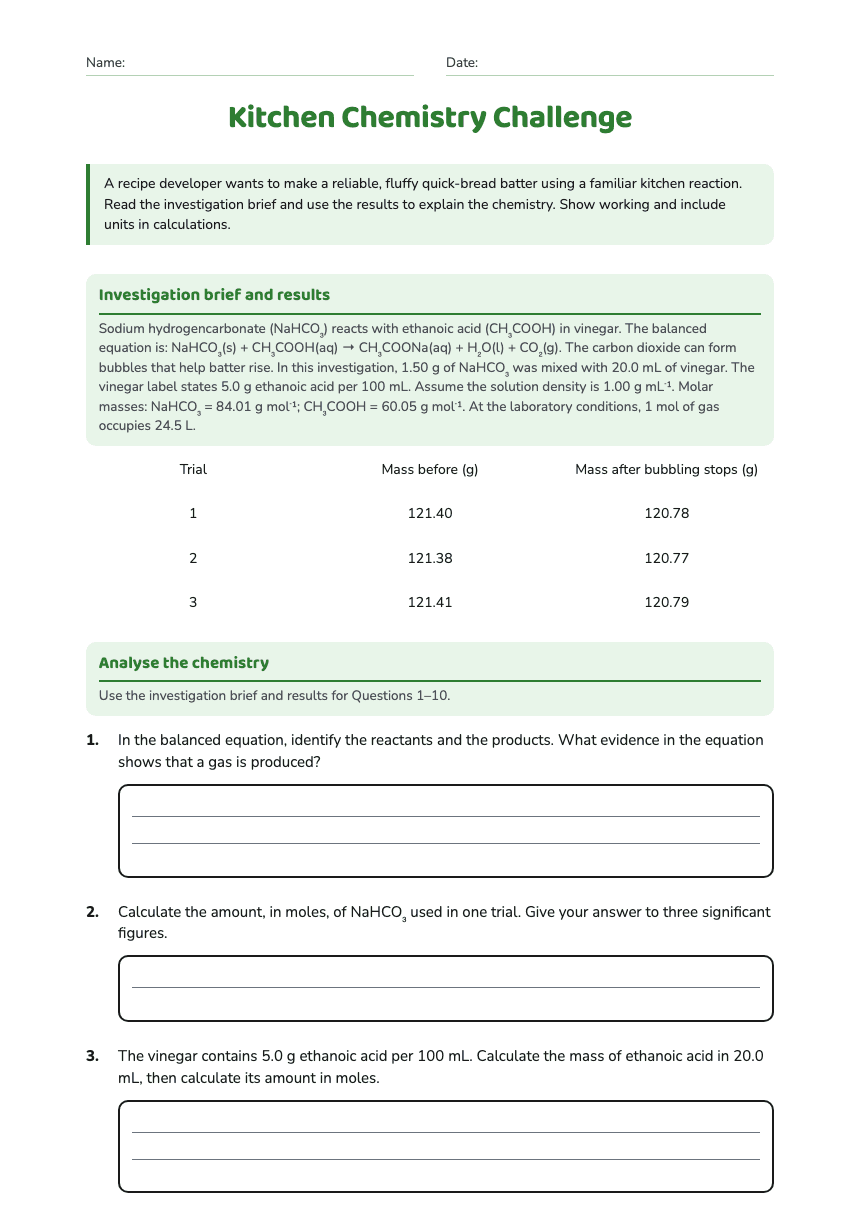
Kitchen Chemistry Challenge worksheet preview
Name:Date:

Kitchen Chemistry Challenge

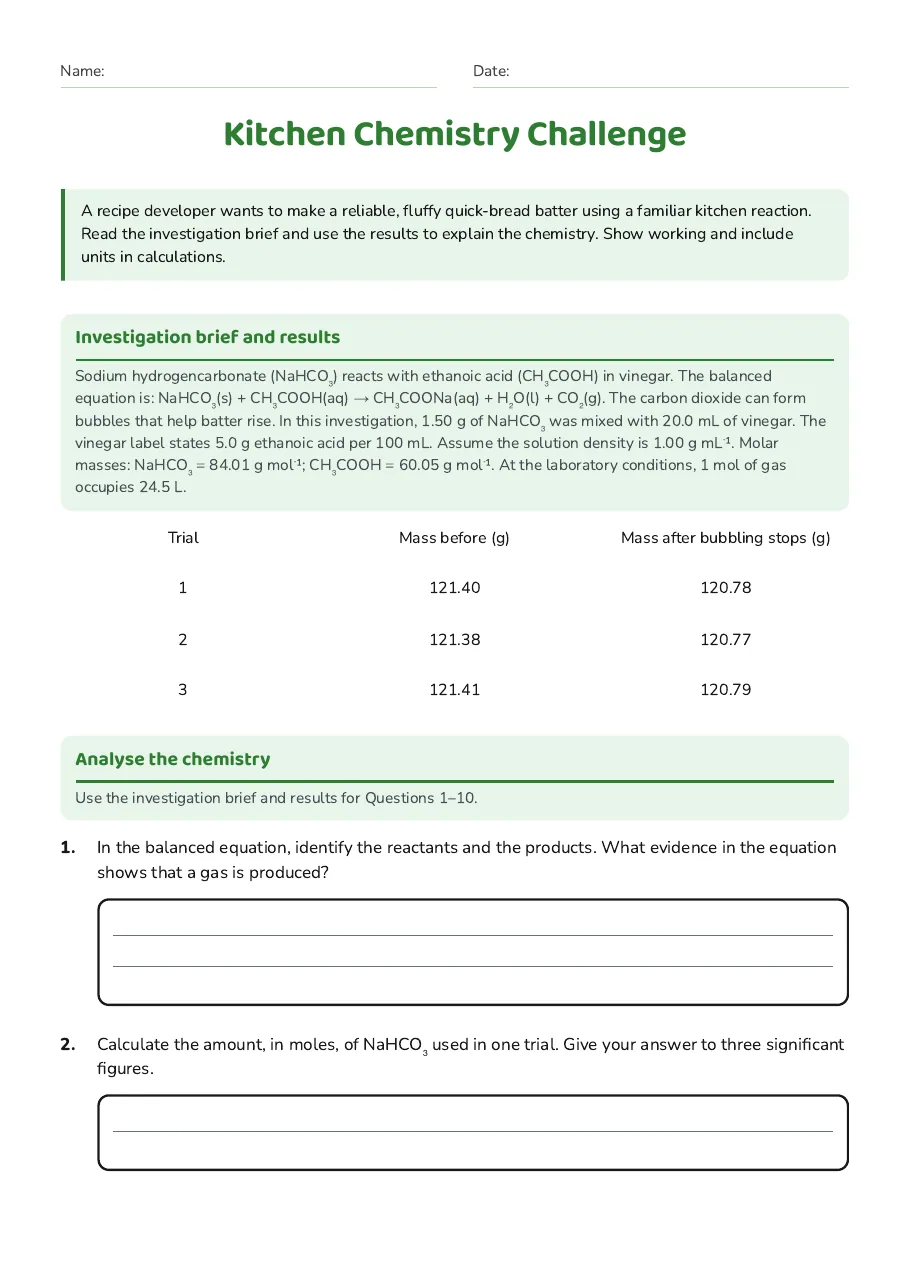
A recipe developer wants to make a reliable, fluffy quick-bread batter using a familiar kitchen reaction. Read the investigation brief and use the results to explain the chemistry. Show working and include units in calculations.

Investigation brief and results

Sodium hydrogencarbonate (NaHCO₃) reacts with ethanoic acid (CH₃COOH) in vinegar. The balanced equation is: NaHCO₃(s) + CH₃COOH(aq) → CH₃COONa(aq) + H₂O(l) + CO₂(g). The carbon dioxide can form bubbles that help batter rise. In this investigation, 1.50 g of NaHCO₃ was mixed with 20.0 mL of vinegar. The vinegar label states 5.0 g ethanoic acid per 100 mL. Assume the solution density is 1.00 g mL⁻¹. Molar masses: NaHCO₃ = 84.01 g mol⁻¹; CH₃COOH = 60.05 g mol⁻¹. At the laboratory conditions, 1 mol of gas occupies 24.5 L.

Trial

Mass before (g)

Mass after bubbling stops (g)

1

121.40

120.78

2

121.38

120.77

3

121.41

120.79

Analyse the chemistry

Use the investigation brief and results for Questions 1–10.

1.In the balanced equation, identify the reactants and the products. What evidence in the equation shows that a gas is produced?
2.Calculate the amount, in moles, of NaHCO₃ used in one trial. Give your answer to three significant figures.
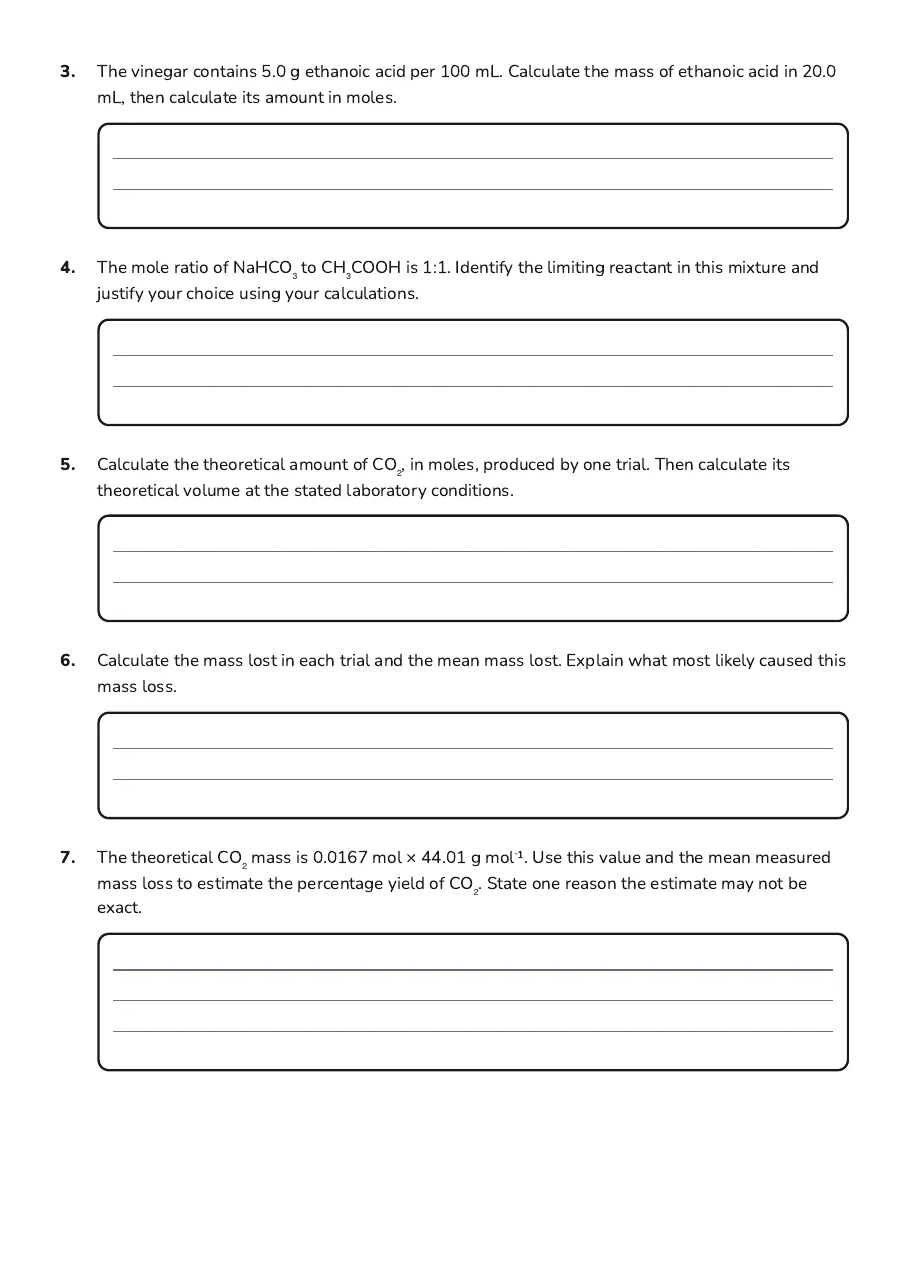
3.The vinegar contains 5.0 g ethanoic acid per 100 mL. Calculate the mass of ethanoic acid in 20.0 mL, then calculate its amount in moles.
4.The mole ratio of NaHCO₃ to CH₃COOH is 1:1. Identify the limiting reactant in this mixture and justify your choice using your calculations.
5.Calculate the theoretical amount of CO₂, in moles, produced by one trial. Then calculate its theoretical volume at the stated laboratory conditions.
6.Calculate the mass lost in each trial and the mean mass lost. Explain what most likely caused this mass loss.
7.The theoretical CO₂ mass is 0.0167 mol × 44.01 g mol⁻¹. Use this value and the mean measured mass loss to estimate the percentage yield of CO₂. State one reason the estimate may not be exact.
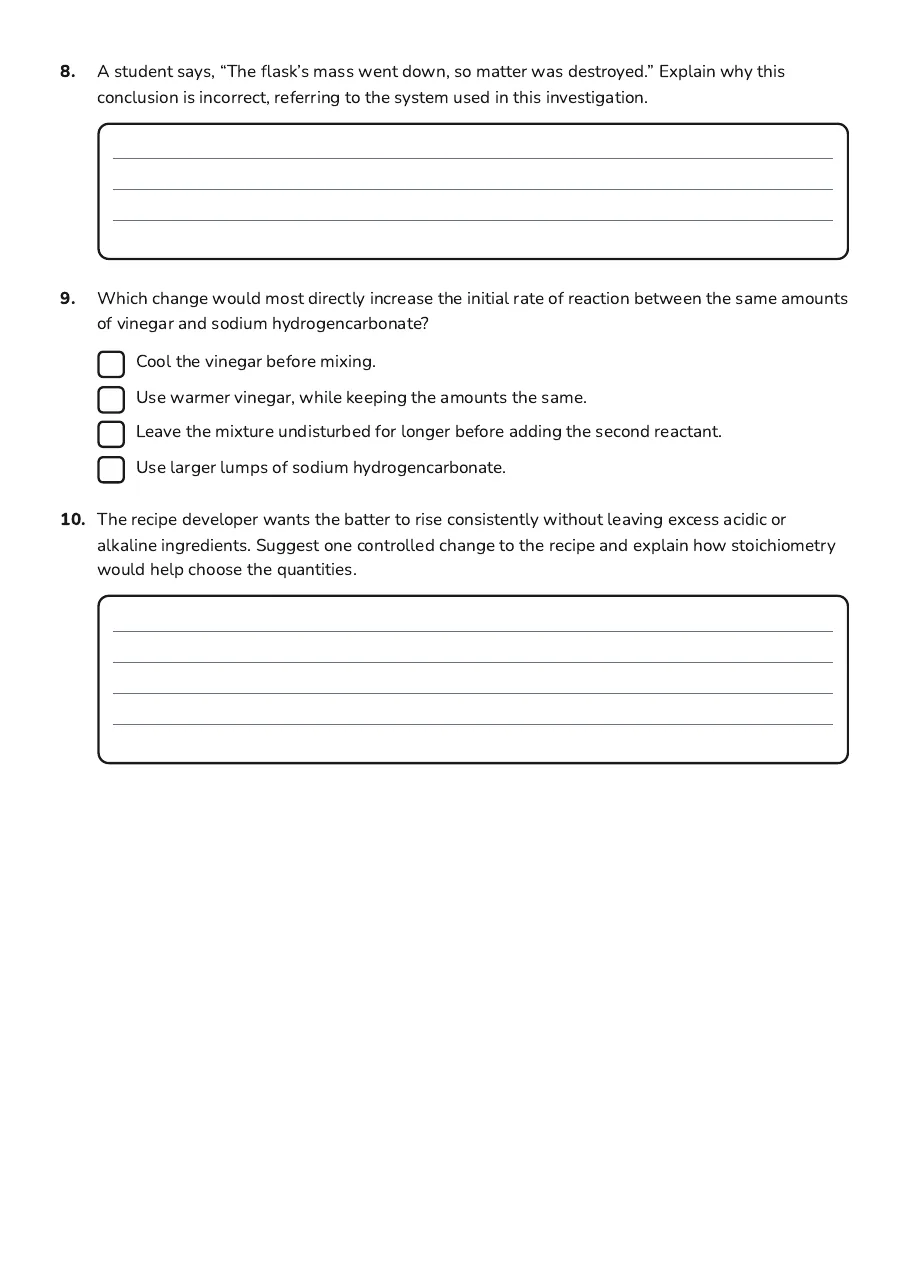
8.A student says, “The flask’s mass went down, so matter was destroyed.” Explain why this conclusion is incorrect, referring to the system used in this investigation.
9.Which change would most directly increase the initial rate of reaction between the same amounts of vinegar and sodium hydrogencarbonate?
  • Cool the vinegar before mixing.
  • Use warmer vinegar, while keeping the amounts the same.
  • Leave the mixture undisturbed for longer before adding the second reactant.
  • Use larger lumps of sodium hydrogencarbonate.
10.The recipe developer wants the batter to rise consistently without leaving excess acidic or alkaline ingredients. Suggest one controlled change to the recipe and explain how stoichiometry would help choose the quantities.

3 printable pages

  • Kitchen Chemistry Challenge, page 1 of 3: Investigation brief and results, Analyse the chemistry

    Page 1

  • Kitchen Chemistry Challenge, page 2 of 3: 3. The vinegar contains 5.0 g ethanoic acid per 100 mL. Calculate the mass of ethanoic…

    Page 2

  • Kitchen Chemistry Challenge, page 3 of 3: 8. A student says, “The flask’s mass went down, so matter was destroyed.” Explain why this

    Page 3

About This Worksheet

Free in Kuraplan

Sign up free, grab the PDF, and customize it for your class.

Print-Ready

Formatted for standard paper. Clean layout, easy to read.

AI-Generated

Created with Kuraplan's AI, designed for real classroom use.

For Teachers & Parents

Use in classrooms, for homework, tutoring, or homeschool.

Need a custom version of this worksheet?

Kuraplan's AI generates custom worksheets in seconds — differentiated for every learner, aligned to your curriculum.

Generate Custom Worksheets — Free
No credit card Curriculum-aligned Under 60 seconds