ScienceFreePrintable

Kitchen Chemistry pH Testing

A free science worksheet ready for your classroom. Open in Kuraplan to grab the print-ready PDF, customize it for your students, or generate a fresh version in seconds.
Kitchen Chemistry pH Testing worksheet preview
Name:Date:

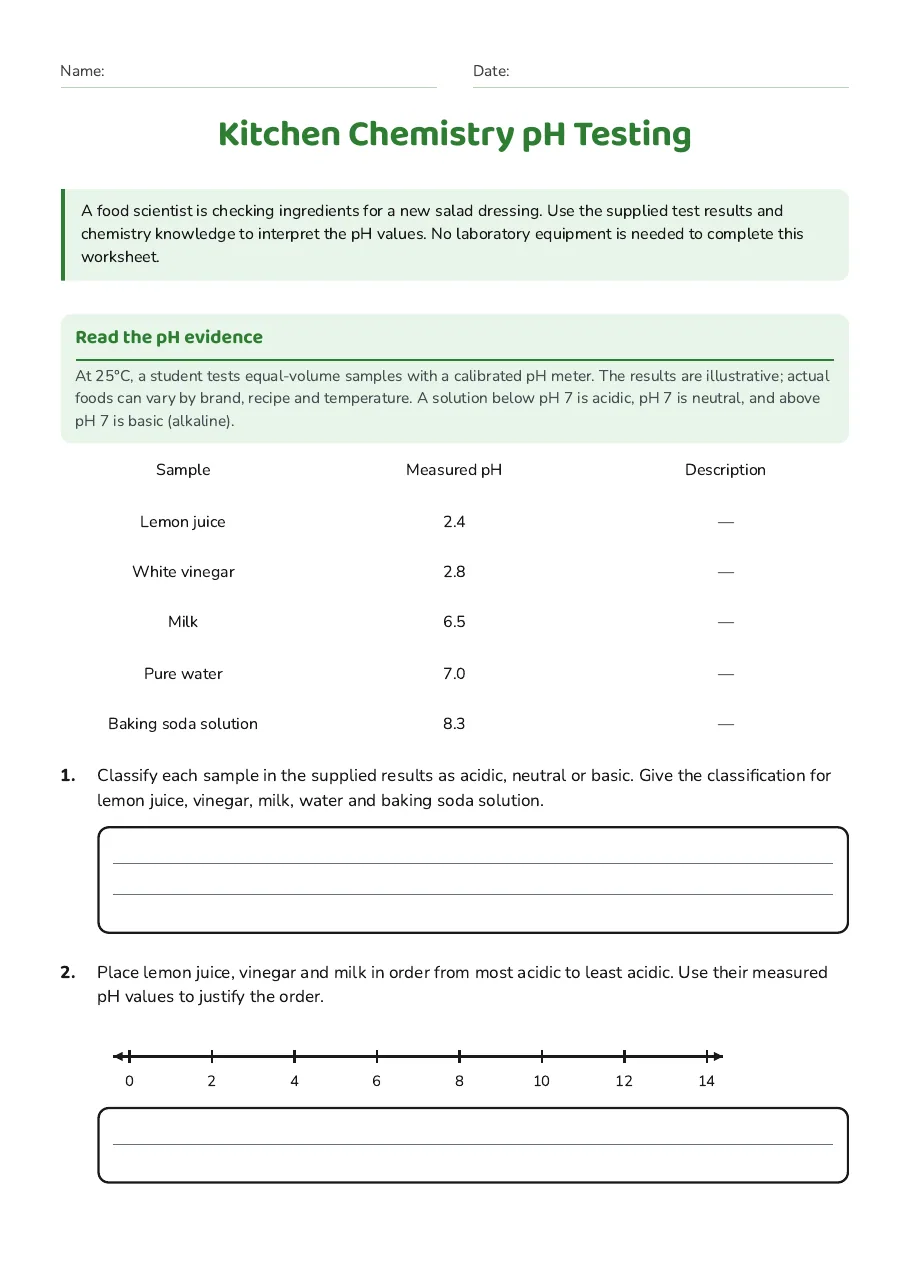
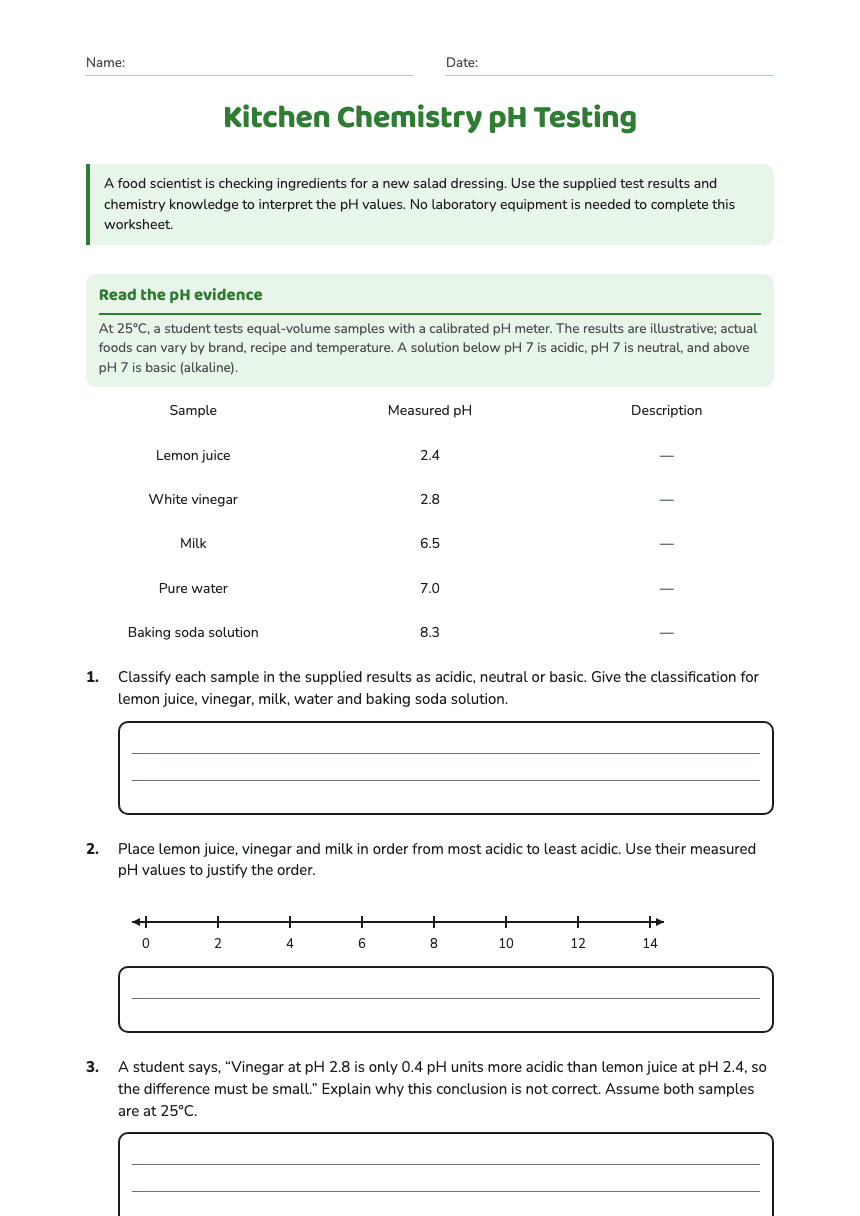
Kitchen Chemistry pH Testing

A food scientist is checking ingredients for a new salad dressing. Use the supplied test results and chemistry knowledge to interpret the pH values. No laboratory equipment is needed to complete this worksheet.

Read the pH evidence

At 25°C, a student tests equal-volume samples with a calibrated pH meter. The results are illustrative; actual foods can vary by brand, recipe and temperature. A solution below pH 7 is acidic, pH 7 is neutral, and above pH 7 is basic (alkaline).

Sample

Measured pH

Description

Lemon juice

2.4

—

White vinegar

2.8

—

Milk

6.5

—

Pure water

7.0

—

Baking soda solution

8.3

—

1.Classify each sample in the supplied results as acidic, neutral or basic. Give the classification for lemon juice, vinegar, milk, water and baking soda solution.
2.Place lemon juice, vinegar and milk in order from most acidic to least acidic. Use their measured pH values to justify the order.
02468101214
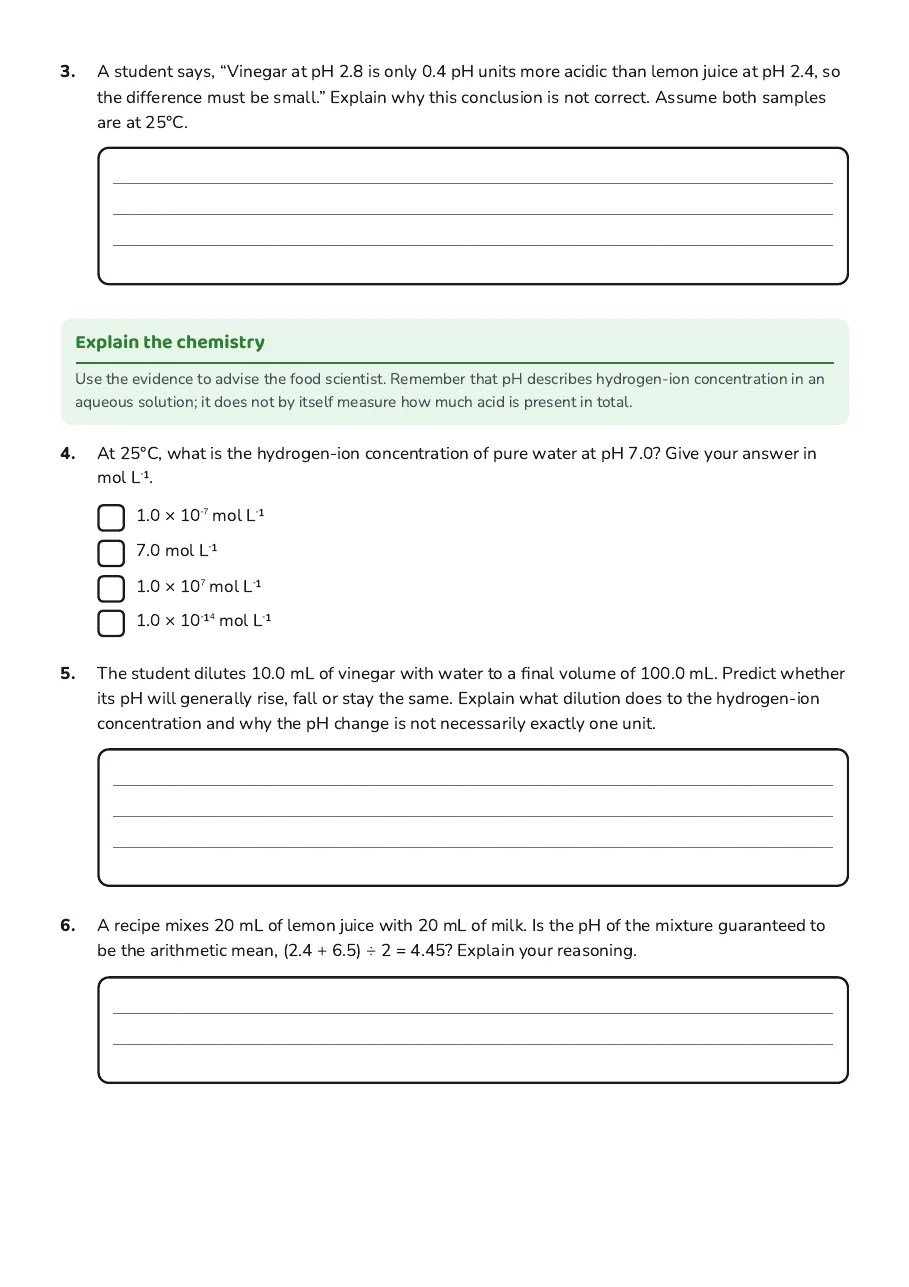
3.A student says, “Vinegar at pH 2.8 is only 0.4 pH units more acidic than lemon juice at pH 2.4, so the difference must be small.” Explain why this conclusion is not correct. Assume both samples are at 25°C.

Explain the chemistry

Use the evidence to advise the food scientist. Remember that pH describes hydrogen-ion concentration in an aqueous solution; it does not by itself measure how much acid is present in total.

4.At 25°C, what is the hydrogen-ion concentration of pure water at pH 7.0? Give your answer in mol L⁻¹.
  • 1.0 × 10⁻⁷ mol L⁻¹
  • 7.0 mol L⁻¹
  • 1.0 × 10⁷ mol L⁻¹
  • 1.0 × 10⁻¹⁴ mol L⁻¹
5.The student dilutes 10.0 mL of vinegar with water to a final volume of 100.0 mL. Predict whether its pH will generally rise, fall or stay the same. Explain what dilution does to the hydrogen-ion concentration and why the pH change is not necessarily exactly one unit.
6.A recipe mixes 20 mL of lemon juice with 20 mL of milk. Is the pH of the mixture guaranteed to be the arithmetic mean, (2.4 + 6.5) ÷ 2 = 4.45? Explain your reasoning.
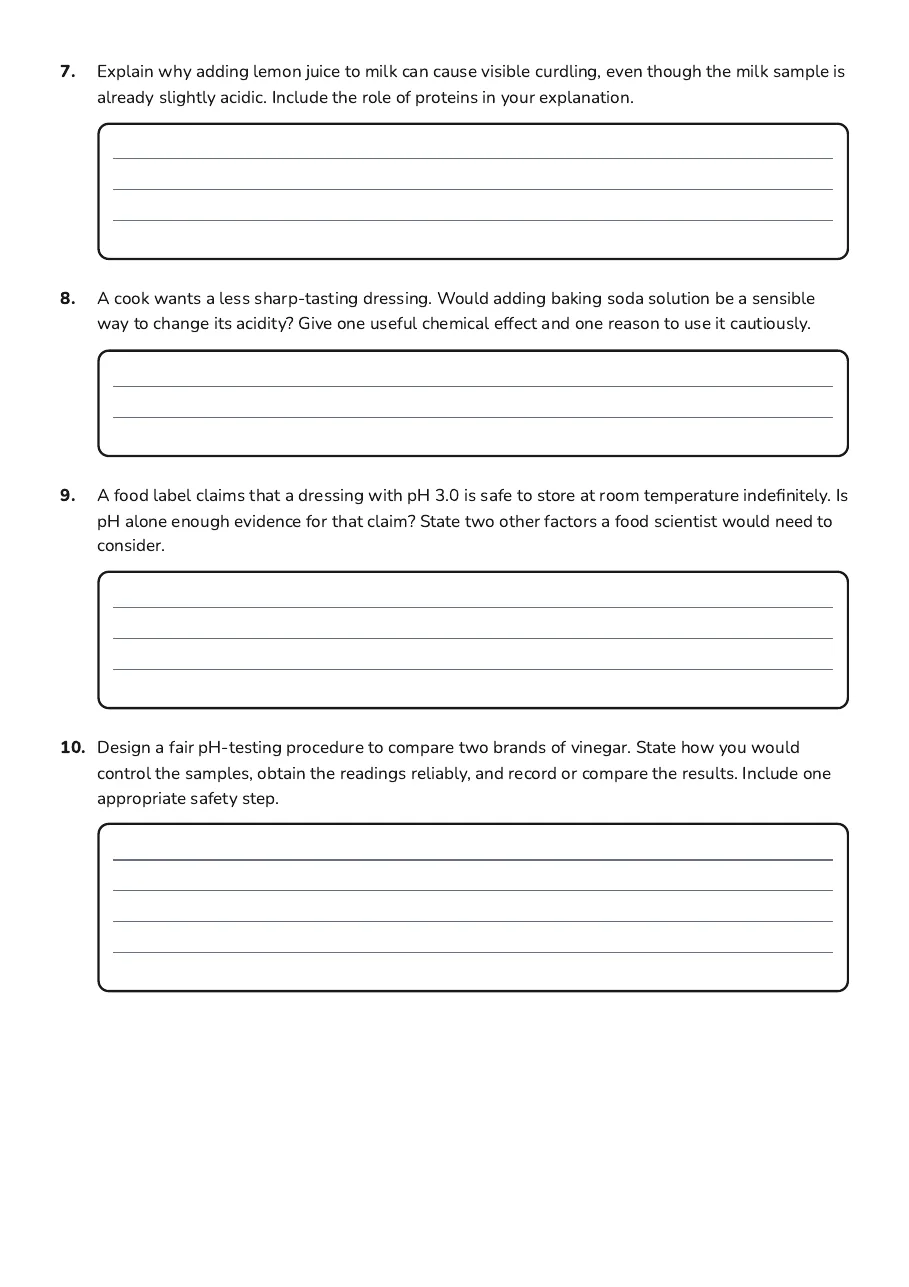
7.Explain why adding lemon juice to milk can cause visible curdling, even though the milk sample is already slightly acidic. Include the role of proteins in your explanation.
8.A cook wants a less sharp-tasting dressing. Would adding baking soda solution be a sensible way to change its acidity? Give one useful chemical effect and one reason to use it cautiously.
9.A food label claims that a dressing with pH 3.0 is safe to store at room temperature indefinitely. Is pH alone enough evidence for that claim? State two other factors a food scientist would need to consider.
10.Design a fair pH-testing procedure to compare two brands of vinegar. State how you would control the samples, obtain the readings reliably, and record or compare the results. Include one appropriate safety step.

3 printable pages

  • Kitchen Chemistry pH Testing, page 1 of 3: Read the pH evidence

    Page 1

  • Kitchen Chemistry pH Testing, page 2 of 3: Explain the chemistry

    Page 2

  • Kitchen Chemistry pH Testing, page 3 of 3: 7. Explain why adding lemon juice to milk can cause visible curdling, even though the…

    Page 3

About This Worksheet

Free in Kuraplan

Sign up free, grab the PDF, and customize it for your class.

Print-Ready

Formatted for standard paper. Clean layout, easy to read.

AI-Generated

Created with Kuraplan's AI, designed for real classroom use.

For Teachers & Parents

Use in classrooms, for homework, tutoring, or homeschool.

Need a custom version of this worksheet?

Kuraplan's AI generates custom worksheets in seconds — differentiated for every learner, aligned to your curriculum.

Generate Custom Worksheets — Free
No credit card Curriculum-aligned Under 60 seconds