Moon Knowledge and Myths
A free science worksheet ready for your classroom. Open in Kuraplan to grab the print-ready PDF, customize it for your students, or generate a fresh version in seconds.
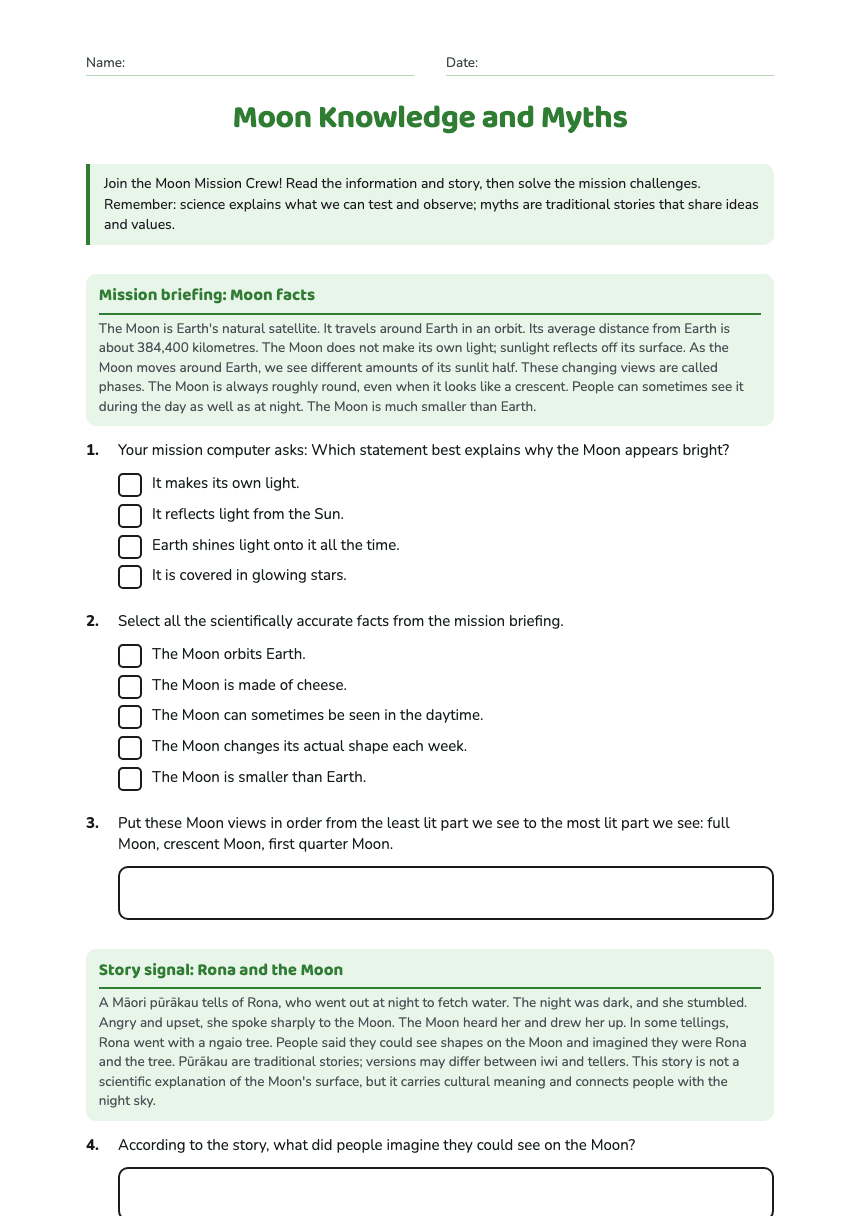
Moon Knowledge and Myths
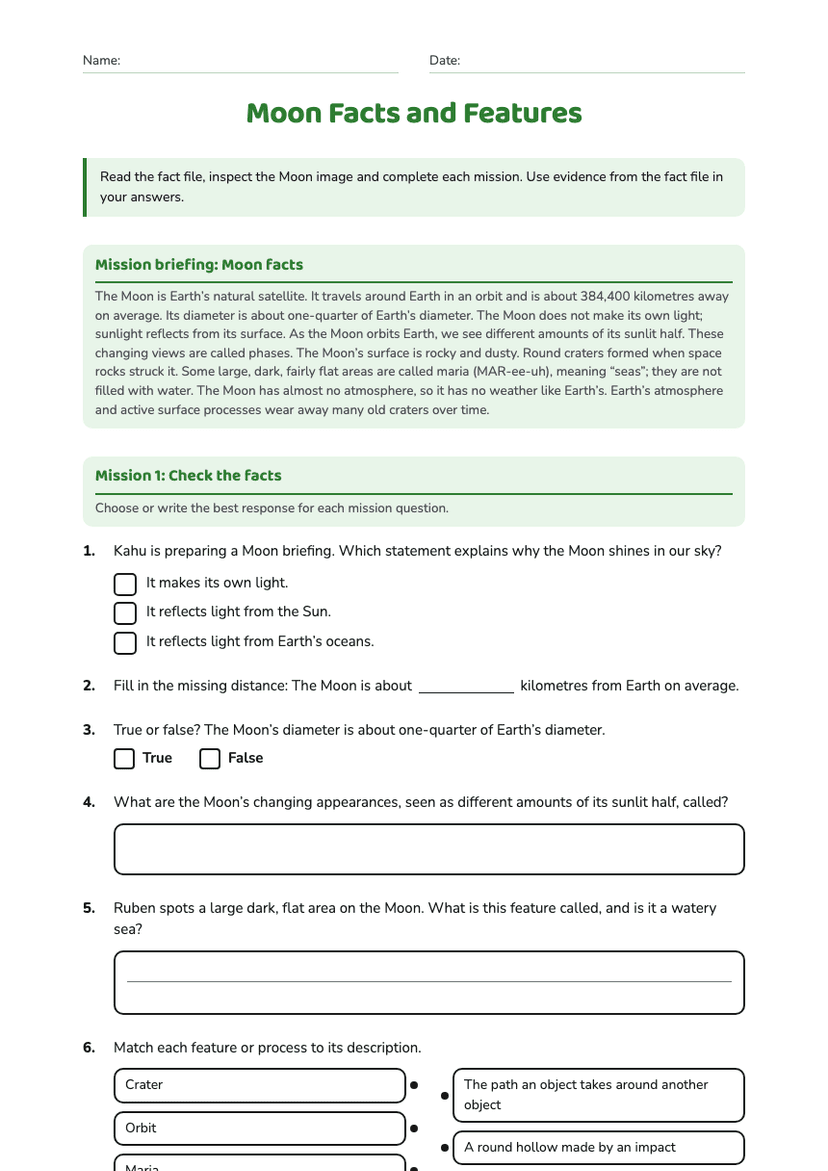
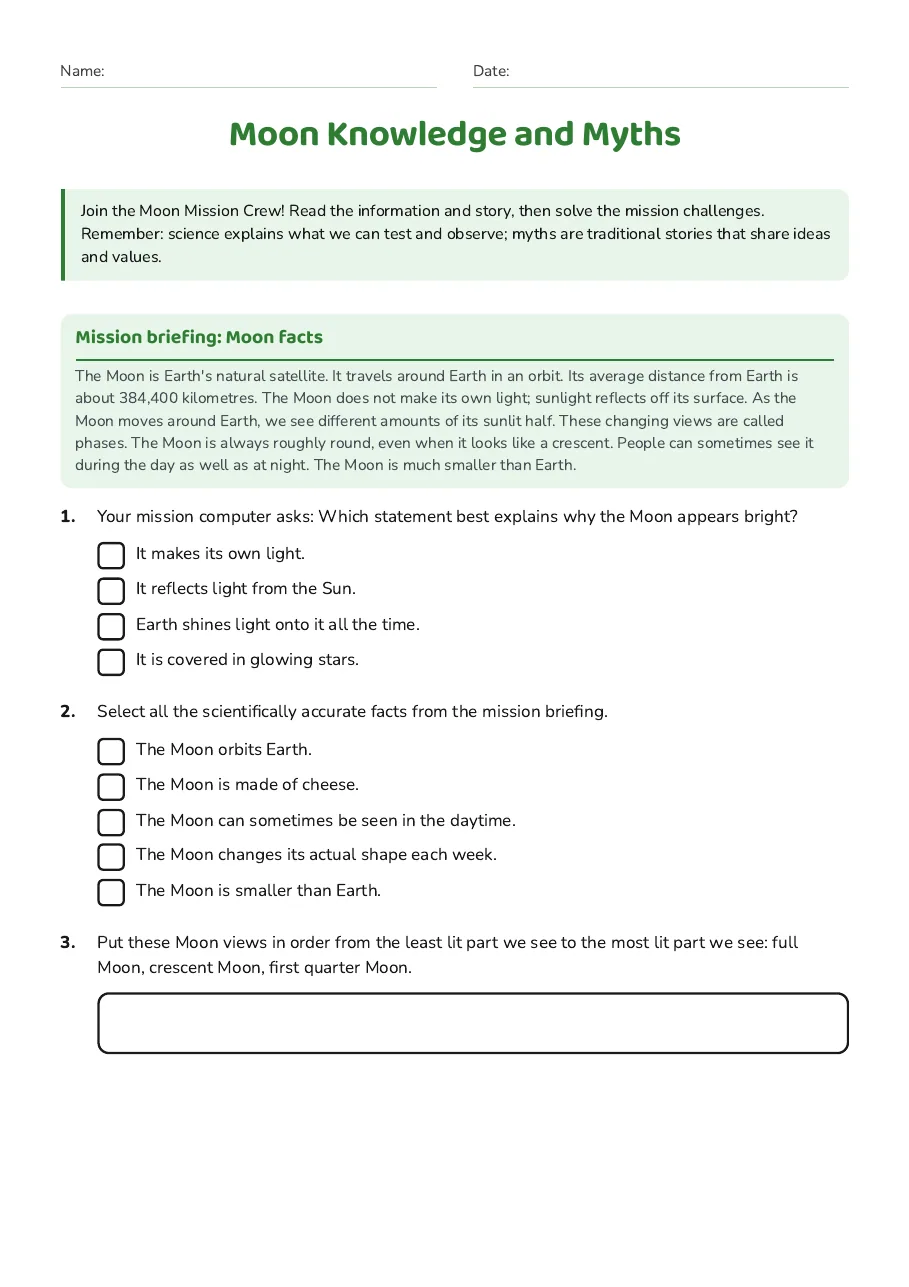
Mission briefing: Moon facts
The Moon is Earth's natural satellite. It travels around Earth in an orbit. Its average distance from Earth is about 384,400 kilometres. The Moon does not make its own light; sunlight reflects off its surface. As the Moon moves around Earth, we see different amounts of its sunlit half. These changing views are called phases. The Moon is always roughly round, even when it looks like a crescent. People can sometimes see it during the day as well as at night. The Moon is much smaller than Earth.
- It makes its own light.
- It reflects light from the Sun.
- Earth shines light onto it all the time.
- It is covered in glowing stars.
- The Moon orbits Earth.
- The Moon is made of cheese.
- The Moon can sometimes be seen in the daytime.
- The Moon changes its actual shape each week.
- The Moon is smaller than Earth.
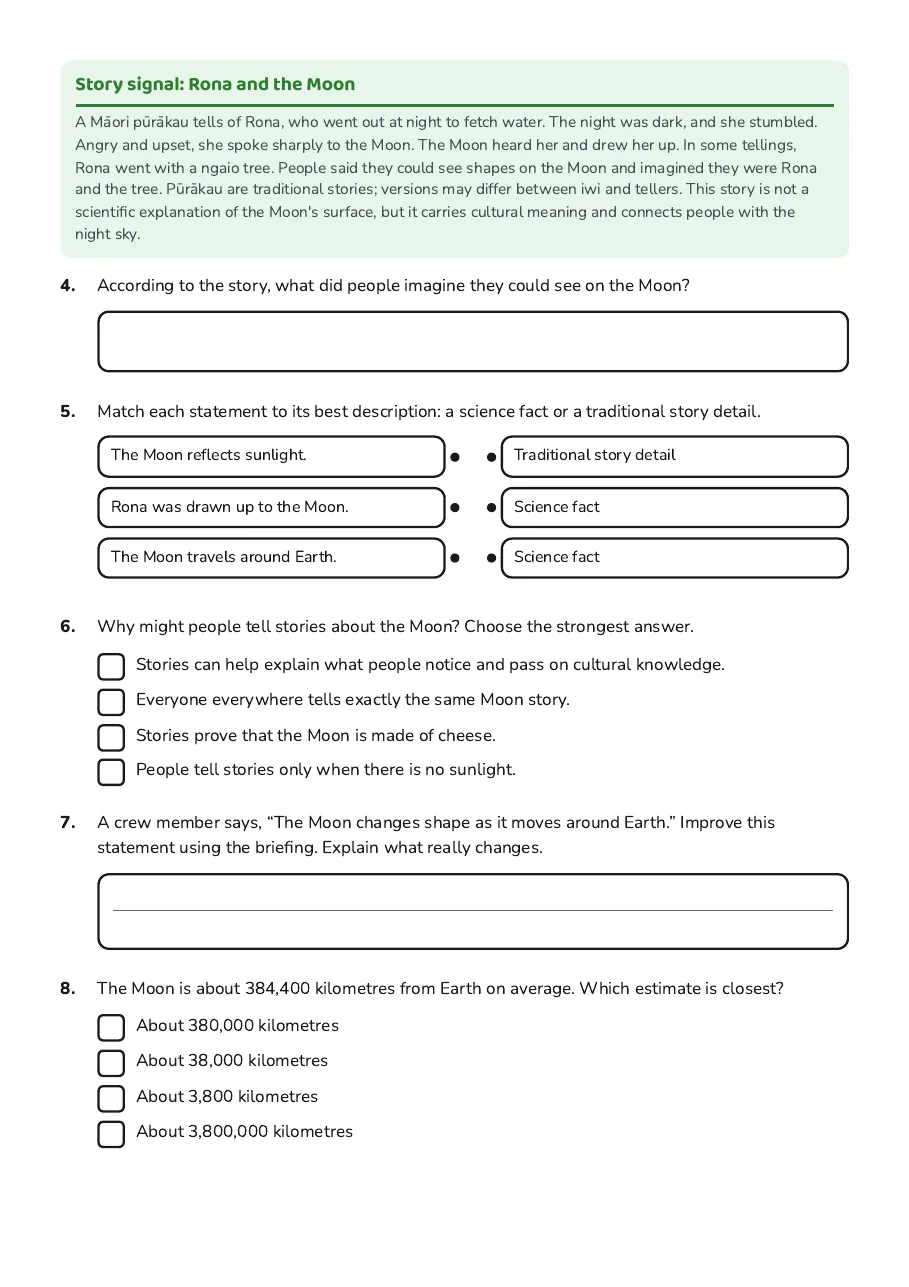
Story signal: Rona and the Moon
A Māori pūrākau tells of Rona, who went out at night to fetch water. The night was dark, and she stumbled. Angry and upset, she spoke sharply to the Moon. The Moon heard her and drew her up. In some tellings, Rona went with a ngaio tree. People said they could see shapes on the Moon and imagined they were Rona and the tree. Pūrākau are traditional stories; versions may differ between iwi and tellers. This story is not a scientific explanation of the Moon's surface, but it carries cultural meaning and connects people with the night sky.
- The Moon reflects sunlight.
- Rona was drawn up to the Moon.
- The Moon travels around Earth.
- Traditional story detail
- Science fact
- Science fact
- Stories can help explain what people notice and pass on cultural knowledge.
- Everyone everywhere tells exactly the same Moon story.
- Stories prove that the Moon is made of cheese.
- People tell stories only when there is no sunlight.
- About 380,000 kilometres
- About 38,000 kilometres
- About 3,800 kilometres
- About 3,800,000 kilometres
3 printable pages
Page 1
Page 2
Page 3
About This Worksheet
Free in Kuraplan
Sign up free, grab the PDF, and customize it for your class.
Print-Ready
Formatted for standard paper. Clean layout, easy to read.
AI-Generated
Created with Kuraplan's AI, designed for real classroom use.
For Teachers & Parents
Use in classrooms, for homework, tutoring, or homeschool.
Need a custom version of this worksheet?
Kuraplan's AI generates custom worksheets in seconds — differentiated for every learner, aligned to your curriculum.
Generate Custom Worksheets — Free