Moon Phases and Maramataka
A free science worksheet ready for your classroom. Open in Kuraplan to grab the print-ready PDF, customize it for your students, or generate a fresh version in seconds.
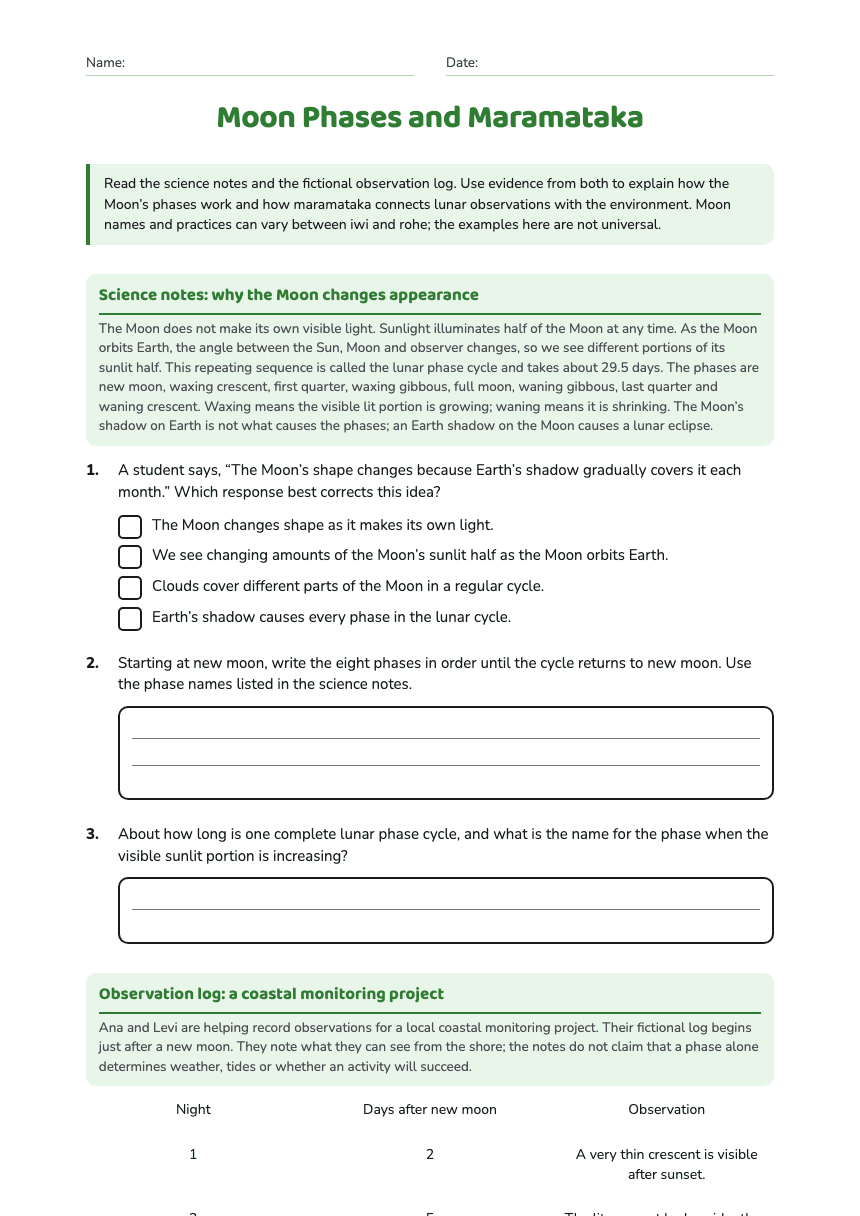
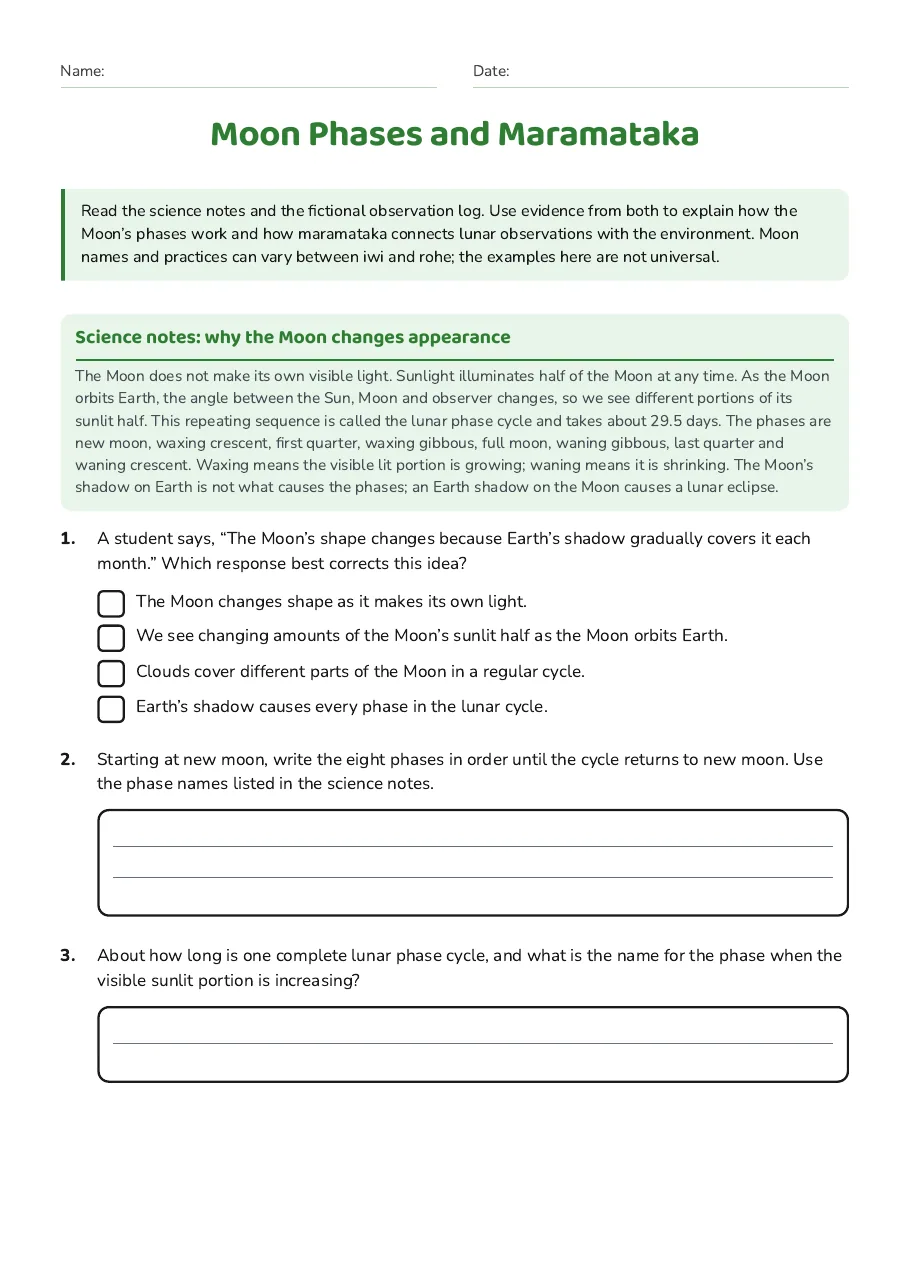
Moon Phases and Maramataka
Science notes: why the Moon changes appearance
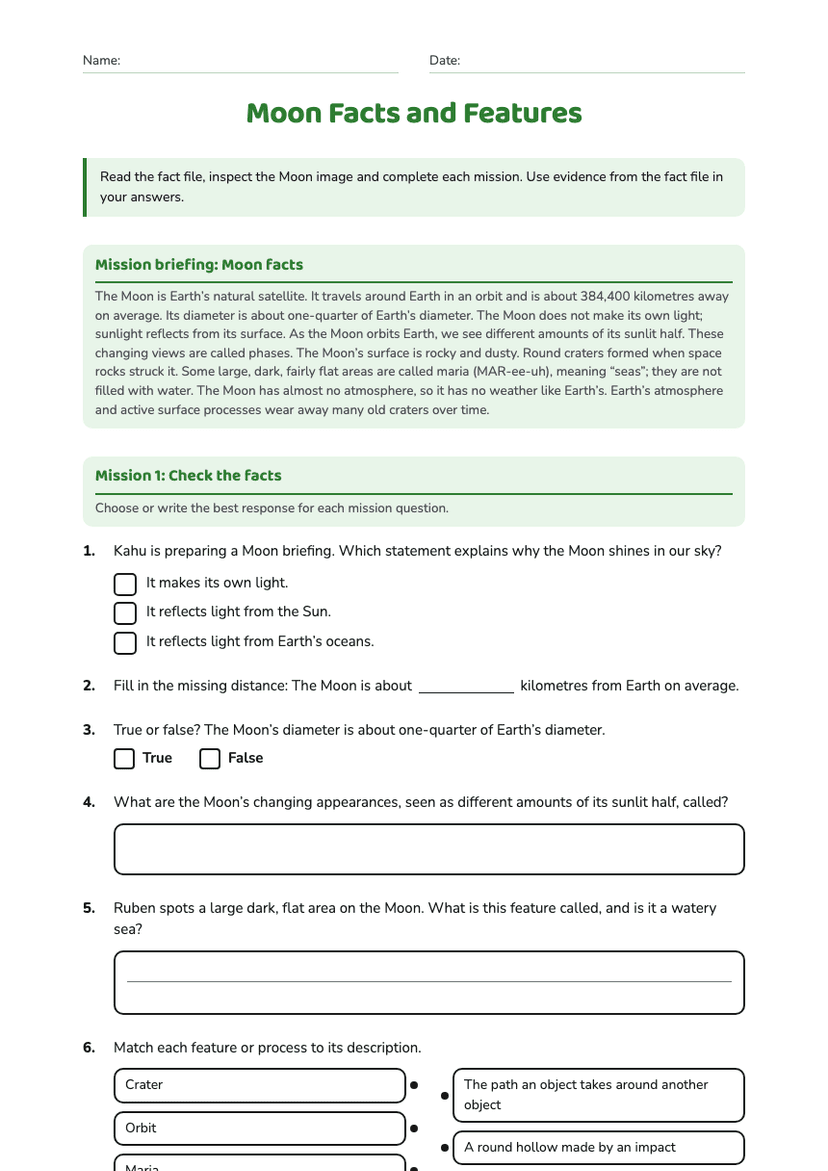
The Moon does not make its own visible light. Sunlight illuminates half of the Moon at any time. As the Moon orbits Earth, the angle between the Sun, Moon and observer changes, so we see different portions of its sunlit half. This repeating sequence is called the lunar phase cycle and takes about 29.5 days. The phases are new moon, waxing crescent, first quarter, waxing gibbous, full moon, waning gibbous, last quarter and waning crescent. Waxing means the visible lit portion is growing; waning means it is shrinking. The Moon’s shadow on Earth is not what causes the phases; an Earth shadow on the Moon causes a lunar eclipse.
- The Moon changes shape as it makes its own light.
- We see changing amounts of the Moon’s sunlit half as the Moon orbits Earth.
- Clouds cover different parts of the Moon in a regular cycle.
- Earth’s shadow causes every phase in the lunar cycle.
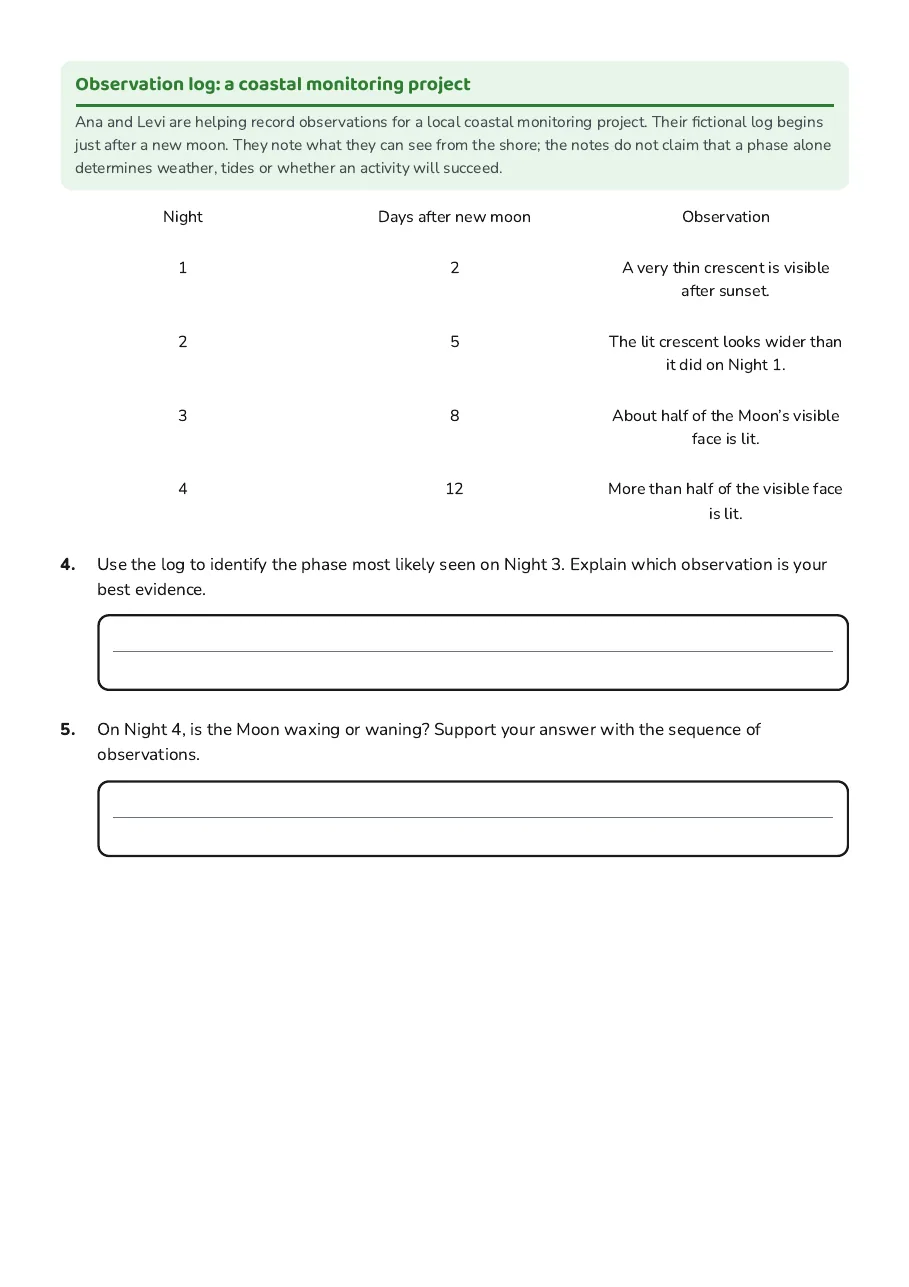
Observation log: a coastal monitoring project
Ana and Levi are helping record observations for a local coastal monitoring project. Their fictional log begins just after a new moon. They note what they can see from the shore; the notes do not claim that a phase alone determines weather, tides or whether an activity will succeed.
Night
Days after new moon
Observation
1
2
A very thin crescent is visible after sunset.
2
5
The lit crescent looks wider than it did on Night 1.
3
8
About half of the Moon’s visible face is lit.
4
12
More than half of the visible face is lit.
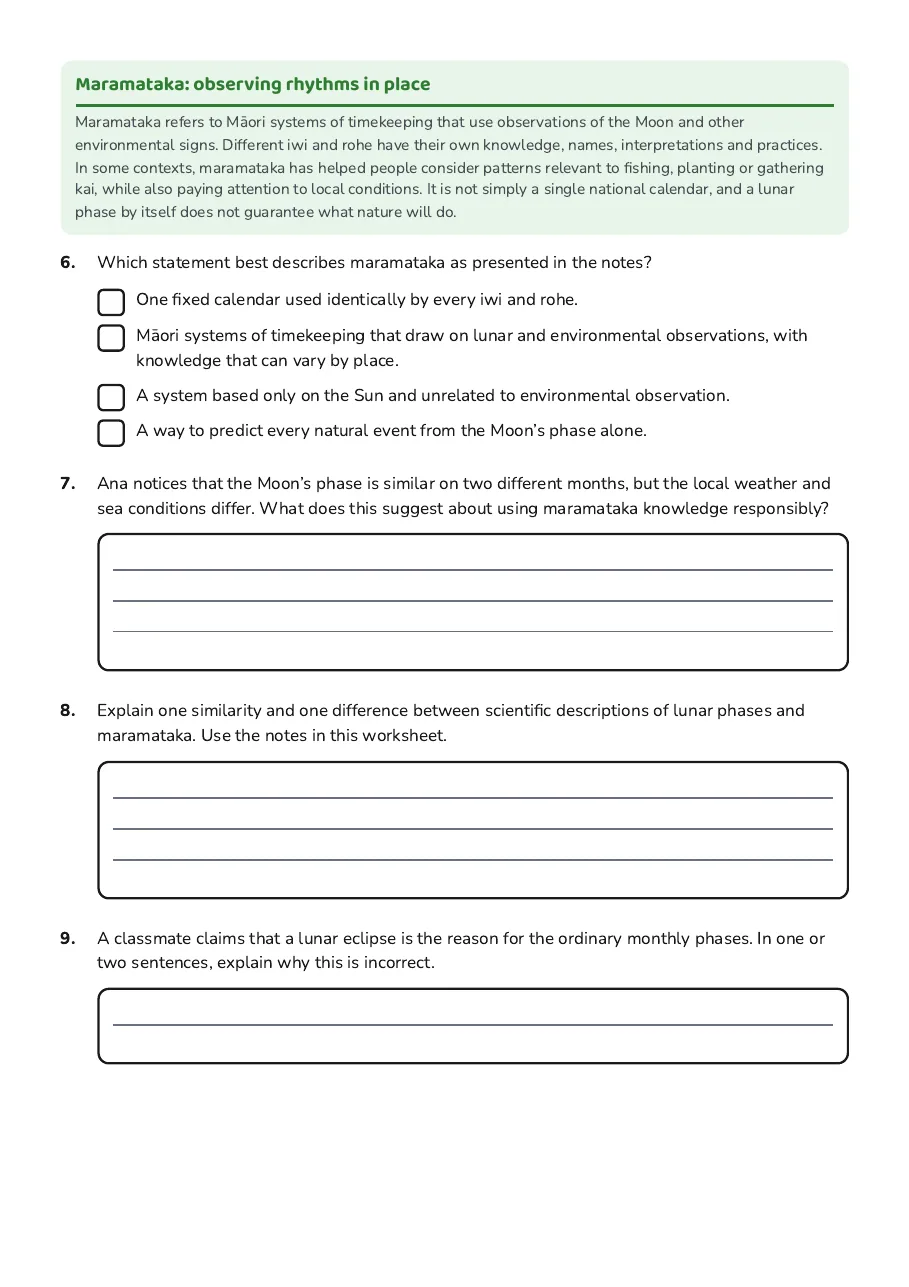
Maramataka: observing rhythms in place
Maramataka refers to Māori systems of timekeeping that use observations of the Moon and other environmental signs. Different iwi and rohe have their own knowledge, names, interpretations and practices. In some contexts, maramataka has helped people consider patterns relevant to fishing, planting or gathering kai, while also paying attention to local conditions. It is not simply a single national calendar, and a lunar phase by itself does not guarantee what nature will do.
- One fixed calendar used identically by every iwi and rohe.
- Māori systems of timekeeping that draw on lunar and environmental observations, with knowledge that can vary by place.
- A system based only on the Sun and unrelated to environmental observation.
- A way to predict every natural event from the Moon’s phase alone.
3 printable pages
Page 1
Page 2
Page 3
About This Worksheet
Free in Kuraplan
Sign up free, grab the PDF, and customize it for your class.
Print-Ready
Formatted for standard paper. Clean layout, easy to read.
AI-Generated
Created with Kuraplan's AI, designed for real classroom use.
For Teachers & Parents
Use in classrooms, for homework, tutoring, or homeschool.
Need a custom version of this worksheet?
Kuraplan's AI generates custom worksheets in seconds — differentiated for every learner, aligned to your curriculum.
Generate Custom Worksheets — Free