MusicFreePrintable

Music Style Listening Guide

A free music worksheet ready for your classroom. Open in Kuraplan to grab the print-ready PDF, customize it for your students, or generate a fresh version in seconds.
Music Style Listening Guide worksheet preview
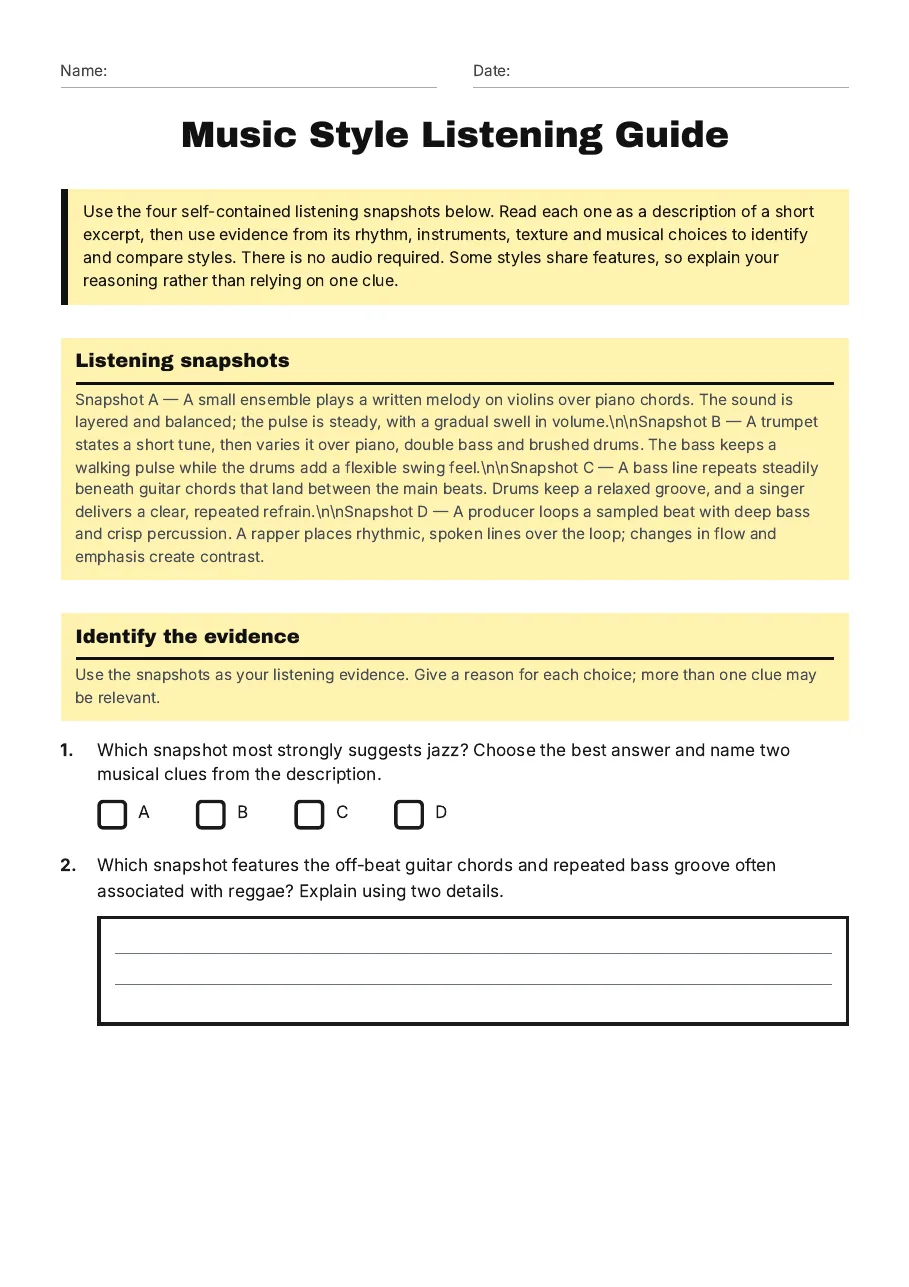
Name:Date:

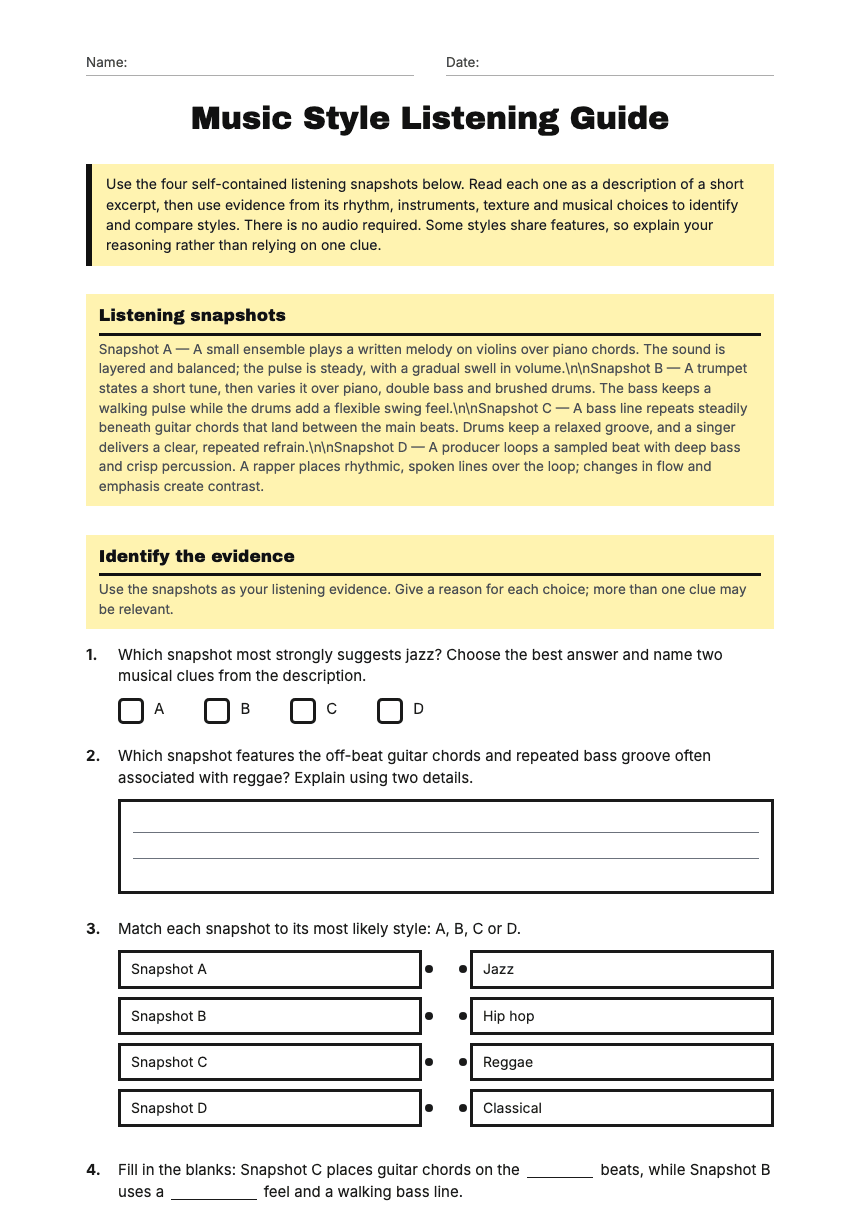
Music Style Listening Guide

Use the four self-contained listening snapshots below. Read each one as a description of a short excerpt, then use evidence from its rhythm, instruments, texture and musical choices to identify and compare styles. There is no audio required. Some styles share features, so explain your reasoning rather than relying on one clue.

Listening snapshots

Snapshot A — A small ensemble plays a written melody on violins over piano chords. The sound is layered and balanced; the pulse is steady, with a gradual swell in volume.\n\nSnapshot B — A trumpet states a short tune, then varies it over piano, double bass and brushed drums. The bass keeps a walking pulse while the drums add a flexible swing feel.\n\nSnapshot C — A bass line repeats steadily beneath guitar chords that land between the main beats. Drums keep a relaxed groove, and a singer delivers a clear, repeated refrain.\n\nSnapshot D — A producer loops a sampled beat with deep bass and crisp percussion. A rapper places rhythmic, spoken lines over the loop; changes in flow and emphasis create contrast.

Identify the evidence

Use the snapshots as your listening evidence. Give a reason for each choice; more than one clue may be relevant.

1.Which snapshot most strongly suggests jazz? Choose the best answer and name two musical clues from the description.
  • A
  • B
  • C
  • D
2.Which snapshot features the off-beat guitar chords and repeated bass groove often associated with reggae? Explain using two details.
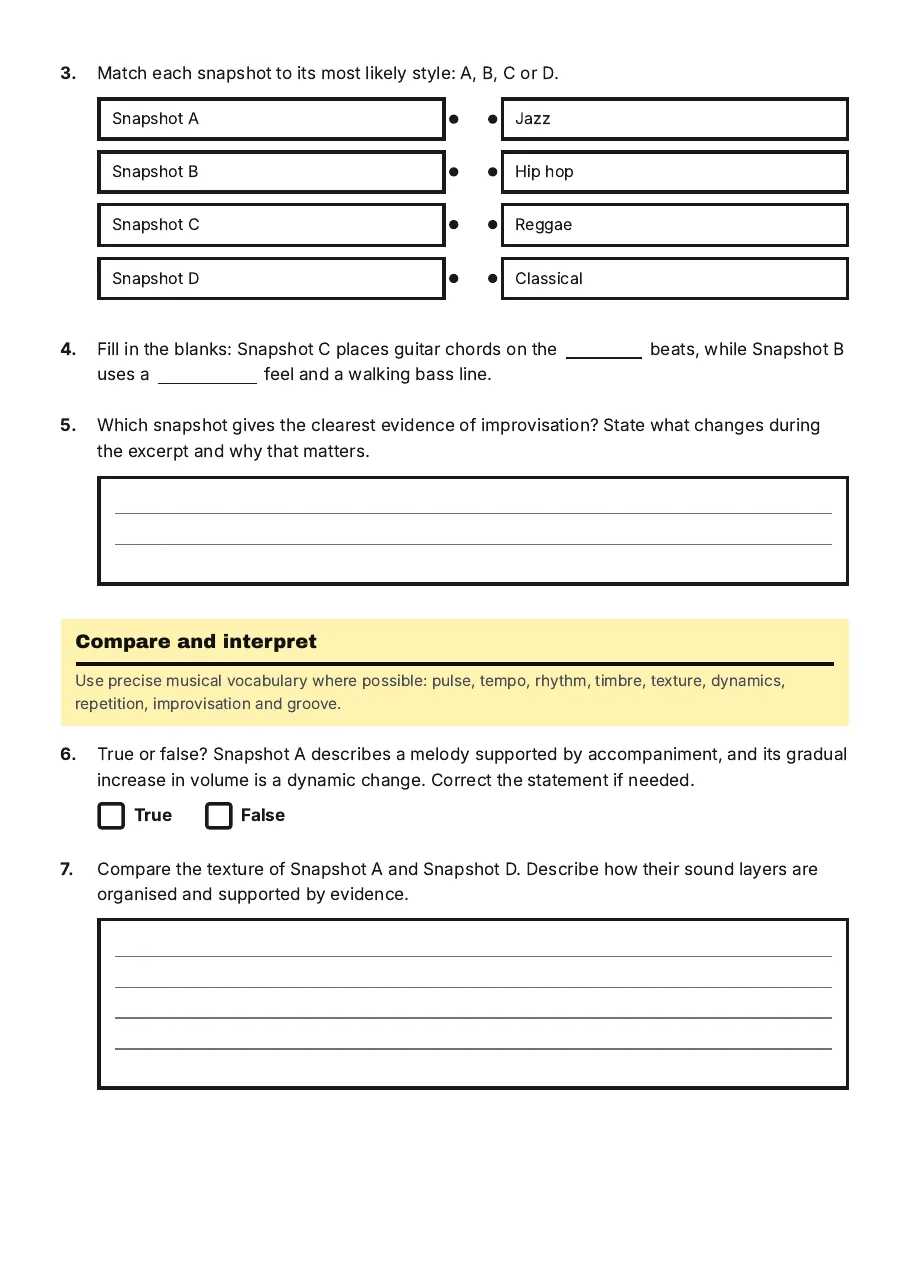
3.Match each snapshot to its most likely style: A, B, C or D.
  • Snapshot A
  • Snapshot B
  • Snapshot C
  • Snapshot D
  • Jazz
  • Hip hop
  • Reggae
  • Classical
4.Fill in the blanks: Snapshot C places guitar chords on the beats, while Snapshot B uses a feel and a walking bass line.
5.Which snapshot gives the clearest evidence of improvisation? State what changes during the excerpt and why that matters.

Compare and interpret

Use precise musical vocabulary where possible: pulse, tempo, rhythm, timbre, texture, dynamics, repetition, improvisation and groove.

6.True or false? Snapshot A describes a melody supported by accompaniment, and its gradual increase in volume is a dynamic change. Correct the statement if needed.
TrueFalse
7.Compare the texture of Snapshot A and Snapshot D. Describe how their sound layers are organised and supported by evidence.
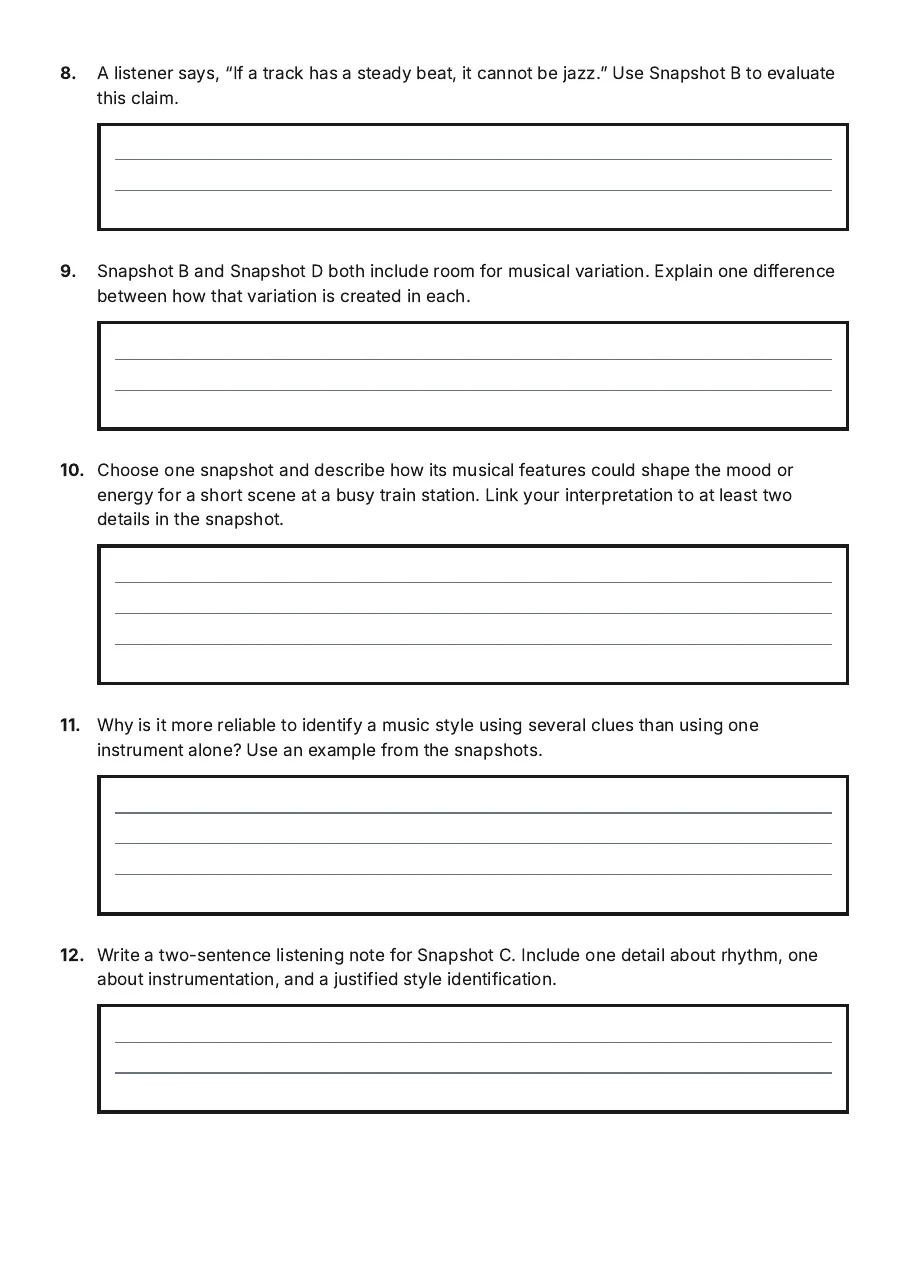
8.A listener says, “If a track has a steady beat, it cannot be jazz.” Use Snapshot B to evaluate this claim.
9.Snapshot B and Snapshot D both include room for musical variation. Explain one difference between how that variation is created in each.
10.Choose one snapshot and describe how its musical features could shape the mood or energy for a short scene at a busy train station. Link your interpretation to at least two details in the snapshot.
11.Why is it more reliable to identify a music style using several clues than using one instrument alone? Use an example from the snapshots.
12.Write a two-sentence listening note for Snapshot C. Include one detail about rhythm, one about instrumentation, and a justified style identification.

3 printable pages

  • Music Style Listening Guide, page 1 of 3: Listening snapshots, Identify the evidence

    Page 1

  • Music Style Listening Guide, page 2 of 3: Compare and interpret

    Page 2

  • Music Style Listening Guide, page 3 of 3: 8. A listener says, “If a track has a steady beat, it cannot be jazz.” Use Snapshot B to…

    Page 3

About This Worksheet

Free in Kuraplan

Sign up free, grab the PDF, and customize it for your class.

Print-Ready

Formatted for standard paper. Clean layout, easy to read.

AI-Generated

Created with Kuraplan's AI, designed for real classroom use.

For Teachers & Parents

Use in classrooms, for homework, tutoring, or homeschool.

Need a custom version of this worksheet?

Kuraplan's AI generates custom worksheets in seconds — differentiated for every learner, aligned to your curriculum.

Generate Custom Worksheets — Free
No credit card Curriculum-aligned Under 60 seconds