Non-Fiction Summary Practice
A free english (ela) worksheet ready for your classroom. Open in Kuraplan to grab the print-ready PDF, customize it for your students, or generate a fresh version in seconds.
Non-Fiction Summary Practice
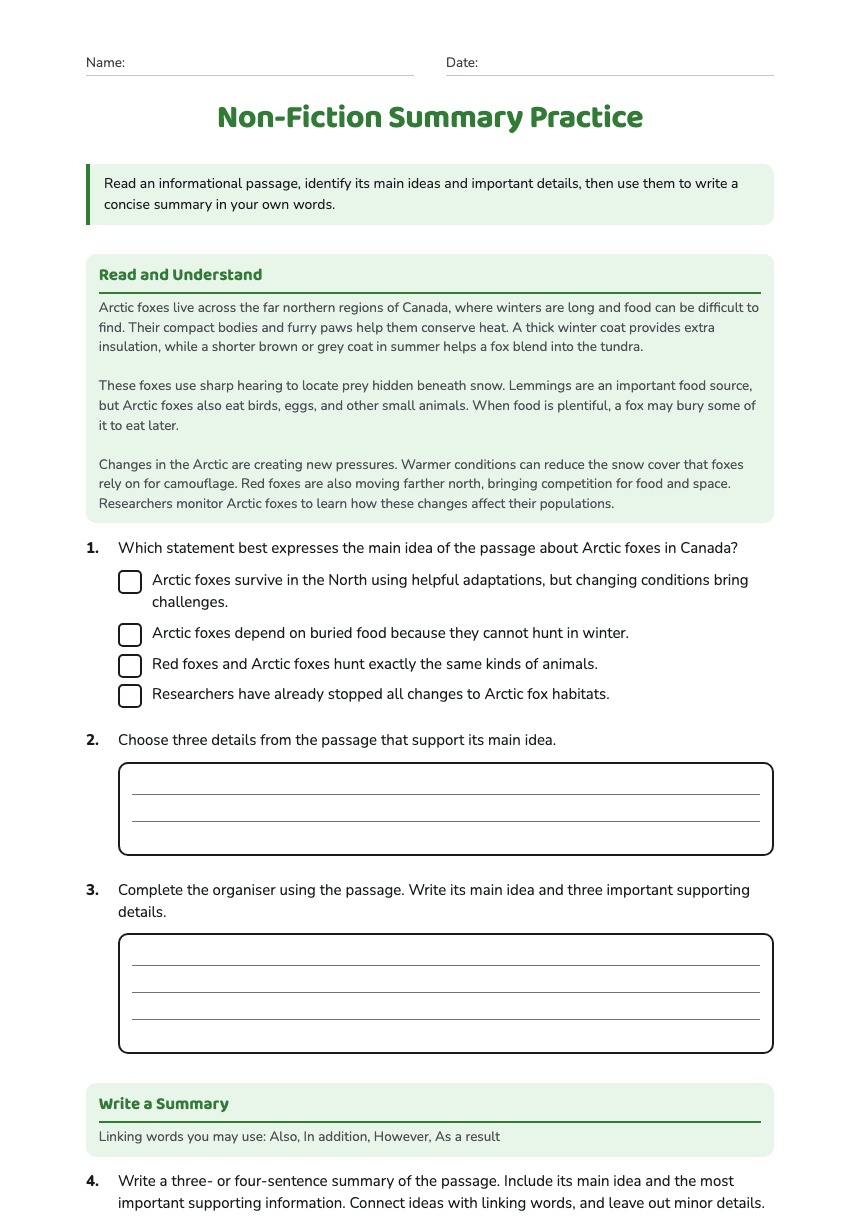
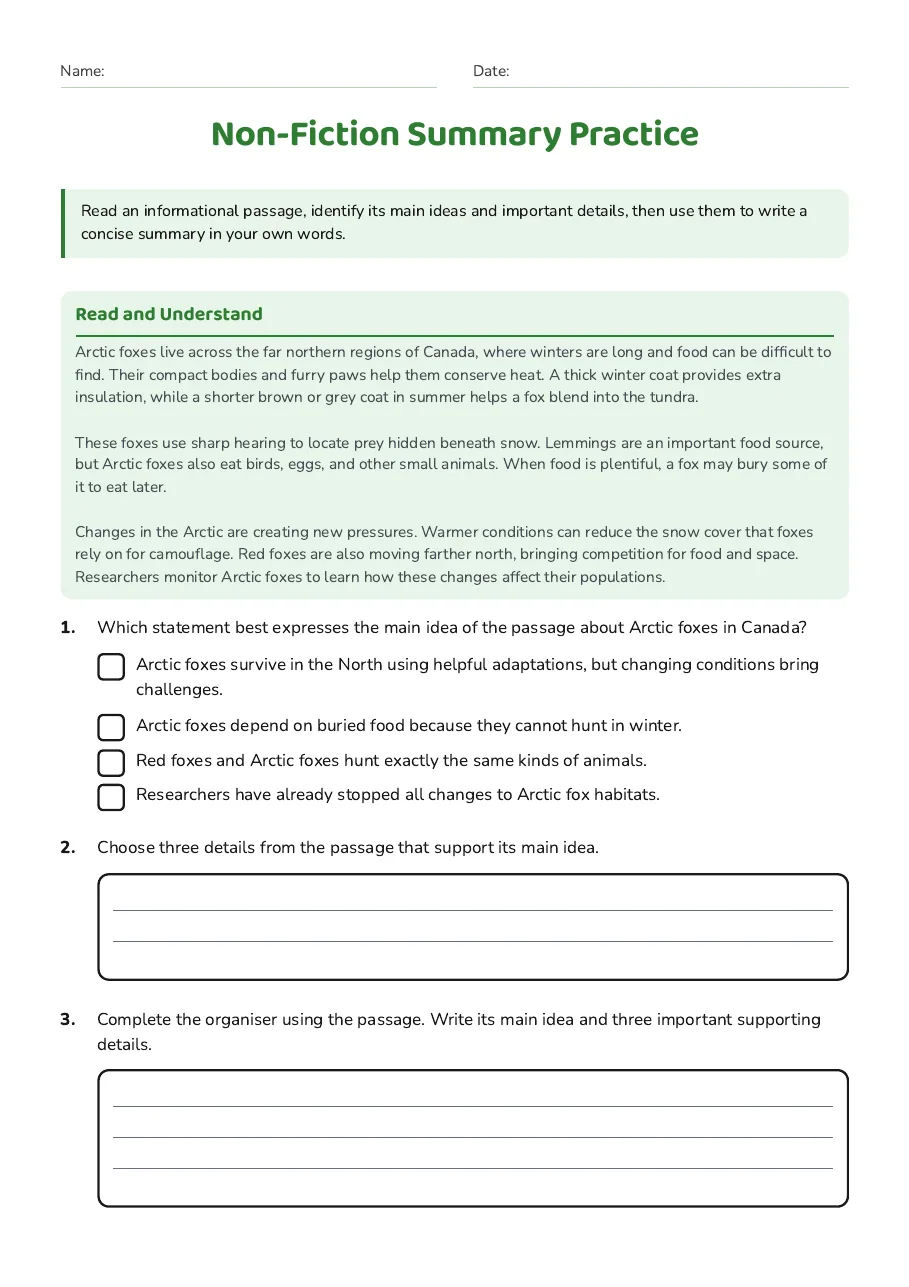
Read and Understand
Arctic foxes live across the far northern regions of Canada, where winters are long and food can be difficult to find. Their compact bodies and furry paws help them conserve heat. A thick winter coat provides extra insulation, while a shorter brown or grey coat in summer helps a fox blend into the tundra. These foxes use sharp hearing to locate prey hidden beneath snow. Lemmings are an important food source, but Arctic foxes also eat birds, eggs, and other small animals. When food is plentiful, a fox may bury some of it to eat later. Changes in the Arctic are creating new pressures. Warmer conditions can reduce the snow cover that foxes rely on for camouflage. Red foxes are also moving farther north, bringing competition for food and space. Researchers monitor Arctic foxes to learn how these changes affect their populations.
- Arctic foxes survive in the North using helpful adaptations, but changing conditions bring challenges.
- Arctic foxes depend on buried food because they cannot hunt in winter.
- Red foxes and Arctic foxes hunt exactly the same kinds of animals.
- Researchers have already stopped all changes to Arctic fox habitats.
Write a Summary
Linking words you may use: Also, In addition, However, As a result
2 printable pages
Page 1

Page 2
About This Worksheet
Free in Kuraplan
Sign up free, grab the PDF, and customize it for your class.
Print-Ready
Formatted for standard paper. Clean layout, easy to read.
AI-Generated
Created with Kuraplan's AI, designed for real classroom use.
For Teachers & Parents
Use in classrooms, for homework, tutoring, or homeschool.
Need a custom version of this worksheet?
Kuraplan's AI generates custom worksheets in seconds — differentiated for every learner, aligned to your curriculum.
Generate Custom Worksheets — Free