EnglishFreePrintable
Othello Scene III Analysis
A free english worksheet ready for your classroom. Open in Kuraplan to grab the print-ready PDF, customize it for your students, or generate a fresh version in seconds.
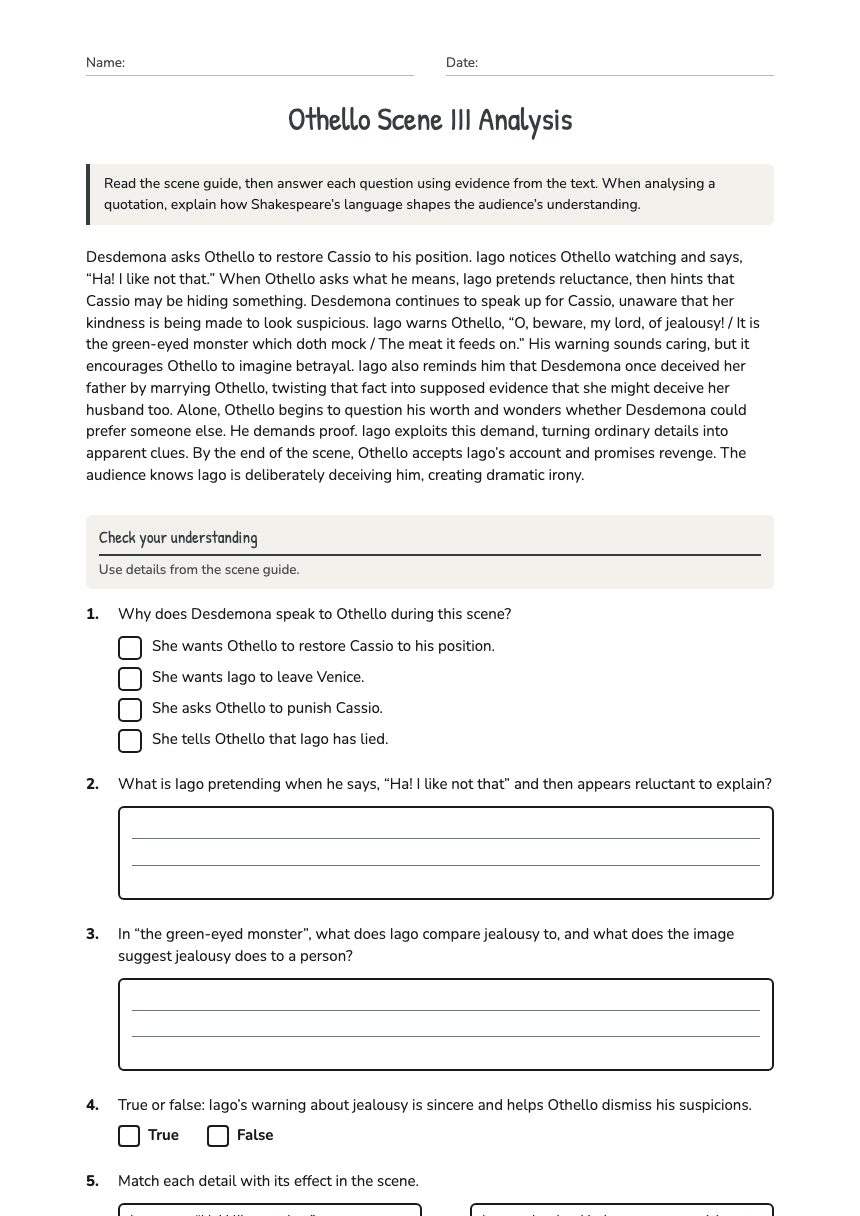
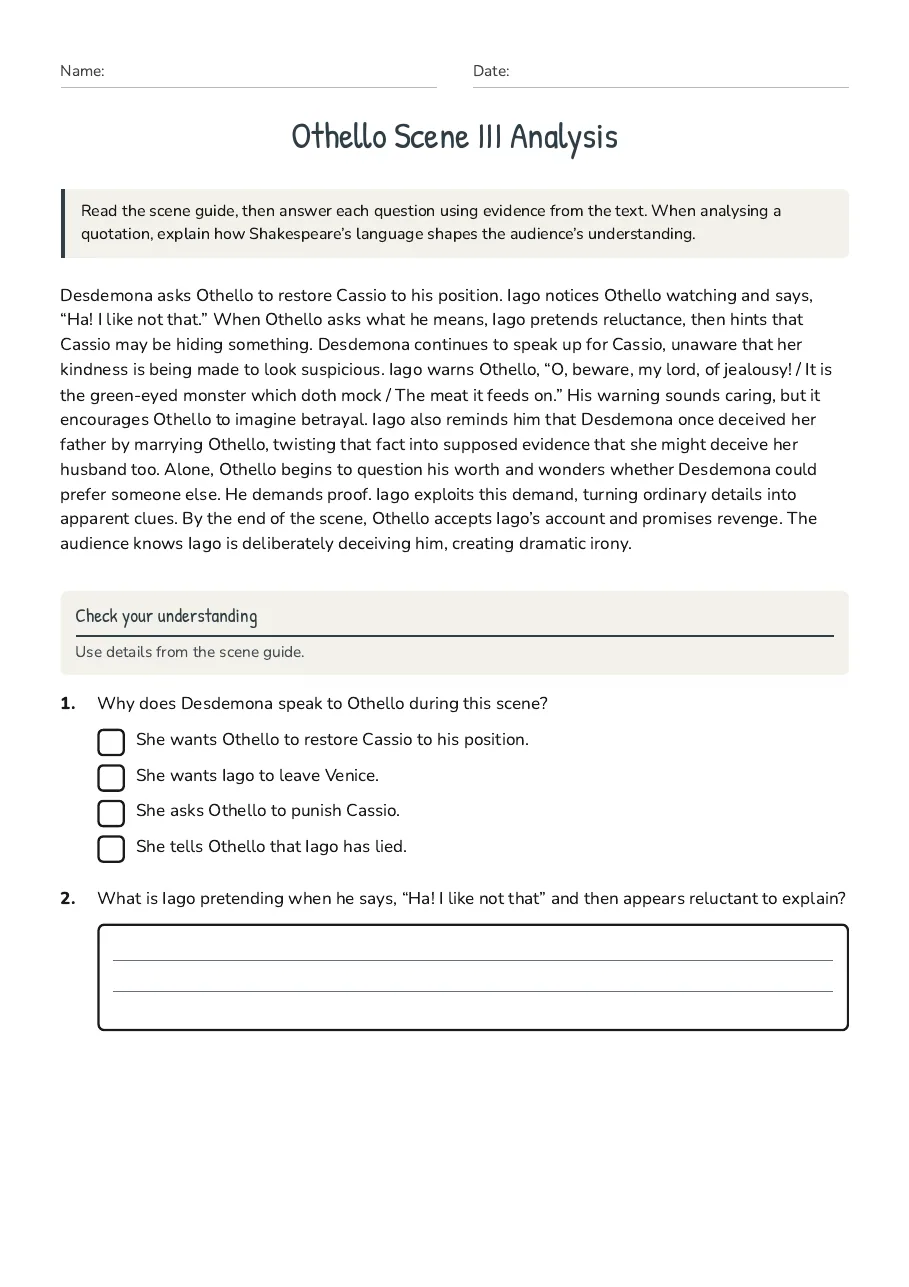
Name:Date:
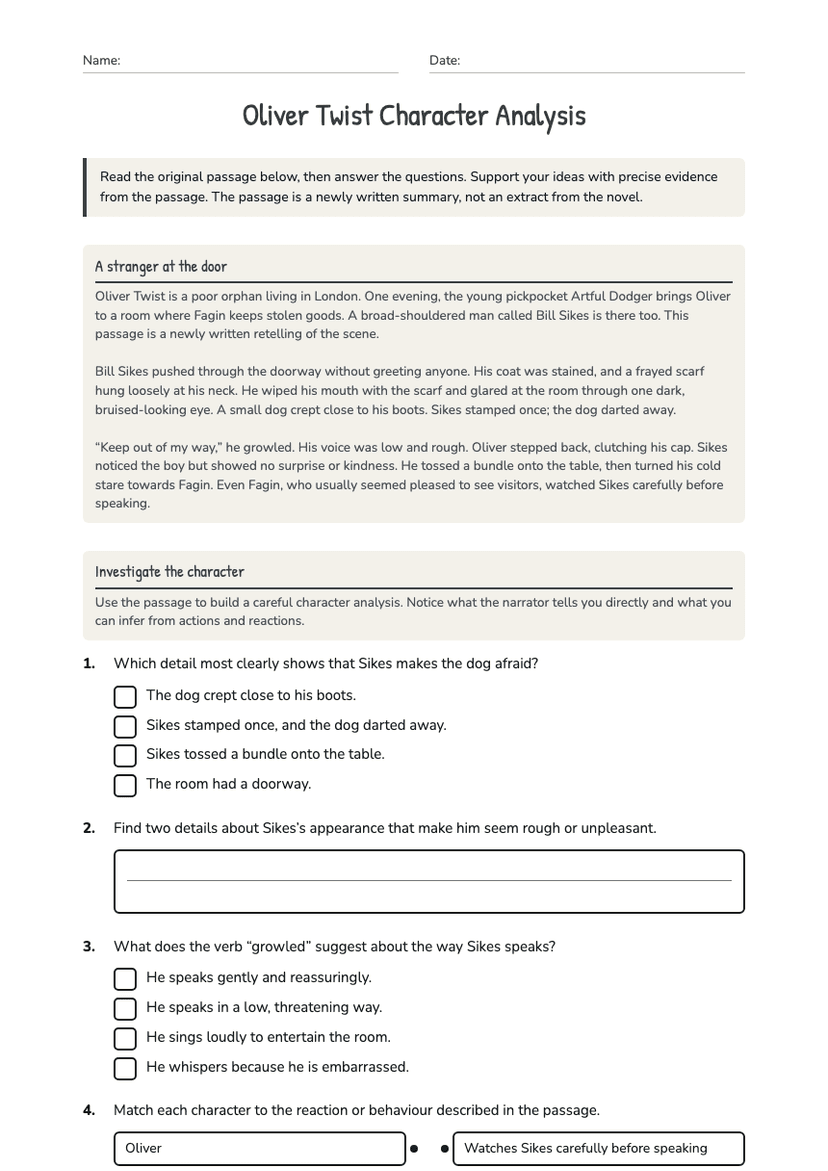
Othello Scene III Analysis
Read the scene guide, then answer each question using evidence from the text. When analysing a quotation, explain how Shakespeare’s language shapes the audience’s understanding.
Desdemona asks Othello to restore Cassio to his position. Iago notices Othello watching and says, “Ha! I like not that.” When Othello asks what he means, Iago pretends reluctance, then hints that Cassio may be hiding something. Desdemona continues to speak up for Cassio, unaware that her kindness is being made to look suspicious.
Iago warns Othello, “O, beware, my lord, of jealousy! / It is the green-eyed monster which doth mock / The meat it feeds on.” His warning sounds caring, but it encourages Othello to imagine betrayal. Iago also reminds him that Desdemona once deceived her father by marrying Othello, twisting that fact into supposed evidence that she might deceive her husband too.
Alone, Othello begins to question his worth and wonders whether Desdemona could prefer someone else. He demands proof. Iago exploits this demand, turning ordinary details into apparent clues. By the end of the scene, Othello accepts Iago’s account and promises revenge. The audience knows Iago is deliberately deceiving him, creating dramatic irony.
Check your understanding
Use details from the scene guide.
1.Why does Desdemona speak to Othello during this scene?
- She wants Othello to restore Cassio to his position.
- She wants Iago to leave Venice.
- She asks Othello to punish Cassio.
- She tells Othello that Iago has lied.
2.What is Iago pretending when he says, “Ha! I like not that” and then appears reluctant to explain?
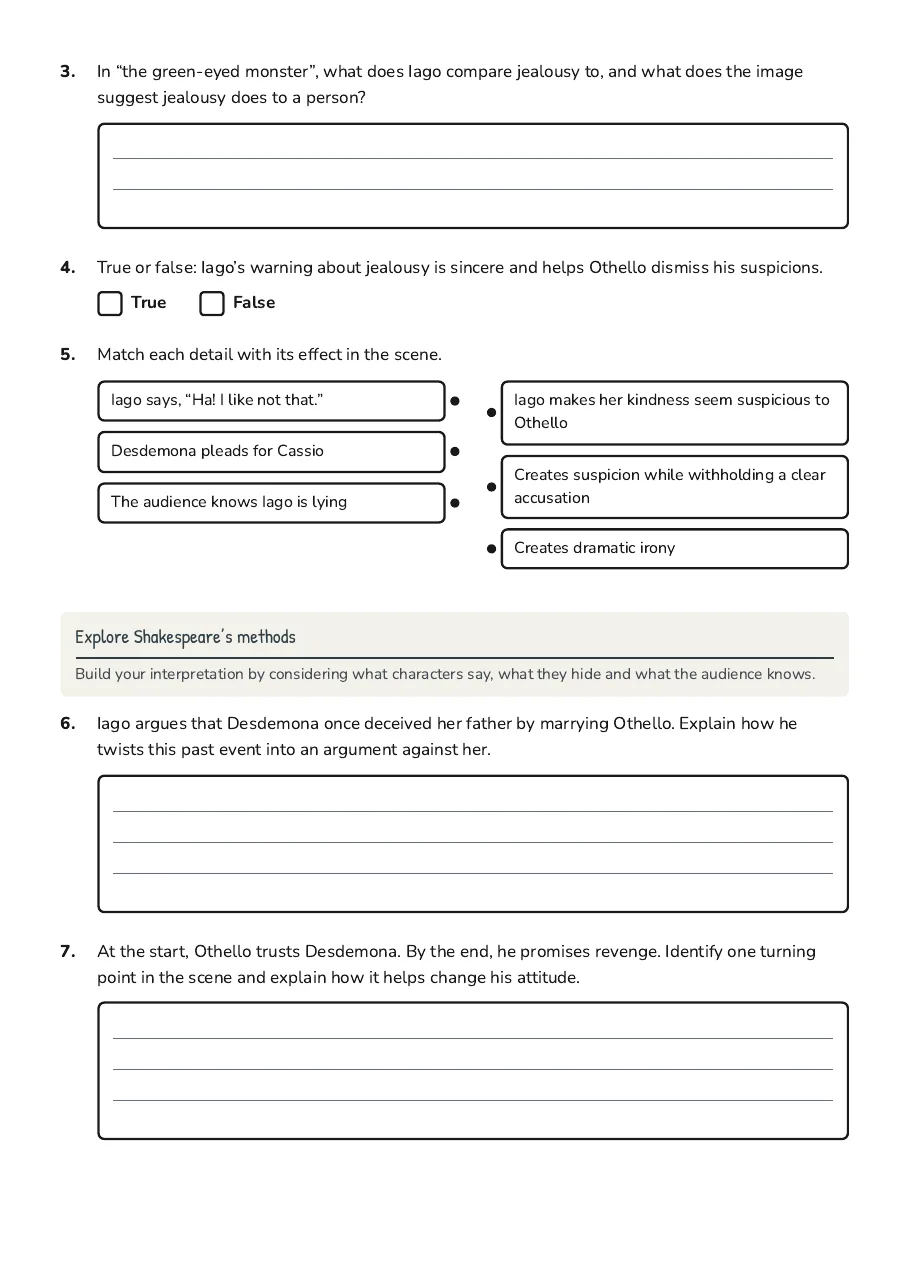
3.In “the green-eyed monster”, what does Iago compare jealousy to, and what does the image suggest jealousy does to a person?
4.True or false: Iago’s warning about jealousy is sincere and helps Othello dismiss his suspicions.
TrueFalse
5.Match each detail with its effect in the scene.
- Iago says, “Ha! I like not that.”
- Desdemona pleads for Cassio
- The audience knows Iago is lying
- Iago makes her kindness seem suspicious to Othello
- Creates suspicion while withholding a clear accusation
- Creates dramatic irony
Explore Shakespeare’s methods
Build your interpretation by considering what characters say, what they hide and what the audience knows.
6.Iago argues that Desdemona once deceived her father by marrying Othello. Explain how he twists this past event into an argument against her.
7.At the start, Othello trusts Desdemona. By the end, he promises revenge. Identify one turning point in the scene and explain how it helps change his attitude.
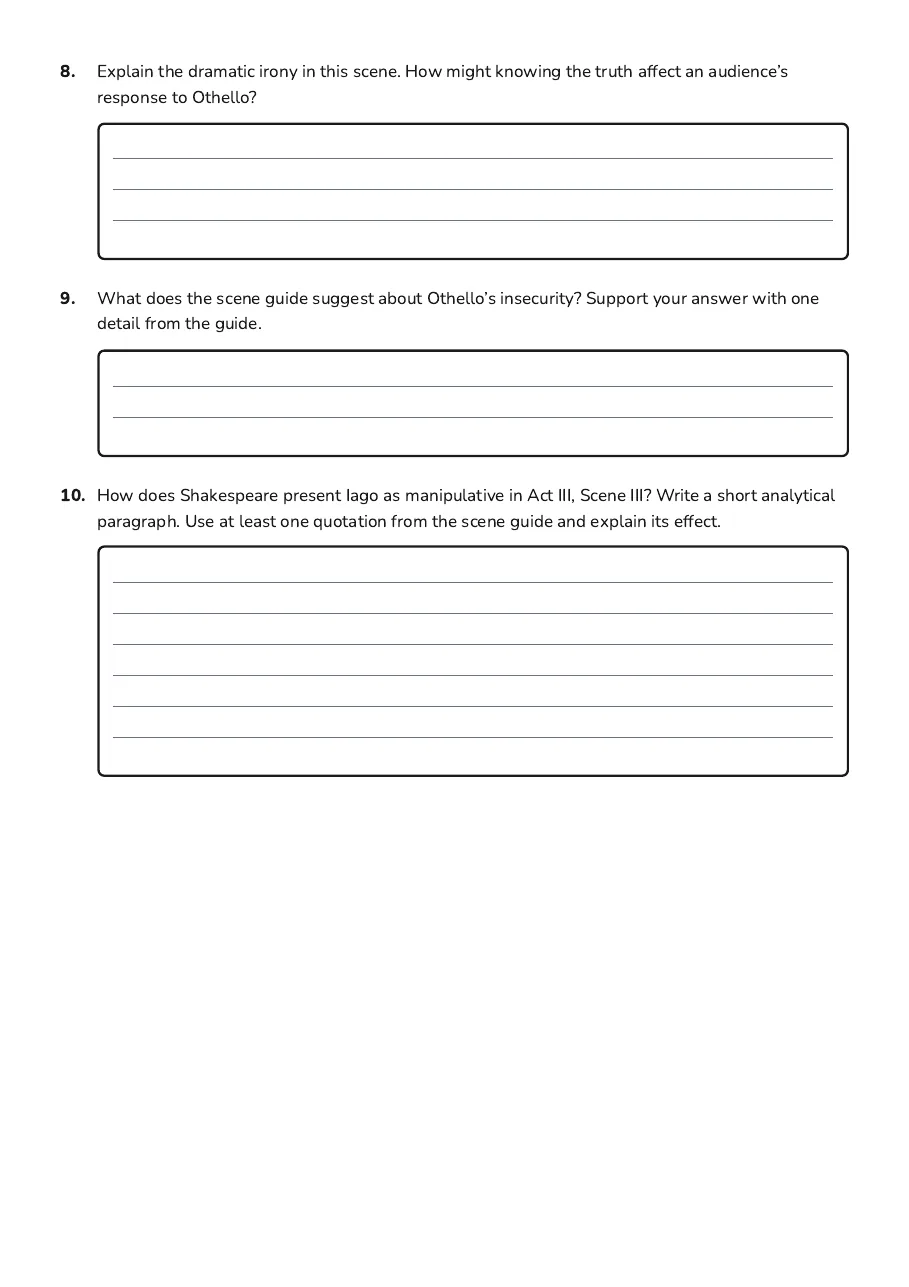
8.Explain the dramatic irony in this scene. How might knowing the truth affect an audience’s response to Othello?
9.What does the scene guide suggest about Othello’s insecurity? Support your answer with one detail from the guide.
10.How does Shakespeare present Iago as manipulative in Act III, Scene III? Write a short analytical paragraph. Use at least one quotation from the scene guide and explain its effect.
3 printable pages
Page 1
Page 2
Page 3
About This Worksheet
Free in Kuraplan
Sign up free, grab the PDF, and customize it for your class.
Print-Ready
Formatted for standard paper. Clean layout, easy to read.
AI-Generated
Created with Kuraplan's AI, designed for real classroom use.
For Teachers & Parents
Use in classrooms, for homework, tutoring, or homeschool.
Need a custom version of this worksheet?
Kuraplan's AI generates custom worksheets in seconds — differentiated for every learner, aligned to your curriculum.
Generate Custom Worksheets — Free No credit card Curriculum-aligned Under 60 seconds