MathsFreePrintable
Parallelogram Area Calculations
A free maths worksheet ready for your classroom. Open in Kuraplan to grab the print-ready PDF, customize it for your students, or generate a fresh version in seconds.
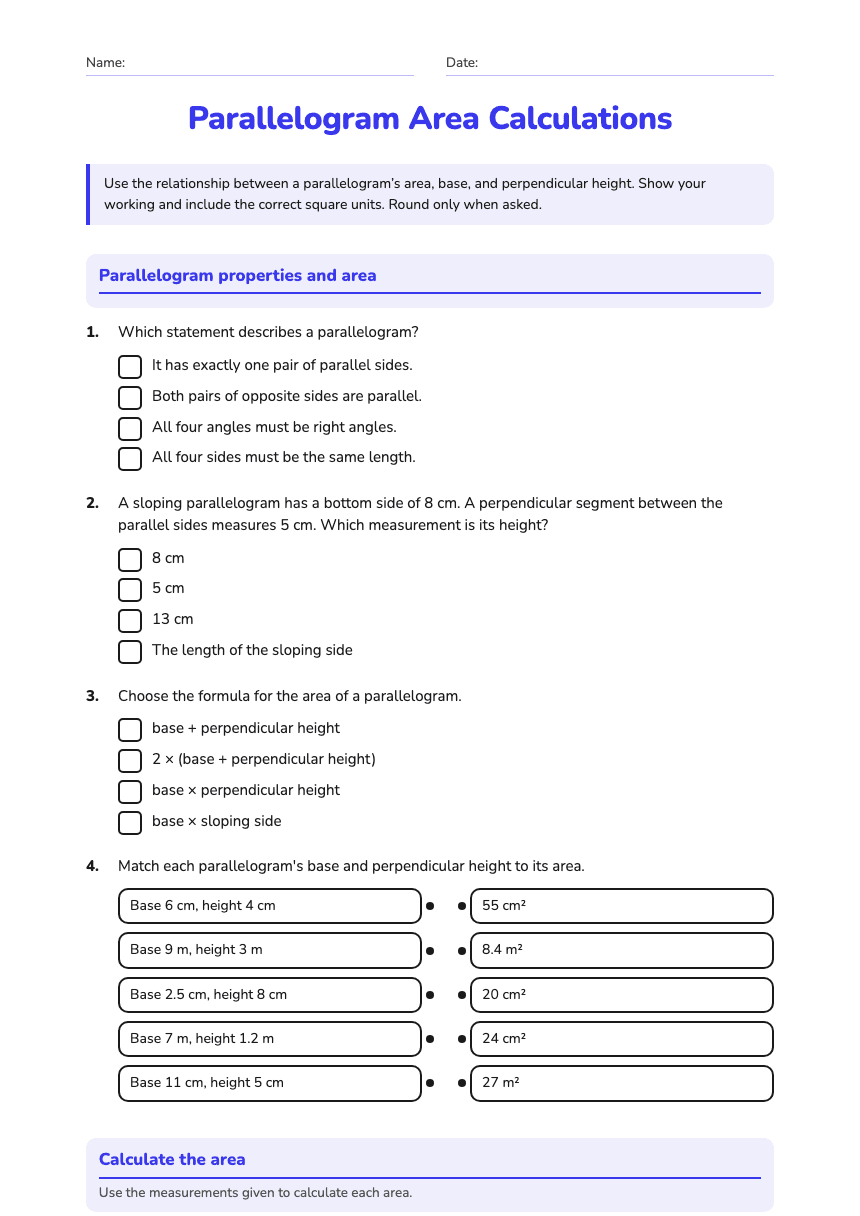
Name:Date:
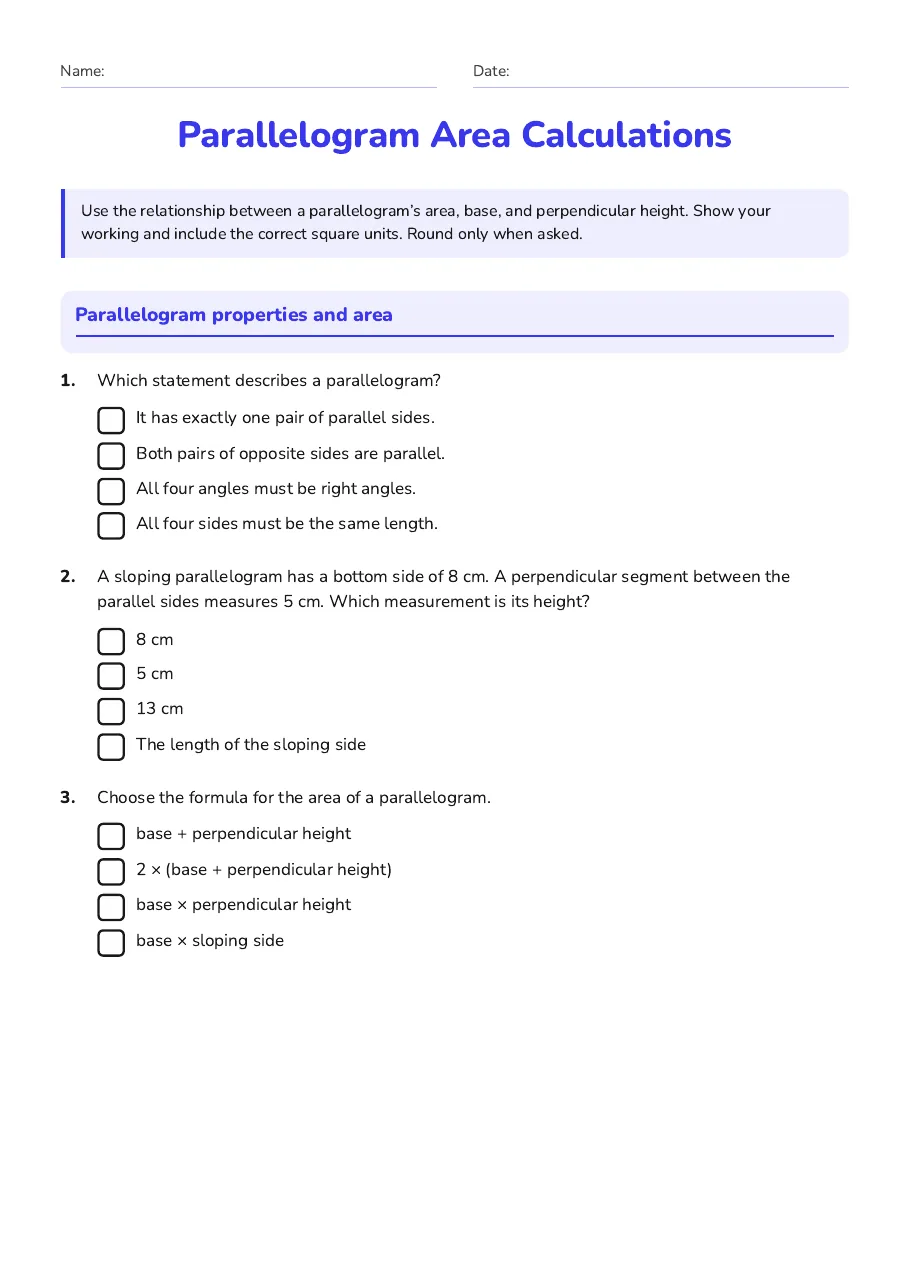
Parallelogram Area Calculations
Use the relationship between a parallelogram’s area, base, and perpendicular height. Show your working and include the correct square units. Round only when asked.
Parallelogram properties and area
1.Which statement describes a parallelogram?
- It has exactly one pair of parallel sides.
- Both pairs of opposite sides are parallel.
- All four angles must be right angles.
- All four sides must be the same length.
2.A sloping parallelogram has a bottom side of 8 cm. A perpendicular segment between the parallel sides measures 5 cm. Which measurement is its height?
- 8 cm
- 5 cm
- 13 cm
- The length of the sloping side
3.Choose the formula for the area of a parallelogram.
- base + perpendicular height
- 2 × (base + perpendicular height)
- base × perpendicular height
- base × sloping side
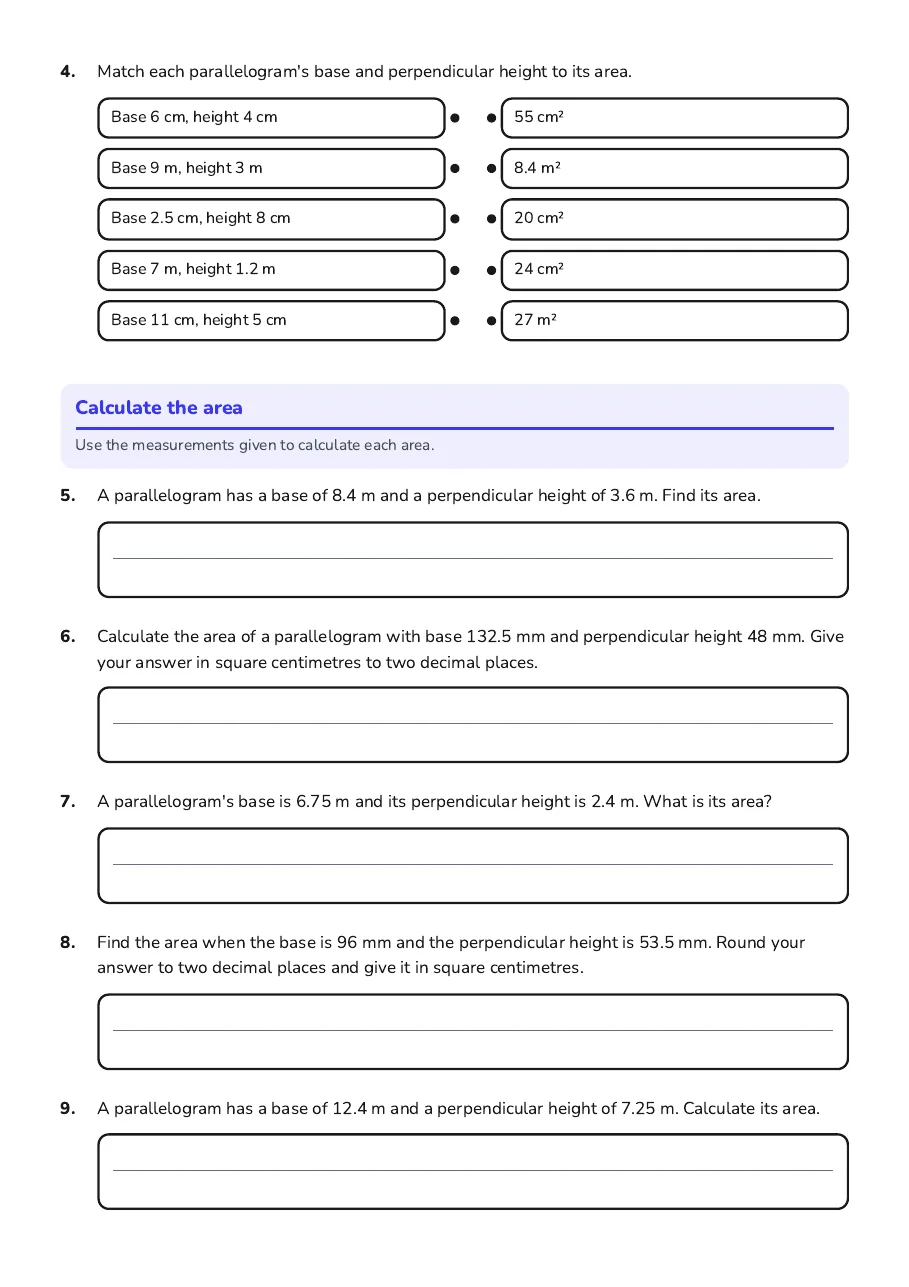
4.Match each parallelogram's base and perpendicular height to its area.
- Base 6 cm, height 4 cm
- Base 9 m, height 3 m
- Base 2.5 cm, height 8 cm
- Base 7 m, height 1.2 m
- Base 11 cm, height 5 cm
- 55 cm²
- 8.4 m²
- 20 cm²
- 24 cm²
- 27 m²
Calculate the area
Use the measurements given to calculate each area.
5.A parallelogram has a base of 8.4 m and a perpendicular height of 3.6 m. Find its area.
6.Calculate the area of a parallelogram with base 132.5 mm and perpendicular height 48 mm. Give your answer in square centimetres to two decimal places.
7.A parallelogram's base is 6.75 m and its perpendicular height is 2.4 m. What is its area?
8.Find the area when the base is 96 mm and the perpendicular height is 53.5 mm. Round your answer to two decimal places and give it in square centimetres.
9.A parallelogram has a base of 12.4 m and a perpendicular height of 7.25 m. Calculate its area.
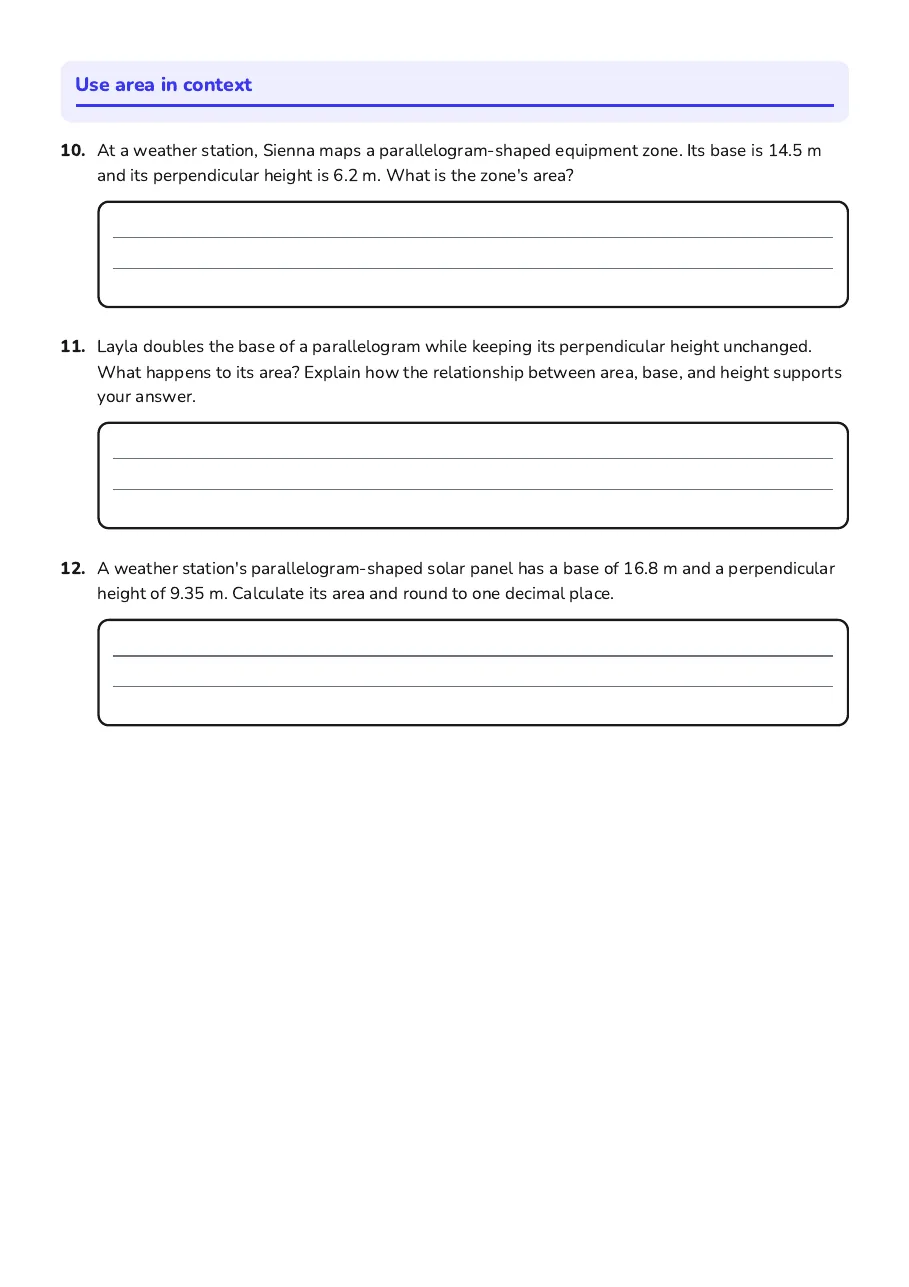
Use area in context
10.At a weather station, Sienna maps a parallelogram-shaped equipment zone. Its base is 14.5 m and its perpendicular height is 6.2 m. What is the zone's area?
11.Layla doubles the base of a parallelogram while keeping its perpendicular height unchanged. What happens to its area? Explain how the relationship between area, base, and height supports your answer.
12.A weather station's parallelogram-shaped solar panel has a base of 16.8 m and a perpendicular height of 9.35 m. Calculate its area and round to one decimal place.
3 printable pages
Page 1
Page 2
Page 3
About This Worksheet
Free in Kuraplan
Sign up free, grab the PDF, and customize it for your class.
Print-Ready
Formatted for standard paper. Clean layout, easy to read.
AI-Generated
Created with Kuraplan's AI, designed for real classroom use.
For Teachers & Parents
Use in classrooms, for homework, tutoring, or homeschool.
Need a custom version of this worksheet?
Kuraplan's AI generates custom worksheets in seconds — differentiated for every learner, aligned to your curriculum.
Generate Custom Worksheets — Free No credit card Curriculum-aligned Under 60 seconds