EnglishFreePrintable

Pathetic Fallacy Creative Writing

A free english worksheet ready for your classroom. Open in Kuraplan to grab the print-ready PDF, customize it for your students, or generate a fresh version in seconds.
Pathetic Fallacy Creative Writing worksheet preview
Name:Date:

Pathetic Fallacy Creative Writing

Create an evocative setting in which the weather or natural world reflects a character’s emotions. Read the short extracts, analyse the choices, then plan, draft and refine your own piece. Pathetic fallacy is not simply personification: it is when nature or weather reflects a mood or feeling.

Read and notice

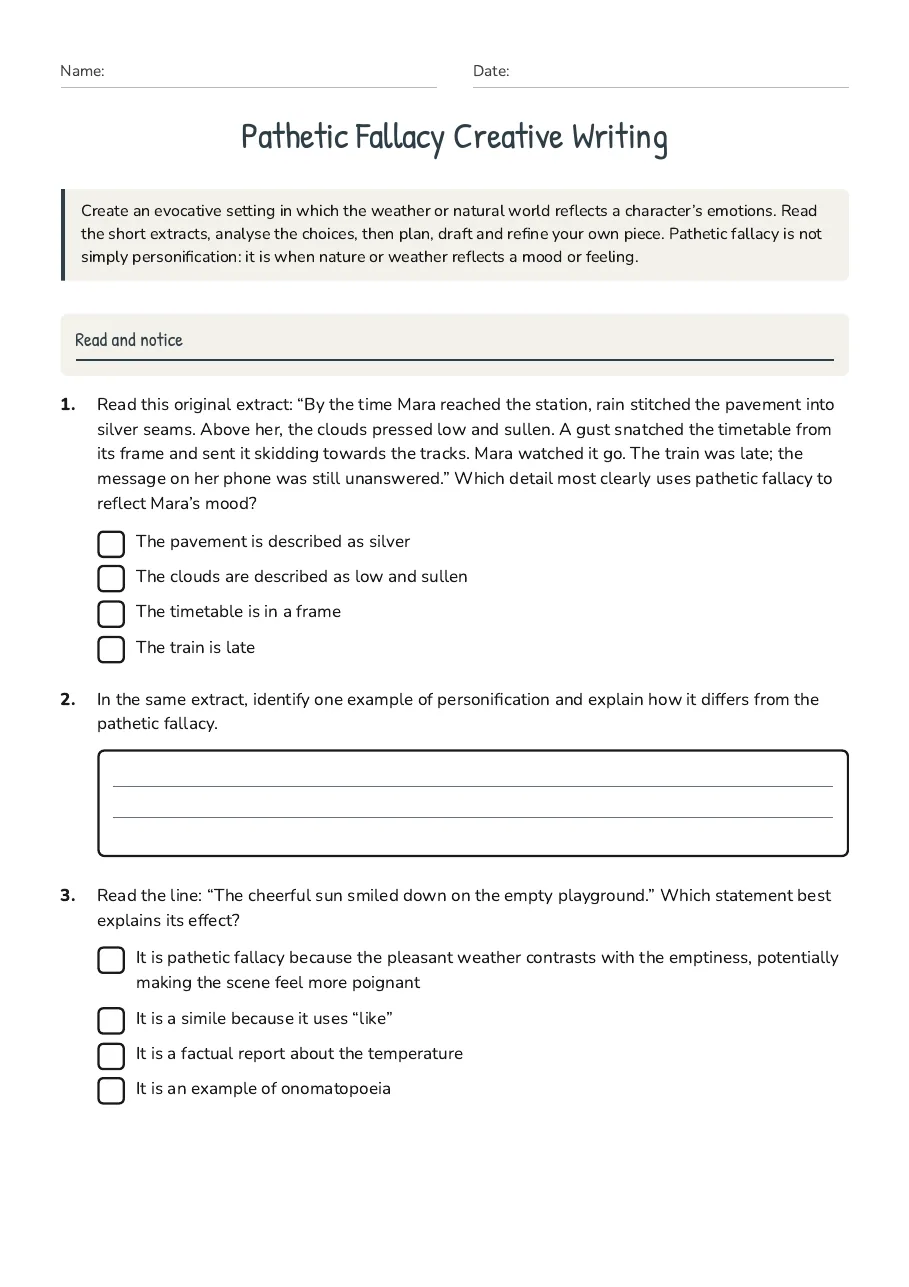
1.Read this original extract: “By the time Mara reached the station, rain stitched the pavement into silver seams. Above her, the clouds pressed low and sullen. A gust snatched the timetable from its frame and sent it skidding towards the tracks. Mara watched it go. The train was late; the message on her phone was still unanswered.” Which detail most clearly uses pathetic fallacy to reflect Mara’s mood?
  • The pavement is described as silver
  • The clouds are described as low and sullen
  • The timetable is in a frame
  • The train is late
2.In the same extract, identify one example of personification and explain how it differs from the pathetic fallacy.
3.Read the line: “The cheerful sun smiled down on the empty playground.” Which statement best explains its effect?
  • It is pathetic fallacy because the pleasant weather contrasts with the emptiness, potentially making the scene feel more poignant
  • It is a simile because it uses “like”
  • It is a factual report about the temperature
  • It is an example of onomatopoeia
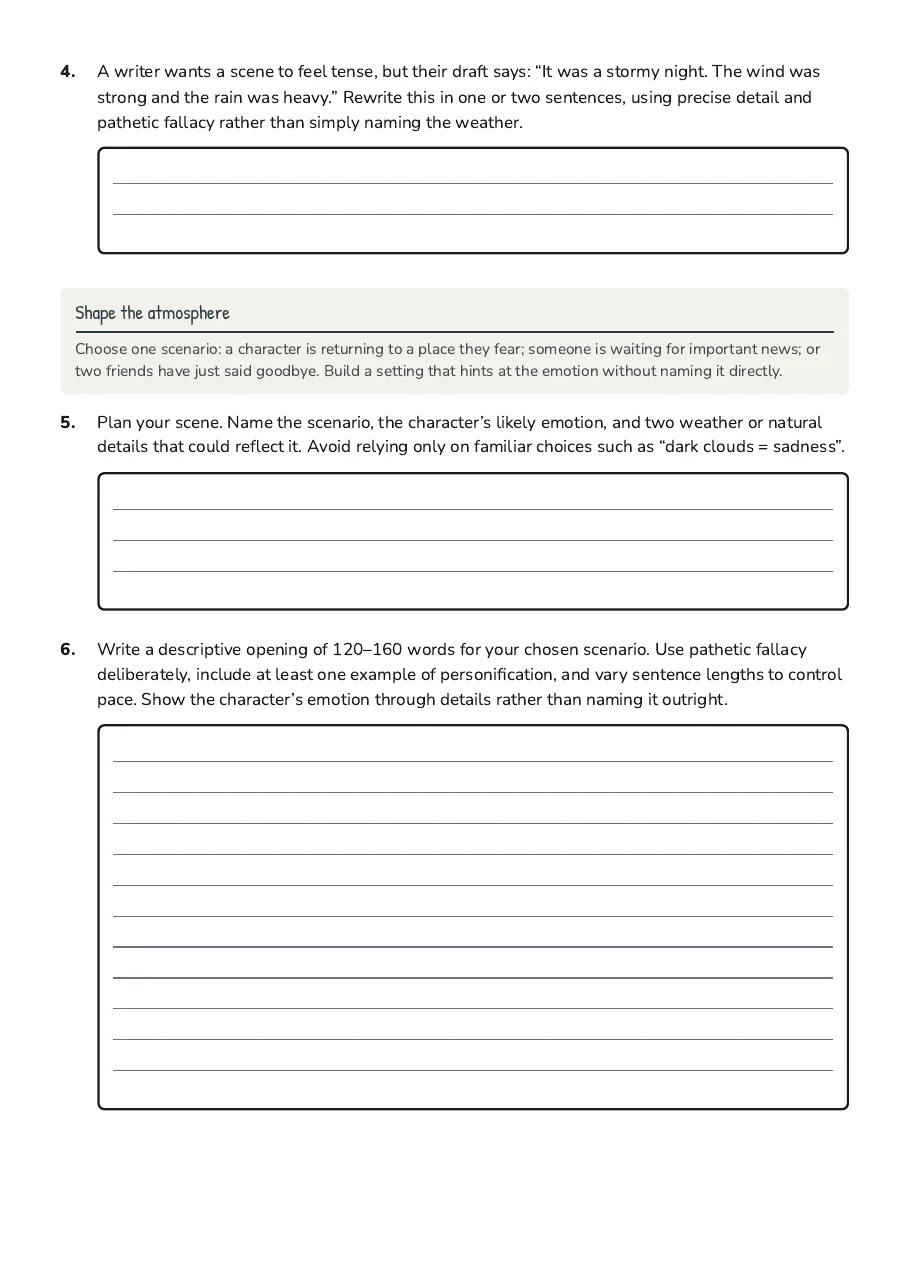
4.A writer wants a scene to feel tense, but their draft says: “It was a stormy night. The wind was strong and the rain was heavy.” Rewrite this in one or two sentences, using precise detail and pathetic fallacy rather than simply naming the weather.

Shape the atmosphere

Choose one scenario: a character is returning to a place they fear; someone is waiting for important news; or two friends have just said goodbye. Build a setting that hints at the emotion without naming it directly.

5.Plan your scene. Name the scenario, the character’s likely emotion, and two weather or natural details that could reflect it. Avoid relying only on familiar choices such as “dark clouds = sadness”.
6.Write a descriptive opening of 120–160 words for your chosen scenario. Use pathetic fallacy deliberately, include at least one example of personification, and vary sentence lengths to control pace. Show the character’s emotion through details rather than naming it outright.

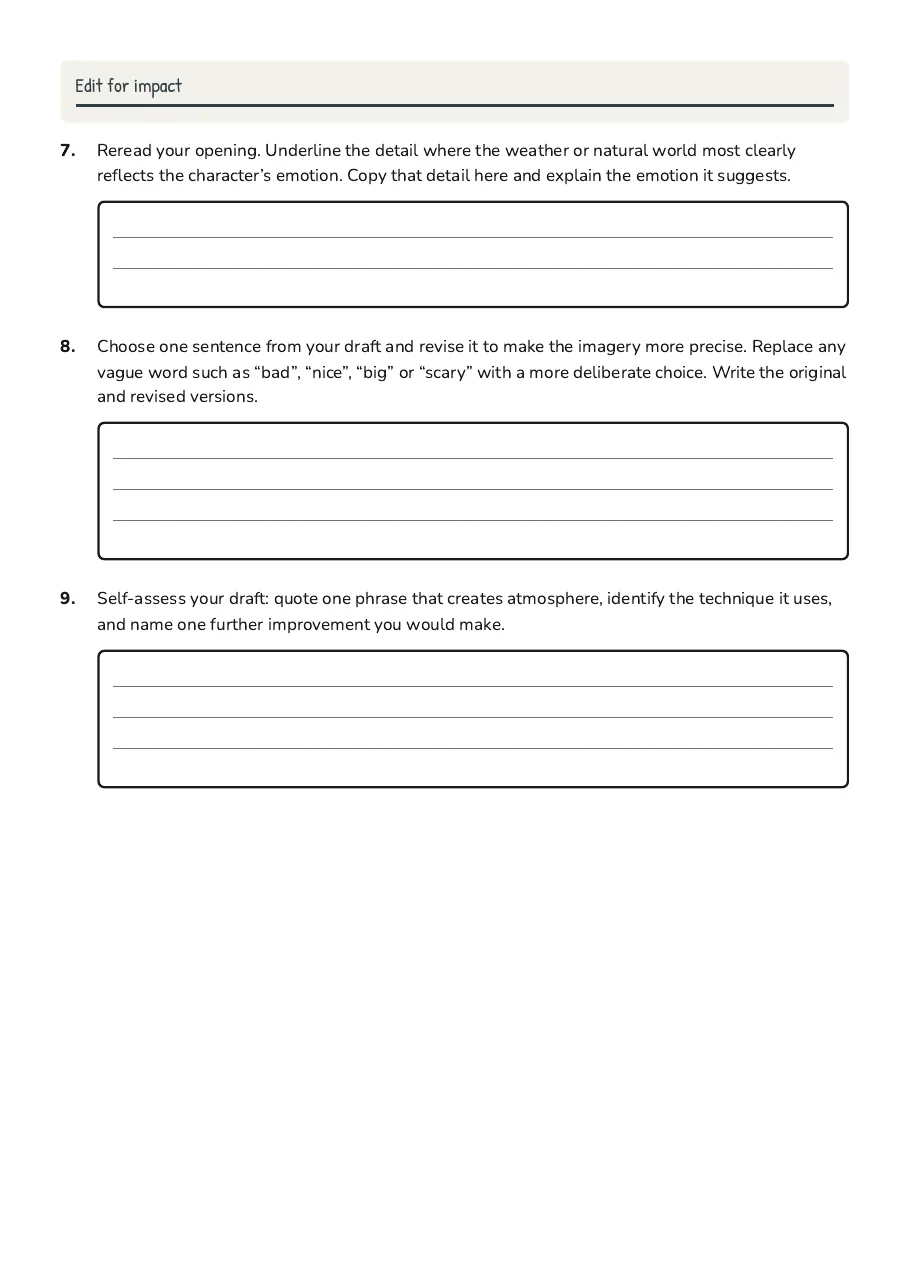
Edit for impact

7.Reread your opening. Underline the detail where the weather or natural world most clearly reflects the character’s emotion. Copy that detail here and explain the emotion it suggests.
8.Choose one sentence from your draft and revise it to make the imagery more precise. Replace any vague word such as “bad”, “nice”, “big” or “scary” with a more deliberate choice. Write the original and revised versions.
9.Self-assess your draft: quote one phrase that creates atmosphere, identify the technique it uses, and name one further improvement you would make.

3 printable pages

  • Pathetic Fallacy Creative Writing, page 1 of 3: Read and notice

    Page 1

  • Pathetic Fallacy Creative Writing, page 2 of 3: Shape the atmosphere

    Page 2

  • Pathetic Fallacy Creative Writing, page 3 of 3: Edit for impact

    Page 3

About This Worksheet

Free in Kuraplan

Sign up free, grab the PDF, and customize it for your class.

Print-Ready

Formatted for standard paper. Clean layout, easy to read.

AI-Generated

Created with Kuraplan's AI, designed for real classroom use.

For Teachers & Parents

Use in classrooms, for homework, tutoring, or homeschool.

Need a custom version of this worksheet?

Kuraplan's AI generates custom worksheets in seconds — differentiated for every learner, aligned to your curriculum.

Generate Custom Worksheets — Free
No credit card Curriculum-aligned Under 60 seconds