EnglishFreePrintable

Personal Narrative Writing Guide

A free english worksheet ready for your classroom. Open in Kuraplan to grab the print-ready PDF, customize it for your students, or generate a fresh version in seconds.
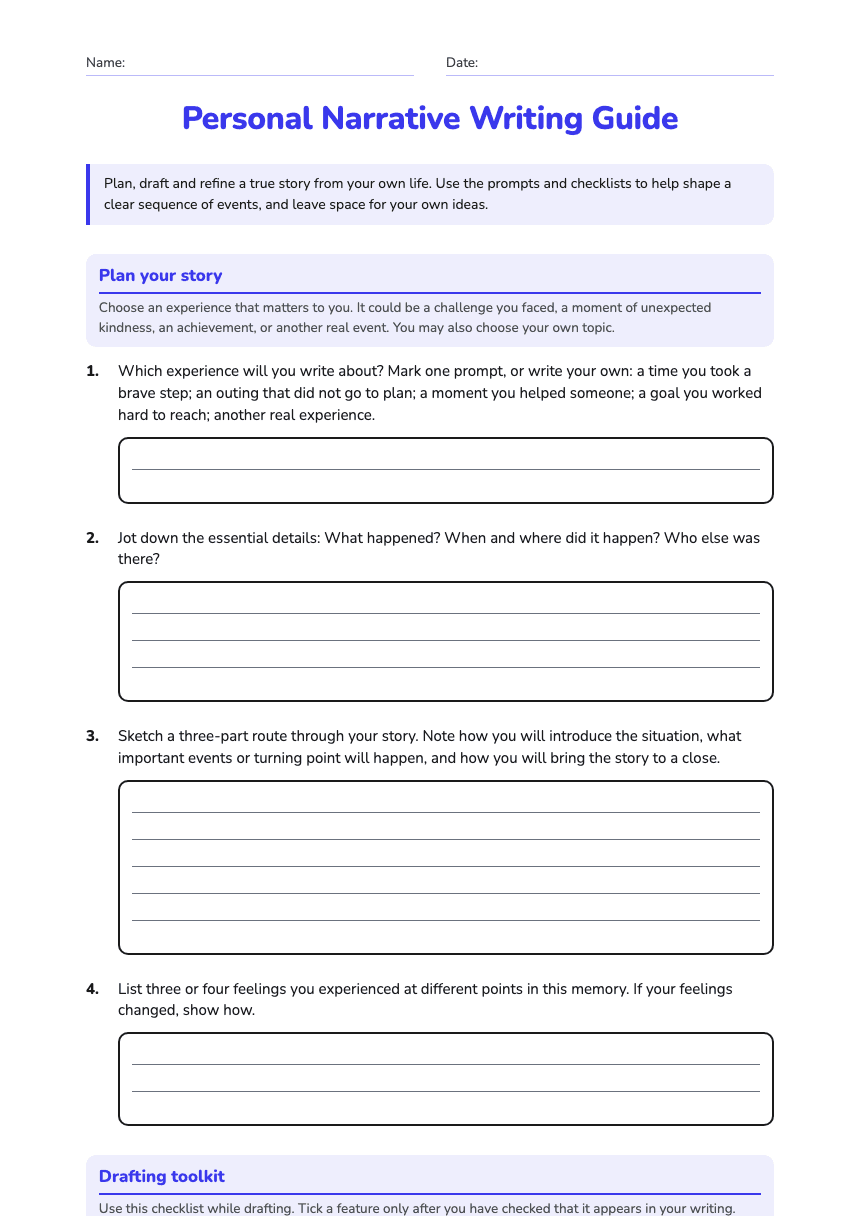
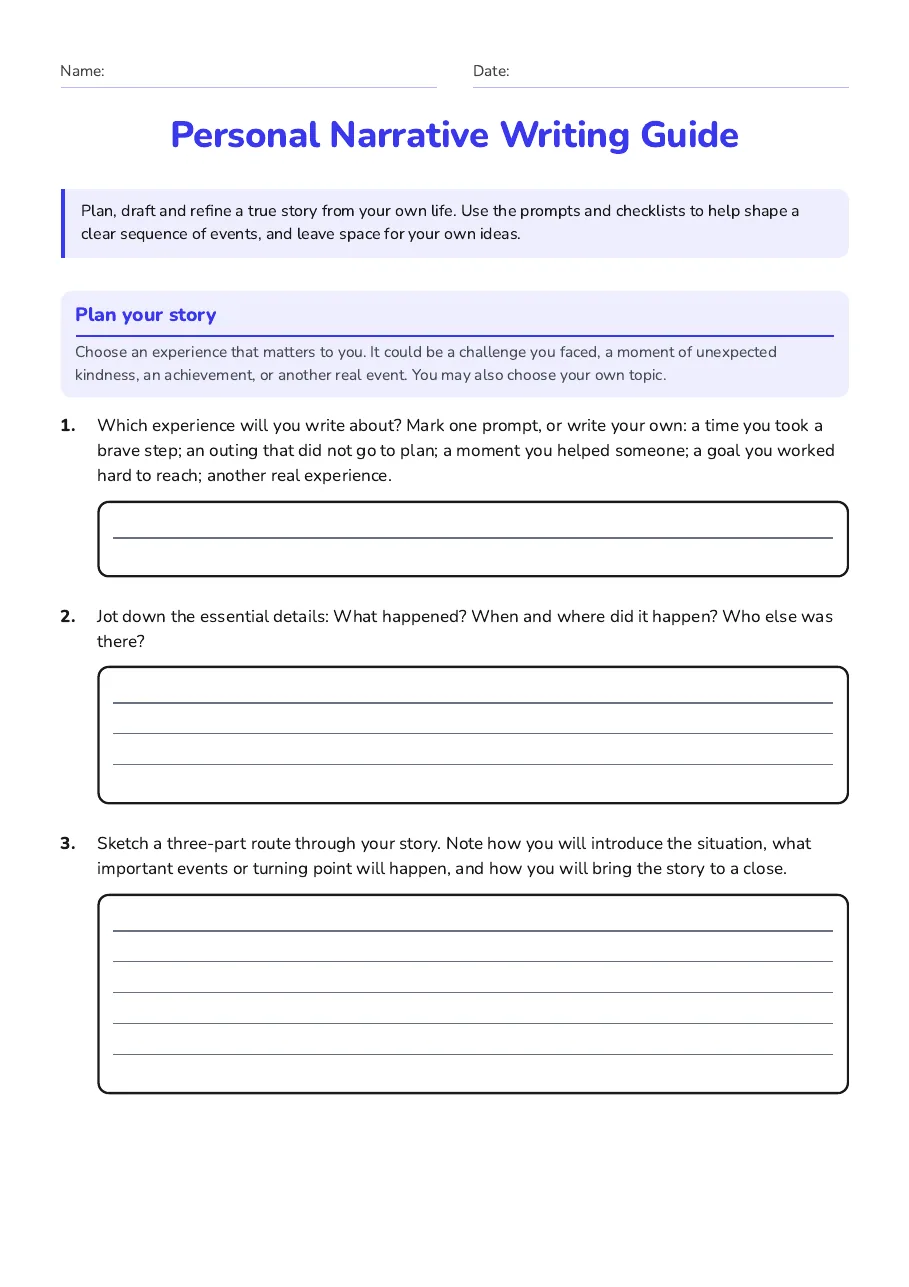
Personal Narrative Writing Guide worksheet preview
Name:Date:

Personal Narrative Writing Guide

Plan, draft and refine a true story from your own life. Use the prompts and checklists to help shape a clear sequence of events, and leave space for your own ideas.

Plan your story

Choose an experience that matters to you. It could be a challenge you faced, a moment of unexpected kindness, an achievement, or another real event. You may also choose your own topic.

1.Which experience will you write about? Mark one prompt, or write your own: a time you took a brave step; an outing that did not go to plan; a moment you helped someone; a goal you worked hard to reach; another real experience.
2.Jot down the essential details: What happened? When and where did it happen? Who else was there?
3.Sketch a three-part route through your story. Note how you will introduce the situation, what important events or turning point will happen, and how you will bring the story to a close.
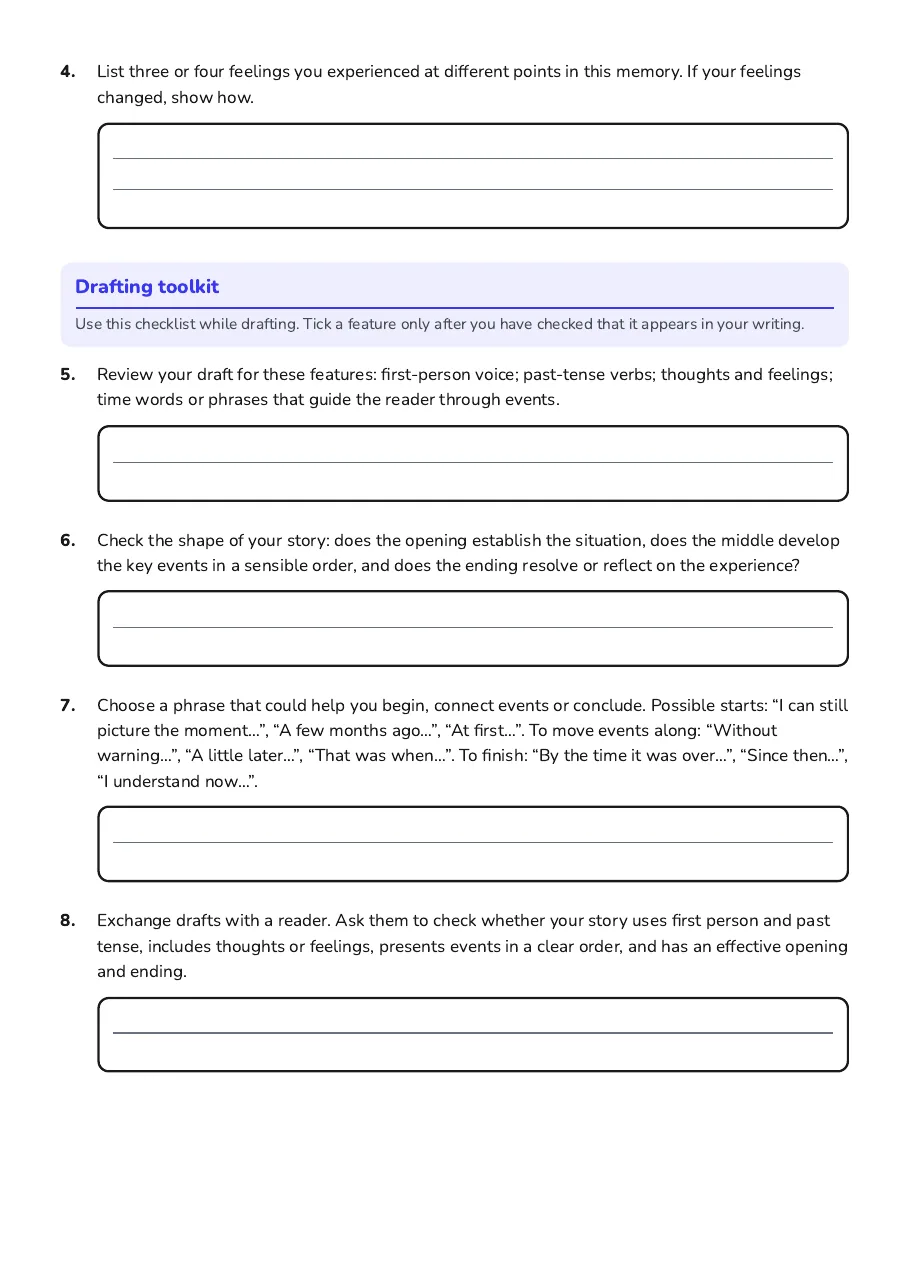
4.List three or four feelings you experienced at different points in this memory. If your feelings changed, show how.

Drafting toolkit

Use this checklist while drafting. Tick a feature only after you have checked that it appears in your writing.

5.Review your draft for these features: first-person voice; past-tense verbs; thoughts and feelings; time words or phrases that guide the reader through events.
6.Check the shape of your story: does the opening establish the situation, does the middle develop the key events in a sensible order, and does the ending resolve or reflect on the experience?
7.Choose a phrase that could help you begin, connect events or conclude. Possible starts: “I can still picture the moment…”, “A few months ago…”, “At first…”. To move events along: “Without warning…”, “A little later…”, “That was when…”. To finish: “By the time it was over…”, “Since then…”, “I understand now…”.
8.Exchange drafts with a reader. Ask them to check whether your story uses first person and past tense, includes thoughts or feelings, presents events in a clear order, and has an effective opening and ending.
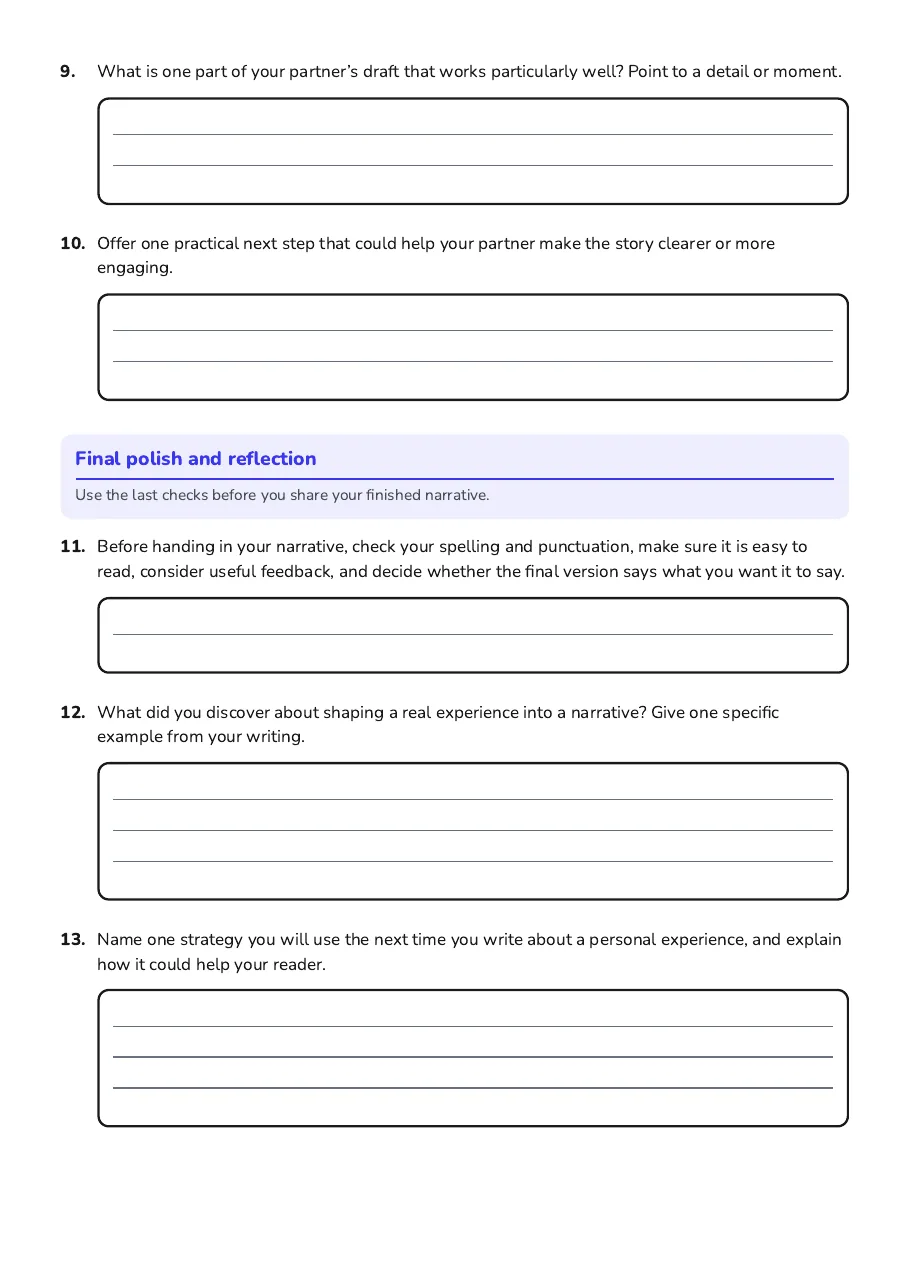
9.What is one part of your partner’s draft that works particularly well? Point to a detail or moment.
10.Offer one practical next step that could help your partner make the story clearer or more engaging.

Final polish and reflection

Use the last checks before you share your finished narrative.

11.Before handing in your narrative, check your spelling and punctuation, make sure it is easy to read, consider useful feedback, and decide whether the final version says what you want it to say.
12.What did you discover about shaping a real experience into a narrative? Give one specific example from your writing.
13.Name one strategy you will use the next time you write about a personal experience, and explain how it could help your reader.

3 printable pages

  • Personal Narrative Writing Guide, page 1 of 3: Plan your story

    Page 1

  • Personal Narrative Writing Guide, page 2 of 3: Drafting toolkit

    Page 2

  • Personal Narrative Writing Guide, page 3 of 3: Final polish and reflection

    Page 3

About This Worksheet

Free in Kuraplan

Sign up free, grab the PDF, and customize it for your class.

Print-Ready

Formatted for standard paper. Clean layout, easy to read.

AI-Generated

Created with Kuraplan's AI, designed for real classroom use.

For Teachers & Parents

Use in classrooms, for homework, tutoring, or homeschool.

Need a custom version of this worksheet?

Kuraplan's AI generates custom worksheets in seconds — differentiated for every learner, aligned to your curriculum.

Generate Custom Worksheets — Free
No credit card Curriculum-aligned Under 60 seconds