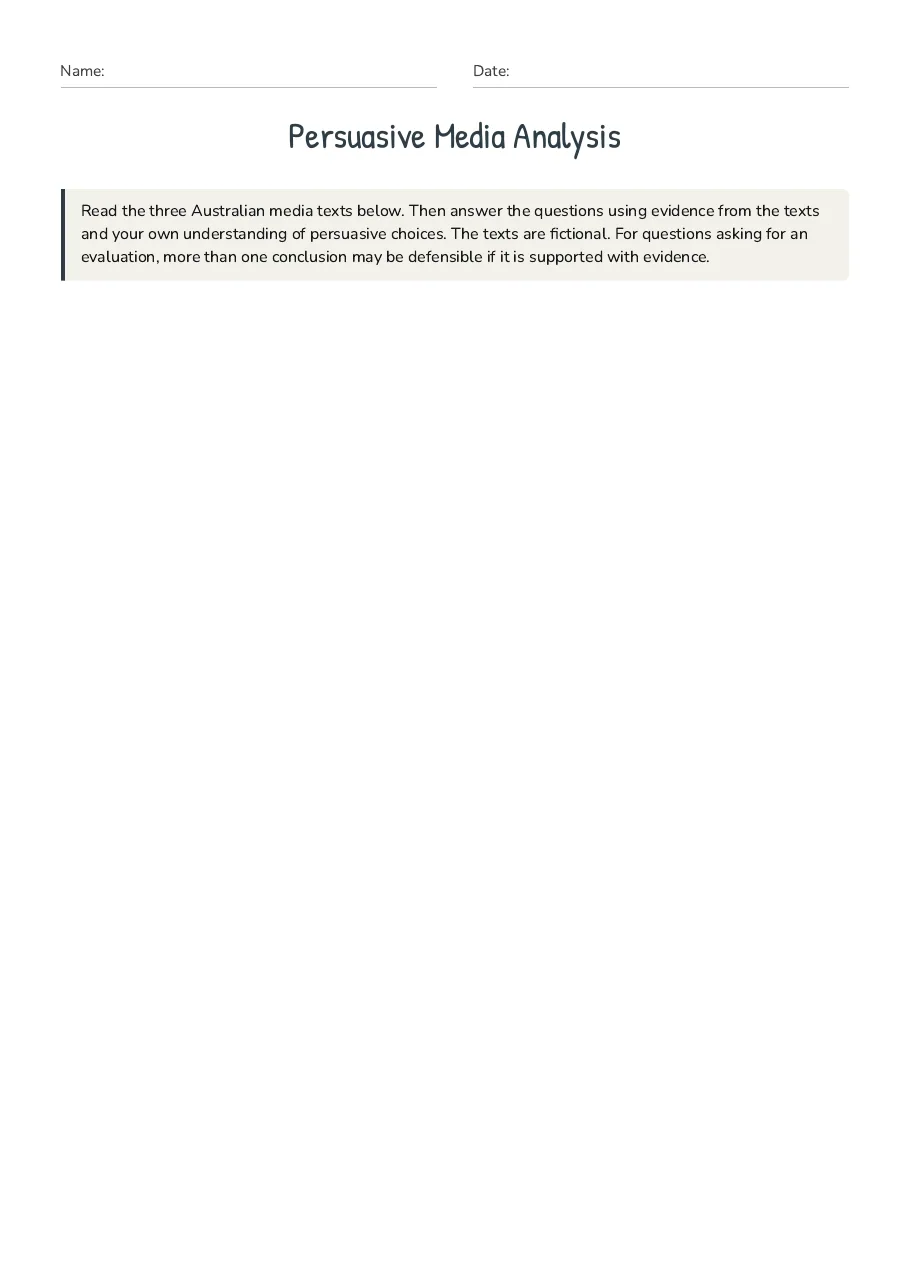
Persuasive Media Analysis
A free english worksheet ready for your classroom. Open in Kuraplan to grab the print-ready PDF, customize it for your students, or generate a fresh version in seconds.
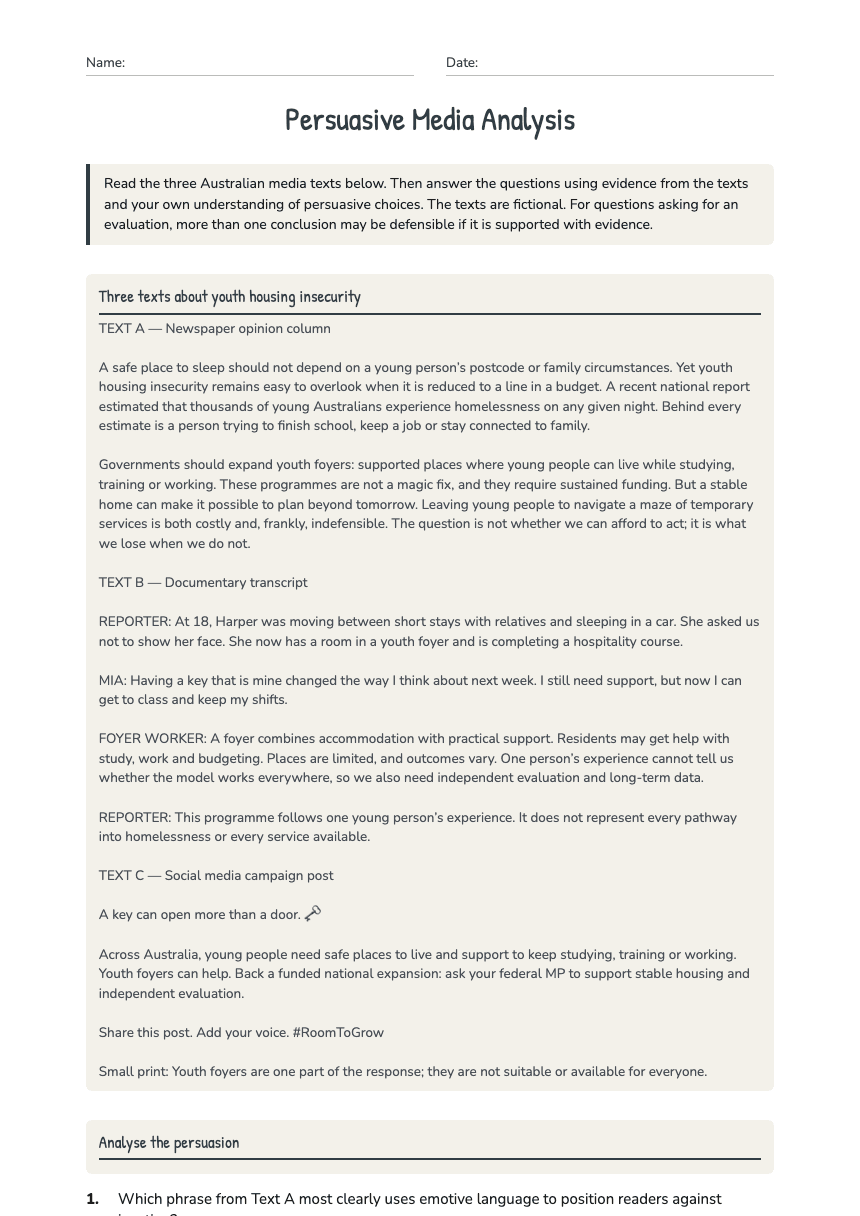
Persuasive Media Analysis
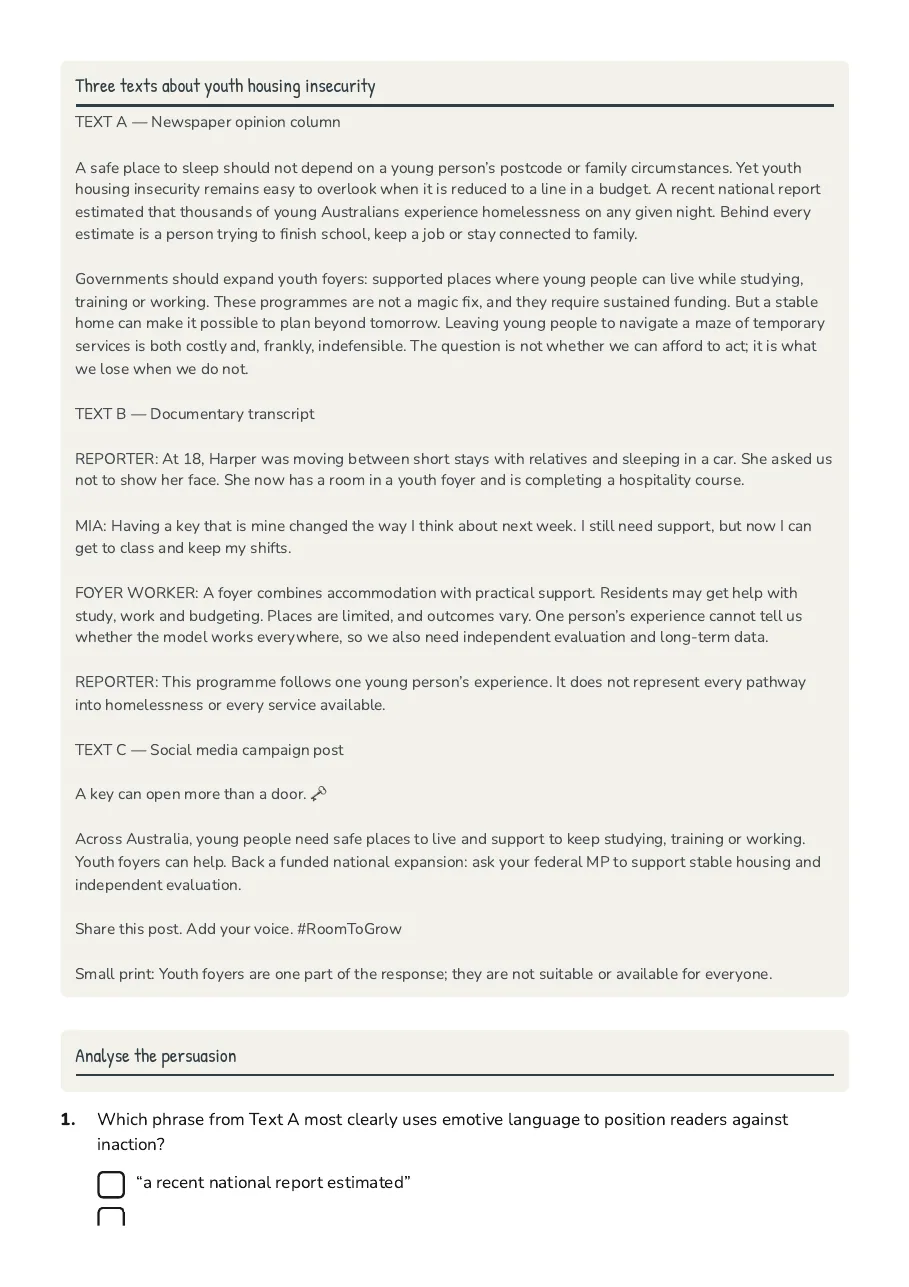
Three texts about youth housing insecurity
TEXT A — Newspaper opinion column A safe place to sleep should not depend on a young person’s postcode or family circumstances. Yet youth housing insecurity remains easy to overlook when it is reduced to a line in a budget. A recent national report estimated that thousands of young Australians experience homelessness on any given night. Behind every estimate is a person trying to finish school, keep a job or stay connected to family. Governments should expand youth foyers: supported places where young people can live while studying, training or working. These programmes are not a magic fix, and they require sustained funding. But a stable home can make it possible to plan beyond tomorrow. Leaving young people to navigate a maze of temporary services is both costly and, frankly, indefensible. The question is not whether we can afford to act; it is what we lose when we do not. TEXT B — Documentary transcript REPORTER: At 18, Harper was moving between short stays with relatives and sleeping in a car. She asked us not to show her face. She now has a room in a youth foyer and is completing a hospitality course. MIA: Having a key that is mine changed the way I think about next week. I still need support, but now I can get to class and keep my shifts. FOYER WORKER: A foyer combines accommodation with practical support. Residents may get help with study, work and budgeting. Places are limited, and outcomes vary. One person’s experience cannot tell us whether the model works everywhere, so we also need independent evaluation and long-term data. REPORTER: This programme follows one young person’s experience. It does not represent every pathway into homelessness or every service available. TEXT C — Social media campaign post A key can open more than a door. 🗝️ Across Australia, young people need safe places to live and support to keep studying, training or working. Youth foyers can help. Back a funded national expansion: ask your federal MP to support stable housing and independent evaluation. Share this post. Add your voice. #RoomToGrow Small print: Youth foyers are one part of the response; they are not suitable or available for everyone.
Analyse the persuasion
- “a recent national report estimated”
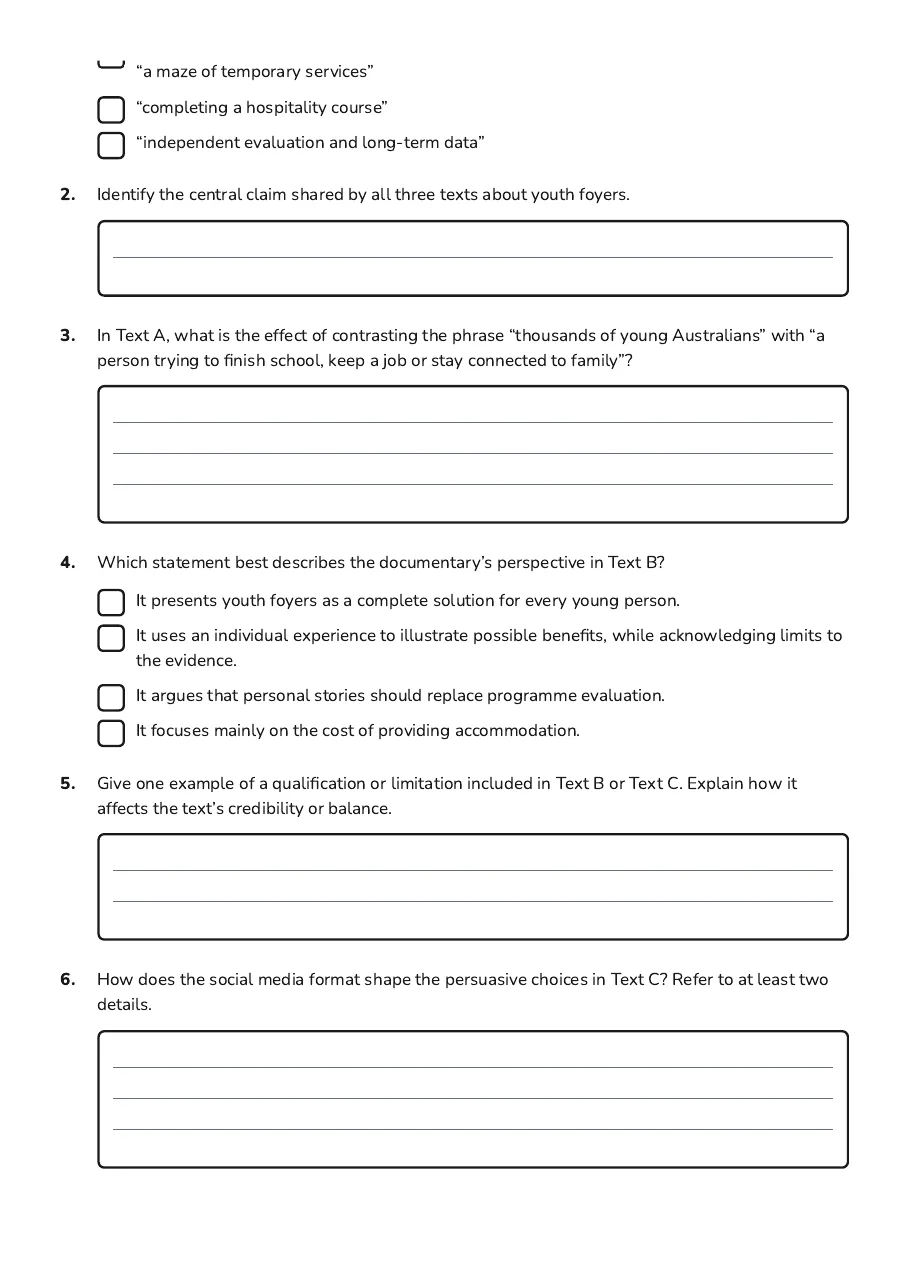
- “a maze of temporary services”
- “completing a hospitality course”
- “independent evaluation and long-term data”
- It presents youth foyers as a complete solution for every young person.
- It uses an individual experience to illustrate possible benefits, while acknowledging limits to the evidence.
- It argues that personal stories should replace programme evaluation.
- It focuses mainly on the cost of providing accommodation.
4 printable pages
Page 1
Page 2
Page 3
Page 4
About This Worksheet
Free in Kuraplan
Sign up free, grab the PDF, and customize it for your class.
Print-Ready
Formatted for standard paper. Clean layout, easy to read.
AI-Generated
Created with Kuraplan's AI, designed for real classroom use.
For Teachers & Parents
Use in classrooms, for homework, tutoring, or homeschool.
Need a custom version of this worksheet?
Kuraplan's AI generates custom worksheets in seconds — differentiated for every learner, aligned to your curriculum.
Generate Custom Worksheets — Free