EnglishFreePrintable

Plant Life Cycle Writing

A free english worksheet ready for your classroom. Open in Kuraplan to grab the print-ready PDF, customize it for your students, or generate a fresh version in seconds.
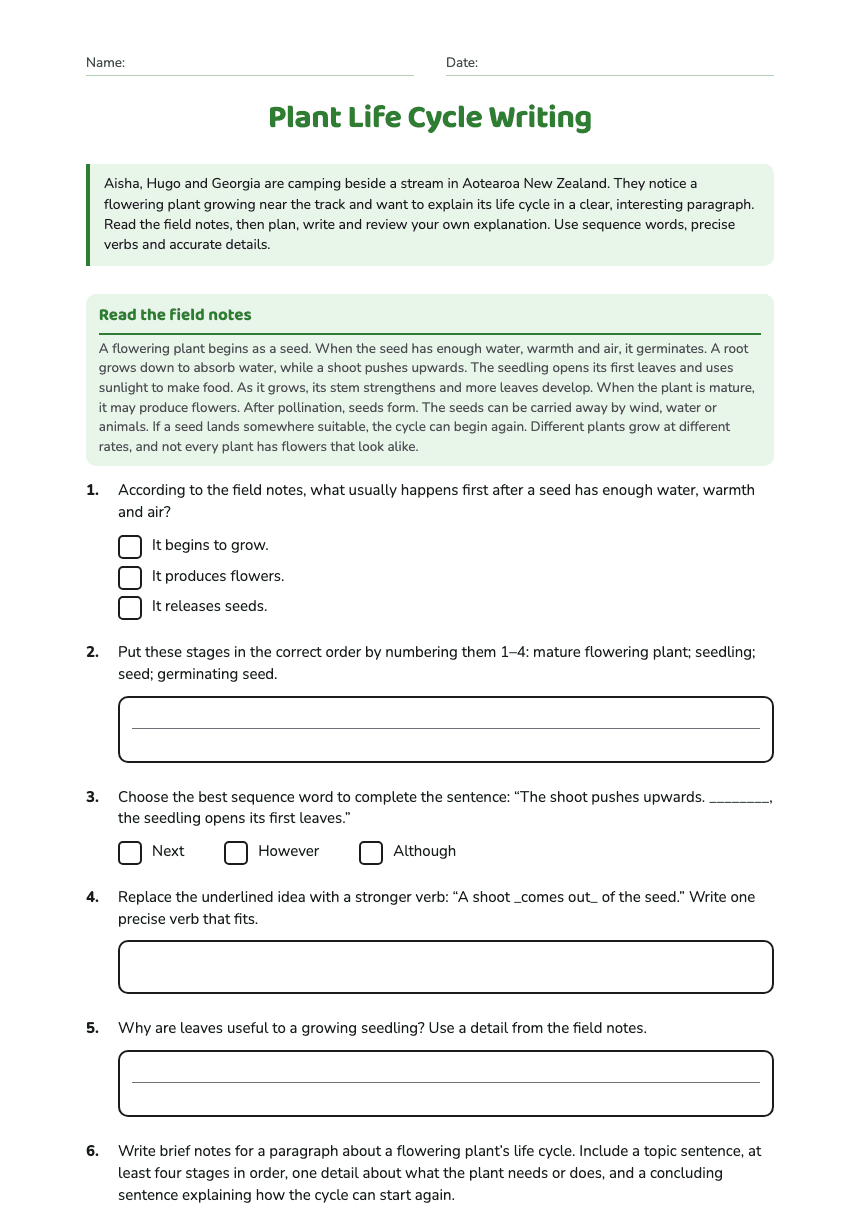
Plant Life Cycle Writing worksheet preview
Name:Date:

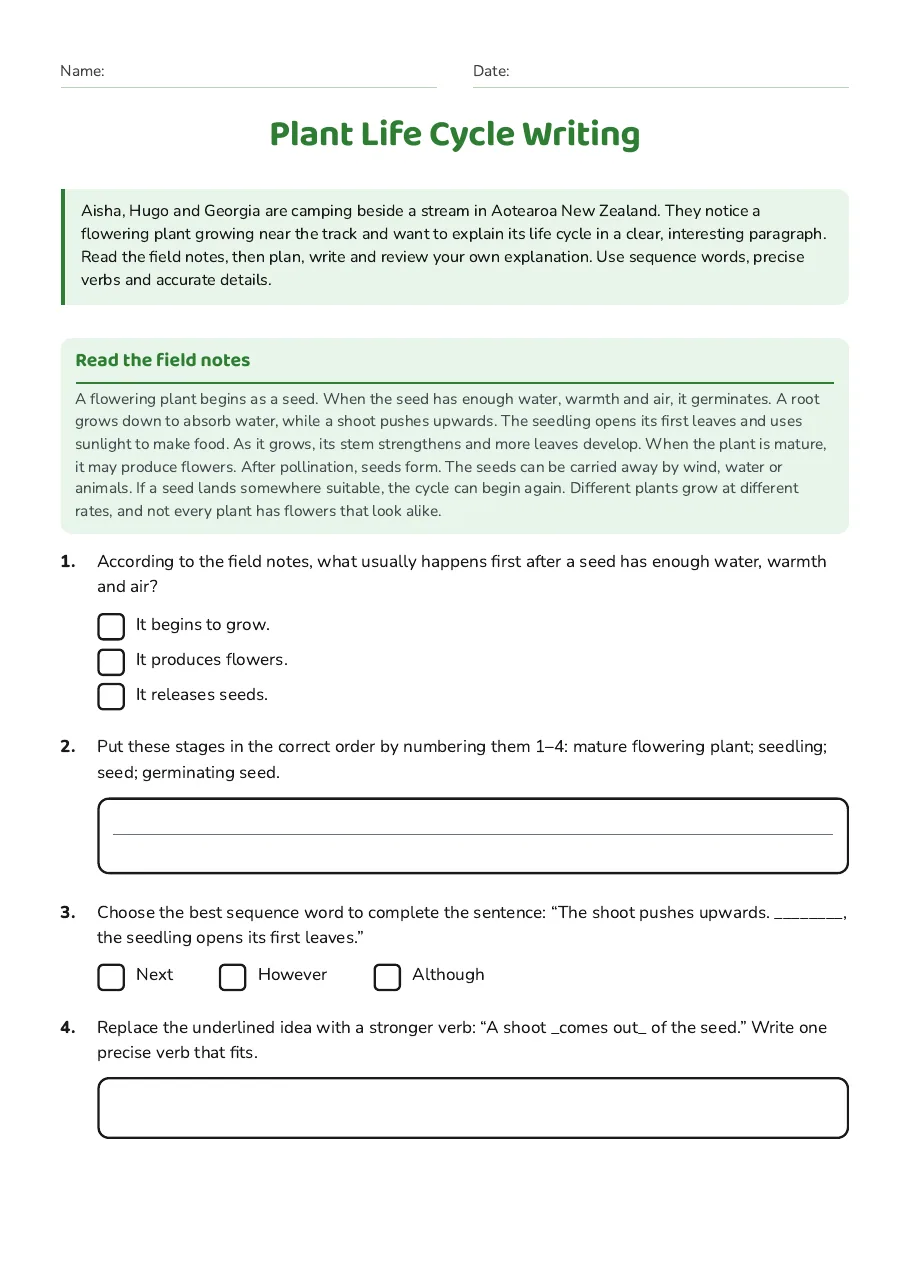
Plant Life Cycle Writing

Aisha, Hugo and Georgia are camping beside a stream in Aotearoa New Zealand. They notice a flowering plant growing near the track and want to explain its life cycle in a clear, interesting paragraph. Read the field notes, then plan, write and review your own explanation. Use sequence words, precise verbs and accurate details.

Read the field notes

A flowering plant begins as a seed. When the seed has enough water, warmth and air, it germinates. A root grows down to absorb water, while a shoot pushes upwards. The seedling opens its first leaves and uses sunlight to make food. As it grows, its stem strengthens and more leaves develop. When the plant is mature, it may produce flowers. After pollination, seeds form. The seeds can be carried away by wind, water or animals. If a seed lands somewhere suitable, the cycle can begin again. Different plants grow at different rates, and not every plant has flowers that look alike.

1.According to the field notes, what usually happens first after a seed has enough water, warmth and air?
  • It begins to grow.
  • It produces flowers.
  • It releases seeds.
2.Put these stages in the correct order by numbering them 1–4: mature flowering plant; seedling; seed; germinating seed.
3.Choose the best sequence word to complete the sentence: “The shoot pushes upwards. ________, the seedling opens its first leaves.”
  • Next
  • However
  • Although
4.Replace the underlined idea with a stronger verb: “A shoot _comes out_ of the seed.” Write one precise verb that fits.
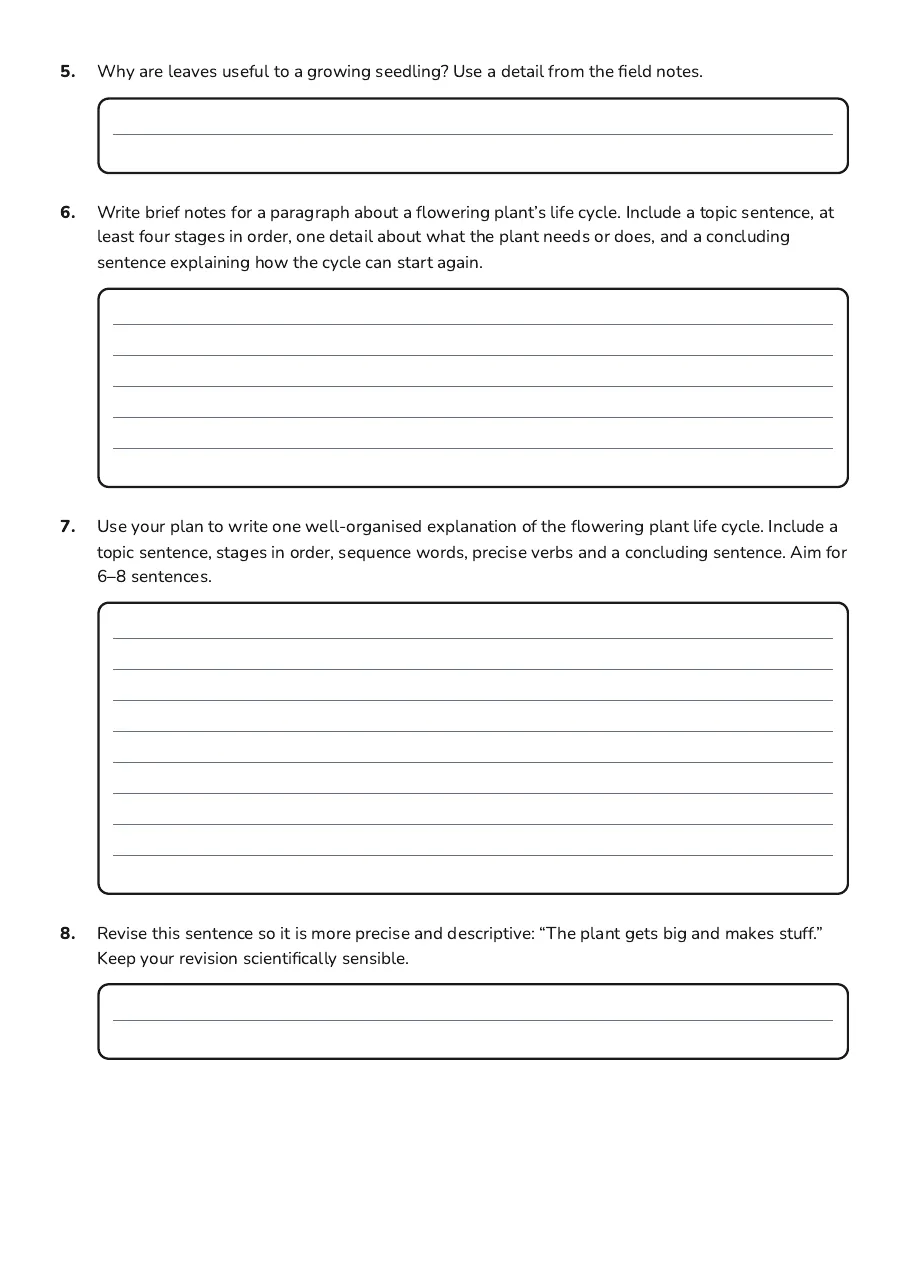
5.Why are leaves useful to a growing seedling? Use a detail from the field notes.
6.Write brief notes for a paragraph about a flowering plant’s life cycle. Include a topic sentence, at least four stages in order, one detail about what the plant needs or does, and a concluding sentence explaining how the cycle can start again.
7.Use your plan to write one well-organised explanation of the flowering plant life cycle. Include a topic sentence, stages in order, sequence words, precise verbs and a concluding sentence. Aim for 6–8 sentences.
8.Revise this sentence so it is more precise and descriptive: “The plant gets big and makes stuff.” Keep your revision scientifically sensible.
9.Read a partner’s paragraph. Tick each feature you can find: stages are in a sensible order; sequence words connect events; verbs are precise; details are accurate; the paragraph has a clear beginning and ending. Write one specific strength and one useful next step.
10.Name one part of writing your explanation that went well, and set one specific goal for your next piece of writing.

3 printable pages

  • Plant Life Cycle Writing, page 1 of 3: Read the field notes

    Page 1

  • Plant Life Cycle Writing, page 2 of 3: 5. Why are leaves useful to a growing seedling? Use a detail from the field notes.

    Page 2

  • Plant Life Cycle Writing, page 3 of 3: 9. Read a partner’s paragraph. Tick each feature you can find: stages are in a sensible…

    Page 3

About This Worksheet

Free in Kuraplan

Sign up free, grab the PDF, and customize it for your class.

Print-Ready

Formatted for standard paper. Clean layout, easy to read.

AI-Generated

Created with Kuraplan's AI, designed for real classroom use.

For Teachers & Parents

Use in classrooms, for homework, tutoring, or homeschool.

Need a custom version of this worksheet?

Kuraplan's AI generates custom worksheets in seconds — differentiated for every learner, aligned to your curriculum.

Generate Custom Worksheets — Free
No credit card Curriculum-aligned Under 60 seconds