ScienceFreePrintable

Plate Tectonics Forces Worksheet

A free science worksheet ready for your classroom. Open in Kuraplan to grab the print-ready PDF, customize it for your students, or generate a fresh version in seconds.
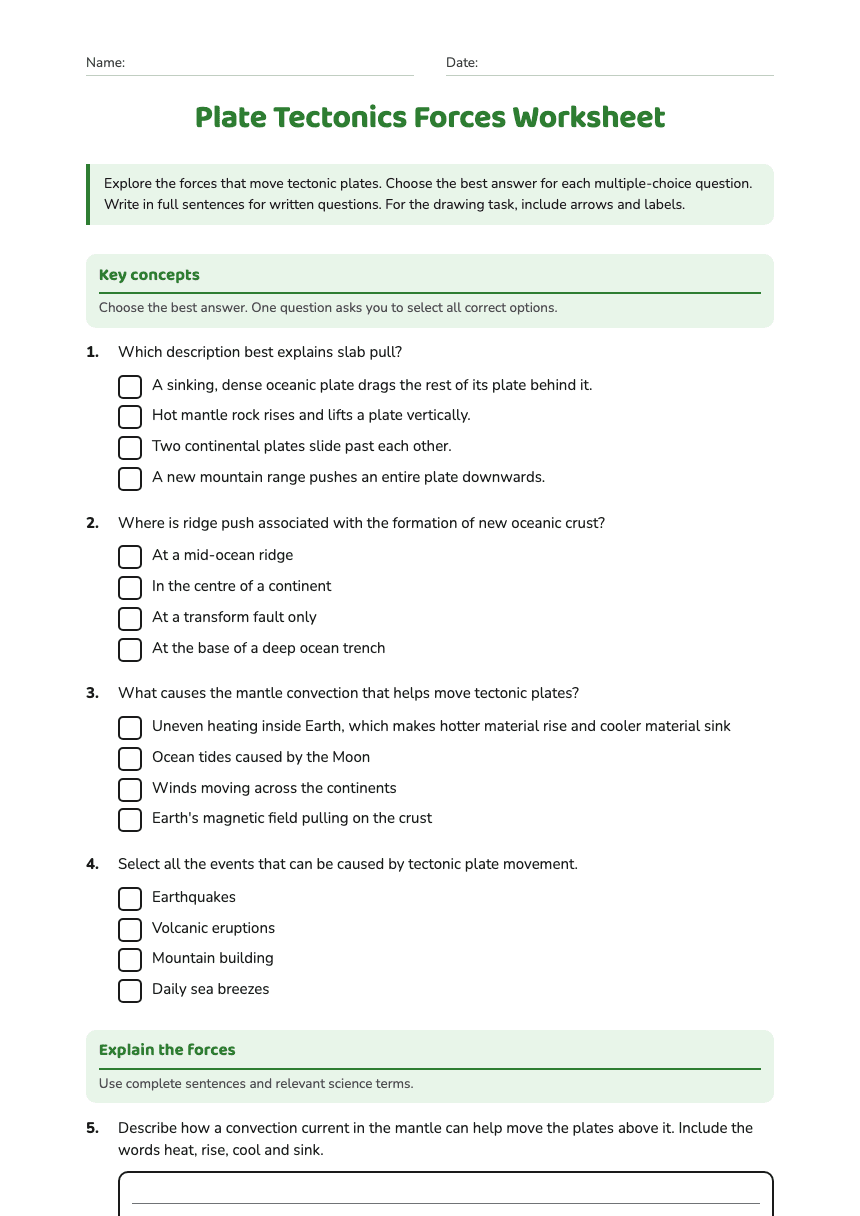
Plate Tectonics Forces Worksheet worksheet preview
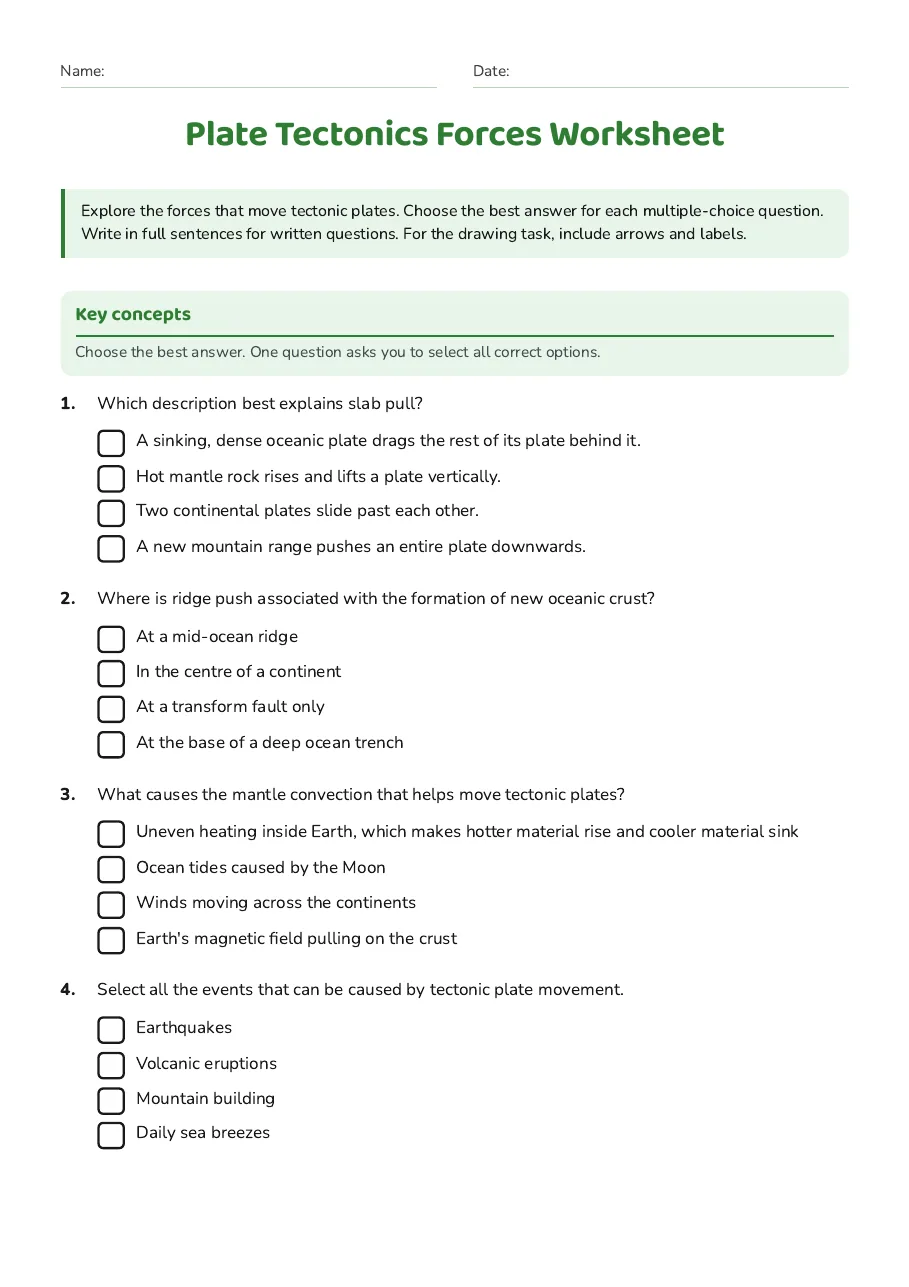
Name:Date:

Plate Tectonics Forces Worksheet

Explore the forces that move tectonic plates. Choose the best answer for each multiple-choice question. Write in full sentences for written questions. For the drawing task, include arrows and labels.

Key concepts

Choose the best answer. One question asks you to select all correct options.

1.Which description best explains slab pull?
  • A sinking, dense oceanic plate drags the rest of its plate behind it.
  • Hot mantle rock rises and lifts a plate vertically.
  • Two continental plates slide past each other.
  • A new mountain range pushes an entire plate downwards.
2.Where is ridge push associated with the formation of new oceanic crust?
  • At a mid-ocean ridge
  • In the centre of a continent
  • At a transform fault only
  • At the base of a deep ocean trench
3.What causes the mantle convection that helps move tectonic plates?
  • Uneven heating inside Earth, which makes hotter material rise and cooler material sink
  • Ocean tides caused by the Moon
  • Winds moving across the continents
  • Earth's magnetic field pulling on the crust
4.Select all the events that can be caused by tectonic plate movement.
  • Earthquakes
  • Volcanic eruptions
  • Mountain building
  • Daily sea breezes

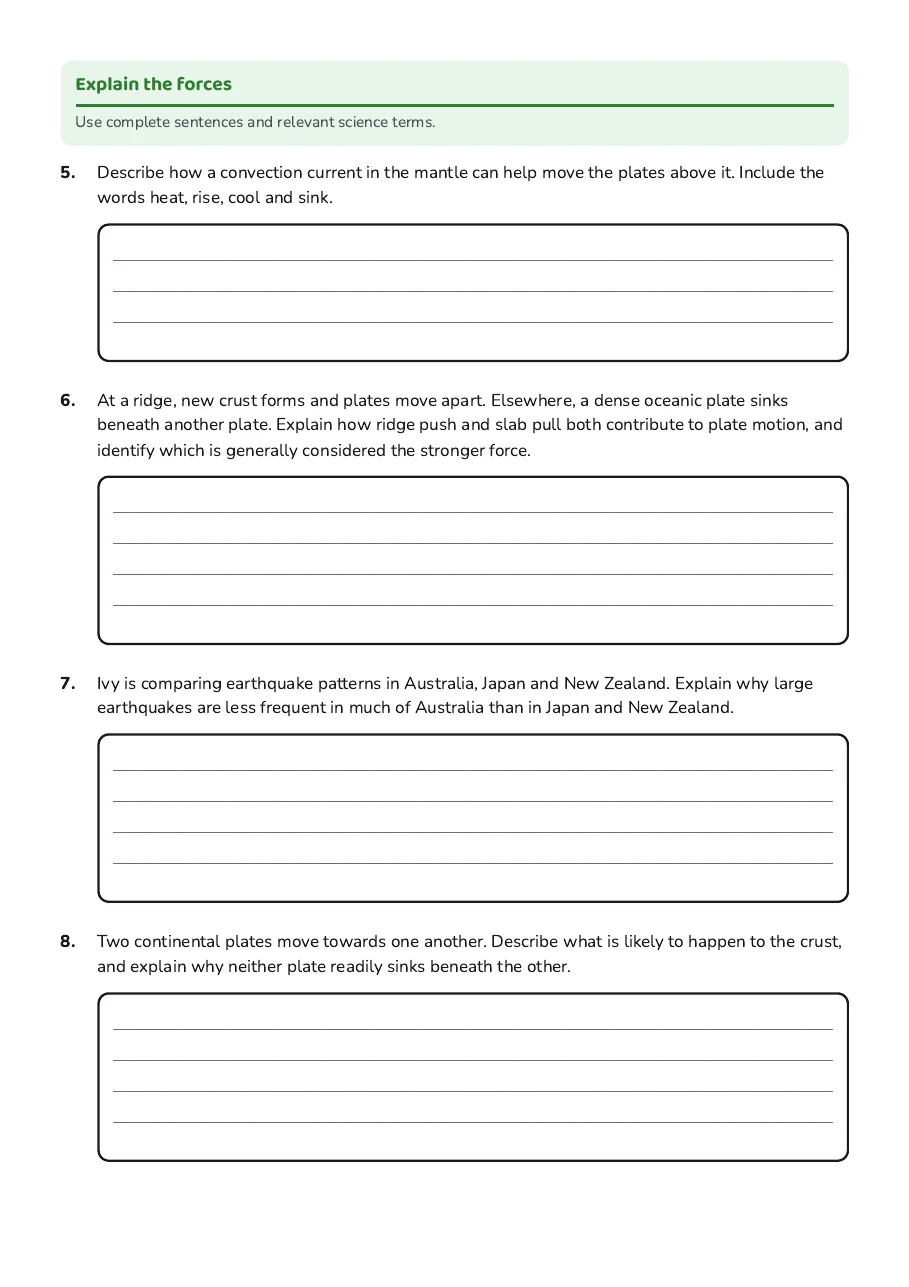
Explain the forces

Use complete sentences and relevant science terms.

5.Describe how a convection current in the mantle can help move the plates above it. Include the words heat, rise, cool and sink.
6.At a ridge, new crust forms and plates move apart. Elsewhere, a dense oceanic plate sinks beneath another plate. Explain how ridge push and slab pull both contribute to plate motion, and identify which is generally considered the stronger force.
7.Ivy is comparing earthquake patterns in Australia, Japan and New Zealand. Explain why large earthquakes are less frequent in much of Australia than in Japan and New Zealand.
8.Two continental plates move towards one another. Describe what is likely to happen to the crust, and explain why neither plate readily sinks beneath the other.

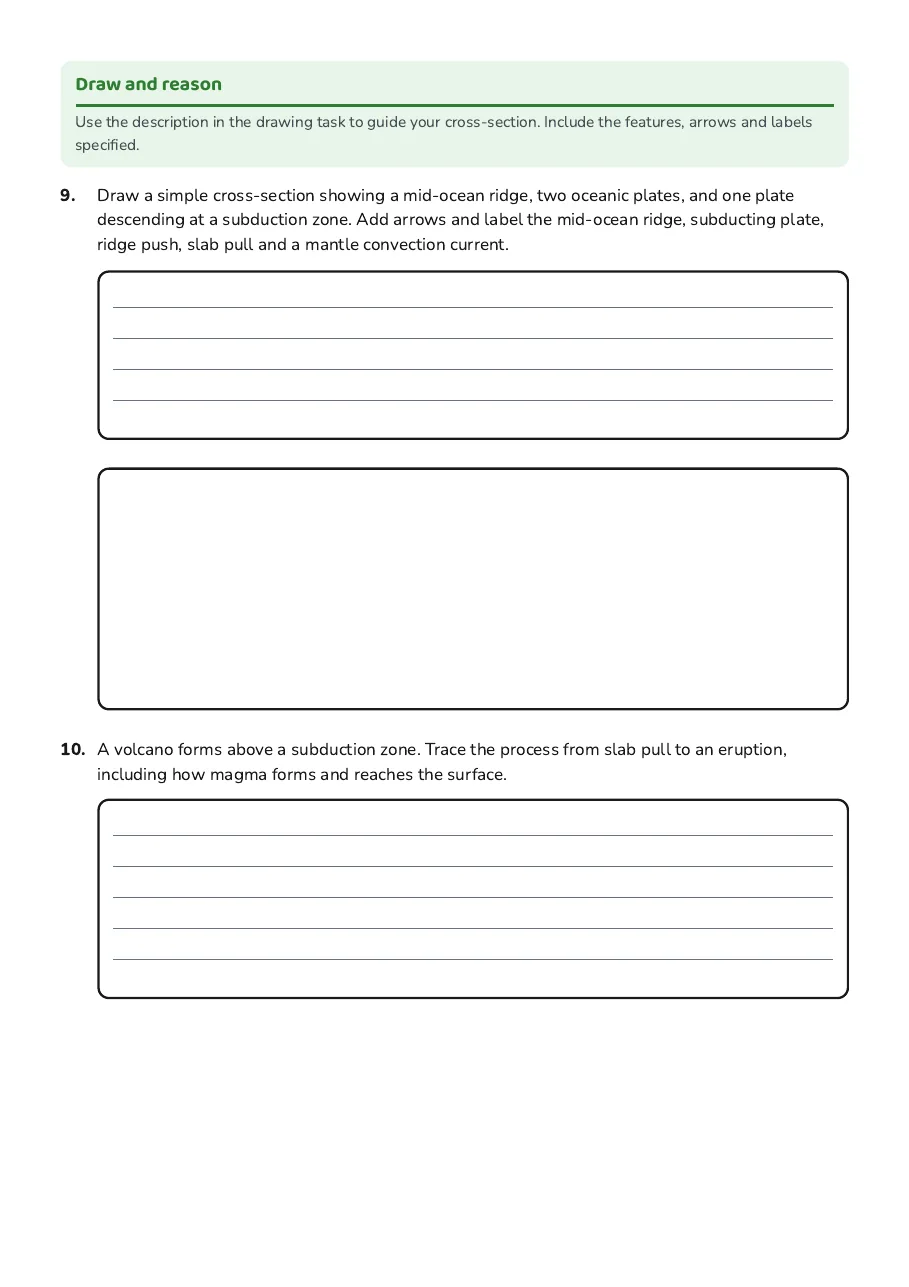
Draw and reason

Use the description in the drawing task to guide your cross-section. Include the features, arrows and labels specified.

9.Draw a simple cross-section showing a mid-ocean ridge, two oceanic plates, and one plate descending at a subduction zone. Add arrows and label the mid-ocean ridge, subducting plate, ridge push, slab pull and a mantle convection current.
10.A volcano forms above a subduction zone. Trace the process from slab pull to an eruption, including how magma forms and reaches the surface.

3 printable pages

  • Text-based multiple-choice questions about a mid-ocean ridge, subducting plate and the forces that move tectonic plates.

    Page 1

  • Written responses about convection, slab pull, ridge push, plate boundaries and continental collisions.

    Page 2

  • Cross-section drawing task and an explanation of how subduction can lead to volcanic eruptions.

    Page 3

About This Worksheet

Free in Kuraplan

Sign up free, grab the PDF, and customize it for your class.

Print-Ready

Formatted for standard paper. Clean layout, easy to read.

AI-Generated

Created with Kuraplan's AI, designed for real classroom use.

For Teachers & Parents

Use in classrooms, for homework, tutoring, or homeschool.

Need a custom version of this worksheet?

Kuraplan's AI generates custom worksheets in seconds — differentiated for every learner, aligned to your curriculum.

Generate Custom Worksheets — Free
No credit card Curriculum-aligned Under 60 seconds