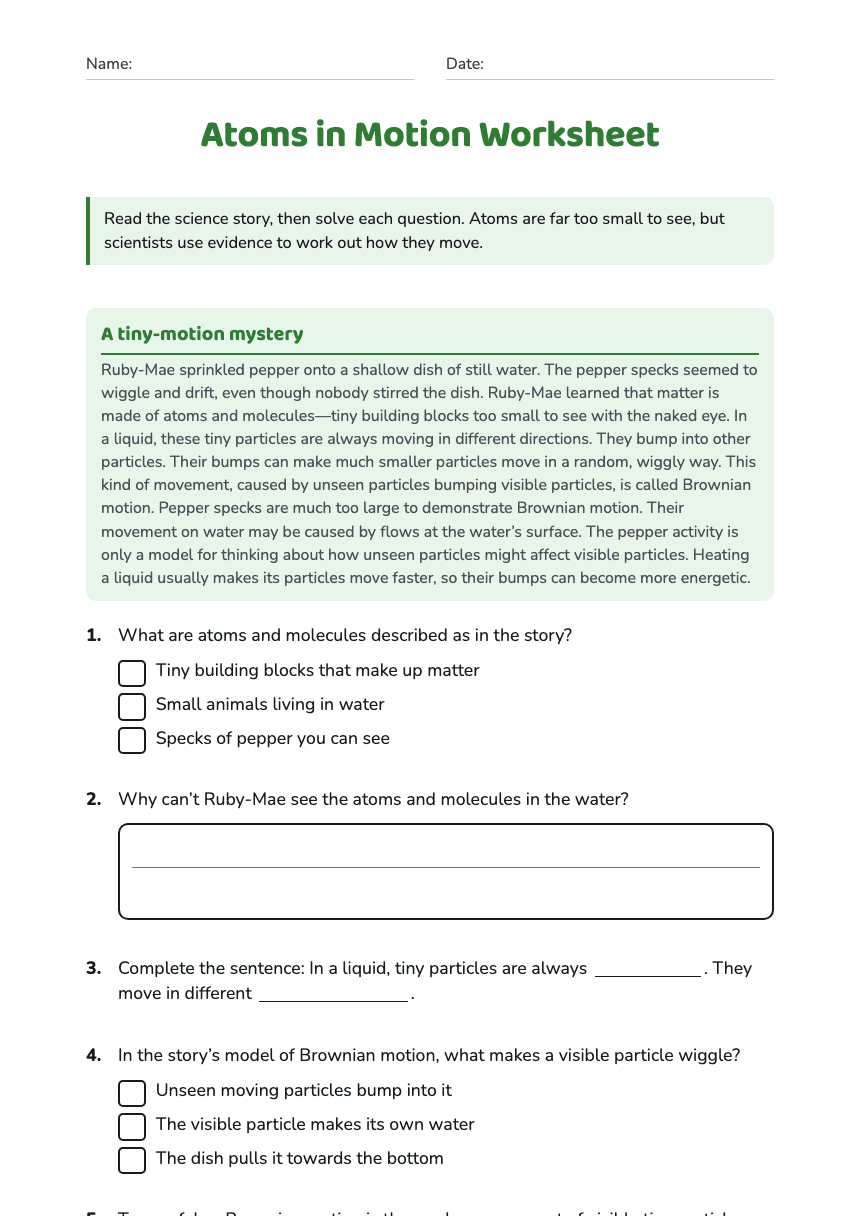
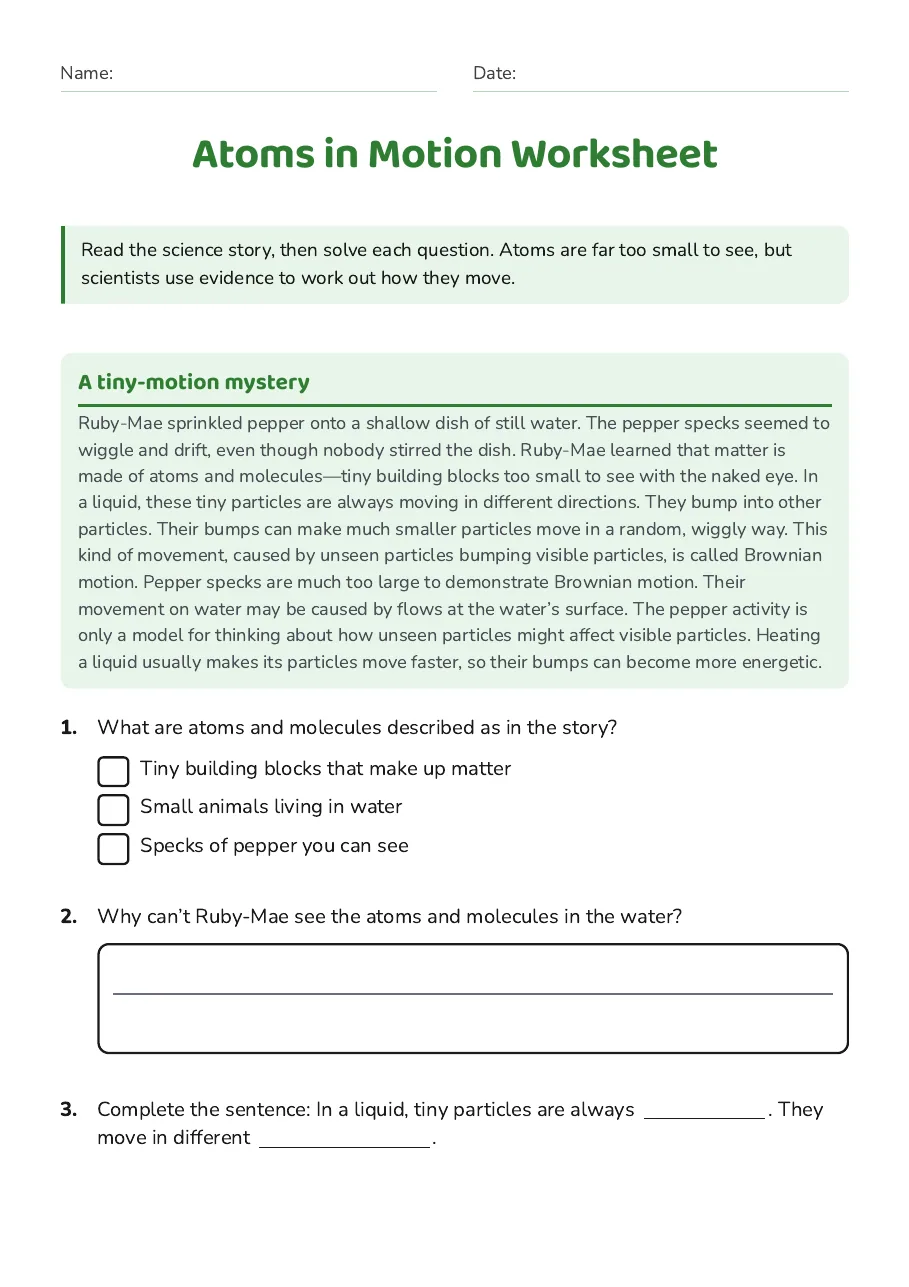
Atoms in Motion Worksheet
A free science worksheet ready for your classroom. Open in Kuraplan to grab the print-ready PDF, customize it for your students, or generate a fresh version in seconds.
Atoms in Motion Worksheet
A tiny-motion mystery
Ruby-Mae sprinkled pepper onto a shallow dish of still water. The pepper specks seemed to wiggle and drift, even though nobody stirred the dish. Ruby-Mae learned that matter is made of atoms and molecules—tiny building blocks too small to see with the naked eye. In a liquid, these tiny particles are always moving in different directions. They bump into other particles. Their bumps can make much smaller particles move in a random, wiggly way. This kind of movement, caused by unseen particles bumping visible particles, is called Brownian motion. Pepper specks are much too large to demonstrate Brownian motion. Their movement on water may be caused by flows at the water’s surface. The pepper activity is only a model for thinking about how unseen particles might affect visible particles. Heating a liquid usually makes its particles move faster, so their bumps can become more energetic.
- Tiny building blocks that make up matter
- Small animals living in water
- Specks of pepper you can see
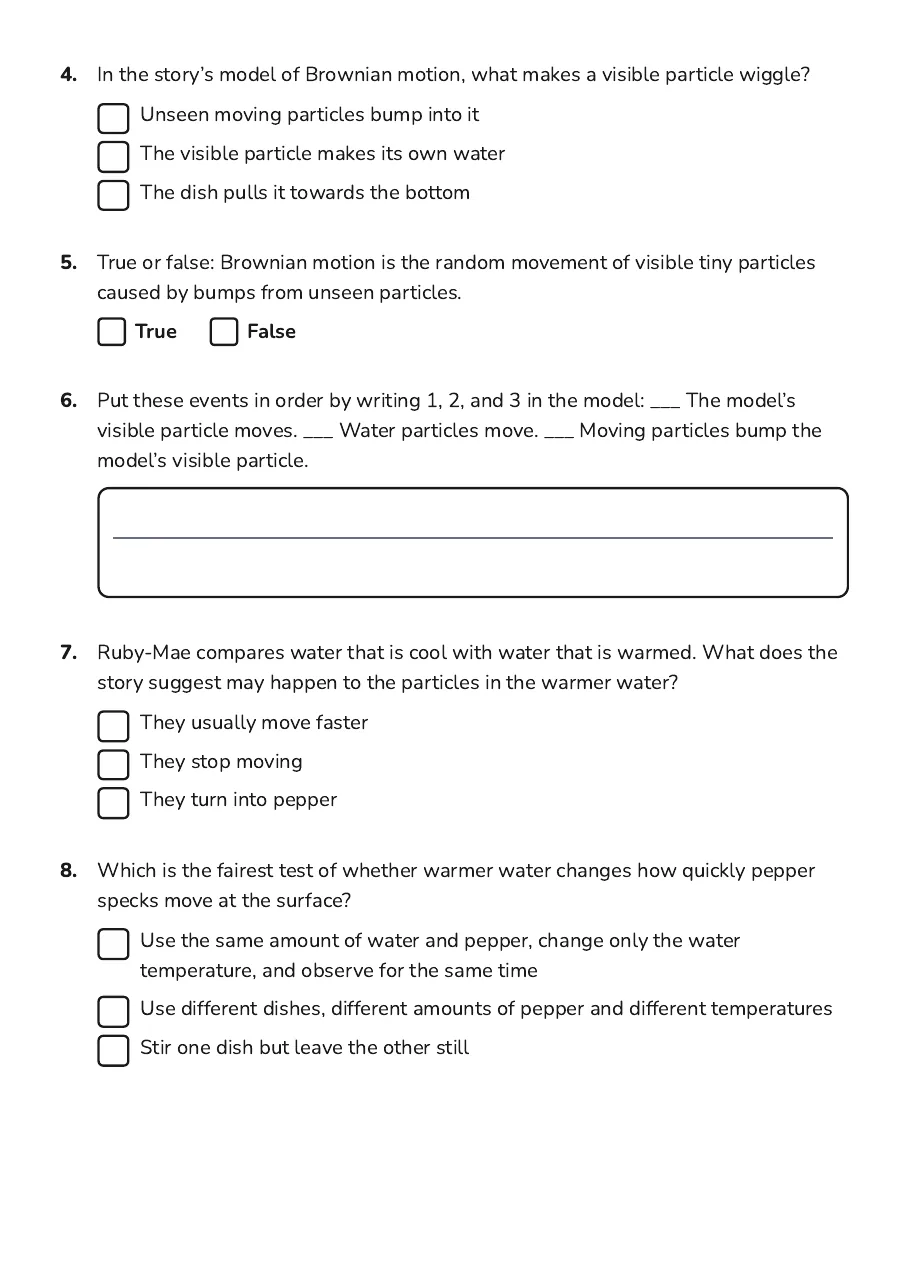
- Unseen moving particles bump into it
- The visible particle makes its own water
- The dish pulls it towards the bottom
- They usually move faster
- They stop moving
- They turn into pepper
- Use the same amount of water and pepper, change only the water temperature, and observe for the same time
- Use different dishes, different amounts of pepper and different temperatures
- Stir one dish but leave the other still
3 printable pages
Page 1
Page 2
Page 3
About This Worksheet
Free in Kuraplan
Sign up free, grab the PDF, and customize it for your class.
Print-Ready
Formatted for standard paper. Clean layout, easy to read.
AI-Generated
Created with Kuraplan's AI, designed for real classroom use.
For Teachers & Parents
Use in classrooms, for homework, tutoring, or homeschool.
Need a custom version of this worksheet?
Kuraplan's AI generates custom worksheets in seconds — differentiated for every learner, aligned to your curriculum.
Generate Custom Worksheets — Free