Rainforest Plant Adaptations
A free geography worksheet ready for your classroom. Open in Kuraplan to grab the print-ready PDF, customize it for your students, or generate a fresh version in seconds.

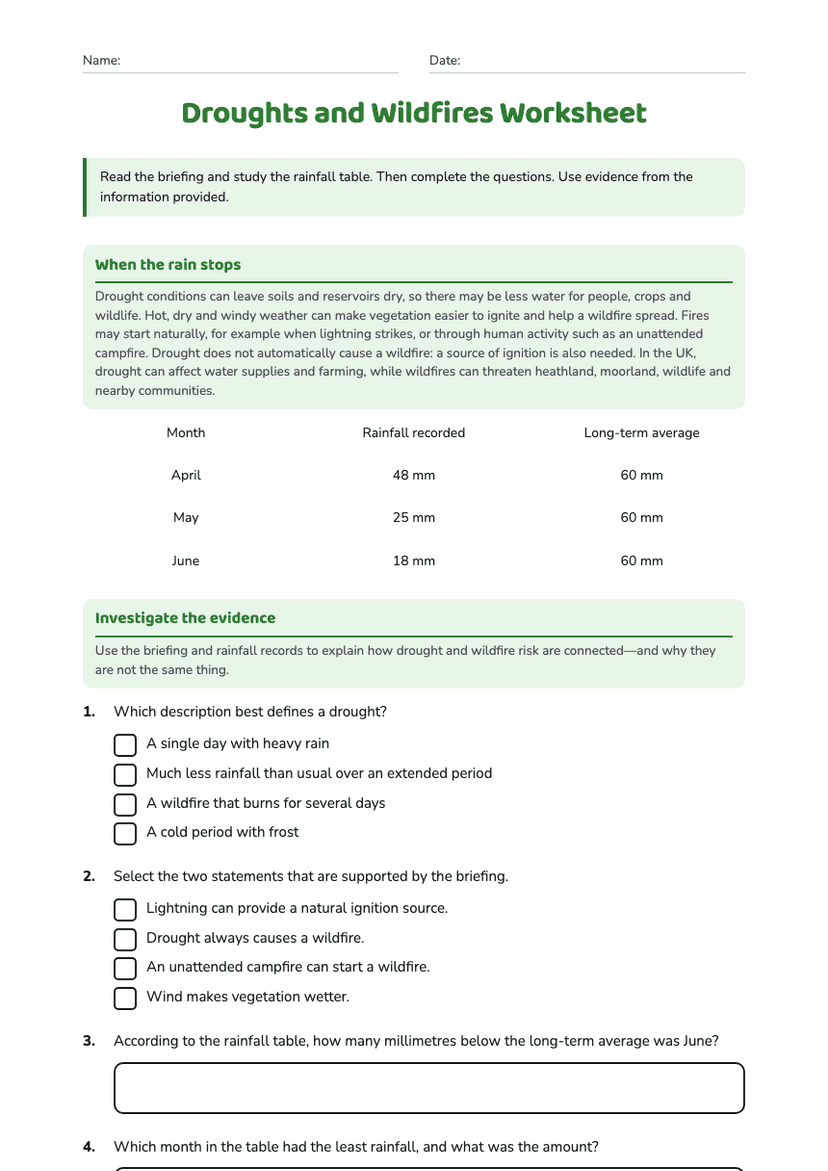
Rainforest Plant Adaptations
Field notes: plants in a crowded forest
Rainforests receive heavy rain and have warm, humid air. The canopy—the leafy roof formed by treetops—gets much of the sunlight. Below it, the understory is shady, and little light reaches the forest floor. Many rainforest soils are shallow and nutrients are quickly used by plants. A leaf with a pointed drip tip can shed rainwater quickly. This may help stop water sitting on the leaf. Buttress roots spread out above the ground and help support tall trees in shallow soil. Lianas are woody climbing plants that use tree trunks to reach sunlight. Epiphytes, such as some orchids, grow on branches to reach light; they do not take food from the tree. In shady places, some plants have broad leaves that can catch the limited sunlight.
Mission 1: Spot the survival clues
Use the field notes to answer each question.
- Canopy
- Forest floor
- Understory
- To help rainwater run off quickly
- To dig into shallow soil
- To climb a tree trunk
- Buttress roots
- Liana
- Epiphyte
- Grows on a branch to reach light
- Support a tall tree in shallow soil
- Climbs using a tree trunk
Mission 2: Make the evidence count
Use what you have read and observed to explain your thinking.
3 printable pages
Page 1

Page 2

Page 3
About This Worksheet
Free in Kuraplan
Sign up free, grab the PDF, and customize it for your class.
Print-Ready
Formatted for standard paper. Clean layout, easy to read.
AI-Generated
Created with Kuraplan's AI, designed for real classroom use.
For Teachers & Parents
Use in classrooms, for homework, tutoring, or homeschool.
Need a custom version of this worksheet?
Kuraplan's AI generates custom worksheets in seconds — differentiated for every learner, aligned to your curriculum.
Generate Custom Worksheets — Free