MathsFreePrintable

Real-World Geometry Applications

A free maths worksheet ready for your classroom. Open in Kuraplan to grab the print-ready PDF, customize it for your students, or generate a fresh version in seconds.
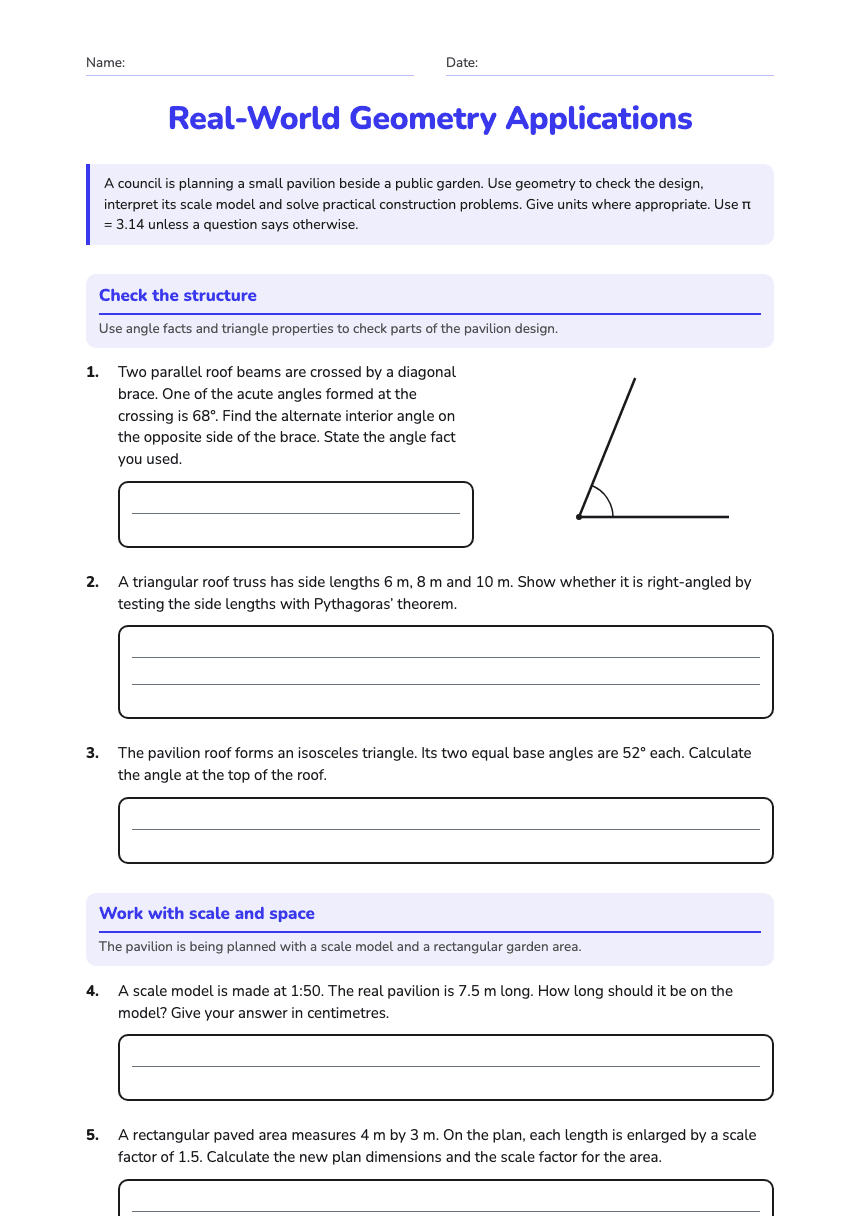
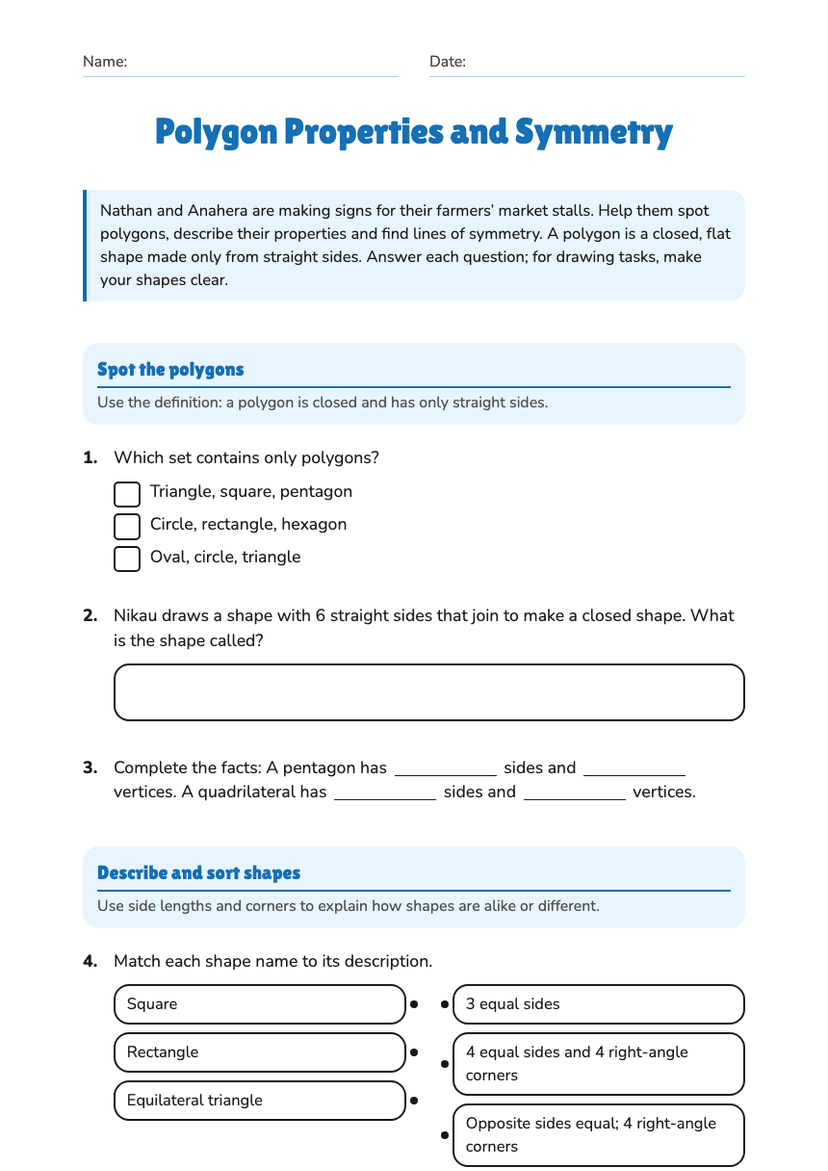
Real-World Geometry Applications worksheet preview
Name:Date:

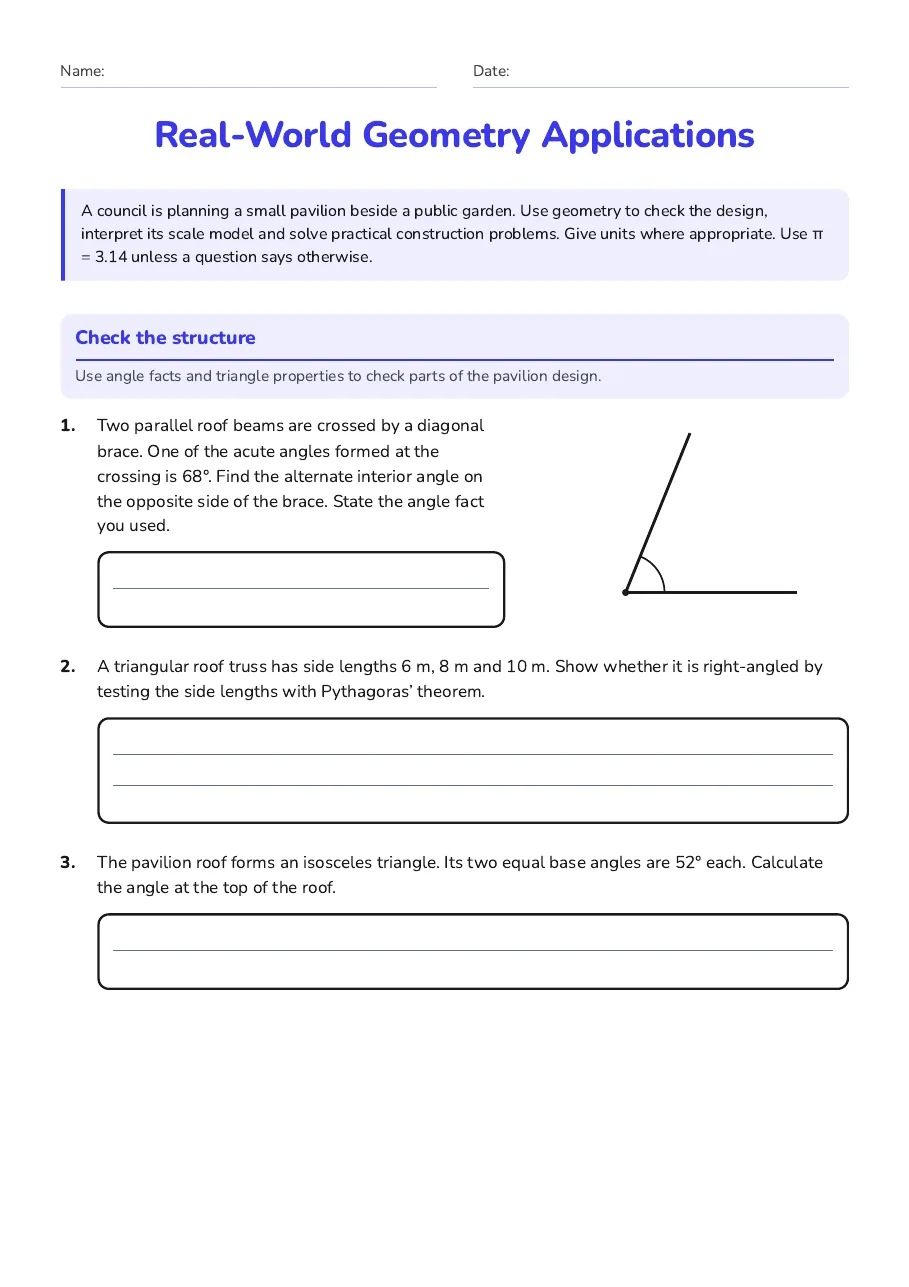
Real-World Geometry Applications

A council is planning a small pavilion beside a public garden. Use geometry to check the design, interpret its scale model and solve practical construction problems. Give units where appropriate. Use π = 3.14 unless a question says otherwise.

Check the structure

Use angle facts and triangle properties to check parts of the pavilion design.

1.Two parallel roof beams are crossed by a diagonal brace. One of the acute angles formed at the crossing is 68°. Find the alternate interior angle on the opposite side of the brace. State the angle fact you used.
2.A triangular roof truss has side lengths 6 m, 8 m and 10 m. Show whether it is right-angled by testing the side lengths with Pythagoras’ theorem.
3.The pavilion roof forms an isosceles triangle. Its two equal base angles are 52° each. Calculate the angle at the top of the roof.

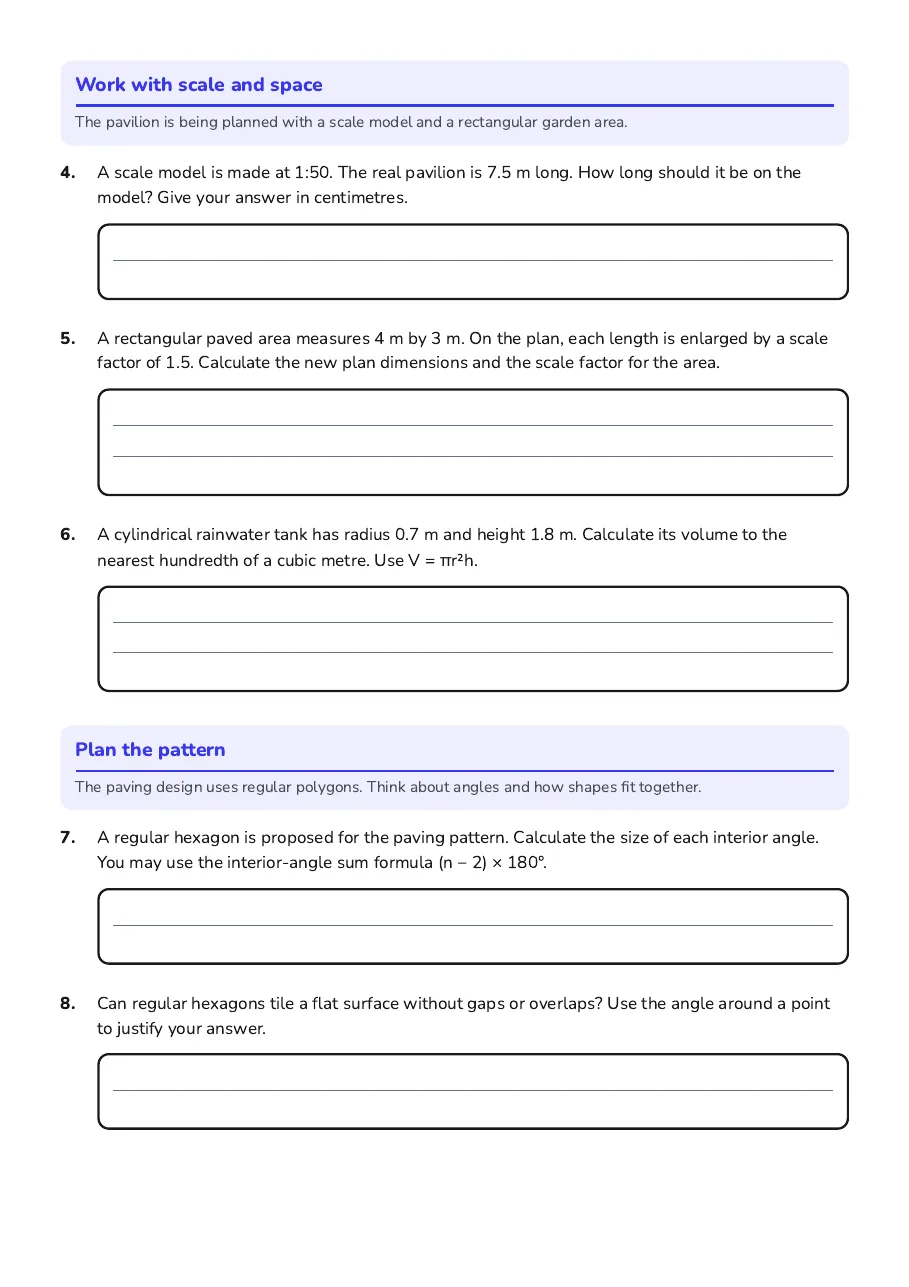
Work with scale and space

The pavilion is being planned with a scale model and a rectangular garden area.

4.A scale model is made at 1:50. The real pavilion is 7.5 m long. How long should it be on the model? Give your answer in centimetres.
5.A rectangular paved area measures 4 m by 3 m. On the plan, each length is enlarged by a scale factor of 1.5. Calculate the new plan dimensions and the scale factor for the area.
6.A cylindrical rainwater tank has radius 0.7 m and height 1.8 m. Calculate its volume to the nearest hundredth of a cubic metre. Use V = πr²h.

Plan the pattern

The paving design uses regular polygons. Think about angles and how shapes fit together.

7.A regular hexagon is proposed for the paving pattern. Calculate the size of each interior angle. You may use the interior-angle sum formula (n − 2) × 180°.
8.Can regular hexagons tile a flat surface without gaps or overlaps? Use the angle around a point to justify your answer.
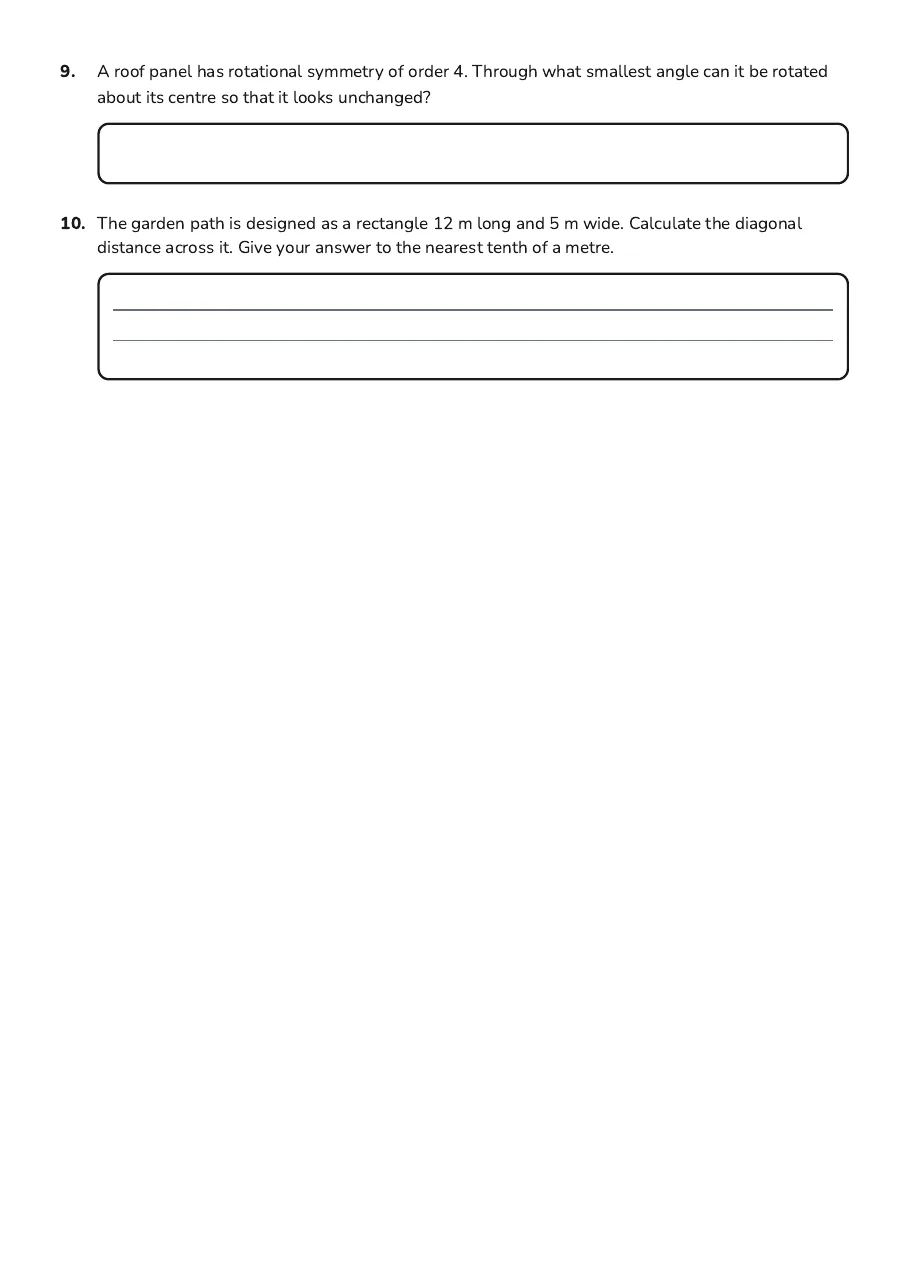
9.A roof panel has rotational symmetry of order 4. Through what smallest angle can it be rotated about its centre so that it looks unchanged?
10.The garden path is designed as a rectangle 12 m long and 5 m wide. Calculate the diagonal distance across it. Give your answer to the nearest tenth of a metre.

3 printable pages

  • Real-World Geometry Applications, page 1 of 3: Check the structure

    Page 1

  • Real-World Geometry Applications, page 2 of 3: Work with scale and space, Plan the pattern

    Page 2

  • Real-World Geometry Applications, page 3 of 3: 9. A roof panel has rotational symmetry of order 4. Through what smallest angle can it be…

    Page 3

About This Worksheet

Free in Kuraplan

Sign up free, grab the PDF, and customize it for your class.

Print-Ready

Formatted for standard paper. Clean layout, easy to read.

AI-Generated

Created with Kuraplan's AI, designed for real classroom use.

For Teachers & Parents

Use in classrooms, for homework, tutoring, or homeschool.

Need a custom version of this worksheet?

Kuraplan's AI generates custom worksheets in seconds — differentiated for every learner, aligned to your curriculum.

Generate Custom Worksheets — Free
No credit card Curriculum-aligned Under 60 seconds